- 294 pages
- English
- ePUB (mobile friendly)
- Available on iOS & Android
eBook - ePub
About this book
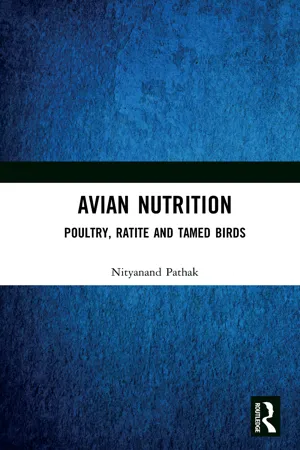
The scope of book has relevant and important informations on some of the popular tamed birds reared as pet in cages. Among these Parrots and Mayana are companion species capable of learning and limited conversation with members of the house. Bulbul, partridges and pigeon are used for sports. Owners of these birds expect guidance for care and management from the experts of poultry science because so far there appears to be no school on the management of such avian species.
Incorporation of these avian species in the book is expected to enrich the knowledge of students and teachers of the Avian and Poultry Science.
Note: T& F does not sell or distribute the Hardback in India, Pakistan, Nepal, Bhutan, Bangladesh and Sri Lanka.
Information
1
INTRODUCTION
Poultry production for nutritional security of mankind has been established as one of the quick method of nutritious food production of high biological value. The coordinated application of breeding, feeding, management and maintenance of health has made possible to finish broilers of 1 to 2 kg body weight in 4-6 weeks and many layer strains of fowl are now laying more than 300 eggs annually. For sustaining such high level of productivity the requirement of specialized education and intensive training has acquired important place in the syllabi of veterinary science and animal husbandry. Feeding alone costs about 70 per cent of total expenditure of commercial poultry production. Therefore, it is important to understand the feed utilization processes in fowl and other birds.
Majority of Indian population was strict vegetarian and milk, milk products and pulses were the sources of dietary protein. However, this pattern has changed at a fast rate during the past half century and even strict vegetarian families are now not averse of inclusion of eggs and even many other kinds of foods of animal origin in the diets of youngsters in the family. The human population has crossed 121 million number by the end of 2010. It is becoming difficult to bring down population growth below 18 per thousand. At the same time average age is also increasing. Under such situation requirement of highly nutritious foods of animal origin will continue to increase for maintaining the requirement of growing children, pregnant ladies and senior citizens.
Factors responsible for increase in the number of non-vegetarian population
Some of the factors found responsible for increase in the number of non-vegetarian population is due to the major shift in the food habit of vegetarian population which may be listed as follows.
1. Drastic fall in the production of pulses: The pulses were an important and easily available source of dietary protein in the diets of almost all categories of vegetarian and other people because pulses were in the category of coarse grains and they were much cheaper than most of the cereal grains, but the balance changed and now pulses are beyond the reach of common people. No doubt that during 1960s there was acute need of increasing the production or cereal grains to save the people from starvation. The success of green revolution was praised globally but the extension of approach for very long period disturbed the balance of food grain production. Monoculture that too of wheat and rice for food, and sugarcane, toacco and cotton for commercial farming changed the composition of human kitchen. This resulted in craving for proteinous foods and ultimately gradual shift to protenious foods of animal origin started and today good number of younger members of even from strict vegetarian background are eating the preparations of egg, meat and fish. Such members eat such foods either in restaurants or in some houses separate kitchen and utensils are used.
The composition of food crops has been seriously disturbed due to delay in the analysis of food grain production pattern. The corrective measures for balancing the ratio of cereal grain, pulses, oil seeds and commercial crops are considerably delayed and it will take some time to place the situation in order.
2. Increasing population and changed demography: Under the present programmes of family welfare there appears to be little scope of considerable fall in the growth rate of human population. The present growth rate of 17 or 18 births per 1000 is actually would have been a little higher, if there could have been effective control on the female foeticide. The increase in proportion of infants nursing mother, growing children and geriatrics will proportionately increase the requirement of proteinous foods of animal sources specially the milk and egg.
3. Exposer to nutritional significance of foods of animal origin: Due to increasing education, interaction among population, different extension agencies, family welfare programmes and media the awareness about the nutrition and significance of foods of animal sources in the diets of humans is increasing.
4. Shrinking of arable land: Due to increased diversion of agricultural land for infra-structure development, urbanization and change in life style a considerable area of land is being used for industries, housing, markets, educational institutions and health care centres etc. Due to division of families into nuclear family the space in house like common room or so called drawing room and kitchen etc is multiplying. The impact of such social changes will be felt seriously if carrying capacity of land for food production and animal production (including poultry) is not increased with the comparable pace.
5. Busy life: the time is becoming a limiting factor in house management specially in urban life requiring all eligible member to earn for running the family. Morning is hectic in almost all households and it has been seen that majority of urban house holds are using boiled eggs, omlets, bread, butter or cheese and some fruits for breakfast and also for the lunch of school going children. Due to lack of time in morning it is very difficult for the working couple to serve conventional foods. This change in life style has significantly increased the demand of eggs specialy in the urban areas. The families also feel shy in offering traditional fast foods of local menu due to fear of being ticked a...
Table of contents
- Cover
- Half Title
- Title Page
- Copyright Page
- Table of Contents
- Preface
- 1. Introduction
- 2. Feeds of Poultry
- 3. Nutrients
- 4. Function of Nutrients
- 5. Feed Additives
- 6. Anti-nutritional Factors in Poultry Feed Ingredients
- 7. Harmful and Toxic Fungi in Foods (Mycotoxicosis and Mycoses)
- 8. Physical Quality Assay of Feeds
- 9. The Digestive System, Digestion, Absorption and Metabolism
- 10. Poultry Feed Processing Technology
- 11. Feed Formulation for Poultry
- 12. The Ratites (Flightless Birds)
- 13. Eggs and Meat for Food
- 14. Red Jungle Fowl
- 15. Domestic Fowl (Gallus domesticus)
- 16. Pea Fowl (Pavo spp.)
- 17. Jananese Quail (Coturnix cotunix)
- 18. Partridges
- 19. Turkey (Meliagridis sp.)
- 20. Parrots
- 21. Pigeon (Columba livea)
- 22. Bulbul (Pycnonotus)
- 23. Mayana/Mynah/Myna (Strunidae birds)
- 24. Saras Crane (The Grus)
- 25. Swan (Cygnus spp)
- Subject Index
Trusted by 375,005 students
Access to over 1.5 million titles for a fair monthly price.
Study more efficiently using our study tools.
Frequently asked questions
Yes, you can cancel anytime from the Subscription tab in your account settings on the Perlego website. Your subscription will stay active until the end of your current billing period. Learn how to cancel your subscription
No, books cannot be downloaded as external files, such as PDFs, for use outside of Perlego. However, you can download books within the Perlego app for offline reading on mobile or tablet. Learn how to download books offline
Perlego offers two plans: Essential and Complete
- Essential is ideal for learners and professionals who enjoy exploring a wide range of subjects. Access the Essential Library with 800,000+ trusted titles and best-sellers across business, personal growth, and the humanities. Includes unlimited reading time and Standard Read Aloud voice.
- Complete: Perfect for advanced learners and researchers needing full, unrestricted access. Unlock 1.5M+ books across hundreds of subjects, including academic and specialized titles. The Complete Plan also includes advanced features like Premium Read Aloud and Research Assistant.
We are an online textbook subscription service, where you can get access to an entire online library for less than the price of a single book per month. With over 1.5 million books across 990+ topics, we’ve got you covered! Learn about our mission
Look out for the read-aloud symbol on your next book to see if you can listen to it. The read-aloud tool reads text aloud for you, highlighting the text as it is being read. You can pause it, speed it up and slow it down. Learn more about Read Aloud
Yes! You can use the Perlego app on both iOS and Android devices to read anytime, anywhere — even offline. Perfect for commutes or when you’re on the go.
Please note we cannot support devices running on iOS 13 and Android 7 or earlier. Learn more about using the app
Please note we cannot support devices running on iOS 13 and Android 7 or earlier. Learn more about using the app
Yes, you can access Avian Nutrition by Nityanand Pathak in PDF and/or ePUB format, as well as other popular books in Technology & Engineering & Veterinary Medicine. We have over 1.5 million books available in our catalogue for you to explore.