- English
- ePUB (mobile friendly)
- Available on iOS & Android
eBook - ePub
About this book
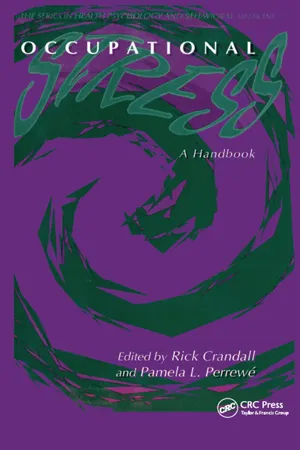
Bringing together renowned scholars, this handbook contains innovative current empirical and theoretical research in the area of job stress. The workplace is one of the major sources of stress in an individual's life. Placing this important topic in the context of a transactional process, this work is intended to be of use to practitioners working in clinical, organisational, family and health psychology, mental health, substance abuse, the military, and with families and women.; Chapters are arranged in five parts, the first considering theoretical approaches with an introductory article by Professor Emeritus Richard S. Lazarus. Next is an examination of various model testing formats, followed by a section on occupational stress research and coping mechanisms. Fourth is a collection of articles on the subject of burnout, and the book closes with two distinct interventions directed at stress reduction.
Information
PART ONE
Theoretical Perspectives in Occupational Stress Research
Psychological Stress in the Workplace
Richard S. Lazarus
If one scans the research on work stress, one discovers that attention has been given mainly to the organizational arrangement of work as stressful, less to person variables, and almost none to the stress process, that is, actual stressful transactions that take place between workers and the environment, coping, and changes in stress from moment to moment and encounter to encounter. In the research tradition that has been dominant, antecedent variables of stress reactions, which include both environmental conditions and person characteristics, are treated as separate and static causes of behavioral and medical states, such as illness, distress and burnout, work dissatisfaction, performance, and absenteeism.
I present here a somewhat heretical outlook, one with which I have long been identified, namely, a transactional, process, contextual, and meaning-centered approach to stress (Lazarus, 1966; Lazarus & Folkman, 1984, 1987). It is my conviction that the traditional outlook toward work stress, while correctly identifying many normative antecedent and consequent environmental and personality variables, is not serviceable when we wish to deal with individual working people and groups who are suffering from excessive stress and dysfunction. This sweeping conclusion needs to be defended.
Prodigious reviews, such as that of Holt (1982), divide research into stressful stimulus conditions such as work overload, role ambiguity and conflict, poor labor-management relations, monotony, and lack of control over job demands and possibilities; Holt lists 57 such variables. He also identifies 55 response variables that mitigate or exacerbate stress effects. The reader might also examine a series of edited books by Cooper and Kasl (e.g., Cooper & Payne, 1980), and one by Ivancevich and Matteson (1980), which is more theoretical in focus, to get the flavor of social science thinking about stress in the workplace. In short, industrial psychologists have recognized that stress at work is important, but, in the main, continue to do lip service to the most advanced theories about the stress process.
The ideas about person-environment fit presented by the Michigan group of French, Caplan, and Van Harrison (1982), which combine the separate causal variables of environment and person into an ongoing relationship characterized by fit or misfit, were, in my opinion, an important advance in thinking. Good person-environment fit is said to be associated with good adaptation, and misfit with bad adaptation. However, this approach falls short because the concept of fit between the person and the environment is static. It emphasizes stable relationships between the person and the workplace rather than flux or process in which stress constantly changes over time and varies with specific work-related contexts. A static or structural approach is indigenous to the field of industrial stress.
It is simplistic to carry over from medicine, clinical psychology, and personality psychology an emphasis on psychopathology or dysfunction, and to make the assumption that, as a result of personality traits, some people usually or always function badly whereas others usually or always function well. Although this assumption may have some probabilistic validity, sound workers not only experience stress at work, but they may also cope badly with certain stressful encounters; and, vice versa, unsound workers sometimes function well. In effect, even when there is, in general, a good stable fit between the work setting and person, stress can still be generated in particular encounters such as being evaluated, failure to be promoted or receive a raise in pay, dealing with difficult co-workers, and other difficulties to which all of us are subject in our working lives. A worker might deal very well with one work encounter yet experience major stress in other encounters.
It is also simplistic to carry over from social psychology and sociology the idea that some social environments generally result in healthy functioning and other environments generally result in dysfunction. Except for the most destructive and tyrannical environments, which are comparatively rare and whose pathogenic qualities are easily recognized, it is a half truth that most people respond similarly to the same conditions.
I do not mean by this to challenge the conclusion that uprooting, dehumanization at work, work changes, and environmental constraints are stressful institutional conditions. Of course they are. Nor do I dispute Levi, Frankenhaeuser, and Gardell’s (1982) claim that mass-production technology, including shift work, can generate stress. My point is simply that psychological stress and its damaging effects are quite an individual matter. Without knowing what is involved personally for individuals and particular collectivities, and the particular contexts in which they operate, we will be handicapped in our understanding and in our efforts to ameliorate or prevent stress in the workplace.
In the remainder of this paper, I focus on what I think are keys to understanding not only work stress but stress in any context of living. The analysis is centered on the concepts of transaction, process, and personal meaning.
METATHEORY
Two metatheoretical principles underlie the approach I am advocating. Transaction means not only that, in a particular adaptational encounter, the person influences the environment and vice-versa, but also that person-environment relationships transcend the separate interacting variables of person and environment, and are constantly subject to change. For a relationship to be stressful, there must, first, be some stake in the outcome. This is another way of saying that the person believes the transaction is relevant to personal goals of importance. Second, psychological stress occurs only when a person had made an evaluation (appraisal) that external or internal demands tax or exceed his or her resources. Stress is not a property of the person, or of the environment, but arises when there is a conjunction between a particular kind of environment and a particular kind of person that leads to a threat appraisal.
Since we usually attempt to change that which is undesirable or distressing, stress implies a process rather than a static arrangement. Process means that the psychological state changes over time and across diverse encounters. Person-environment relationships, and the goodness of fit between person and environment, are not constant over time, or from one work task or activity to another. This principle cannot be grasped and evaluated unless we employ research designs that are intra-individual, in addition to inter-individual or normative, in order to observe the degree of stability or instability of the reaction over time and across adaptational encounters.
THEORY
I said, above, that a transaction between the person and the environment is stressful only when it is evaluated by the person as a harm, threat or challenge to that person’s well-being. The term I have used for this evaluation is appraisal. In a cognitive-motivational-relational theory, stress depends on the balance of power, as judged subjectively, between the environmental demands, constraints, and resources and the ability of the person to manage them.
Harm refers to damage that has already occurred, as in a loss of job, a poor job evaluation, a failure to be promoted, or disapproval by management or one’s peers. Threat refers to a harm that has not yet happened, but is anticipated in the future. Challenge refers to a condition of high demand in which the emphasis is on mastering the demands, overcoming obstacles, and growing and expanding as an individual. In threat, the focus is on protecting against harm. In challenge, the emphasis is on the positive outcome possibilities. We like challenge, but dislike threat. The attitude of challenge allows us to feel enthused, engaged, and expansive, rather than endangered, defensive, and self-protective.
My early experimental and field research on appraisal was begun in the 1960s (Lazarus, 1966; 1968), and has continued to the present (Lazarus, Averill, & Opton, 1970, 1974; Lazarus & Folkman, 1984, 1987). It demonstrated that the way people evaluate what is happening with respect to their well-being, and the way they cope with it, influences whether or not psychological stress w...
Table of contents
- Cover
- Half Title
- Title Page
- Copyright Page
- Table of Contents
- Contributors
- Foreword
- Part One: Theoretical Perspectives in Occupational Stress Research
- Part Two: Sources and Consequences of Occupational Stress: Model Testing
- Part Three: The Roles of Coping and Dispositional Influences in Occupational Stress Research
- Part Four: An Examination of Burnout
- Part Five: Interventions Aimed at Occupational Strain Reduction
- Index
Trusted by 375,005 students
Access to over 1.5 million titles for a fair monthly price.
Study more efficiently using our study tools.
Frequently asked questions
Yes, you can cancel anytime from the Subscription tab in your account settings on the Perlego website. Your subscription will stay active until the end of your current billing period. Learn how to cancel your subscription
No, books cannot be downloaded as external files, such as PDFs, for use outside of Perlego. However, you can download books within the Perlego app for offline reading on mobile or tablet. Learn how to download books offline
Perlego offers two plans: Essential and Complete
- Essential is ideal for learners and professionals who enjoy exploring a wide range of subjects. Access the Essential Library with 800,000+ trusted titles and best-sellers across business, personal growth, and the humanities. Includes unlimited reading time and Standard Read Aloud voice.
- Complete: Perfect for advanced learners and researchers needing full, unrestricted access. Unlock 1.5M+ books across hundreds of subjects, including academic and specialized titles. The Complete Plan also includes advanced features like Premium Read Aloud and Research Assistant.
We are an online textbook subscription service, where you can get access to an entire online library for less than the price of a single book per month. With over 1.5 million books across 990+ topics, we’ve got you covered! Learn about our mission
Look out for the read-aloud symbol on your next book to see if you can listen to it. The read-aloud tool reads text aloud for you, highlighting the text as it is being read. You can pause it, speed it up and slow it down. Learn more about Read Aloud
Yes! You can use the Perlego app on both iOS and Android devices to read anytime, anywhere — even offline. Perfect for commutes or when you’re on the go.
Please note we cannot support devices running on iOS 13 and Android 7 or earlier. Learn more about using the app
Please note we cannot support devices running on iOS 13 and Android 7 or earlier. Learn more about using the app
Yes, you can access Occupational Stress by Rick Crandall in PDF and/or ePUB format, as well as other popular books in Psychology & Careers. We have over 1.5 million books available in our catalogue for you to explore.