- 328 pages
- English
- ePUB (mobile friendly)
- Available on iOS & Android
eBook - ePub
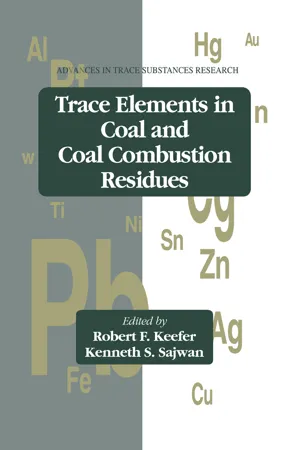
Trace Elements in Coal and Coal Combustion Residues
About this book
Trace Elements in Coal and Coal Combustion Residues focuses on trace metal chemistry of coal and coal combustion residues. Special emphasis is placed on management of coal combustion residues in electric power plants and the influence of coal and associated residues on soils, plants, water, and animals. Topics covered include a brief summary of research sponsored by Electric Power Research Institute, environmental pollution from coal combustion plants in low-rainfall regions, accumulation of trace elements in freshwater mussels near a power plant, testing to evaluate fossil fuel wastes by chemicals and isotopes, transport of metals from coal piles and ash impoundments, leachability and toxicity of metals in fly ash, and plant absorption of chemicals from ash. The book will be a useful reference for environmental and reclamation consultants, environmental engineers, toxicologists, environmental regulatory personnel, officials with electric power utilities and water treatment plants, and soil scientists.
Information
Environmental Effects from Power Plants
3
Coal-Based Environmental Problems in a Low-Rainfall Tropical Region
M. Agrawal, J. Singh, A. K. Jha and J. S. Singh
Banaras Hindu University, Varanasi, India
ABSTRACT
Several thermal power projects and open-cast coal mines have ensued in northern India’s Singrauli belt, which has massive coal reserves. Thermal power plant (TPP) emissions have remarkably affected the air quality and vegetation, particularly in the vicinity of emission sources and at sites affected by emissions from both power plants and adjacent coal mines. Vegetation at sites receiving higher pollution loads have reduced total chlorophyll content, leaf area, and specific leaf area as well as increased contents of sulfate-S and trace elements. Coal mine spoils exhibited changes with time in physiochemical and biological properties, species composition, and biomass levels. Total soil N, mineral N, NaHCO3-extractable P, and exchangeable K increased with age of mine spoils, these parameters were lower than native forest soil even after 20 years of succession. Only a few species dominated in the vegetation succession. Impact of microsites, even after 20 years of soil and vegetation development, remained important. Undulating surface and flat surface microsites were better habitats than slope and coalpatch margin microsites for plant growth. On the 12-year-old flat surface microsites, 24 out of 30 plant species seeded showed satisfactory growth performance.
INTRODUCTION
Availability of energy in terms of electricity has been a powerful motivator of economic development and social change throughout the world. In India also, a high priority has been given to programs related to electricity generation and distribution for achieving economic self-reliance. The national energy policy, accepted by the Government of India in May 1981, recognizes coal as the principal source of energy. Most of the coal consumed in India is burned at TTPs, which contribute 85% of the total installed electric generating capacity in the country. The present installed capacity is around 65,000 MW and is expected to exceed 100,000 MW by the end of 1995. In other Third World countries, the utilization of coal has also increased tremendously during the past decade. For example, in China the contribution of coal to total energy has increased from 71.81% in 1980 to 76.03% in...
Table of contents
- Cover
- Title Page
- Copyright Page
- Advances in Trace Substances Research
- Series Page
- Preface and Acknowledgments
- The Editors
- Dedication
- Contributors
- Table of Contents
- INTRODUCTION
- ENVIRONMENTAL EFFECTS FROM POWER PLANTS
- TESTS FOR AND MONITORING OF FOSSIL FUEL DISPERSION AND ASH DISPOSAL
- TRANSPORT AND LEACHABILITY OF METALS FROM COAL AND ASH PILES
- USE OF COAL ASH FOR PLANT GROWTH
- Index
Trusted by 375,005 students
Access to over 1.5 million titles for a fair monthly price.
Study more efficiently using our study tools.
Frequently asked questions
Yes, you can cancel anytime from the Subscription tab in your account settings on the Perlego website. Your subscription will stay active until the end of your current billing period. Learn how to cancel your subscription
No, books cannot be downloaded as external files, such as PDFs, for use outside of Perlego. However, you can download books within the Perlego app for offline reading on mobile or tablet. Learn how to download books offline
Perlego offers two plans: Essential and Complete
- Essential is ideal for learners and professionals who enjoy exploring a wide range of subjects. Access the Essential Library with 800,000+ trusted titles and best-sellers across business, personal growth, and the humanities. Includes unlimited reading time and Standard Read Aloud voice.
- Complete: Perfect for advanced learners and researchers needing full, unrestricted access. Unlock 1.5M+ books across hundreds of subjects, including academic and specialized titles. The Complete Plan also includes advanced features like Premium Read Aloud and Research Assistant.
We are an online textbook subscription service, where you can get access to an entire online library for less than the price of a single book per month. With over 1.5 million books across 990+ topics, we’ve got you covered! Learn about our mission
Look out for the read-aloud symbol on your next book to see if you can listen to it. The read-aloud tool reads text aloud for you, highlighting the text as it is being read. You can pause it, speed it up and slow it down. Learn more about Read Aloud
Yes! You can use the Perlego app on both iOS and Android devices to read anytime, anywhere — even offline. Perfect for commutes or when you’re on the go.
Please note we cannot support devices running on iOS 13 and Android 7 or earlier. Learn more about using the app
Please note we cannot support devices running on iOS 13 and Android 7 or earlier. Learn more about using the app
Yes, you can access Trace Elements in Coal and Coal Combustion Residues by Robert F. Keefer,Kenneth S. Sajwan in PDF and/or ePUB format, as well as other popular books in Biological Sciences & Environmental Science. We have over 1.5 million books available in our catalogue for you to explore.