This innovative and user-friendly book uses a design thinking approach to examine transformative learning and liminality in physical education. Covering theory and practice, it introduces the important idea of 'threshold concepts' for physical education, helping physical educators to introduce those concepts into curriculum, pedagogy and assessment.
The book invites us to reflect on what is learned in, through and about physical education - to identify its core threshold concepts. Once identified, the book explains how the learning of threshold concepts can be planned using principles of pedagogical translation for all four learning domains (cognitive, psychomotor, affective and social). The book is arranged into three key sections which walk the reader through the underpinning concepts, use movement case studies to explore and generate threshold concepts in physical education using design thinking approach and, finally, provide a guiding Praxis Matrix for PE Threshold Concepts that can be used for physical educators across a range of school and physical activity learning contexts.
Outlining fundamental theory and useful, practical teaching and coaching advice, this book is invaluable reading for all PE teacher educators, coach educators, and any advanced student, coach or teacher looking to enrich their knowledge and professional practice.
The languages of/for movement in 21st Century physical education
David Aldous, Anna Bryant and Rebecca Straker
Introduction: The continued transformation of Physical Education
Much continues to be written, discussed and debated about the ability of physical educators to respond to an eclectic range of globally significant economic, social, political and technological challenges of the 21st Century (Organization for Economic Cooperation and Development (OECD), 2018). As evidenced by the title of this book, one of the most enduring challenges, past, present and future has been the role of physical educators in the construction and practice of movement (Laker, 2002; Brown & Payne, 2009) and preparing young people for lifelong physical activity (PA) in the hope of addressing a plethora of health outcomes (Evans et al., 2004; Sperka et al., 2018). In addressing these issues, physical educators have continued to draw upon an eclectic range of conceptual and pedagogical positions, perspectives and ideas (Evans & Davies, 2002; 2012) that have been historically constructed across the hierarchical and horizontal knowledge structures (Bernstein, 2000; Moore & Maton, 2001) comprised of philosophy, science and pedagogy (Kretchmar, 2008; Tinning, 2008).
Echoing the thoughts of Evans & Davies (2011, p. 276), students and practitioners of physical education (PE) in the conceptualisation and practice of movement are too frequently ‘required to speak particular social and theoretical languages … and tend to become socialised deeply into the underlying codes and modes (or more particularly, their teachers perspectives).’ Indeed, drawing upon the thoughts of Bernstein (1977, p. 167) physical educators are often ‘told and socialised into what to reject but rarely told how to create.’ In many respects such tendency for conceptual rejection prohibits teachers from engaging with what Kirk (2010, p. 129) has previously illustrated as a ‘radical agenda for PE’; one that necessitates both the convergence and divergence of different perspectives that are generated from an eclectic range of theoretical and practical languages.
Such aspirations for the discipline of PE are not as utopian as once perceived (Quennerstedt, 2019). Indeed, readers will be familiar with how the transformation of PE curricula towards health, lifelong PA and movement continues to be seen across a number of different global contexts. For example, within our own context of Wales, the transformative education agenda outlined by the Welsh Government (2017) and the renewed focus on health and well-being offers potential for Welsh physical educators to contribute to a holistic, progressive agenda for lifelong engagement with PA (Aldous, 2018). Nevertheless, translating such a position into practice necessitates that scholars and practitioners within 21st Century PE continue to challenge what Evans & Davies (2011, p. 276) term ‘research fundamentalism’ and move across the rigid boundaries of existing conceptual positions. Doing so necessitates that practitioners are provided with the skills and knowledge to move beyond positions of ‘acceptance’ and ‘rejection’ of ideas, values and practices to one in which they are able to create new languages of and for movement that enable the continued transformation and evolution of PE through the 21st Century.
With this in mind, in this chapter, we begin outlining how such a process of language/concept creation might be achieved. In line with Tinning's (2008) argument for a ‘languaging’ of the terms pedagogy and sport pedagogy about the meanings of such terms, we are also keen to focus on how practices of and for movement are informed by certain languages and ways of seeing the world that encourages practitioners to engage with further reflexive, critical thinking and practice within PE. In foregrounding this, we shine a light on the underlying generative principles of existing movement languages, with the intention of providing a starting point from where we might offer forms of support to practitioners in the creation of their own movement languages and pedagogies. We now outline the influence of Bernstein's concept of languages of description (Bernstein, 1996; 1999; 2000) on our understanding of ‘languages of movement.’
Articulating the languages of movement within PE: The contribution of Bernstein's sociological theory
Research within the intertwined fields of education and physical education has continued to be enriched by the contribution of Bernstein's sociology of and for education (Morais et al., 2001). Such contribution is particular notable in the ways Bernstein's concepts have been utilised in the construction and implementation of curricula in which the practice of movement is strongly emphasised through particular discourses (Penney & Evans, 1999; Penney et al., 2009; Brown & Penney, 2017). Yet, whilst much of this important utilisation of Bernstein's principles has focused on how movement is constructed within forms of curriculum and pedagogical practice, our use of his work aims to contribute to the field by offering a slightly different conceptual angle. To do so, our position draws extensively on Bernstein's concept of the languages of description (Bernstein, 1996; 1999; 2000), which places focus on:
what is to count as an empirical referent, how such referents relate to each other to produce a specific text and translates these referential relations into theoretical objects or potential theoretical objects (Bernstein, 1996, p. 136).
Resonating strongly with Chomsky's work on surface and deep grammar (Moss, 2001), Bernstein's concept enabled a stronger, more enriched and dialectical understanding of how languages within the field of education are transformed and how this transformation leads to the creation of new, empirically informed understandings of the pedagogical context in which they are practiced (Ivinson, 1997). This relationship is wonderfully illustrated within the work of Morais and Neves (2001, p. 186) who advocated using Bernstein's principles to develop a model in which the ‘theoretical and empirical are viewed dialectically’ to provide a conceptual structure that is ‘diagnostic, predictive, descriptive, explanatory and transferable’ (Morais & Neves, 2001, p. 187). In adapting these principles, we have attempted to illustrate some of the existing languages that inform the practice of movement within contemporary PE.
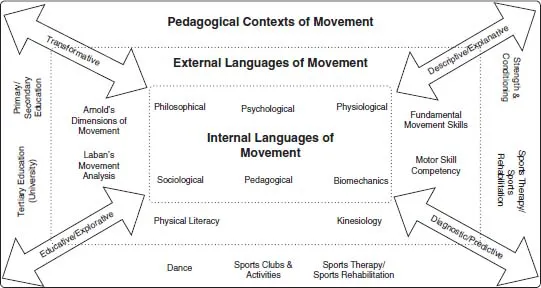
Importantly, our adaptation exemplifies how the use Bernstein's language of description provides an illustrative account of how PE as a discipline is comprised of three elements that describe the dynamic interplay between theoretical concepts and empirical research. The first describes an internal language of description that is comprised of concepts (e.g. experimental, sociological, psychological and pedagogical) that enables articulation of ‘the perspectives and activities of its members, the kinds of things that are defined as ‘problems,’ the ways in which problems will be typically dealt with’(Moore & Muller, 2002, p. 630). The second element outlines the external language of description (Bernstein, 1999) and focuses on the structure of specialised approaches and frameworks (such as Laban's Movement Analysis, Fundamental Movement Skills or Physical Literacy) how they are classified, maintained and insulated to produce empirical data. The third element then outlines the social relations of the pedagogic activity, where the two languages, are expressed. Commonly, Bernstein postulated how this might be within textbooks or contexts such as classroom activities.
Significantly, for our own work, the principles outlined in Figure 1.1, offers a means from where to understand the complex, dialectical relationships that lie between (i) the construction of languages of description (as outlined within the internal languages component); (ii) those languages of movement where there is a focus on external language of description (specialised knowledges with an empirical focus) and (iii) the social contexts in which those languages are expressed and acquired within practice (and also through texts) in PE. What is also interesting is how the dialectical position offered by Bernstein's model resonates with some of the thoughts of Arnold (1979, p. 103) who asserted that language is not a static entity, ‘but something that evolves in response to a need to identify and refer the pertinent phenomena in a more economic and/or illuminating way.’
Figure 1.1 Diagram to illustrate the languages of description within the context of contemporary Physical Education.
Source: Adapted from Morais & Neves, 2001.
In adding a further layer of analytical sensitivity, Bernstein also made a distinction between those languages that have a strong/weak internal grammar and those that have a strong/weak external grammar (Bernstein, 1999). Those disciplines that are comprised of languages with weaker internal grammars might include sociology, philosophy, social anthropology and cultural studies. Importantly, with languages of description that are comprised of weaker structures, particular within the internal language of description, there is more onus on the knower (e.g. within the focus of our work academics and practitioners) to translate the internal language into their own context. It also demands that they be responsible for the transferability, description and explanation of models and concepts within the pedagogical activities in which these languages are expressed (see Figure 1.1 above).
Contrastingly, those langua...
Table of contents
Cover
Half Title
Title Page
Copyright Page
Dedication Page
Contents
Contributors
Introduction
PART I Core concepts
PART II Movement case studies: A design thinking approach
PART III Lessons learned: Threshold concepts for physical education
Index
Trusted by 375,005 students
Access to over 1.5 million titles for a fair monthly price.
Study more efficiently using our study tools.
Frequently asked questions
Yes, you can cancel anytime from the Subscription tab in your account settings on the Perlego website. Your subscription will stay active until the end of your current billing period. Learn how to cancel your subscription
No, books cannot be downloaded as external files, such as PDFs, for use outside of Perlego. However, you can download books within the Perlego app for offline reading on mobile or tablet. Learn how to download books offline
We are an online textbook subscription service, where you can get access to an entire online library for less than the price of a single book per month. With over 1.5 million books across 990+ topics, we’ve got you covered! Learn about our mission
Look out for the read-aloud symbol on your next book to see if you can listen to it. The read-aloud tool reads text aloud for you, highlighting the text as it is being read. You can pause it, speed it up and slow it down. Learn more about Read Aloud
Yes! You can use the Perlego app on both iOS and Android devices to read anytime, anywhere — even offline. Perfect for commutes or when you’re on the go. Please note we cannot support devices running on iOS 13 and Android 7 or earlier. Learn more about using the app
Yes, you can access Threshold Concepts in Physical Education by Fiona C. Chambers, David Aldous, Anna Bryant, Fiona C. Chambers,David Aldous,Anna Bryant in PDF and/or ePUB format, as well as other popular books in Didattica & Educazione fisica. We have over 1.5 million books available in our catalogue for you to explore.