Towards Smart World
eBook - ePub

Towards Smart World

Homes to Cities Using Internet of Things

  1. 342 pages
  2. English
  3. ePUB (mobile friendly)
  4. Available on iOS & Android
eBook - ePub

Towards Smart World

Homes to Cities Using Internet of Things

About this book

Towards Smart World: Homes to Cities Using Internet of Things provides an overview of basic concepts from the rising of machines and communication to IoT for making cities smart, real-time applications domains, related technologies, and their possible solutions for handling relevant challenges. This book highlights the utilization of IoT for making cities smart and its underlying technologies in real-time application areas such as emergency departments, intelligent traffic systems, indoor and outdoor securities, automotive industries, environmental monitoring, business entrepreneurship, facial recognition, and motion-based object detection.

Features

The book covers the challenging issues related to sensors, detection, and tracking of moving objects, and solutions to handle relevant challenges.

  • It contains the most recent research analysis in the domain of communications, signal processing, and computing sciences for facilitating smart homes, buildings, environmental conditions, and cities.
  • It presents the readers with practical approaches and future direction for using IoT in smart cities and discusses how it deals with human dynamics, the ecosystem, and social objects and their relation.
  • It describes the latest technological advances in IoT and visual surveillance with their implementations.

This book is an ideal resource for IT professionals, researchers, undergraduate or postgraduate students, practitioners, and technology developers who are interested in gaining deeper knowledge and implementing IoT for smart cities, real-time applications areas, and technologies, and a possible set of solutions to handle relevant challenges.

Dr. Lavanya Sharma is an Assistant Professor in the Amity Institute of Information Technology at Amity University UP, Noida, India. She has been a recipient of several prestigious awards during her academic career. She is an active nationally recognized researcher who has published numerous papers in her field.
Frequently asked questions

Yes, you can cancel anytime from the Subscription tab in your account settings on the Perlego website. Your subscription will stay active until the end of your current billing period. Learn how to cancel your subscription.
No, books cannot be downloaded as external files, such as PDFs, for use outside of Perlego. However, you can download books within the Perlego app for offline reading on mobile or tablet. Learn more here.
Perlego offers two plans: Essential and Complete
  • Essential is ideal for learners and professionals who enjoy exploring a wide range of subjects. Access the Essential Library with 800,000+ trusted titles and best-sellers across business, personal growth, and the humanities. Includes unlimited reading time and Standard Read Aloud voice.
  • Complete: Perfect for advanced learners and researchers needing full, unrestricted access. Unlock 1.4M+ books across hundreds of subjects, including academic and specialized titles. The Complete Plan also includes advanced features like Premium Read Aloud and Research Assistant.
Both plans are available with monthly, semester, or annual billing cycles.
We are an online textbook subscription service, where you can get access to an entire online library for less than the price of a single book per month. With over 1 million books across 1000+ topics, we’ve got you covered! Learn more here.
Look out for the read-aloud symbol on your next book to see if you can listen to it. The read-aloud tool reads text aloud for you, highlighting the text as it is being read. You can pause it, speed it up and slow it down. Learn more here.
Yes! You can use the Perlego app on both iOS or Android devices to read anytime, anywhere — even offline. Perfect for commutes or when you’re on the go.
Please note we cannot support devices running on iOS 13 and Android 7 or earlier. Learn more about using the app.
Yes, you can access Towards Smart World by Lavanya Sharma in PDF and/or ePUB format, as well as other popular books in Computer Science & Cloud Computing. We have over one million books available in our catalogue for you to explore.

Part 1

1

The Rise of Internet of Things and Smart Cities

Lavanya Sharma
Amity Institute of Information Technology, Amity University
Noida, India
Contents
  • 1.1The Emergence of the Smart City from the Traditional City
  • 1.2Features of a Smart City and Its Components
    • 1.2.1Smart Transportation
    • 1.2.2Smart Energy Empowerment
    • 1.2.3Smart Data
    • 1.2.4Smart Networks and Connecting Devices
    • 1.2.5Smart Quality of Life
  • 1.3Smart City Architecture
    • 1.3.1Goals, People, and the Ecosystem
    • 1.3.2Soft Infrastructure
    • 1.3.3Hard Infrastructure
  • 1.4Smart City Tools and Technologies
    • 1.4.1IoT and Big Data
    • 1.4.2IOT and Computer Vision
    • 1.4.3IoT and Remote Sensing
    • 1.4.4IoT and Artificial Intelligence
    • 1.4.5IoT and Machine Learning
    • 1.4.6IoT and Fog Computing
  • 1.5Conclusion
  • References

1.1 The Emergence of the Smart City from the Traditional City

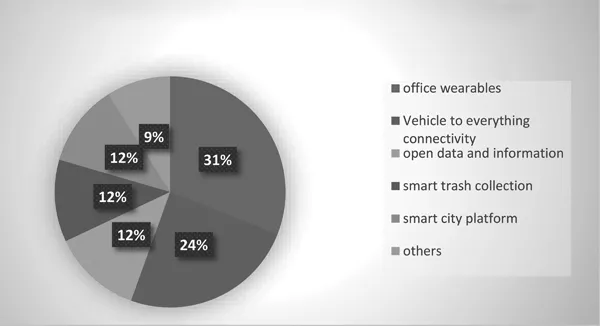
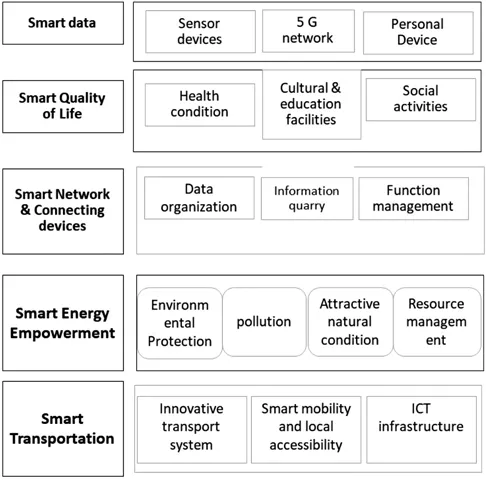
According to a 2014 United Nations (UN) report, more than 50% of the global population is urbanized [1-20]. In today's scenario, cities are home to more than 50% of the current world's population and are expected to add another 2.5 billion new inhabitants by 2050 [1, 2]. Every day, people are facing increased environmental burdens, infrastructure requirements, and increasing demands from populaces to provide a better quality of life, as shown in Figure 1.1 21–24. Smart tools and technologies can help cities meet these day-to-day issues or challenges, and they are already enabling the next wave of community investment; because cities, in all their complexity and scope, generate oceans of it [ 14]. Smart cities use information and communication technologies (ICT) to upgrade the quality of life of residents, the local economy, transportation, traffic management, the environment, and interaction with the government to plan for the future, as shown in Figure 1.2. Furthermore, by adding all the realistic data to the organization and community helps in empowering for better decision making and also plays an important role in improving the city's overall performance. When cities get smarter, they become more civilized and more responsive.
FIGURE 1.1
FIGURE 1.1
Global growth rate for smart cities (2017–2020) [5, 6].
FIGURE 1.2
FIGURE 1.2
Features of a smart city and its components.
The idea of smart cities has attracted substantial consideration from researchers within multiple domains including information systems, smart homes, smart ecosystems, smart residents, smart governments, smart parking, and many more [5, 6]. Rapid growth of global urbanization has also put a lot of pressure on inhabitants' hubs, presenting a challenge for cities to deliver ecosystem sustainability, security, and safety of residents alongside a rise in crime and threats [7]. In order to avoid these upcoming challenging issues, cities seek a sustainable environment but also resist growth in terms of current development, as shown in Figure 1.1.

1.2 Features of a Smart City and Its Components

Generally, a city with a base of information and computer technology can be termed as a “smart city.” ICT is the base of the entire city: its medium of communication, its property, and other services. The concept of “smart cities” comes from two campaigns in 2008 and 2009, namely the Smarter Planet initiative launched by IBM. Presently, various countries including India are taking effective control measures in order to develop smart cities. One of the best examples of a smart city is “Curitiba,” a capital of Paraná in Brazil, where waste management was a big issue that led to the release of waste masses in the streets [810]. In this city, approximately 70% of the population actively participates in recycling of waste from streets and, as a result, the city has become much cleaner and was also rewarded by the government of Brazil. Some other companies also launched campaigns to develop cities like Singapore, Dubai, Amsterdam, Barcelona, and New York. All the listed cities are applying novel solutions to infrastructure in order to improve it [1016].
There are various components present in literature that makes a city smarter. In general, this includes smart transportation, smart energy empowerment, smart data, smart networks, and smart quality of life, as shown in Figure 1.2.

1.2.1 Smart Transportation

This type of city has less traffic flow that results in ease of transportation of goods and individuals through numerous sources. Reducing the number of traffic results in less road accidents, less traffic congestion, a decrease in the level of air pollution, and also helps in promoting a better lifestyle [2, 10, 17]. There are various challenging issues in terms of smart transport development because various developing cities around the world are not able to make a balance between the supply of goods and demand of the urban transport system, as shown in Figure 1.2 and later in Figure 1.5. Some of the core challenging issues are listed here:
  • Developing cities lag behind due to inadequate capacity to mobilize the large amount of funds that will be required to initiate the transport development projects.
  • The rapid increase in population is one of the biggest challenging issues that has to be taken on a priority basis.
  • Unlawful occupancy of automobiles on footpaths and bicycle traffic lanes is another important challenging issue.

1.2.2 Smart Energy Empowerment

Residential and commercial buildings are both efficient at using less energy. The saved energy is analyzed to collect relevant information. Intelligent networks are the entry point of a smart city and improve failure detection, collect relevant data and information, and carry out disaster management, field operations, and various techniques to upgrade the network. In this, the Internet of Things (IoT) plays an important role that results in smart home electric meters that allow the consumer to flexibly adjust power consumption, provide better network management, and provide a better distribution of energy. In smart cities, homes and energy suppliers can exchange data in a transparent manner to the consumer [2, 18, 19]. The energy empowered will be very challenging by the end of 2025 due to around 4.6 billion people living in metropolitan regions. These cities will consume approximately 65% of existing primary energy and count for around 70% of greenhouse gas emissions to supply energy for illumination, heating, cooling, and transportation [16, 20].

1.2.3 Smart Data

A smart city collects huge volumes of raw data to be promptly analyzed to provide valuable information to its people. Residents can install an open-data portal and publish online d...

Table of contents

  1. Cover
  2. Half Title
  3. Title Page
  4. Copyright Page
  5. Dedication
  6. Contents
  7. Preface
  8. Acknowledgments
  9. Editor Bio
  10. Contributors
  11. Part 1
  12. Part 2
  13. Part 3
  14. Part 4
  15. Index