- 310 pages
- English
- ePUB (mobile friendly)
- Available on iOS & Android
eBook - ePub
About this book
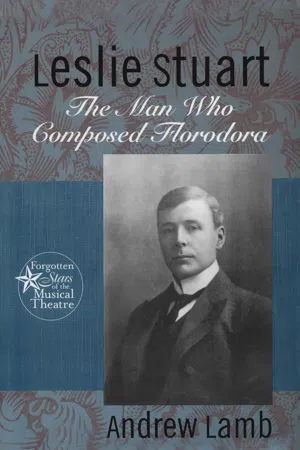
Leslie Stuart (1864-1928) was a British songwriter best remembered as the composer of the hit show, Florodora. He began writing popular songs as a teenager, first for blackface and vaudeville performers, and eventually for more "legitimate" shows and revues. Florodora (1899), written in collaboration with London's most fashionable librettist, Owen Hall, was a musical-comedy sensation. Its combination of the traditional slow love ballads and waltzes with more rhythmic and long-lined numbers made it a worldwide success. He continued to compose through the first decade of the 20th century, laying the groundwork for the coming innovations in British and American musical theater.
Information
Chapter 1Irish Ancestry, Lancashire Boyhood
For over 150 years, Ireland has been an exporter not only of Guinness and peat but also of people. In the early 1800s, over two-thirds of the Irish people were dependent on agriculture, and the potato was a major source of food and income. Alas, in September 1845 a fungus was found to be destroying the potato crop, having thrived in the warm, wet weather of the time. Years of famine followed. The less fortunate of the population died of starvation or diseases such as cholera or typhoid, while the more fortunate found a solution in emigration. Between 1800 and 1841, the Irish population had increased from around five to eight million; but an estimated one million people died during the famine, and some two million emigrated. By 1911 the Irish population had declined to less than four and a half million.
Many of the emigrants went to North America, creating the Irish populations that exist to the present day. Others made the shorter crossing to Liverpool, often moving on to find employment elsewhere in England. The opening of the Liverpool and Manchester Railway in 1830 made it an easy trip to Manchester, where the raw cotton that arrived from America by ship for transporting along the Bridgewater Canal was processed. The population of Manchester and adjoining Salford (towns separated only by the River Irwell) grew from about 95,000 in 1800 to over 455,000 by 1851. Irish-born immigrants formed a third of Manchester's population by 1867, when members of the Irish Republican Brotherhood (the Fenians), sworn to bring about Irish independence from England, stormed a Manchester police van and murdered a police sergeant in the course of releasing two Irish prisoners.
Among areas of Ireland most affected by the 1845-48 famine was County Mayo, in the west, where some 90 percent of the population were dependent on the potato. It was from Ballina in County Mayo that one Thomas Barrett immigrated to England. The name Barrett supposedly came from Spaniards who arrived on the west coast of Ireland a thousand years ago. Since the local people had no names for them, "the priest who offered up Mass in thanksgiving for their safe arrival christened them Biretta, after the headgear which priests wear."62
Thomas Barrett was one of five brothers who emigrated to England, all apparently at one time becoming cabinetmakers in Liverpool.62 In 1854, he was in Manchester, where on May 15 he married Mary Ann Burke at St. Mary's Church. On the marriage certificate, Thomas Barratt [sic] is described as a bachelor and a joiner by profession, the son of Henry Barratt, joiner, while his wife is described as daughter of Bernard Lester, also a joiner. She was from Athlone, in the center of Ireland. Though described as "spinster," she was actually a widow and was apparently always referred to by her second husband as The Widow.65
The marriage certificate records both parties as twenty-eight years old and living at 39 Dearden Street, Hulme, Hulme was then a separate township to the southeast, divided from Manchester by the River Medlock, and one of the working-class areas that fed the larger city. On June 11, 1855, Mary Ann gave birth to the couple's first child, a son named Stephen, and a second name, William, was added subsequently. On the birth certificate their name is spelled "Barrett," while Mary Ann is recorded as "late Burke, formerly Lister" [sic]. The birth took place at 3 Welcomb Street, a thoroughfare off River Street, Hulme, though Dearden Street continued to appear in the 1855 and 1856 Manchester street directories as the business address of Thomas Barrett, joiner.
Thomas's disappearance from subsequent Manchester street directories brings a period of fourteen years when documentary evidence of the family's whereabouts is scarce. The gap is more regrettable because it covers the period when the couple's second son was born. Named Thomas Augustine Barrett, his first name came from his father, and his second from the saint who brought Christianity to Ireland. He was to become known to the world as Leslie Stuart, composer of Florodora.
We may assume that the family moved from Manchester to the Lancashire coast, because it was in the seaside resort of Southport, to the north of Liverpool, that Thomas Augustine Barrett was born. That much is consistently stated in his published biographical details, as is the date of March 15. Of the actual year there is no such consistency. In reference works, he gave his year of birth variously as 1864 or 1866, and the matter is further complicated by his 1928 death certificate, which gives his age as sixty-six, implying that he was born in 1862. His daughter, at whose home he died, admitted that she didn't know the true year, adding that "no-one seemed to care."65
Before state benefits, of course, people often had only a vague knowledge of their true ages. Members of the theatrical profession, especially, were inclined to knock a few years off. For Leslie Stuart, creating a mystery of his true age seemed to be an obsession. A magazine feature ended with the intriguing statement that "birthdays and similar anniversaries are never alluded to in his family."77 On another occasion he stated, "There is no official record of my birth My parents being worthy Irish folk, they did not consider it any business of the registrar's when I was born or that I was born at all, and contented themselves with having me christened at the Roman Catholic Church and my birth recorded there. The church was eventually devastated by fire, and from that moment there was no longer a record of the day I commenced this mortal coil."62
It is true that there is no birth entry in the records of Britain's Registrar-General. Neither has any baptismal record come to light. Nor has the Roman Catholic church that was "devastated by fire" been identified. School records and 1871 census records have proved equally elusive. The most convincing evidence of Leslie Stuart's year of birth is provided by the April 1881 national census, where his brother is correctly shown as age twenty-five and he as eighteen, implying a year of birth of 1863. This is supported also by the age on his marriage certificate, and there is even confirmation of a kind in the 1891 census. Though he gave his age there as only twenty-six, he equally knocked two years off the ages of his wife and sister-in-law, whose true ages can be verified. Overall, the best estimate we can make is that he was born on March 15, 1863.
We can at least confirm the presence of the family in Southport around that time from the appearance of Thomas Barrett, joiner, in the Southport street guide of 1864-65. His address is given as Duke Street, in the center of the town. According to Leslie Stuart's own testimony, he was actually born in Birkdale,56 which until incorporation into Southport in 1911 was a separate urban district. Situated a couple of miles to the south, Birkdale was heavily developed during the 1850s and 1860s, attracting wealthy businessmen from Manchester and elsewhere in Lancashire. Joiners from urban Lancashire would doubtless have been equally welcome for house building.
Thomas Augustine Barrett, alias Leslie Stuart, later commented on early signs of his musical talent: "Even during my first stay in Southport the nurse declared there were notes, especially an ut de poitrine, in my voice suggestive of Sims Reeves."63 (An ut de poitrine is the high C of a tenor's chest voice, and Sims Reeves was the most celebrated English tenor of the second half of the nineteenth century.) However, he did not live in Southport long: "One month after my birth our family migrated to Liverpool, where my father entered the theatrical profession, he becoming the head stage-carpenter at the Amphitheatre...."62 Opened in 1826 in Great Charlotte Street, at its junction with Queen Square, the Royal Amphitheatre was a huge building, accommodating nearly 4,000 people. In its early days it was noted for equestrian performances and music festivals, but from the 1840s it housed a more conventional range of theatrical entertainment. Together with the Theatre Royal in Williamson Square, it was from 1843 under the management of William Robert Copeland and from 1868 that of his daughter, with Henry Leslie as director. Thereafter it encountered increasing competition from the newer Adelphi and Prince of Wales Theatres. In 1880 it was sold and rebuilt, reopening in 1881 as the Court Theatre.
It was at the Royal Amphitheatre that Leslie Stuart's memories of the theater began. His daughter May claimed that "at three years old he used to sit on an orange box in the flies and watch the greatest actors and actresses of the Victorian age."66 Stuart himself recalled, "The house we lived in so commanded the stage door that we had full view of all that happened about it, and I have seen [Samuel] Phelps, [Tomasso] Salvini, Barry Sullivan, and their famous contemporaries pass under my gaze to play their parts. In fact I became a child super to some of them, so that my association with the stage began very early. These efforts ranged from 'Julius Caesar' to 'The Poor of London.' I was a child super remember, not the lead."62 There were other early memories linked to his father's theatrical activities. As he noted, "The first star trap through which demon-like individuals are usually shot on to the stage from below, was constructed by my father—at least in Liverpool. When the time for the big test had arrived, I was the person who was shot through it."62

Popular entertainment outside St. George's Hall, Lime Street, Liverpool (The Graphic, May 5,1877; author's collection)
The experience evidently gave Stuart a passion for all things theatrical. He recalled walking up and down the steps of St. George's Hall, "on his hands for pennies from his impromptu audience," an occupation that ceased only when "I happened to number my father in my audience."62 Evidently it did not kill his initiative:
Being fired with dramatic ambition from the age of six or seven ... I found myself an infantile confederate with a hawker who used to stand in the streets selling tiny champagne bottles that had the reputation of defying gravitation until he caused them to be submissive by his agent. The cherubic or seraphic youngster—whichever it was I most appeared with my flaxen hair and baby blue eyes—fortified with a tiny piece of metal that I used to slip into the neck of the bottle, was the agent of that deceiver of the British public This source of revenue was also ungraciously destroyed for me just when I began to grasp the meaning of avarice. Gone were two perfectly good opportunities for making money through a father's untimely intervention while a worthy son was endeavouring to follow his bent.62
Alas, there is no obvious sign of Thomas Barrett senior in the credits for Royal Amphitheatre productions of the 1860s, even for the pantomimes that most obviously required elaborate properties. Nor is there any sign of him in Gore's Street Directory of Liverpool until 1870, when we find Thomas Barrett, cabinetmaker, at 13 Beau Street, Everton. The Barretts were no longer there in the April 1871 census, though, nor at 34 and 36 Wilde Street, the address given in the 1871 and 1872 street directories,
It may have been when the family lived in Wilde Street, which runs off London Road, that further signs of musical awareness in young Tom Barrett became apparent.
When I was a baby we lived in Liverpool within an easy distance of the headquarters of the Irish Brigade, who paraded every Saturday afternoon past the end of our street to a popular tune on the band. I am told that, after they passed, I used to imitate that band with marvellous accuracy, my people discerning four distinct instruments playing at the same time.... This was the first discovery by my parents of my great musical gifts....
It was not in the musical department of my profession, however, that my earliest achievements were accomplished. I had a great leaning towards the stage When I became old enough to read advanced literature I was permitted to study the touring managers' advertisements and the back page of the Era, and perceiving that I possessed all the requirements for success—inborn modesty and saintly humility—I became an author-actor-manager. I wrote my own version of The Miller and his Men, bought my own stage, scenery and characters, and two pennyworth of red fire for the explosion of the mill. My reason for stocking so much red fire was that I had recently been to a melodrama at the old Adelphi... and I noticed particularly that when the play became dull and the comedian's scenes began to bore the audience they lit red fire and exploded something or other. This struck me as an excellent idea. They don't burn red fire for that purpose nowadays, they use composers instead. I had fitted up the proscenium in front of our wash boiler, so that I might sit in the copper and push on the cardboard characters on either side—a most uncomfortable position, yet commanding. I arranged a Saturday matinee as my first performance—eight boys in the neighbourhood having guaranteed me their halfpennies for admission. On the day of the show they presented a respectable queue outside our back door awaiting admittance to the Scullery Theatre.
It was rather unfortunate for me that my mother had delayed her shopping that afternoon—this was an unlicensed performance—as three of the boys—through waiting for the doors to open—fell to the allurements of the winkle man who was passing, and spent their admission money. I have noticed ever since then what a thin line divides first class drama from winkles. I opened the door when all was clear, admitting the three boys who had no money on their undertaking to applaud and encore at the smallest provocation. Knowing what an advantage it was for a manager to play all the characters, I spoke all the parts myself through the flies. The book soon palled on them, so I brought on the mill scene very early and burnt the red fire. The scene was encored, the deadhead claque in front overdoing it so much that my red fire was soon expended, and, having to fall back on my book to get me through, the audience very soon demanded another explosion. After addressing them over the top of the proscenium with that humility discernible in a manager only when addressing an audience, I appeased them by promising an extra special explosion if they would only stand my play to the bitter end, to which they agreed.
Having no red fire, I ignited two whole boxes of household matches, which subterfuge was at once detected, and a demand for the return of their money was unanimous, the most satirical and unfriendly criticism coming, of course, from the three deadheads. They threatened to acquaint my mother of the illegal performance in her absence, which weighed with me, so I disgorged. This was a waste of money on my part; the smell of lucifers and red powder was quite sufficient to betray to my mother that a bad play had taken place in her boiler, and after certain preliminaries she reduced the show to ruins, displaying unforgivable vandalism in burning the scrip [sic]—the first of many occasions when my compositions have been roasted. I have ofttimes observed, since then, that it is generally my friends who do the most roasting. A lot of my old-time companions must have become pressmen.61
Young Tom Barrett's schooling in Liverpool was at St. Francis Xavier's, a Jesuit Roman Catholic boys' school founded in 1842. There is no sign of his name in the incomplete surviving admission registers of the school, but he recalled that it was there that he "first conquered the alphabet."62 Before he was in his teens, however, the family moved back to Manchester—this time not to Hulme, but to Ancoats, just northwest of the city center. Smoke-begrimed Ancoats was a working-class district with significant populations of both Irish and Italian immigrants. It was thus a strongly Roman Catholic area, and also a musical one. Many of the Italians who lived there were either ice cream makers or street musicians, making a living from their mechanical organs. From 1874 Tom Barrett senior appears in Manchester street guides as cabinetmaker at 7 Blossom Street, and later at number 88.
It was in Manchester that Tom Barrett juniors musical talents were really developed:
I attended St Patrick's School in Livesey-street, a thoroughfare that connects Oldham-road with Rochdale-road, two of Manchester's greatest arteries connecting the city with the greater Cottonopolis.... The school was in charge of that inestimable body of men—all great scholars and the most capable of teachers—the Christian Brothers,
with headquarters in Ireland. The weekly payment of sixpence entitled the student to a curriculum extending from the common subjects, to Euclid, algebra, and even music, the latter through the unselfish devotion to Catholic boys ...
Table of contents
- Cover
- Half Title
- Series Page
- Title Page
- Copyright Page
- Dedication
- Contents
- SERIES INTRODUCTION
- ACKNOWLEDGMENTS
- Chapter One IRISH ANCESTRY, LANCASHIRE BOYHOOD
- Chapter Two EARLY CAREER IN MANCHESTER
- Chapter Three EXPANDING HORIZONS
- Chapter Four CONCERT PROMOTER AND SONG COMPOSER
- Chapter Five LESLIE STUART: POPULAR SONGWRITER
- Chapter Six EUGENE STRATTON, AND MUSICAL PIRACY
- Chapter Seven FLORODORA
- Chapter Eight FROM THE WEST END TO BROADWAY
- Chapter Nine THE SILVER SLIPPER
- Chapter Ten ACROSS AMERICA
- Chapter Eleven THE SCHOOL GIRL
- Chapter Twelve FRUITS OF SUCCESS
- Chapter Thirteen THE BELLE OF MAYFAIR
- Chapter Fourteen HAVANA
- Chapter Fifteen CAPTAIN KIDD AND THE SLIM PRINCESS
- Chapter Sixteen PEGGY, BANKRUPTCY, AND BUBBLES
- Chapter Seventeen WORLD WAR I, AMERICA, AND NINA
- Chapter Eighteen DEATH AND LEGACY
- SOURCES
- COMPOSITIONS
- INDEX
Trusted by 375,005 students
Access to over 1.5 million titles for a fair monthly price.
Study more efficiently using our study tools.
Frequently asked questions
Yes, you can cancel anytime from the Subscription tab in your account settings on the Perlego website. Your subscription will stay active until the end of your current billing period. Learn how to cancel your subscription
No, books cannot be downloaded as external files, such as PDFs, for use outside of Perlego. However, you can download books within the Perlego app for offline reading on mobile or tablet. Learn how to download books offline
Perlego offers two plans: Essential and Complete
- Essential is ideal for learners and professionals who enjoy exploring a wide range of subjects. Access the Essential Library with 800,000+ trusted titles and best-sellers across business, personal growth, and the humanities. Includes unlimited reading time and Standard Read Aloud voice.
- Complete: Perfect for advanced learners and researchers needing full, unrestricted access. Unlock 1.5M+ books across hundreds of subjects, including academic and specialized titles. The Complete Plan also includes advanced features like Premium Read Aloud and Research Assistant.
We are an online textbook subscription service, where you can get access to an entire online library for less than the price of a single book per month. With over 1.5 million books across 990+ topics, we’ve got you covered! Learn about our mission
Look out for the read-aloud symbol on your next book to see if you can listen to it. The read-aloud tool reads text aloud for you, highlighting the text as it is being read. You can pause it, speed it up and slow it down. Learn more about Read Aloud
Yes! You can use the Perlego app on both iOS and Android devices to read anytime, anywhere — even offline. Perfect for commutes or when you’re on the go.
Please note we cannot support devices running on iOS 13 and Android 7 or earlier. Learn more about using the app
Please note we cannot support devices running on iOS 13 and Android 7 or earlier. Learn more about using the app
Yes, you can access Leslie Stuart by Andrew Lamb in PDF and/or ePUB format, as well as other popular books in Media & Performing Arts & Music. We have over 1.5 million books available in our catalogue for you to explore.