- 670 pages
- English
- ePUB (mobile friendly)
- Available on iOS & Android
eBook - ePub
About this book
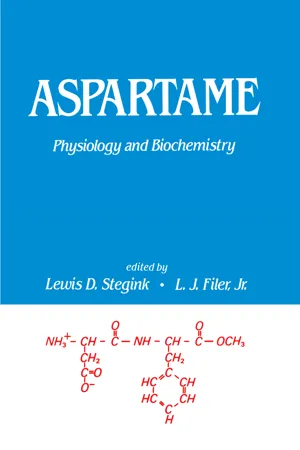
This book summarizes the research that resulted in aspartame's approval as a food additive as well as related topics regarding its function as a potential sweetening agent. It complies specific issues relating to human consumption of aspartame.
PRECLINICAL STUDIES
14 Preclinical Studies of Aspartame in Nonprimate Animals
Samuel V. Molinary
PepsiCo, Inc., Valhalla, New York
PepsiCo, Inc., Valhalla, New York
INTRODUCTION
Aspartame, [3-amino-N-(2-carboxyphenethyl)succinamic acid methyl ester], the methyl ester of L-aspartyl-L-phenylalanine, and its principal decomposition product, 3-carboxymethyl-6-benzyl-2,5-diketopiperazme (diketopiperazine, or DKP) have been extensively studied for their toxicological potential for the past 15 years. Over 112 studies concerning the metabolism, pharmacology, and toxicology of these two compounds were filed by G. D. Searle & Company with the Food and Drug Administration (FDA) as proof of the safety of aspartame (APM) as a food additive.* In approving APM as a sweetener in 1981, Commissioner Hayes said (1), “The safety evaluation of aspartame has been a long and arduous process, spanning the tenure of several FDA commissioners. Few compounds have withstood such detailed testing and repeated, close scrutiny, and the process through which aspartame has gone should provide the public with additional confidence of its safety.” While APM may not be the most studied food additive, it probably has had the largest number of studies carried out prior to FDA approval.
Of these 112 safety studies submitted to the FDA, 93 are or pertain to reports of studies of aspartame and its DKP in animals. Many of these studies have been reviewed and evaluated by the Joint Expert Committee on Food Additives (JEC/FA) of the Food and Agricultural Organization of the United Nations and the World Health Organization (FAO/WHO) in 1975, 1976, 1977, and 1980. A monograph on the toxicological evaluation was written following the 1980 JEC/FA meeting in Rome (2). This review will be confined to those animal studies carried out early in the development of aspartame (1968-1974). Some of these studies, especially the carcinogenicity studies in the rat, became the focal point for questions that were considered by the Public Board of Inquiry in 1980; the interpretation of these is discussed in depth elsewhere in this book (3-5).
These studies are contained in the so-called “E-File” at the Food and Drug Administration, Hearing Clerk File, Administrative Record, Aspartame 75F-0355, Rockville, Maryland.
In proposing a novel compound as a food additive, especially a sweetener which will be consumed by all segments of the population, it is important that the sponsor prove that this compound is safe to a reasonable certainty. The development of a data base for product safety assessment typically starts in three scientific areas: metabolism (including absorption, tissue distribution, pharmacokinetics, and elimination), pharmacology, and toxicology. Metabolism studies are carried out in a number of different species, ultimately including man, and the data obtained are used to design and interpret studies in the other two areas. In this specific case pharmacology studies are performed to discover if the compound has any biological activity other than that of creating the perception of a sweet taste. Pharmacological activity is not a desirable property for a food additive. Toxicology studies are carried out in two parts, acute and chronic exposure, and are undertaken to determine what harm may accrue as a result of ingesting the food additive, especially under conditions of high intake. Each of these areas will be considered as they relate to the studies of animals administered aspartame or its DKP.
The metabolism of aspartame and its diketopiperazine have been extensively studied in mice, rats, rabbits, dogs, monkeys, and man (2,6-19). The major point to emerge from the metabolism studies is that in all species tested, aspartame is broken down in the gastrointestinal tract to its constitutents L-phenylalanine, L-aspartic acid, and methanol. These findings suggest that outside the gastrointestinal tract, any toxicological activity of aspartame would result from systemic imbalances caused by increases in the plasma concentration of these two amino acids and methanol. This finding also suggests that if the dipeptide (aspartyl-phenylalanine) per se had any pharmacological activity, it would be in the gastrointestinal tract itself. This was considered possible since the dipeptide sequence aspartyl-phenylalanine is found at the carboxy terminal end of the gastrointestinal hormones gastrin and cholecystokinin (20).
Studies were undertaken by Bianchi et al. (21) to delineate any pharmacological effects that aspartame might have on the gastrointestinal system. Rats were given 200 mg/kg body weight of aspartame intragastrically and observed for effects on appetite suppression, inhibition or stimulation of gastric secretion, acid secretion, and proteolytic activity. No compound-related effects were observed.
In addition to tests on the gastrointestinal system, other pharmacological tests were carried out in a variety of in vivo and in vitro model systems (22). As pointed out by Potts et al. (23), “some of thes...
Table of contents
- Cover
- Half Title
- Series Page
- Title Page
- Copyright Page
- Preface
- Contributors
- Contents
- HISTORY AND BACKGROUND
- METABOLISM
- SENSORY AND DIETARY ASPECTS
- PRECLINICAL STUDIES
- STUDIES OF ASPARTAME METABOLISM IN HUMANS
- Index
Trusted by 375,005 students
Access to over 1.5 million titles for a fair monthly price.
Study more efficiently using our study tools.
Frequently asked questions
Yes, you can cancel anytime from the Subscription tab in your account settings on the Perlego website. Your subscription will stay active until the end of your current billing period. Learn how to cancel your subscription
No, books cannot be downloaded as external files, such as PDFs, for use outside of Perlego. However, you can download books within the Perlego app for offline reading on mobile or tablet. Learn how to download books offline
Perlego offers two plans: Essential and Complete
- Essential is ideal for learners and professionals who enjoy exploring a wide range of subjects. Access the Essential Library with 800,000+ trusted titles and best-sellers across business, personal growth, and the humanities. Includes unlimited reading time and Standard Read Aloud voice.
- Complete: Perfect for advanced learners and researchers needing full, unrestricted access. Unlock 1.5M+ books across hundreds of subjects, including academic and specialized titles. The Complete Plan also includes advanced features like Premium Read Aloud and Research Assistant.
We are an online textbook subscription service, where you can get access to an entire online library for less than the price of a single book per month. With over 1.5 million books across 990+ topics, we’ve got you covered! Learn about our mission
Look out for the read-aloud symbol on your next book to see if you can listen to it. The read-aloud tool reads text aloud for you, highlighting the text as it is being read. You can pause it, speed it up and slow it down. Learn more about Read Aloud
Yes! You can use the Perlego app on both iOS and Android devices to read anytime, anywhere — even offline. Perfect for commutes or when you’re on the go.
Please note we cannot support devices running on iOS 13 and Android 7 or earlier. Learn more about using the app
Please note we cannot support devices running on iOS 13 and Android 7 or earlier. Learn more about using the app
Yes, you can access Aspartame by Filer Stegink in PDF and/or ePUB format, as well as other popular books in Physical Sciences & Chemistry. We have over 1.5 million books available in our catalogue for you to explore.