This book examines the life of the Australian artist Harry Reade (1927–1998) and his largely overlooked contribution to animation. It constitutes a biography of Reade, tracing his life from his birth to his period of involvement with animation between 1956 and 1969. It explores the forces that shaped Reade and chronicles his experiences as a child, his early working life, the influence of left-wing ideology on his creative development, his introduction to animation through the small but radical Waterside Workers' Federation Film Unit (WWFFU), and the influence he had on the development of Cuban animation as an educational tool of the Revolution.
Key Features
The text offers an alternative framework for considering the political, social, and cultural themes that characterised 1950s Australia and 1960s Cuba.
A rare look into the cultural heritage of labor organizations and the populist power of animation to stimulate radical social consciousness.
The book also crosses a range of intellectual disciplines, including Animation Studies, Art History, Cinema Studies, and the Social and Political Histories of Australia and Cuba.
Max Bannah lives on Queensland's Sunshine Coast. Between 1976 and 2010, he worked in Brisbane as an animator producing television commercials, short films, and cartoon graphics. He also lectured in Animation History and Practice and Drawing for Animation at the Queensland University of Technology where, in 2007, he completed his Masters by Research thesis, "A Cause for Animation: Harry Reade and the Cuban Revolution."
Political and Social Influences on Harry Reade's Early Life (1927–1954)
In 1963, the short animated film La Cosa (The Thing) received Cuba's first international award for animation at the London Film Festival. The award was a boost for Cuban films and vindication of the establishment in 1959 of an animation studio (Dibujos Animados) within the Cuban Institute of the Art and Industry of Cinema (ICAIC). Such international recognition helped to promote a positive image of the Cuban Revolution abroad. Not that ICAIC sought foreign approval. On the contrary, its guiding principle was that foreign recognition would follow if the films were authentic expressions of the Revolution's own needs (Chanan, M. 2004, 131). La Cosa is a Marxist parable about the world created by capitalism and the society it sustains, and illustrates how human beings can organise the means of production for their own subsistence. What is intriguing about this film is that it was written and directed by an Australian named Harry Reade—a waterside worker and part-time journalist, author, dramatist, cartoonist, illustrator and animator who linked creative expression with radical action in society.
Although he is a little-known figure in Australian animation history, Harry Reade had an enduring influence on the development of the educational sector of Cuban animation. Given the intense conservatism and anti-communist feeling that prevailed in Australia at the height of the Cold War, how was it that a Sydney wharfie could emerge to have such an impact on revolutionary Cuban culture and society?
Reade recounts the poverty and harshness of his childhood in the first volume of his autobiography, An Elephant Charging My Chookhouse—a title prompted by a question that young Harry had asked his father Tom Reade who struggled with what he called ‘the bloody system’ and his distrust of the world created by capitalism and the society it sustained:
‘What's capitalism, Dad?’
‘An elephant charging a chookhouse, shouting, every man for himself!’
(Reade, H. 1987, 101)
This personal account of the social reality of Reade's formative years evokes the atmosphere of general hardship experienced by the Australian jobless and their families during the Great Depression. It helps explain his relationship with the society in which he lived and provides an understanding of the intellectual framework guiding his personal development and his identification with working class communities. His story focuses on the conditions that determined his ideological beliefs and his rejection of capitalism.
Reade describes how his mother and father met at Australia's great horse race, the Melbourne Cup. His mother was 18, his father 43: ‘He tipped her a wink, bought her a drink, and one thing led to another … namely my own birth on 17 November 1927 in Murtoa, Victoria’ (Reade, H. 1987, 16). His name, Henry Garbutt Reade, honoured his mother, Vera Violet Garbutt, and a nineteenth-century mathematician after whom his father had named himself. Tom Reade had changed his surname from Reed to Reade in honour of William Winwood Reade who had written The Martyrdom of Man—a prominent freethinking text published in 1872, which dealt with four common stages of human development: war, religion, liberty and intellect. William Winwood Reade gave a glimpse of humanity's future by examining the past. He believed science would replace humanity's dependence on religion, and predicted people would be liberated from labour by three inventions: air travel, a fuel to replace coal and oil, and the production of food in factories (Reade, H. 1987, 24).
Harry Reade had been delivered into a world of uncertainty, one in which the speculative euphoria of the Roaring Twenties was turned upside down by the worldwide economic slump of 1929 and the beginning of the Great Depression. With his father out of work, Harry's first memories of childhood were ‘bitter sweet recollections of the Hungry Thirties’. By 1930, the rosy glow of romance between his parents had dimmed, and the marriage fell apart. Reade is not certain what contributed to the failure of the relationship but offers that ‘theirs was not the only marriage torn apart by the Great Depression. Many marriages were, especially those that were simple unions of the flesh’. His mother left when he was 3, and he never saw her again. He says in his autobiography that because he was so young when she abandoned him, all real knowledge of her was ‘denied to memory’. He could not recall the touch of her hand or the colour of her hair, and the only descriptions of her that his father bequeathed him were, ‘That's where you got your big nose’ on one occasion, and ‘Look in the mirror sometime’ on another (Reade, H. 1987, 18–32).
Tom Reade, a tough, militant, unemployed and politically committed Wobbly, took on his son's upbringing. He was born in Sydney, in 1883, and became an atheist at the age of 16 when he ran away to sea as a deckhand on a Norwegian barquentine. For a while he worked on the Sydney waterfront before economic recessions and industrial accidents left him unemployed just prior to the World War I. Harry writes of the blustering defiance in his father's character and his ‘sign-on’ with the Industrial Workers of the World:
In the early 1900s—young, strong, fearless, penniless and godless—he was ripe for recruitment to the Industrial Workers of the World. The eye double you, double you … the eye, double double you … the ‘I Won't Works', the Wobblies. The Wobs. The Reds. They recruited him one Sunday afternoon on the Sydney Domain, with a left hook to the chin.
(Reade, H. 1987, 22)
As a Wobbly, Tom Reade shared the belief that under capitalism any gains or losses made by some workers, from or to bosses, would eventually affect all workers. Therefore, to protect each other, all workers had to support one another in a broader class conflict. The Wobblies were united in their desire to transform capitalist society and pursued the abolition of wage labour and the establishment of an Industrial Commonwealth. They wanted a self-managing society where there were no bosses or ‘business agents’, and where decisions affecting workers were made by themselves. Their ideological practice centred on the concept of ‘direct action’ at the work place, ‘the point where exploitation was begun’. Direct action encompassed sabotage, go-slow tactics, job control, strikes and every method of waging class war in direct confrontation with the wages system controlled by employers. Frank Farrell describes the general character of the Wobblies in International Socialism and Australian Labour: The Left in Australia 1919–1939:
In terms of worldwide trends the Wobblies were anarcho-syndicalist in that they fused an emotional anarchistic revulsion at organised society with the idea of a giant industrial union emancipating the workers by means of a general strike and seizure of the means of production. But a dominating aspect of Wobbly agitation was its anarchistic rejection of society, the actual formation of industrial unions being for the most part forgotten.
(Farrell, F. 1981, 14)
Farrell's description of the Wobblies' tendencies did not mean that the Wobblies were Luddites, for they did not engage in industrial sabotage for the sake of it. On the contrary, they ‘welcomed mechanisation and demanded it’. However, in a capitalist system, as machines improved and performed the work of people, those same people rather than benefiting from the improved technology by gaining more leisure time were actually working even harder. Reade points out that when he was a child, his father often quoted The Right to be Lazy, written in 1883 by the French author, Paul Lafargue (1842–1911) who was a socialist writer and political activist married to Karl Marx's daughter. Lafargue advocated the creation of a political party of the working class. His book urged the working class to reject ‘the right to work (the right to be exploited)’ as outlined in Tom Paine's, The Rights of Man (1791).1 Lafargue also called on workers to refuse to work more than three hours a day in an attempt to force employers to modernise industry. Such an action, he argued, would assure workers a share of available work and would not take sustenance from other workers in a competitive system. Like Martyrdom of Man, The Right to be Lazy too proposed the means for ‘people's liberation from labour’.
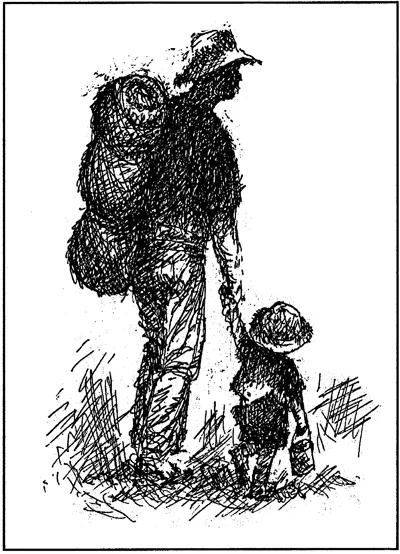
Reade stresses that while his father campaigned on behalf of the IWW movement, he did not spend his time ‘burning down buildings, slugging policemen, selling illegal papers, agitating, and doing time’. As a man looking to feed himself and a child, he had to work (Reade, H. 1987, 29). Like many others jobless during the Depression, his father was down on his luck and took whatever work was at hand: ‘fencing, ring-barking, pick-and-shovel work, harvesting … anything and everything the bush had to offer’. Tom took 4-year-old Harry on the road, walking miles each day, jumping trains, surviving on ingenuity, begging for food and, on occasions, stealing. The necessities of life like food and shelter were no longer guaranteed. Out of the wretchedness of hard times, the pair developed a no-nonsense, self-reliant way of life.
During the worst of it, my bed was the ground, my blankets the clothes I wore. My fire was the warmth of Dad's body; my only shelter his strong brown arms. He was the house that sheltered me and the church at which I worshipped.
(Reade, H. 1987, 34)
The conditions father and son experienced together forged an extremely close bond between them. In a 1987 Sydney Morning Herald article, Reade recalled his father's ‘cranky toughness’ as he grew up in a world ‘without caresses’. Yet he loved his father, and honoured his memory. He said that he ‘could not understand the current fashion that insists that fathers regularly hug their children to demonstrate their affection’ (Stephens, T. 1987, 45).
By late 1931, 28 percent of the work force in Australia was out of work. Internationally, industrial production in the capitalist world fell by 35 percent, the volume of world trade in manufactured goods fell by over 40 percent, and by 1932 over 30 million people were unemployed in the four major capitalist economies alone (Clark, D. 1981, 10–26). Workers became prisoners of poverty and the economic system, and stood in dole and ration queues.
Living from hand to mouth, Tom Reade found that handouts were few and far between as he looked for work in tough times. People who once thought they would rather die than beg would now sooner beg than ask for charity. Those who were out of work found themselves dependent on others. Workers without a job had to rely on their own cunning, self-reliance and ability to wrangle to survive. Knowing that ‘the appeal of a four-year-old boy would elicit more response than that of a fifty-year-old man’, Tom sent Harry to knock on the back doors of houses and ask, ‘Please missus, Dad wants to know can you spare a bit of tea and sugar?’ Mothers responded generously towards young Harry and he remembers the great pleasure he felt in their compassion:
It is a joy I can now equate with opening packets under Christmas trees, finding Easter eggs, plunging your hand into a lucky dip, and scrabbling in the grass after a ‘lolly shower’ at a school picnic. I got masses of the stuff. Fruit and vegetables and cold meat, cupcakes with hundreds and thousands on top and a tin of sardines.
(Reade, H. 1987, 42)
FIGURE 1.1Cover illustration for An Elephant Charging My Chookhouse drawn by Harry Reade. (Courtesy of Pat Evans.)
Associating begging with kindness, Harry warmed to his task. There was no stopping his innocent enthusiasm as he ‘collected an embarrassment of food’. When it became apparent that this enterprise was spoiling Harry, his father called a halt to their food scavenging scheme. Overall, Reade's experience of the leanness of those years stoked his rage against society and his empathy with disadvantaged children. Years later, he learned to feel his father's shame and indignation at what a workless world had forced upon them both:
In the burn of that shame and indignation, a Red was hardened. In every corner of this world where children are forced to beg and parents forced to let them, others are being forged of tougher metal. In those places where, as a better writer than I once put it, ‘the grapes of wrath grow heavy for the vintage’. You don't like Reds … you don't like revolutions? Then stop the hunger. The solution is as simple, and as uncomplicated, as that.
(Reade, H. 1987, 43)
Community attitudes towards charity for the unemployed varied during the Great Depression. In his opus, A History of Australia, Manning Clark outlines one approach to dole relief for the unemployed during the 1930 New South Wales coal-mining dispute. The All-Australian Trade Union Congress felt it was the primary duty of the Australian Government to provide unemployed workers with adequate food, clothing and shelter. Conservatives in power said that the dole ‘corrupted morale, and withered individual initiative’. The church spoke of the duty of their members to distribute charity. Communists, however, held firm to the line that capitalism was the cause of worker's suffering and humiliation: it had ‘degraded them into s...
Table of contents
Cover
Half Title
Series
Title
Copyright
Dedication
Contents
Acknowledgements,
About the Author,
INTRODUCTION,
CHAPTER 1 ◾ A Wobbly Road
CHAPTER 2 ◾ On the Waterfront
CHAPTER 3 ◾ Wharfie Animation
CHAPTER 4 ◾ Our Man in Havana
CHAPTER 5 ◾ Harry Reade's Legacy
APPENDIX: HARRY READE's FILMOGRAPHY,
REFERENCES,
INDEX,
Trusted by 375,005 students
Access to over 1.5 million titles for a fair monthly price.
Study more efficiently using our study tools.
Frequently asked questions
Yes, you can cancel anytime from the Subscription tab in your account settings on the Perlego website. Your subscription will stay active until the end of your current billing period. Learn how to cancel your subscription
No, books cannot be downloaded as external files, such as PDFs, for use outside of Perlego. However, you can download books within the Perlego app for offline reading on mobile or tablet. Learn how to download books offline
Perlego offers two plans: Essential and Complete
Essential is ideal for learners and professionals who enjoy exploring a wide range of subjects. Access the Essential Library with 800,000+ trusted titles and best-sellers across business, personal growth, and the humanities. Includes unlimited reading time and Standard Read Aloud voice.
Complete: Perfect for advanced learners and researchers needing full, unrestricted access. Unlock 1.5M+ books across hundreds of subjects, including academic and specialized titles. The Complete Plan also includes advanced features like Premium Read Aloud and Research Assistant.
Both plans are available with monthly, semester, or annual billing cycles.
We are an online textbook subscription service, where you can get access to an entire online library for less than the price of a single book per month. With over 1.5 million books across 990+ topics, we’ve got you covered! Learn about our mission
Look out for the read-aloud symbol on your next book to see if you can listen to it. The read-aloud tool reads text aloud for you, highlighting the text as it is being read. You can pause it, speed it up and slow it down. Learn more about Read Aloud
Yes! You can use the Perlego app on both iOS and Android devices to read anytime, anywhere — even offline. Perfect for commutes or when you’re on the go. Please note we cannot support devices running on iOS 13 and Android 7 or earlier. Learn more about using the app
Yes, you can access Wharfie Animator by Max Bannah in PDF and/or ePUB format, as well as other popular books in Computer Science & Digital Media. We have over 1.5 million books available in our catalogue for you to explore.