Conditioned by local ways of knowing and doing, Great Zimbabwe develops a new interpretation of the famous World Heritage site of Great Zimbabwe.
It combines archaeological knowledge, including recent material from the author's excavations, with native concepts and philosophies. Working from a large data set has made it possible, for the first time, to develop an archaeology of Great Zimbabwe that is informed by finds and observations from the entire site and wider landscape. In so doing, the book strongly contributes towards decolonising African and world archaeology. Written in an accessible manner, the book is aimed at undergraduate students, graduate students, and practicing archaeologists both in Africa and across the globe.
The book will also make contributions to the broader field such as African Studies, African History, and World Archaeology through its emphasis on developing synergies between local ways of knowing and the archaeology.
Learning, relearning, and unlearning Great Zimbabwe
1Unveiling a ‘confiscated’ past
Introduction: is recapturing a ‘confiscated’ past realistic or utopian?
The chaotic scramble for African territory by European countries, both strong and weak, precipitated the partitioning of Africa into more than 50 colonies at the Berlin Congress of 1884–1885. By the deed of Berlin, Africans lost control over territory, education, economy, religion, their past, and almost everything, including their destinies (Fanon 1952; Griffiths 1986; Césaire 2001; Armah 2010; Ndlovu-Gatsheni 2013a). Pivoted on racism, colonial domination and subjugation were often accompanied by a concerted effort to mould colonies and their inhabitants into the image of the West and Westerners (Césaire 2001; Nyerere 1967; Sankara 1988). Often, Africa was denied a deep history (e.g. Trevor-Roper 1966) while everything African was considered inferior to the people, inventions, and ideas from outside the continent (Senghor 1966; Garlake 1973; Cabral 1974; Mudimbe 1994; Masolo 1994). Not surprisingly, past African achievements such as Great Zimbabwe (Figure 1.1) were appropriated and accorded outside origins (Randall-MacIver 1906; Caton-Thompson 1931; Garlake 1982; Hall 1990; Robertshaw 1990; Mahachi and Ndoro 1997; Pikirayi 2001; Trigger 2003). Predictably, African resistance was bound to bubble as various peoples on the continent fought for self-determination from colonial rule (Fanon 1952; Cabral 1974; Machel 1975; Césaire 2001; Ndlovu-Gatsheni 2013b). In the ensuing struggle, the deep and recent histories of Africa provided ideological undercurrents that underwrote the struggle for independence across the continent (Nkrumah 1957; Senghor 1966; Garlake 1982; Robertshaw 1990). African nationalist leaders such as Amilcar Cabral (Cape Verde), Kwame Nkrumah (Ghana), Julius Nyerere (Tanzania), Seretse Khama (Botswana), Samora Machel (Mozambique), and many others saw the value of the past in mobilising African people to achieve self-rule (Ndlovu-Gatsheni 2013a). As a consequence, the fight for African political, economic, and intellectual independence became inextricably linked to reclaiming the African past and embedded inheritances (Cabral 1974; Holl 1990; Césaire 2001). The Négritude movement of Leopold Senghor and Aimé Césaire emphasised the African origins and nature of Egypt and Nubia as a testament to the fact that the continent had a glorious and deep history, full of achievement across all walks of life, including the arts, the sciences and technology. For its part, Great Zimbabwe provided inspiration to the liberation struggle in Southern Rhodesia and beyond (Garlake 1982). Inevitably, the site gave its name to the independent nation called Zimbabwe in 1980 (Garlake 1982; Matenga 2011). After various forms of independence struggles, both violent and non-violent, African countries from the 1950s onwards – one by one – started to gain political independence, such that by the dawn of the 21st century virtually all but one had gained ‘notional’ self-rule. The endurance and persistence of coloniality, however, conspired with some nationalists and reactionary elites to dictate that no total liberation was gained (Fanon 1952; Cabral 1974; Ndlovu-Gatsheni 2013a).
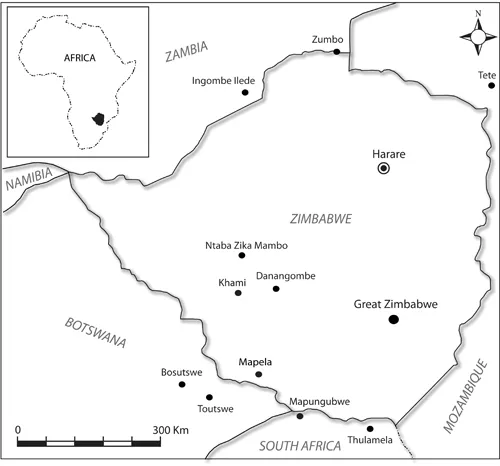
Figure 1.1 Map of Zimbabwe showing the location of Great Zimbabwe.
The study of Africa’s deep and recent histories through the discipline of archaeology and its outcomes played an important role in Africa’s fight for self-determination. Introduced as a tool and accessory of empire (Gosden 2012) to understand the lifeways of the colonised from the viewpoint of the colonisers in order to better govern natives (Fabian 2014), the discipline’s history is saddled with colonial and imperial baggage (Trigger 1989). During the colonial period, the practice and products of archaeology were the preserve of expatriate and settler Europeans and other Westerners (Shepherd 2002). Consequently, like anthropology, archaeology was, in the first instance, never meant for the consumption of the subjugated (natives knew themselves anyway!). The principal role of Africans was as informants whose primary function was to furnish labour, ethnographies, and oral traditions to assist expatriate anthropologists and archaeologists to better understand their kith and kin, and their history for the realisation of imperial objectives (Shepherd 2003; Chirikure et al. 2016). During the colonial period, the number of African archaeologists was very small, if not non-existent, making the study of the past through material and non-material remains exclusively a non-African affair. Neither was the resulting archaeological knowledge reviewed nor validated by locals (Chirikure et al. 2017a). Vividly, this suggests that the results of colonial archaeological research were mostly, if not solely, reserved for the settler community and those left at ‘home’ in the Global North. If archaeology is to be useful for improving destinies and the lives of the majority on the African continent, it must rid itself of imperialist and colonialist undercurrents and baggage (see Smith and Wobst 2004; Fontein 2006; Lane 2011; Pikirayi 2015; Schmidt and Pikirayi 2016; Manyanga and Chirikure 2017). It also must not continue to mimic colonial practices (Bhabha 1997; Ndoro 2001).
Amidst this irrelevance, the expectation was that the achievement of political independence in different African countries would produce a crop of local archaeologists with potential to apply insider knowledge and experiences to mint less colonial versions of the past that would improve the lives of people who live around archaeological sites and heritage (Garlake 1982; Ndoro 2001; Stump 2013; Ndoro et al. 2017). However, such an aspiration was never fully realised for two related reasons: first, most archaeologists of Western ancestry who worked in the colonial period continued with their practice in the postcolony as before, and never amended their post-African independence approaches to align with the concerns of the discipline with those of African communities. They deeply entrenched colonialist knowledge production structures that made them experts with knowledge (of others), superior to those of their subjects (host and African communities) (see Mignolo 2007; Ndlovu-Gatsheni 2013a; Todd 2020). Second, post-independence African archaeologists tended to opt for mimicry. Like their Western counterparts and mentors, they conformed to received epistemologies, and treated archaeology as an expert-only domain and scientific subject that ‘objectively’ studied material culture and other cultural behaviours temporally distanced from themselves, their own communities, their history, and their lived and shared experiences (Chirikure et al. 2017a; see also Fabian 2014). In so doing, they were captured and became complicit in the epistemic ‘heist’ (epistemicide – sensu Mignolo 2003; Ndlovu-Gatsheni 2013a), which denied coevality with their own experiences and further confiscated the past from, not only themselves, but also their own communities. Despite numerous calls to decolonise the African past, most postcolonial African and Africanist archaeologists have largely failed to produce locally relevant, usable, decolonial and decolonised versions of the past (Ndoro 2001; Fontein 2006; Chirikure and Pwiti 2008; Lane 2011; Pikirayi 2015; Schmidt and Pikirayi 2016). This may not be surprising because coloniality and its tendencies primarily govern, to a large extent, the concerns of archaeology and its arsenal of tools, interpretation frameworks, outcome narratives, and how they are published.
Consequently, there is need to decolonise mindsets (Wa Thiong’o 1986), practices, and theories (Schmidt and Pikirayi 2016; Manyanga and Chirikure 2017) to Africanise knowledge production and in the process dismantle legacies of coloniality (Ndlovu-Gatsheni 2013b). That way, the pendulum of archaeology knowledge production might swing constructively and positively, beyond mimicry, towards local relevance in the postcolony. Despite the fact that terms such as ‘decolonisation’, the search for ‘usable’ and locally relevant pasts, have become ‘flavours of the month’ in archaeology and African studies for the past couple of decades, there is no substantial difference in form and outcomes between the archaeology practised in colonial and postcolonial Africa. It appears as if archaeologists and allied researchers, while contending with applying labels such as ‘decolonisation’, are not matching words and terminology with real, transformative change on the ground. The consequence is that most African communities do not connect in any sense with expert archaeologists’ narratives about their pasts (Ndoro 2001; Chirikure et al. 2017a). Bluntly expressed, some orthodox archaeological narratives only satisfy the fancy of their propagators, the archaeologists, and not those of African communities who have their own narratives to go on (Ndoro 2001; Fontein 2006; Stump 2013; Chirikure et al. 2017a). This dissonance prompted Stahl (1996) to offer a manifesto suggesting that to avoid being parochial, African archaeology must take instruction from local ways of knowing and doing, and must also engage with wider fields such as African studies. Such a call, whose echoes reverberate across generations, provides inspiration to this work on Great Zimbabwe. To critically examine archaeology is not to challenge its worth as a discipline; rather, a critique fortified with solutions makes the subject even better and more relevant to wider audiences beyond academia.
This book deals with Great Zimbabwe (Figure 1.1), a place whose interpretation was previously ‘confiscated’ by some colonists, who ascribed it a Hamitic or Semitic origin (see Mauch 1874; Bent 1896; Hall 1905). As colonialism unfolded, however, the site in turn provided inspiration for the struggle for African independence. In the postcolony, Great Zimbabwe remains an essential symbol of African achievement (Matenga 2011). Nevertheless, the narrative is still dominated by archaeologists (including natives) and Africanist experts, with local voices, myths and legends remaining inaudible and invisible (Ndoro 2001; Fontein 2006). As a result, most prevailing postcolonial narratives about Great Zimbabwe are largely colonial in texture and complexion and are therefore in parts, out of sync with local beliefs, needs and expectations (Ndoro 2001; Fontein 2006; Chirikure et al. 2010; Matenga 2011).
As a step towards an alternative direction, the central thread that runs through the book is that it is not the colonially derived method of archaeology which is a concern; rather, the problem is with the colonial and mimicking nature in which remnants from the past are still being interpreted at Great Zimbabwe and beyond. The book attempts to demonstrate that studying Great Zimbabwe using native concepts and philosophies closes the distance – actual, symbolic, metaphoric, and otherwise – between local knowledge, local ways of doing, African communities, and narratives of the past developed for this important place. While beholden to disciplinary tools, and regardless of the colonial ancestry of African archaeology, this work attaches significance to African concepts to bui...
Table of contents
Cover
Endorsement
Half-Title
Series
Title
Copyright
Dedication
Contents
List of figures
List of tables
Foreword
Preface
Acknowledgements
Glossary of Shona concepts
PART I Learning, relearning, and unlearning Great Zimbabwe
PART II Objects, their context, and meaning
PART III Native cosmologies and ways of knowing
Index
Trusted by 375,005 students
Access to over 1.5 million titles for a fair monthly price.
Study more efficiently using our study tools.
Frequently asked questions
Yes, you can cancel anytime from the Subscription tab in your account settings on the Perlego website. Your subscription will stay active until the end of your current billing period. Learn how to cancel your subscription
No, books cannot be downloaded as external files, such as PDFs, for use outside of Perlego. However, you can download books within the Perlego app for offline reading on mobile or tablet. Learn how to download books offline
Perlego offers two plans: Essential and Complete
Essential is ideal for learners and professionals who enjoy exploring a wide range of subjects. Access the Essential Library with 800,000+ trusted titles and best-sellers across business, personal growth, and the humanities. Includes unlimited reading time and Standard Read Aloud voice.
Complete: Perfect for advanced learners and researchers needing full, unrestricted access. Unlock 1.5M+ books across hundreds of subjects, including academic and specialized titles. The Complete Plan also includes advanced features like Premium Read Aloud and Research Assistant.
Both plans are available with monthly, semester, or annual billing cycles.
We are an online textbook subscription service, where you can get access to an entire online library for less than the price of a single book per month. With over 1.5 million books across 990+ topics, we’ve got you covered! Learn about our mission
Look out for the read-aloud symbol on your next book to see if you can listen to it. The read-aloud tool reads text aloud for you, highlighting the text as it is being read. You can pause it, speed it up and slow it down. Learn more about Read Aloud
Yes! You can use the Perlego app on both iOS and Android devices to read anytime, anywhere — even offline. Perfect for commutes or when you’re on the go. Please note we cannot support devices running on iOS 13 and Android 7 or earlier. Learn more about using the app
Yes, you can access Great Zimbabwe by Shadreck Chirikure in PDF and/or ePUB format, as well as other popular books in History & African History. We have over 1.5 million books available in our catalogue for you to explore.