- 336 pages
- English
- ePUB (mobile friendly)
- Available on iOS & Android
eBook - ePub
The Biology of Particles in Aquatic Systems, Second Edition
About this book
The Biology of Particles in Aquatic Systems, Second Edition presents the latest information on particulate and dissolved matter found in aquatic habitats ranging from small streams to oceans. Only by studying this matter can we gain an understanding of the functioning of aquatic ecosystems and thus be able to predict changes that may occur as these systems become stressed. Updated and extensively revised, this new edition covers such topics as classification of particulate and dissolved matter, origin and formation of particles aquatic systems, factors affecting particle aggregation, methods for capturing particles by benthic and planktonic animals, and the use of particulate and dissolved organic matter as food.
Information
Chapter 1
The Classification of Particulate and Dissolved Matter
TABLE OF CONTENTS
I. Introduction
II. Approaches to Classification
A. Classification of Particles by Type
B. Classification of Particles by Size
C. Classification of Dissolved Matter
References
I. Introduction
In this chapter, I am not setting out to provide a definitive account of the classification of particulate and dissolved matter in water bodies: such a task is impossible at present. It is recognized that there is a need for a working system of classification so that quantities of material within categories can be compared both within and between locations, but there is considerable variety in the categories employed. Some areas (e.g., what the categories within dissolved organic matter should be) are especially problematical; others (e.g., the use of binomial classification of plants and animals) create much less debate, at least in general usage by nontaxonomists.
There are many reasons for classifying particulate and dissolved material, and these will vary according to the needs of each study and the measuring techniques which are employed. For example, a sedimentologist will use a different means of classification of particulate material than that of an organic chemist. In discussing particulate material, a decision must first be reached on a definition of a particle. To an atomic physicist, all material is particulate in that it consists of mixtures of subatomic particles, but this is not a helpful approach for aquatic scientists since we are not able to study this level in any practical way, nor would it be of value in helping us to understand the aquatic environment.
It has become a firm, and routinely applied, convention to define particulate material as that which is retained by a membrane filter with a pore size of 0.45 μm, material which passes in the filtrate being termed dissolved. This is useful as a working cutoff to separate “pools” of material, but it creates problems for anyone interested in the biology of particles since there is much particulate matter in the “dissolved” category (this topic is discussed further in Chapter 2). This material is not only of importance in the metabolism of aquatic communities, but may form a direct source of food for the biota, especially the microorganisms, some of which can themselves pass through membrane filters with a pore size of 0.45 μm.
II. Approaches to Classification
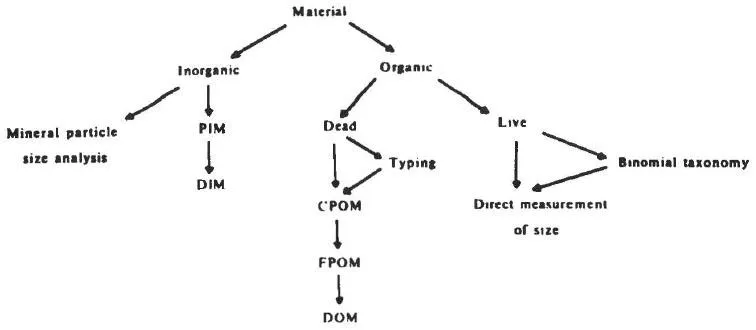
A simplified outline of a system of classification is given in Figure 1. Broadly speaking, particles are classified by type and/or by size; these approaches are considered further in the following sections.
A. CLASSIFICATION OF PARTICLES BY TYPE
An initial classification of particles can be made into those which are organic and those which are inorganic in origin. While this is a relatively easy process for particles of large size, there are considerable problems with those of smaller dimension, and their identification requires the use of analytical techniques which are much too time consuming for most studies, or which are not applicable to samples in bulk. A further problem is how to classify particles which are inorganic but which were produced as a result of secretion by animals and plants (e.g., diatom frustules and fragments thereof). Inorganic particles can be classified into the mineral type to which they belong (e.g., whitings [calcite], sand grains [silicates]). This is of interest to sedimentologists as this will have a profound effect on the type of rock strata which are produced on compression of the sediments. Biologists do not usually classify inorganic particles in this way but are interested in their functional role, e.g., as substrata for burrowing, as material for tube building, as sites for the development of organic coatings, and as material which can be ingested.
Organic particles can be subdivided into those that are living and those that are dead. Whole, and nearly whole, organisms of both categories are identified using the binomial system of classification, which provides a widely acceptable typing. This is easy to describe in theory but less easy to conduct in practice; for example, the taxonomy of some groups can be difficult and, where large numbers of particles are involved, time will often preclude accurate identification of all items. It is also difficult to identify small organisms unless staining procedures are followed, or some other means of rapid identification is employed, e.g., growth of bacteria on nutrient plates.
Dead organic particles are fragments of animals, plants, and microorganisms, and these present a more difficult problem to anyone attempting classification by type. Where the origins are known it is relatively easy, but many particles have only a hint of the living form and are thus difficult to type. These are usually assigned to the category “detritus”. It is often possible to categorize detritus particles as coming from plants or animals. Some methods for the classification of particles according to their origins are given in Chapter 3. Methods for the analysis of the chemical constituents of particles are described in Chapter 2.
Recently, attempts have been made to identify particles formed by the aggre...
Table of contents
- Cover
- Half Title
- Title Page
- Copyright Page
- The Editor
- General Introduction
- Contributors
- Table of Contents
- Chapter 1. The Classification of Particulate and Dissolved Matter
- Chapter 2. Sampling and Analysis of Particulate and Dissolved Matter
- Chapter 3. Origin and Formation of Organic and Inorganic Particles in Aquatic Systems
- Chapter 4. Physico-Chemical Factors in Particle Aggregation
- Chapter 5. Seasonal and Diel Changes in Particulate and Dissolved Organic Matter
- Chapter 6. Dynamics of Particulate and Dissolved Organic Matter over the Substratum of Water Bodies
- Chapter 7. The Dynamics of Surface Microlayers in Aquatic Environments
- Chapter 8. Methods for Capturing Particles in Benthic Animals
- Chapter 9. Zooplankton Particle Selection and Feeding Mechanisms
- Chapter 10. Particulate and Dissolved Organic Matter as Food
- Chapter 11. The Functional Significance of Selection of Particles by Aquatic Animals
- Index
Trusted by 375,005 students
Access to over 1.5 million titles for a fair monthly price.
Study more efficiently using our study tools.
Frequently asked questions
Yes, you can cancel anytime from the Subscription tab in your account settings on the Perlego website. Your subscription will stay active until the end of your current billing period. Learn how to cancel your subscription
No, books cannot be downloaded as external files, such as PDFs, for use outside of Perlego. However, you can download books within the Perlego app for offline reading on mobile or tablet. Learn how to download books offline
Perlego offers two plans: Essential and Complete
- Essential is ideal for learners and professionals who enjoy exploring a wide range of subjects. Access the Essential Library with 800,000+ trusted titles and best-sellers across business, personal growth, and the humanities. Includes unlimited reading time and Standard Read Aloud voice.
- Complete: Perfect for advanced learners and researchers needing full, unrestricted access. Unlock 1.5M+ books across hundreds of subjects, including academic and specialized titles. The Complete Plan also includes advanced features like Premium Read Aloud and Research Assistant.
We are an online textbook subscription service, where you can get access to an entire online library for less than the price of a single book per month. With over 1.5 million books across 990+ topics, we’ve got you covered! Learn about our mission
Look out for the read-aloud symbol on your next book to see if you can listen to it. The read-aloud tool reads text aloud for you, highlighting the text as it is being read. You can pause it, speed it up and slow it down. Learn more about Read Aloud
Yes! You can use the Perlego app on both iOS and Android devices to read anytime, anywhere — even offline. Perfect for commutes or when you’re on the go.
Please note we cannot support devices running on iOS 13 and Android 7 or earlier. Learn more about using the app
Please note we cannot support devices running on iOS 13 and Android 7 or earlier. Learn more about using the app
Yes, you can access The Biology of Particles in Aquatic Systems, Second Edition by Roger S. Wotton in PDF and/or ePUB format, as well as other popular books in Biological Sciences & Ecology. We have over 1.5 million books available in our catalogue for you to explore.