- 300 pages
- English
- ePUB (mobile friendly)
- Available on iOS & Android
eBook - ePub
About this book
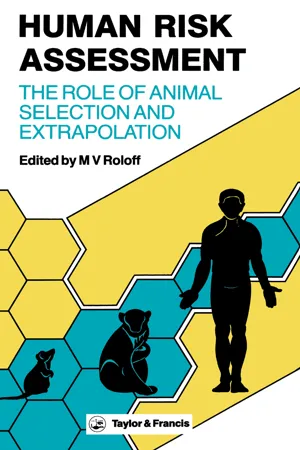
This book explores the factors which are critical in the selection of an appropriate animal species for toxicology studies and the subsequent extrapolation of the data to humans. It provides some future directions for risk assessment activities at the Environmental Protection Agency.
Information
PART 1
Current industrial practices and regulatory status of animal selection and extrapolation
Section editor:
F. A.Ruecker
Current EPA perspectives on animal selection and extrapolation
Richard N. Hill
Office of Pesticides and Toxic Substances, Environmental Protection Agency, Washington, DC 20460, USA
Certain Federal regulatory agencies, including the Environmental Protection Agency (EPA), are charged with the evaluation of chemical safety. Under two of the statutes at the EPA – the pesticides and toxic substances acts – companies are required to submit data on chemical substances for review. The bulk of toxicity information is generated in experimental animals, and then used to assess risks from exposure to humans.
A number of considerations arise as to the selection of animals for testing and the nature of test protocols, as well as the way the data will be analysed to estimate the consequences of potential human exposure. This chapter will briefly review these topics and indicate some future directions for risk-assessment activities at EPA.
Testing guidelines
Industrial groups that provide data to the EPA have for a long time requested that the Agency develop testing guidelines for evaluating chemical toxicity. As a consequence, the Agency proposed guidelines in the late 1970s, and following extensive public hearings and written comments, final protocols were published in 1982 (EPA, 1982a, b). Testing guidelines are not viewed as being static; instead, modifications and additions are made from time to time. For instance, in 1984 the pesticides and toxic substances programmes announced changes in the acute toxicity testing protocols that would help minimize the use of experimental animals, yet maximize the amount of information gained from them. In future years it is expected that many more changes of this nature will occur that will reduce or obviate animal usage.
Each EPA guideline names the animal species for consideration and often gives a preferred species. Critics have claimed that the Agency is too limited in its specification of animals for testing; let us investigate this claim.
Choice of animal species in the guidelines has been based on numerous factors, among them purchase cost, husbandry requirements, size, lifespan, characterized genetic and developmental history, and knowledge of historical control records. As an example, in the 90 d subchronic study, our guidelines specify testing in a rodent and non-rodent species, preferably the rat and the dog. In fact the opportunity exists to select among a variety of species, as long as one chooses among commonly used laboratory strains. Selection of a given species is further illustrated by the metabolism guideline. Although the rat is identified as the preferred species, it states that preliminary testing in several species may be attempted to get some idea of comparative metabolic patterns which, upon occasion, may aid in selection of species for subsequent toxicity testing.
The EPA’s general policy is that alternative animal selection is possible. Guidance and preference are provided in the guidelines without specification of the animals to be used. The protocols state that various mammals may be chosen for testing as long as there is justification for selecting that species. People are encouraged to come to the Agency before testing to discuss issues of animal selection and test design.
A few examples help to illustrate that animal selection can be based on scientific appropriateness:
1. In the pesticide programme a chemical was shown to produce adverse effects in a rat reproduction study. Metabolism information on this agent indicated that the rat did not metabolize the compound as did humans. Therefore, we asked for testing in a mammalian species that handled the chemical like humans did.
2. In the toxic substances programme, the teratology test rule for acetonitrile called for the hamster instead of the rat or rabbit – the preferred species in our test guideline – because other nitriles had demonstrated adverse effects in the hamster.
3. In the EPA testing programmes, in-depth evaluation of existing chemicals frequently results in requesting tests that are not part of our existing guidelines. In these cases, animal selection and test protocol development need to be determined on a case-by-case basis.
In summary, then, the EPA has developed test guidelines that identify mammalian species and often name those that are preferred. Modifications in animal selection can and should be considered; we ask that any deviations be accompanied by a scientific rationale. Agency practice demonstrates that modifications occur, and we encourage companies to confer with Agency scientists about such changes before testing commences.
Risk assessment
The EPA has proposed a set of risk-assessment guidelines for cancer, the evaluation of chemical exposure, mutagenicity, developmental toxicity, and complex mixtures (EPA, 1984a, b, c, d, 1985). The guidelines indicate the methods the Agency will take to assess data for potential toxicity to humans, potential human exposure and the potential risks from exposure to such agents.
The guidelines stress the appropriateness of the animal model to the human condition. For a fall-back strategy, when we lack such information, we use the most sensitive animal. In a similar manner, in the absence of data on interspecies differences we scale carcinogenic effects among species on a weight per body surface area basis.
Future directions
Progress has been made over the past few years in the area of risk assessment, and the future looks even brighter. There are many exciting developments today that will greatly enhance our ability to make judgements about chemical safety. We are moving from a stage of phenomenology – chemical in and toxic effects out – to one where there is much more regard for mechanism of toxic action. Many current discussions revolve around topics of peroxisome proliferation, free-radical formation and the like. The Agency is currently embarking on a review of carcinogenic effects that seem to result from inhibition of a physiological endocrine-feedback l...
Table of contents
- Cover
- Title Page
- Copyright Page
- Contents
- Preface
- Acknowledgements
- Contributors
- Animal selection and extrapolation - the problem defined
- Part 1. Current industrial practices and regulatory status of animal selection and extrapolation
- Part 2. Use of physiological and toxicological data from man and animals as aids in animal selection and extrapolation
- Part 3. Metabolic and pharmacokinetic considerations in species selection
- Part 4. Animal selection considerations in carcinogenic and reproductive toxicity
- Part 5. Pharmacogenetic and human monitoring considerations in animal selection
- Summary
- Index
Trusted by 375,005 students
Access to over 1.5 million titles for a fair monthly price.
Study more efficiently using our study tools.
Frequently asked questions
Yes, you can cancel anytime from the Subscription tab in your account settings on the Perlego website. Your subscription will stay active until the end of your current billing period. Learn how to cancel your subscription
No, books cannot be downloaded as external files, such as PDFs, for use outside of Perlego. However, you can download books within the Perlego app for offline reading on mobile or tablet. Learn how to download books offline
Perlego offers two plans: Essential and Complete
- Essential is ideal for learners and professionals who enjoy exploring a wide range of subjects. Access the Essential Library with 800,000+ trusted titles and best-sellers across business, personal growth, and the humanities. Includes unlimited reading time and Standard Read Aloud voice.
- Complete: Perfect for advanced learners and researchers needing full, unrestricted access. Unlock 1.5M+ books across hundreds of subjects, including academic and specialized titles. The Complete Plan also includes advanced features like Premium Read Aloud and Research Assistant.
We are an online textbook subscription service, where you can get access to an entire online library for less than the price of a single book per month. With over 1.5 million books across 990+ topics, we’ve got you covered! Learn about our mission
Look out for the read-aloud symbol on your next book to see if you can listen to it. The read-aloud tool reads text aloud for you, highlighting the text as it is being read. You can pause it, speed it up and slow it down. Learn more about Read Aloud
Yes! You can use the Perlego app on both iOS and Android devices to read anytime, anywhere — even offline. Perfect for commutes or when you’re on the go.
Please note we cannot support devices running on iOS 13 and Android 7 or earlier. Learn more about using the app
Please note we cannot support devices running on iOS 13 and Android 7 or earlier. Learn more about using the app
Yes, you can access Human Risk Assessment by M V Roloff in PDF and/or ePUB format, as well as other popular books in Medicine & Medical Theory, Practice & Reference. We have over 1.5 million books available in our catalogue for you to explore.