This volume comprises a curated conversation between members of the Material Culture Section of University College London Anthropology. In laying out the state of play in the field, it challenges how the anthropology of material culture is being done and argues for new directions of enquiry and new methods of investigation. The contributors consider the ramifications of specific research methods and explore new methodological frameworks to address areas of human experience that require a new analytical approach. The case studies draw from a range of contexts, including digital objects, infrastructure, data, extraterrestriality, ethnographic curation, and medical materiality. They include timely reappraisals of now-classical analytical models that have shaped the way we understand the object, the discipline, knowledge formation, and the artefact.
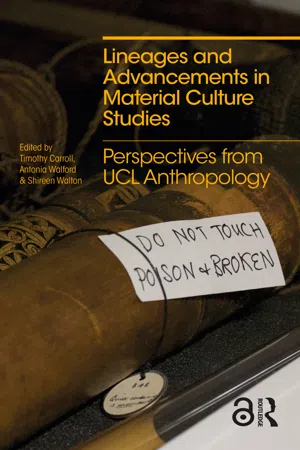
eBook - ePub
Lineages and Advancements in Material Culture Studies
Perspectives from UCL Anthropology
- 282 pages
- English
- ePUB (mobile friendly)
- Available on iOS & Android
eBook - ePub
Lineages and Advancements in Material Culture Studies
Perspectives from UCL Anthropology
About this book
Information
1Introduction
Timothy Carroll, Antonia Walford, and Shireen Walton
Taking insight from the wisdom of Marie-Jeanne Rose Bertin, who – as Marie Antoinette’s dressmaker – cautioned, ‘There is nothing new except what has been forgotten,’ this volume is in part a project in highlighting how the lineages of thought and methodological approach in Material Culture Studies (henceforth MCS) produce the anthropology of material culture as it stands today. These advancements in MCS, represented in the chapters, take a number of forms. Some of the chapters are explicitly position pieces, challenging how anthropology of material culture is currently being done, and arguing for new directions of enquiry or new methods of investigation. Other chapters advance new typologies of objects or take old theories into new areas. Many of the chapters explore the ramifications of specific methods and offer new methodological frameworks to address areas of human experience that demand a new or reimagined analytical approach. While the scale of investigation, and the types of object in question, vary widely across the collection, five key themes emerge around a reconsideration of what the object is. These five themes – concerning the self and personhood, temporality, scales and topology, representation, and participation – draw the object into sharp relief, as an anthropological imperative, and allow us to explore the role the object plays as both a topic of study and an ongoing source of research questions within the anthropological project.
However, the advancements that this book proposes must be understood in relation to what has come before. In framing this book as a stage in a long conversation that is happening within the research group at University College London Anthropology, it is helpful to have a brief account of how that conversation has been shaped so far. There are many ways to retell this history and lineage of MCS, and important contributions to this genealogy have been given by the editors of the Journal of Material Culture (Miller and Tilley 1996), Mike Rowlands (1983), Victor Buchli (2002a), Daniel Miller (2005b), Christopher Tilley (2006), Dan Hicks and Mary Beaudry (2010), Paul Basu (2013) and Haidy Geismar et al. (2014), amongst many others. Our intention in this volume is not, however, to produce another genealogy of MCS for introductory context-setting purposes. Rather, the volume illustrates how the historical foundations of MCS – or what we, the editors, call ‘lineages’ – are central to current and nascent work in the field. By making explicit how these lineages have developed within UCL, we are situating the ‘advancements’ in theory and method put forward in this volume, not in terms of wheels re-invented, but by recognising that the epistemological foundations of MCS allow us to explore very old discourses in light of new phenomena, and to reconsider classic frameworks within new contexts. Each of the chapters actively engage with an epistemology of the lineages and, through this, advancements in various directions are made. In this Introduction, we first offer an overview (albeit brief) of how MCS has developed at UCL and then turn to the five themes that the volume addresses.
MCS at UCL, its foundations and threads
In establishing the Journal of Material Culture in 1996, the editors opened the first issue with an editorial that made the case that material culture studies is an undisciplined field of study. In framing it in this manner, they highlighted the intellectual freedom gained by drawing from multiple disciplinary insights and methodological approaches. There were no certain ancestors to whom homage must be paid, and no need to guard the borders of disciplinary territory. Nonetheless, in this Introduction we argue that there are strong lines of influence that have shaped how the research group at UCL Anthropology (who, notably, are the managing editors of the Journal of Material Culture) has come to claim, and maintain, that undisciplined nature (see also Hicks and Beaudry 2010 and Basu 2013 in this regard).
In founding the Anthropology Department at UCL in 1947,1 Cyril Daryll Forde drew upon his own multidisciplinary training – first in Geography and then in Ethnology – as well as important work being done at the time at the University of London on physical Anthropology (in Anatomy) and material culture as technology (in various collections). Being trained in Ethnology in the United States, under Alfred Kroeber and Robert Lowie, Forde’s ethnographic method was also heavily influenced by Linguistic Anthropology. While Forde rejected the social theories associated with the anatomical studies at the time, he insisted on the study of physical anthropology, and the human relation to material technology, as core to the anthropological project. This broad, interdisciplinary position set him at odds with the dominant school of Social Anthropology at the time, following Bronisław Malinowski, at the London School of Economics (LSE).
Malinowski’s interest in the object was limited to its social function and role within the broader context of meaning (Young 2000; Bell and Geismar 2009), and was marked by an ‘indifference to structural problems,’ giving too little detail to ‘significant structure’ (Lévi-Strauss 1963: 132; cf. Mosko 2013, though see Basu 2013 for a defence of Malinowski’s influence in material culture studies). For his part, Forde maintained that the study of the material basis for humanity was vital. In his book Habitat, Economy and Society, he is concerned with cultural difference and social change, investigating both diffusion and the ‘functional relations’ that ‘any element [of civilisation] plays in the life of a people’; he argues that, ‘These active cultural factors operate on the relatively static materials of race and physical environment,’ but require ‘a fairly full and balanced picture of actual peoples’ to be understood (Forde 1963[1934]: 8).
In 1962, Forde appointed Peter Ucko to help develop the study of technology within the department. For his part, Ucko framed this primarily in terms of art, having studied Near Eastern anthropomorphic figurines during his doctoral research, carried out at UCL. This emphasis on the visual and formal elements of art objects was part of wider interest at the time, such as by those such as Anthony Forge at the LSE. It was Ucko who started using ‘material culture’ in its present sense, that is, the study of the relationship between people and things irrespective of time and space. This was a movement away from specific contexts of historical study in museums or by archaeologists of the distant past and critiquing the ethnographic study of material culture for its overarching concern for categorisation of morphological classification. Concurrently, different groups at other research institutions developed different emphases within MCS, some – such as that at the School of Anthropology and Museum Ethnography at the University of Oxford – maintaining and developing the centrality of museums in MCS. For his part, Ucko broadens the remit of MCS, and argues that ‘the study of human artefacts can act as a bridge between most other aspects of anthropology’; moving outside the museum, he sees the study of material culture as central to ‘the future development of anthropology as an integrated academic subject’ (1969: 28). In the comparative project that he undertakes, in his 1969 Curl Lecture, Ucko highlights the fact that as material culture data is manufactured artefacts, comparison can be done regardless of the specific time of origin (ibid.: 29).
Students of Anthony Forge and Peter Ucko – notably Francis and Howard Morphy, Robert Layton, and Alfred Gell – took forward their interest in material culture as related to the anthropology of art. This group of scholars was also heavily influenced by French structuralism and American symbolic anthropology and, during this period, in the 1960s, the core elements of material culture studies at UCL were established. This can be characterised by a central focus on the object, especially the importance of visual art – and later the image more broadly, an interest in technology, the environment, and archaeological insight into landscape and the contemporary past.
It is also in this period – and especially into the 1970s and 1980s (Hicks 2010) – that a growing interest in structuralism and Marxism shaped the kind of ethnographic work being done. Students of the department, such as Mike Rowlands (1984), responded to the wider Marxist interest in social anthropology, moving emphasis away from the functionalist interest on the object and its uses in favour of wider examination of the processes and modes of production by which they were formed. This gave rise to sustained attention to the means by which objects are made, and the social and historical influences of production, but has been fundamentally shaped by the longer history, especially in francophonic, ethnography and theory on technique (e.g. Lemonnier 1986, 1992; Leroi-Gourhan 1971[1943], 1973[1945]; Mauss 1973[1935]).
In the 1980s, Daniel Miller, trained in Archaeology and Anthropology at Cambridge, joined the research group and brought with him an interest in the work of Georg Wilhelm Friedrich Hegel, Karl Marx, Nancy Munn, and Georg Simmel. In his reading of Hegelian dialectics, Miller (1987) was able to help frame a theory of objectification that sought to overcome the subject/object dualism and open material culture studies to examination of how ‘things make people as much as people make things’ (2009). Miller’s interest in the ‘humility of the thing’ (1987:85ff) also helped bring attention to mundane objects, at the same time as a similar move in culture studies (e.g. Hebdige 1988), that maintained the comparative empirical method of ethnographic enquiry.
In the 1990s, the research group was expanded, incorporating more of an archaeological influence from Cambridge, with the addition of Chris Tilley and Victor Buchli – both students of Ian Hodder. This expanded the already important work on landscape and the built environment by the likes of Barbara Bender (1998). Tilley’s work drew upon the post-processual school of archaeology, with a strong emphasis on phenomenology in dialogue with structuralism (1974, 1996). With his interest in architectural forms and archaeology of the recent past, Buchli’s work opened up new attention to the home (2013), as well as immateriality and decay (2017).
In this same period, two students of Alfred Gell at the LSE, first Susanne Küchler and then later Christopher Pinney, brought new approaches to the anthropology art and visual culture. Küchler’s work on malanggan mortuary statues, and later textiles, proved an important means to rethink the relations between persons and objects, specifically in terms of the role of object as extensions of thought (Küchler 2002; Küchler and Eimke 2009). Pinney’s interest in the image, and the bodily responses they evoke, has brought new perspectives concerning the phenomenology of aesthetics and the localisation of global practices, such as photography (1997, 2004).
The shape of the research group, has had, as one sees when reviewing this history, strong influence from the perspectives of Anthropology of Art at the LSE and Archaeology from Cambridge, as well as the close institutional affiliation, shared teaching and use of the Ethnographic Collections with Archaeology at UCL. In this light, the undisciplinedness of material culture studies, as expressed by Daniel Miller and Christopher Tilley (1996), may be seen in contrast to the stronger (and older, more well-established) schools of thought represented at the institutions from which many of the core members of the research group had come. For its strengths, the Malinowskian tradition of anthropology has, nonetheless, replicated some of his own shortsightedness (Mosko 2013), and, as Tilley has shown (1991, 1994, 1999), MCS affords a much greater interdisciplinary reach than is common to archaeology. Whereas Miller and Tilley made the comparison to language which, while a broad phenomenon has found a home in its own dedicated discipline, may be the better comparison is to Conservation which, drawing from a range of discrete disciplines, benefits from a broad and unifying umbrella. As the Department of Anthropology and Conservation at Kent (or indeed the Human Ecology Research Group at UCL) demonstrates, the holism of sociocultural anthropology allows for this multi- or undisciplined area of study to flourish.
In the breadth of attention to various kinds of objects and technology, the emergence of new genres of objects – such as seen in digital devices and digital objects – gave rise to a new area of research focus, in the establishment of the digital anthropology research group as part of wider MCS. In establishing the new area of study, Miller was joined by a series of people working on various aspects of digital media, e-communications, and earth observation, who have each brought widening perspectives and interdisciplinary backgrounds. At present, this group includes Haidy Geismar, Hannah Knox and Antonia Walford. While ‘the digital’ in its broad sense can be read as a problematisation of material culture, in its claim to ‘virtuality’ and ‘immateriality,’ the fact of the matter is the digital is simply another genre of material culture and, while at times marked by ephemerality, it is also deeply reliant upon established infrastructures of the built environment and articulated within human practice as a material entity with which to engage. For example, drawing on a background in critical museum studies, intellectual property rights, and photography in anthropology, Geismar’s exploration of the practices of digitalisation in museum and archive settings interrogates the continuity of the normativities built into digital architecture within the virtual spaces of digital collections (2018). Knox’s work on roads and hard infrastructure has led to new research pathways in digital infrastructure and ‘smart’ technology developed out of an interest in the politics of material – such as roads and concrete – and implicitly carries forward Forde’s interest in the economy of the material environment and the technological adaptation within a given ecology. Similarly, Walford’s training in the intersection of STS and anthropology of science has led to ongoing research in technology and observation from a relational perspective, shifting from the visual object to rather consider the emergence of new knowledge economies of digital metrics and data, and their social and political efficacy.
Taken in this light, the material culture research group at UCL has had a consistent focus on the object, particularly within the framework of visual art and technology, broadly conceived. This tradition set down by Daryll Forde, has continued through the subsequent generations of the research group. The original engagement around art between Ucko and Forge has continued through students of Forge and Gell, and the original close relationship between archaeology and the research group exemplified in the work of Ucko has been a constant element as well.
In the recent years, as new members of the group have been added – most of whom are represented as contributors in this volume – the central interest in the social roles and implications of the object, the relational capacity of the artwork and the importance of technology and material environment, has continued as important influences. Several different research agendas and pedagogical initiatives have emerged over the last decade that demonstrate the enduring importance of these themes for MCS more broadly. Ludovic Coupaye has developed a research programme around the role of technology drawing on French theorists, often overlooked in anglophone academia, and draws upon his formal training in art history and archaeology to examine the practices and techniques enacted upon and demanded by the object in order to deconstruct the category of ‘technology’ and its sociopolitical role in both public and academic discourse. Adam Drazin’s focus on Design Anthropology brings together classic interests of MCS, such as attention to the form of the object or engagement with the aesthetic qualities of materials, critically examining how academic scholarship is instrumentalised within design contexts, and examining how dialogue with public and private sector institutions around issues such as aging, mobility, and the home can bring new anthropological insight.
It is also worth highlighting that alongside the permanent members of the research group mentioned so far, there is a group of early-career research and teaching fellows. In many cases these have been brought into the group as part of European Research Council grants led by Miller, Pinney, or Buchli, or they have been hired to help support the teaching of MCS within the department. Those included in this volume (Carroll, Jeevendrampillai, Reese, Schacter, and Walton) were in the group as of summer 2018, when the collection began to be collated; alongside these, Delphine Mercier, who is the Collections Curator of the UCL Ethnography Collection, also supports teaching and the intellectual project of object-oriented study within the group. Within this new generation (four of whom completed their PhDs in the research group), the idea of ‘un-disciplined’ MCS was a core defining mark of the kind of anthropology to pursue. This has become something of a self-fulfilling prophecy, as the research trajectories being developed (most explicitly in this volume seen in Schacter’s contribution) push in directions and develop methods of that undisciplined nature. It is an undisciplinedness, however, that is still marked by an interest in collections, museums, visual media, and technology.
Whether this continuity within the tradition established by Forde and Ucko is an intentional act of design or an accident of interest within the wider field is obviously debatable, but it is our contention that this consistency is at the heart of the research group’s capacity to generate innovative research within the broader movement back to ‘materiality,’ seen across many disciplines within the humanities and the social sciences. This tension between the foundational approach to objects in the work of Forde and Ucko, and the new forms of material culture that confront us as scholars of MCS, gives the contributions to this volume a specific inflection. The chapters in this book demonstrate the importance of a relational approach to the object, and how placing objects at the centre of our analyses allows the reimagining of a range of fundamental aspects of social life, such as personhood, temporalities, scales, representation, and politics. The challenge of re-theorising the object and materiality in this way lies in staking out new conceptual territory that does not return us to the deterministic and reductionist perspectives of evolutionists, but draws on lineages of MCS that allow objects, artefacts and materials their full range of social and cultural possibilities and efficacies.
Over the last few decades, the ‘material turn,’ broadly conceived, has converged around a move away from representationalism and semiotics and to a rejuvenated interest in teasing out the affordances of materials and materialities.2 This has been done in different conceptual languages and using different intellectual coordinates, from tracing out object biographies to attending to the physical attributes of images, to a focus on the political materiality of infrastructural systems. However, their convergence indicates a shared commitment to re-theorising the constitutive role of the object in social life in a way that does not reduce objects to inert vessels in human semiotic systems. The chapters in this book all take on this challenge in different ways and, in so doing, push the discipline of MCS in new and exciting directions. Unlike other approaches in MCS that have also taken on this challenge, such as ‘new materialism’ (see for example Barad 2007; Bennett 2010; Braidotti 2013), the authors assembled in this volume do not seek to redefine the material world in terms of vitalism, so much as work through rich ethnographic material in order to propose a framework for how the obj...
Table of contents
- Cover
- Half Title
- Title Page
- Copyright Page
- Contents
- List of figures
- List of tables
- List of contributors
- Preface
- Acknowledgements
- 1 Introduction
- 2 Extraterrestrial methods: Towards an ethnography of the ISS
- 3 Being, being human, becoming beyond human
- 4 ‘Things ain’t the same anymore’: Towards an anthropology of technical objects (or ‘When Leroi-Gourhan and Simondon meet MCS’)
- 5 The object biography
- 6 A new instrumentalism?
- 7 Objects of desire: Sexwork and its objects
- 8 Digital devices: Knowing material culture
- 9 Rethinking objectification and its consequences: From substitution to sequence
- 10 Looking at things
- 11 Making things matter
- 12 Prophetic pictures: Or, What time is the visual?
- 13 Held in Amma’s light: The enchantment and political efficacy of gopurams in Tamilnadu
- 14 A curatorial methodology for anthropology
- 15 Data aesthetics
- 16 Place-objects: Anthropology of digital photography/s
- Bibliography
- Index
Trusted by 375,005 students
Access to over 1.5 million titles for a fair monthly price.
Study more efficiently using our study tools.
Frequently asked questions
Yes, you can cancel anytime from the Subscription tab in your account settings on the Perlego website. Your subscription will stay active until the end of your current billing period. Learn how to cancel your subscription
No, books cannot be downloaded as external files, such as PDFs, for use outside of Perlego. However, you can download books within the Perlego app for offline reading on mobile or tablet. Learn how to download books offline
Perlego offers two plans: Essential and Complete
- Essential is ideal for learners and professionals who enjoy exploring a wide range of subjects. Access the Essential Library with 800,000+ trusted titles and best-sellers across business, personal growth, and the humanities. Includes unlimited reading time and Standard Read Aloud voice.
- Complete: Perfect for advanced learners and researchers needing full, unrestricted access. Unlock 1.5M+ books across hundreds of subjects, including academic and specialized titles. The Complete Plan also includes advanced features like Premium Read Aloud and Research Assistant.
We are an online textbook subscription service, where you can get access to an entire online library for less than the price of a single book per month. With over 1.5 million books across 990+ topics, we’ve got you covered! Learn about our mission
Look out for the read-aloud symbol on your next book to see if you can listen to it. The read-aloud tool reads text aloud for you, highlighting the text as it is being read. You can pause it, speed it up and slow it down. Learn more about Read Aloud
Yes! You can use the Perlego app on both iOS and Android devices to read anytime, anywhere — even offline. Perfect for commutes or when you’re on the go.
Please note we cannot support devices running on iOS 13 and Android 7 or earlier. Learn more about using the app
Please note we cannot support devices running on iOS 13 and Android 7 or earlier. Learn more about using the app
Yes, you can access Lineages and Advancements in Material Culture Studies by Timothy Carroll, Antonia Walford, Shireen Walton, Timothy Carroll,Antonia Walford,Shireen Walton in PDF and/or ePUB format, as well as other popular books in Social Sciences & Anthropology. We have over 1.5 million books available in our catalogue for you to explore.