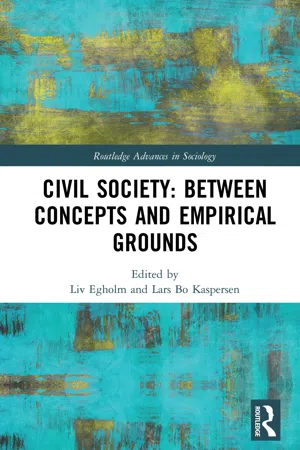
Examining the historical and social trajectories involved in the continuous development of civil society, this volume reveals the contextual nature of the process. Through empirical studies focusing primarily on Denmark and covering the period from 1849 to the present day, it analyses the manner in which civil society has been practised and transformed over time. Presenting a new theoretical framework informed by a relational and processual perspective, the book sheds new light on familiar questions pertaining to civil society, the production of its boundaries and spaces of action, and the means by which these spaces can become causal factors. A fresh intervention in the study of a concept that has been central in defining ideas of solidarity and the common good, and to which researchers and politicians look for solutions to the great challenges of our time, Civil Society: Between Concepts and Empirical Grounds will appeal to scholars of sociology, politics, history and philosophy with interests in civil society.
eBook - ePub
Civil Society: Between Concepts and Empirical Grounds
- 206 pages
- English
- ePUB (mobile friendly)
- Available on iOS & Android
eBook - ePub
Civil Society: Between Concepts and Empirical Grounds
About this book
Information
Part 1
Setting the Scene
1 A processual-relational approach to civil society
Introduction
Civil society appears to us as a theoretical, empirical, and normative category. It is infused with meanings that help us to understand the potential of past, current, and future societies. In the literature and in society, civil society is perceived as a privileged place of emancipation, solidarity, social coherence, democracy, and civilizing forces—a locus of the common good. As such, the concept has been heavily disputed by researchers and politicians, and it was recently singled out by the UN Sustainable development goals (SDG) as one of the most significant spaces of action to solve the grand challenges of our time. Since the actualization of the modern state in the nineteenth century, scholars and intellectuals have been scrutinizing and debating the nature of civil society’s shifting tides, as well as its role and placement vis-a-vis the delineation of state, market, and family. The literature on civil society has an immense influence also on how the state and market are and have been conceptualized throughout time. By the same token, the concept elucidates which questions are essential to raise and answer about societal organization, democracy, capitalism, secularism, citizenship, and many other key historical developments—not to mention the defining impact this literature has had on the idea of solidarity and the common good in our societies.
The conceptualization of civil society as one of three sectors in society (state, market, and civil society) has become widely used in civil society research. It can be grouped under an umbrella that we label the “sector perspective.” This perspective has helped to analytically characterize each sector and, in particular, establish civil society as a space for the common good, democratization, emancipation, and political critique. Still, the sector perspective also has some severe inherent limitations when it comes to its explanatory and analytical strength. Through a processual-relational approach, the book will open up fruitful lines of inquiry by exploring theoretical and analytical ways to meet these limitations. In so doing, the book will advance new ways of theorizing, investigating, and discussing the role of civil society in past, present, and future society—as well as its ramifications for identifying different questions and potential answers to the role civil society has played, currently plays, and potentially can play in order to solve the grand challenges of our time.
This chapter has three parts. The first will set the scene by identifying the origin of the sectoral perspective in the 1980s, emphasizing its three main limitations: (1) infusing empirical analysis with strong normative assumptions; (2) employing an a priori definition of civil society; and (3) presuming a rigid dichotomization between civil society and the state. These limitations come to the fore in different ways within the two most dominant traditions in civil society research: the first concerned with the values of civil society, the second with the organizations and institutions of civil society. The second part reviews new strands in present scholarship on civil society, identifying three currents with potential to disentangle civil society research from the limits of the sector perspective: (1) avoiding an a priori definition of civil society; (2) reshaping the unit of analysis; and (3) emphasizing the (historical) processes of defining, performing, and practicing civil society. The third part advances these currents and paves the way forward for a processual-relational approach to understanding civil society at large. This part also links the chapters together and shows how reiterations of inquiries and delineations within multiple temporalities take an active part in the production of civil society in past, present, and future societies.
Setting the scene
Civil society from a sector perspective
The 1980s saw the concept of civil society resurface in the language of Eastern European dissidents, Western political actors, and researchers alike (Arato, 1981; Arato & Cohen, 1988; Gouldner, 1980; Keane, 1988). Even though its relevance was fiercely debated (e.g. Bryant, 1993, 1994; Kumar, 1993, 1994), its prevalence reflected a need for new perspectives on social movements, activism, voluntarism, democracy, and political grassroots. The concept should encompass the widespread experiences of groups that could influence and act democratically in undemocratized countries and create radical and enduring societal change. The collapse of the communist regimes in the USSR and Eastern Europe prompted the assumption that liberal democracy, as it had developed in many parts of the Western world, would be the only legitimate and possible model of governance for the future. Following these developments, “civil society” was deemed to be not only a transformative agent towards liberty and a particular liberal democracy, but also an essential bulwark against the state.
As a result, myriad research from various disciplines concerned with civil society and democracy flourished. In 1992, the concept was further revitalized in Cohen & Arato’s book on civil society, Civil Society and Political Theory. This book stands out as one of the most significant from that period, providing a comprehensive and theoretically sophisticated analysis of civil society, drawing from empirical experiences throughout the developments in Eastern European countries and authoritarian regimes. It firmly links the privileged place of critique and the producer of alternative life-forms to democratization initiatives and voluntary associations, placed outside both state and market. Cohen & Arato gave voice to a new understanding of civil society’s connections to emancipation, critique, justice, and democracy, which comprised and transcended more than current research on social movements, activism, and dissidents. Thus, “civil society” became a concept capable of investigating and pointing at new political and critical actions, which could control states and markets, keep democracy vibrant, and effectively promote the development of the common good of society.
Inspired by a Gramscian analysis of civil society and democracy, Cohen & Arato framed the contours of the sector model that has since triumphed throughout academic disciplines. The critical tradition developed by Gramsci not only problematized the idea that the common good could be safeguarded by the state (following the traditional Hegelian division), but also identified civil society as a space of resistance against the market (and thereby accommodated the general Marxist critique of the concept). Thus, the inspiration from the Gramscian tradition revitalized civil society as a distinctive normative and empirical sector in contrast to both state and market (Cohen & Arato, 1992, pp. 282–284; Gramsci, 1971). Cohen & Arato argued that a “three-part model distinguishing civil society from both state and economy” would create a reconstruction of civil society theory in which civil society entailed “plurality, publicity, legality, and privacy” (Cohen & Arato, 1992, p. 346) and was understood as “a sphere of social interaction between economy and state, composed above all of the intimate sphere (especially the family), the sphere of associations (especially voluntary associations), social movements, and forms of public communication. Modern civil society is created through forms of self-constitution and self-mobilization” (Cohen & Arato, 1992, p. ix).
Thus, civil society became a concrete, empirical unit of study inhabited by distinct institutions, organizations, actors, and virtues—rather than merely a utopian idea, a quality typically maintained in the earlier normative traditions (Kocka, 2004, pp. 69–70). Cohen & Arato’s concept of civil society draws on a Tocquevillian definition of voluntary action, which emphasizes associational work as essential for democracy—that is, voluntary associations and organizations a priori embody democracy, solidarity, and participation. This framing is linked to a positive version of Habermas’s idealized communicative theory of the public sphere, which is populated by rational citizens striving for peace and consensus through civilized communication (Habermas, 1989). In this way, the authors paved the way for a potential conceptualization of an empirically-grounded, universally “good society” identified as democracy, as well as—to some extent—a peaceful, rational, and enlightened conversation located in civil society. Today, most civil society research is anchored in the sector conceptualization of civil society, understanding state, market, and civil society as three distinct sectors, each with their own types of actions (Kocka, 2004, pp. 68–69), organizations (Cohen & Arato, 1992, p. ix), values (Cohen & Arato, 1992), and logics (Reuter, Wijkström, & Meyer, 2014, p. 76). This has given rise to an explanatory and analytical framework in which the lines between state, market, and civil society—as well as their empirical content, to some degree—are predefined.
The sectoral framing of civil society has always suffered from ambiguity and incoherence, containing at least three inherent limitations as both an analytical term and an empirical site. First, it tends to fuse the normativity and virtue of the concept of “civil society” with its concrete empirical existence. Second, it ontologizes the analytical categories of state, market, and civil society as empirical sites that are inhabited and defined by specific organizations, actions, virtues, and actors. Third, its separation between state, market, and civil society characterizes civil society as the privileged place for critical voices.
This framing has been advanced by many publications using the concept of civil society in their headlines or subtitles. They have studied civil society predominantly as a bounded, empirical sector located between the state and market, consisting of voluntary and social movements with nongovernmental and nonprofit societal actors that are creating a space for critique, social cohesion, and democratic structures based on a distinct logic. There is a tendency we can follow through selected works of two main lines of research—the first concerned with the values of civil society, the second with the organizations and institutions of civil society. In different ways, each have magnified the inherent problems in the sector perspective.
Values of civil society
During the last few decades, research into values predominantly emphasized how values and virtues of civil society define or represent society at large. They can be divided into two categories. The first line of research often merges a neo-Tocquevillian associative tradition with Ferguson’s idea of a civic society, sometimes spiced up by the Habermasian concept of the public sphere (Cohen & Arato, 1992), emphasizing citizenship and democratic orders (Shils, 1997; Walzer, 1991). This view tends to treat associations as the central element in creating social cohesion, trust, and civic engagement (Putnam, 2000, 2004). As such, associations play a fundamental role in stimulating, engaging, and empowering citizens toward political participation, thereby fostering democracy. Some have stressed associations as society’s bedrock of democracy (Zimmer, 2007). In this conception, associations are the institutionalized part of civil society in which diversity and plurality seek to define a democratic society (Burdsey, 2015; Evans, 2012; Kamali, 2001, 2007; Lipset, 1994; Pousadela, 2016) or secure the common good (Cederström & Fleming, 2016; Graddy & Wang, 2009; Pardo, 1995; Silver, 1998, 2001; Freise & Hallmann, 2014).
It draws heavily on normative theories of civil society’s value and associations, stressing that people “voluntarily associate to actively pursue the same ideal often defined as the common good or the public wealth” (Zimmer, 2007, p. 45). Following this reasoning, civil society is studied as a distinct moral and empirical sector that consists of voluntary and philanthropic organizations, as well as nongovernmental and nonprofit societal actors representing and creating social cohesion and democratic structures. As a framework of study, it has pushed for measuring the levels of representation (Fraser, 2007; Johansson & Lee, 2014; Johansson & Metzger, 2016; Kutay, 2015; Avritzer, 2008; Oser, 2010; Zimmermann & Favell, 2011) and the amounts of voluntary associational practices and participation in society (Putnam, 1995, 2000; Foley & Edwards, 1996; Fridberg & Henriksen, 2014; Rosenblum, Post, & Post, 2002)—by which society’s strengths and weaknesses can be evaluated. In doing so, this framework has inevitably spurred an a priori understanding of civil society’s virtues as good, thus sugges...
Table of contents
- Cover
- Half Title
- Title
- Copyright
- Contents
- List of contributors
- Preface
- PART 1. Setting the Scene
- PART 2. The Emergence of the Danish Civil Society
- PART 3. Epilogue
- Index
Trusted by 375,005 students
Access to over 1.5 million titles for a fair monthly price.
Study more efficiently using our study tools.
Frequently asked questions
Yes, you can cancel anytime from the Subscription tab in your account settings on the Perlego website. Your subscription will stay active until the end of your current billing period. Learn how to cancel your subscription
No, books cannot be downloaded as external files, such as PDFs, for use outside of Perlego. However, you can download books within the Perlego app for offline reading on mobile or tablet. Learn how to download books offline
Perlego offers two plans: Essential and Complete
- Essential is ideal for learners and professionals who enjoy exploring a wide range of subjects. Access the Essential Library with 800,000+ trusted titles and best-sellers across business, personal growth, and the humanities. Includes unlimited reading time and Standard Read Aloud voice.
- Complete: Perfect for advanced learners and researchers needing full, unrestricted access. Unlock 1.5M+ books across hundreds of subjects, including academic and specialized titles. The Complete Plan also includes advanced features like Premium Read Aloud and Research Assistant.
We are an online textbook subscription service, where you can get access to an entire online library for less than the price of a single book per month. With over 1.5 million books across 990+ topics, we’ve got you covered! Learn about our mission
Look out for the read-aloud symbol on your next book to see if you can listen to it. The read-aloud tool reads text aloud for you, highlighting the text as it is being read. You can pause it, speed it up and slow it down. Learn more about Read Aloud
Yes! You can use the Perlego app on both iOS and Android devices to read anytime, anywhere — even offline. Perfect for commutes or when you’re on the go.
Please note we cannot support devices running on iOS 13 and Android 7 or earlier. Learn more about using the app
Please note we cannot support devices running on iOS 13 and Android 7 or earlier. Learn more about using the app
Yes, you can access Civil Society: Between Concepts and Empirical Grounds by Liv Egholm, Lars Bo Kaspersen, Liv Egholm,Lars Bo Kaspersen in PDF and/or ePUB format, as well as other popular books in Politics & International Relations & Arms Control. We have over 1.5 million books available in our catalogue for you to explore.