Offering a concise account of the most appropriate and efficient procedures for analyzing data from queries dealing with sensitive and confidential issues- including the first book-length treatment of infinite and finite population set-ups - this volume begins with the simplest problems, complete with their properties and solutions, and proceeds to incrementally more difficult topics. Randomized Response is mandatory reading for statisticians and biostatisticians, market researchers, operations researchers, pollsters, sociologists, political scientists, economists and advanced undergraduate and graduate students in these areas.
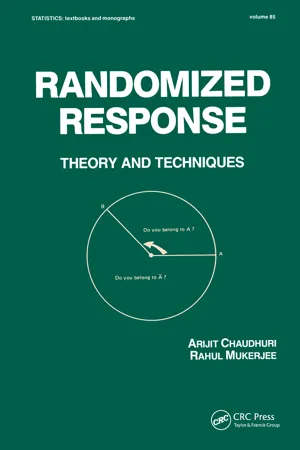
- 184 pages
- English
- ePUB (mobile friendly)
- Available on iOS & Android
eBook - ePub
About this book
Information
1.1. INTRODUCTION: WHY RANDOMIZED RESPONSE?
Socioeconomic investigations often relate to certain personal features that people wish to hide from others. In comprehensive inquiries, detailed questionnaires include numerous items. Data on most of them are frequently easy to procure merely by asking. But a few others may be on sensitive issues for which people are not inclined to state honest responses. For example, most people prefer to conceal the truth regarding their savings, the extent of their accumulated wealth, their history of intentional tax evasion and other illegal and/or unethical practices leading to earnings from clandestine sources, crimes, trade in contraband goods, susceptibility to intoxication, expenditures on addictions of various forms, homosexuality, and similar issues which are customarily disapproved of by society.
Open or direct queries often fail to yield reliable data on such confidential aspects of human life. Nonresponse or false or evasive responses to attempted direct queries about such private matters are so pronounced in practice that it is difficult to measure and control their effects to make an effective use of the acquired data from samples to reach a correct and fair conclusion about populations. So instead of open surveys, alternative procedures are needed if we are to procure reliable data on such confidential matters, especially the sensitive ones, believed to carry reprehensible stigmas. Randomized response (RR) survey techniques introduced by Warner (1965) provide such an alternative to meeting the twin objectives of generating enough reliable data to yield fruitful inference and creating a feeling among respondents that their privacy is protecteddespite their truthful replies to cleverly designed questions which do not reveal individual identities in the course of the survey.
1.2. THE WARNER MODEL
Consider the simple setup of a dichotomous population. Every person in the population belongs either to a sensitive group A, or to its complement, Ā. The problem is to estimate πA, (0 <A < 1), the unknown proportion of population members in group A. To do so, a simple random sample with replacement (SRSWR) of size n is drawn from the population. Because of the sensitive, possibly stigmatizing nature of the characteristic under study, a direct question regarding membership in A or otherwise is not expected to be helpful in terms of cooperation from the respondents. Hence the results, based on such a direct question, are quite likely, to an inestimable extent, to be vitiated by bias due to untruthful and evasive answers, or more important, there may be excessive refusals, resulting in too small a sample size, thus reducing the level of efficiency of an estimator based on such survey data.
To overcome the difficulty noted above, Warner (1965) suggests the technique of randomized response (RR). In this procedure, each respondent is provided with a randomization device by which he or she chooses one of the two questions “Do you belong to A?” or “Do you belong to Ā?” with respective probabilities P and 1–P (0 <P < 1) and then replies “yes” or “no” to the question chosen. In applications, of course, equivalent and appropriate vocabulary is to be used for the questions. The process of selecting one of the two questions is unobserved by the interviewer. Also, the interviewee is not to disclose the question to which his or her answer corresponds. Thus although the interviewer gets a “yes” or “no” reply, because of the randomization procedure, he or she cannot identify a particular respondent with group A or A on the basis of such a reply. This protects the privacy of an interviewee, and thus he or she may now be expected to cooperate and respond truthfully. It may be noted that the probability P is chosen by the interviewer as a part of the design. Further details regarding an appropriate choice of P are considered later in this section.
As a device for randomization, each interviewee may be provided with an identical spinner fitted with a pointer. By drawing angles at the center, the face of the spinner may be so depicted that the pointer indicates the question relating to membership of A with probability P and the question relating to membership of Ā with probability 1—P. This is illustrated in Figure 1.1. It is then enough to ask each respondent to spin the spinner andreply “yes” or “no” truthfully to the question indicated by the pointer. Infact, one can imagine numerous other devices for randomization. For example, instead of using a spinner, each respondent may be supplied with a deck of cards bearing the question regarding membership in A or Ā in proportions P and 1—P respectively. He or she may then be asked to draw one card after shuffling the deck thoroughly and to reply to the question ins...
Table of contents
- Cover
- Half Title
- Title Page
- Copyright Page
- Dedication
- Foreword
- Preface
- Acknowledgments
- Table of Contents
- 1 Introduction to Randomized Response: The Warner Model
- 2 The Unrelated-Question Model
- 3 Polychotomous Population and Multiattribute Situations
- 4 Techniques for Quantitative Characters
- 5 Efficient Estimation and Protection of Privacy
- 6 Miscellaneous Topics on RR Techniques
- 7 RR in a Finite Population Setting: A Unified Approach; Sampling with Varying Probabilities
- 8 Application of RRT and Concluding Remarks
- 9 Case Studies
- Index
Trusted by 375,005 students
Access to over 1.5 million titles for a fair monthly price.
Study more efficiently using our study tools.
Frequently asked questions
Yes, you can cancel anytime from the Subscription tab in your account settings on the Perlego website. Your subscription will stay active until the end of your current billing period. Learn how to cancel your subscription
No, books cannot be downloaded as external files, such as PDFs, for use outside of Perlego. However, you can download books within the Perlego app for offline reading on mobile or tablet. Learn how to download books offline
Perlego offers two plans: Essential and Complete
- Essential is ideal for learners and professionals who enjoy exploring a wide range of subjects. Access the Essential Library with 800,000+ trusted titles and best-sellers across business, personal growth, and the humanities. Includes unlimited reading time and Standard Read Aloud voice.
- Complete: Perfect for advanced learners and researchers needing full, unrestricted access. Unlock 1.5M+ books across hundreds of subjects, including academic and specialized titles. The Complete Plan also includes advanced features like Premium Read Aloud and Research Assistant.
We are an online textbook subscription service, where you can get access to an entire online library for less than the price of a single book per month. With over 1.5 million books across 990+ topics, we’ve got you covered! Learn about our mission
Look out for the read-aloud symbol on your next book to see if you can listen to it. The read-aloud tool reads text aloud for you, highlighting the text as it is being read. You can pause it, speed it up and slow it down. Learn more about Read Aloud
Yes! You can use the Perlego app on both iOS and Android devices to read anytime, anywhere — even offline. Perfect for commutes or when you’re on the go.
Please note we cannot support devices running on iOS 13 and Android 7 or earlier. Learn more about using the app
Please note we cannot support devices running on iOS 13 and Android 7 or earlier. Learn more about using the app
Yes, you can access Randomized Response by Arijit Chaudhuri,Rahul Mukerjee,Chaudhuri in PDF and/or ePUB format, as well as other popular books in Mathematics & Probability & Statistics. We have over 1.5 million books available in our catalogue for you to explore.