Biomedical Applications of Magnetic Particles discusses fundamental magnetic nanoparticle physics and chemistry and explores important biomedical applications and future challenges.
The first section presents the fundamentals of the field by explaining the theory of magnetism, describing techniques to synthesize magnetic particles, detailing methods to characterize magnetic particles, and quantitatively describing the applied magnetic forces, torques, and the resultant particle motions. The second section describes the wide range of biomedical applications, including chemical sensors, cellular actuators, drug delivery, magnetic hyperthermia, magnetic resonance imaging contrast enhancement, and toxicity.
Additional key features include:
Covers both introduction to physics and characterization of magnetic nanoparticles and the state of the art in biomedical applications
Authoritative reference for scientists and engineers for all new or old to the field
Describes how the size of magnetic nanoparticles affects their magnetic properties, colloidal properties, and biological properties.
Written by a team of internationally respected experts, this book provides an up-to-date authoritative reference for scientists and engineers.
1 Introduction to Biomedical Applications of Magnetic Nanoparticles
Jeffrey N. Anker and O. Thompson Mefford
CONTENTS
1.1 Purpose
1.2 Biomedical Applications of Magnetic Particles
1.3 Why Nanoparticles?
1.1 PURPOSE
The goal of this chapter is to provide a broad overview of properties and biomedical applications of magnetic nanoparticles. Subsequent chapters will elucidate the fundamental magnetic nanoparticle physics and chemistry and explore important biomedical applications. This brief introduction aims to place this information found in the remainder of this book into a broader context.
1.2 BIOMEDICAL APPLICATIONS OF MAGNETIC PARTICLES
A grand challenge in biomedical sciences is to detect and control the location and time of biochemical and biomechanical processes. For example, in treating cancer, the challenge is to direct the therapeutic to the tumor while minimizing damage to normal tissue, which can in principle be facilitated by targeting the drug and/or triggering the drug release. Similarly, the ability to switch cellular signaling on and off and detect this activity is critical for understanding and ultimately controlling cellular activity. A variety of external triggers are available including light (Fomina, Sankaranarayanan, and Almutairi 2012, Deisseroth 2011), ultrasound (Hernot and Klibanov 2008, Deckers and Moonen 2010, Mitragotri 2005), chemical signals (e.g. pH [Huh et al. 2012] or enzymes [De La Rica, Aili, and Stevens 2012]), electrical current or voltage (Murdan 2003), temperature changes (Schmaljohann 2006), magnetic fields (Dobson 2008, Pankhurst et al. 2003), and combinations thereof. Magnetism is an especially useful handle for controlling and detecting stimuli-responsive materials because magnetic fields are easily generated at a distance (using either permanent magnets or electromagnets) and biological tissue is essentially transparent to these magnetic fields. This provides a unique advantage to magnetic sensing and stimulation compared to other methods.
Only a select group of materials displays large magnetic moments at room temperature and magnetic fields that are readily accessible (<2.5 T). These magnetic materials are: elemental iron, nickel, and cobalt; compounds made from these three elements (e.g. certain alloys, oxides, sulfides, carbides, and borides), and a few other materials (e.g. chromium dioxide, and gadolinium metal at <20 °C, and manganese compounds including MnBi, MnSb, MnAs, MnB, Au2MnAl, and Cu2MnAl). Almost all other materials have very small magnetic moments at room temperature and their magnetic properties are apparent only under unusual conditions (e.g. nuclear magnetic resonance [NMR] spectroscopy detects magnetic properties of atomic nuclei using radiofrequency excitation, and largely diamagnetic biological samples can be levitated in very strong fields with large field gradients).
Among room temperature magnetic materials, only maghemite (gamma crystal phase of Fe2O3) is found naturally in cells. Specifically, maghemite is found in magnetotactic bacteria, which use it to orient and navigate and stay in nutrient-rich environments (Matsunaga and Okamura 2003, Blakemore 1975, Martel et al. 2009). Maghemite is also found in birds, fish, and other animals, where it is believed to serve as a compass to help them navigate (Kirschvink and Gould 1981) (although chemical and electroinductive mechanisms have also been proposed for sensing magnetic fields, termed “magnetoreception,” in some organisms) (Lohmann 2010). In humans, a small amount has been found in the brain (Dobson 2002) as well as exogenous magnetic materials from welding fumes (Nakadate et al. 1998) and air pollution (Maher et al. 2016) or from ingestion of iron particles (e.g. in cereal) (Hoppe, Hulthén, and Hallberg 2006). Aside from these esoteric examples, cells and tissues do not contain maghemite and are essentially unaffected by applied magnetic fields and do not affect these fields. This means that any magnetic material added to a cell or tissue can be controlled and imaged separately from the tissue.
1.3 WHY NANOPARTICLES?
In general, nanoparticles become interesting and useful when properties emerge that are specific to their size and shape and/or their composition is chosen to have multiple properties that work together synergistically. Magnetic nanoparticles are quintessential examples of materials with emergent properties. The magnetic moment of magnetic particles arises because interactions between atoms in ferromagnetic or ferromagnetic crystal cause the spin from their valence electrons to align together providing very large magnetic moments compared to the same number of atoms with randomly aligned spins (e.g., in a dissolved iron salt). This increased net magnetic moment of the particle leads to dramatically enhanced alignment energies and quite different behavior in response to applied magnetic fields. As an analogy, it is far easier to throw a snowball than the same amount of water dispersed in a puddle (or worse yet, the same number of water molecules as vapor in the air) because in a snowball the water molecules are mechanically linked together so that the position of one depends on the position of its neighbors. Although this analogy should not be taken too literally (atomic spin is not the same as atomic position and the coupling mechanisms are different too), it illustrates how the behavior of previously independent atoms changes dramatically when they are coupled together.
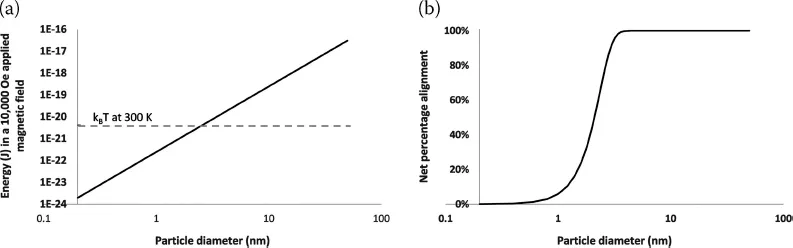
For example, Figure 1.1 shows how the magnetic energy for a magnetite (Fe3O4) nanoparticle depends upon the diameter of the nanoparticle in a 10,000 Oe applied field (µ0H = 1 T in SI units). We assumed that the particle has a saturation magnetization of 470 emu/cm3 (or 470 kA/m in SI units) and calculated the energy as E = µ0MS·HV, where E is the energy in Joules, MS is the saturation magnetization in kA/m, H is the applied field (µ0 H = 1T) and V is the particle volume in m3 (π r3 for a sphere). The magnetic energy increases with the particle size, and becomes equal to thermal energy at 300 K (kBT) when it is 2.6 nm in diameter (Figure 1.1a). Above this size, most of the moments will be aligned in the applied field; below this size the net alignment rapidly decreases. Although this is a crude calculation, which neglects effects from particle shape, crystalline anisotropy, and differences in magnetic properties of the surface of the particle, it shows the rapid change in magnetic energy and alignment with size, and illustrates the need for using magnetic particle that are at least several nanometers in diameter. Chapters 2 and 3 provide more details on the fundamentals of magnetism and their application to nanoparticle rotation and translation.
FIGURE 1.1 (a) Dependence of magnetic energy on particle diameter for a particle with magnetization equal to the saturation magnetization of magnetite (470 kA/m), (b) Net magnetic alignment as a function of diameter.
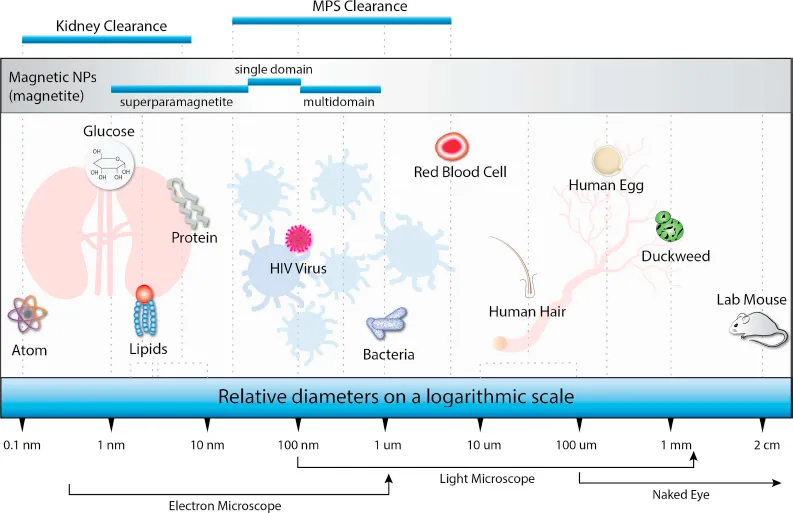
In general, the larger the particle is, the more force and torque can be applied to it with an external magnetic field. However, if the particle becomes too large, it is likely to form aggregates at reasonable concentrations due to magnetic interparticle forces (see Chapter 4). When the particle or aggregates are larger than a few microns, the materials interact with biological systems differently and are likely to block blood capillaries. Thus, magnetic nanoparticles in the 3–100 nm range (or materials/constructs made with them, such as magnetic nanoparticle-labelled cells or gels loaded with magnetic nanoparticles and drugs) are uniquely suited for biomedical applications. Figure 1.2 shows the size regime of biological materials. In general the 3–100 nm size range corresponds to proteins and viruses or intracellular organelles. The figure also shows the relevant ranges for behavior of magnetite nanoparticles (~3–25 nm superparamagnetic; 25–130 nm single domain, >130 nm multidomain). The cutoffs are not absolute and depend partly on the particle shape and composition as well as the time scale used to probe the particles. The figure also shows the range of particle diameters where particles are filtered by the kidneys and excreted in urine (<~6 nm), or taken up by the MPS immune system cells (10 nm to 8 µm), with >8 µm blocking capillaries.
FIGURE 1.2 Relevant size regimes for biological samples (ranging from atoms to lab mouse) and magnetic nanoparticles. Rough ranges for clearance regimes and microscopy observation regimes are also shown.
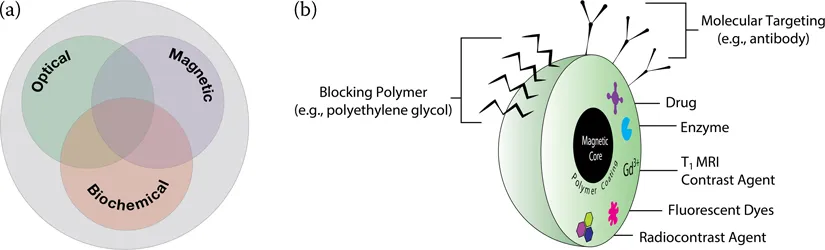
For biological applications, one generally wants to control nanoparticle size, shape, composition, and surface properties for the application. Nanoparticles are well-suited for rational design because they have “real estate” in the core and surface, which can be filled with different materials/coatings to control their surface chemistry, drug content, and optical and magnetic properties. Figure 1.3 is a schematic showing how multiple components and functionalities can be loaded into a single vehicle. Although administering components separately is simpler and often appropriate (e.g. a chemotherapy drug can be used separately from a magnetic resonance imaging (MRI) agent to see the tumor), combining multiple components within a single particle often generates new capabilities (e.g. drug can be magnetically directed/retained at a specific location only if it is attached to a magnetic particle). In addition to bringing particles to a specific location with magnetic forces, torques can be used to separate target molecules, pull or twist on cellular receptors, aggregate together or pull apart, or modulate optical or chemical signals for particles with nonspherical magnetic cores and orientation-dependent optical or chemical properties.
FIGURE 1.3 Multifunctional particle schematics. (a) Combining multiple properties into a single particle or group of particles, (b) Multiple possible components and functions integrated into the same particle.
1.4 SUMMARY OF SUBSEQUENT CHAPTERS
Following this introductory chapter, the book is divided into two sections. The first section is on fundamentals for working with magnetic particles. The second covers practical aspects of nanoparticle synthesis and biomedical applications. Each chapter is written by specialists in their field.
Section I Fundamentals for Working with Magnetic Particle Fundamen...
Table of contents
Cover
Title Page
Contents
Foreword
Preface
Editor Bios
List of Contributors
1 Introduction to Biomedical Applications of Magnetic Nanoparticles
Section I Magnetic Particle Fundamentals
Section II Magnetic Particle Applications
Index
Trusted by 375,005 students
Access to over 1.5 million titles for a fair monthly price.
Study more efficiently using our study tools.
Frequently asked questions
Yes, you can cancel anytime from the Subscription tab in your account settings on the Perlego website. Your subscription will stay active until the end of your current billing period. Learn how to cancel your subscription
No, books cannot be downloaded as external files, such as PDFs, for use outside of Perlego. However, you can download books within the Perlego app for offline reading on mobile or tablet. Learn how to download books offline
Perlego offers two plans: Essential and Complete
Essential is ideal for learners and professionals who enjoy exploring a wide range of subjects. Access the Essential Library with 800,000+ trusted titles and best-sellers across business, personal growth, and the humanities. Includes unlimited reading time and Standard Read Aloud voice.
Complete: Perfect for advanced learners and researchers needing full, unrestricted access. Unlock 1.5M+ books across hundreds of subjects, including academic and specialized titles. The Complete Plan also includes advanced features like Premium Read Aloud and Research Assistant.
Both plans are available with monthly, semester, or annual billing cycles.
We are an online textbook subscription service, where you can get access to an entire online library for less than the price of a single book per month. With over 1.5 million books across 990+ topics, we’ve got you covered! Learn about our mission
Look out for the read-aloud symbol on your next book to see if you can listen to it. The read-aloud tool reads text aloud for you, highlighting the text as it is being read. You can pause it, speed it up and slow it down. Learn more about Read Aloud
Yes! You can use the Perlego app on both iOS and Android devices to read anytime, anywhere — even offline. Perfect for commutes or when you’re on the go. Please note we cannot support devices running on iOS 13 and Android 7 or earlier. Learn more about using the app
Yes, you can access Biomedical Applications of Magnetic Particles by Jeffrey N. Anker, O. Thompson Mefford, Jeffrey N. Anker,O. Thompson Mefford in PDF and/or ePUB format, as well as other popular books in Tecnologia e ingegneria & Biotecnologia in medicina. We have over 1.5 million books available in our catalogue for you to explore.