Between the two world wars, thousands of European antifascists were pushed to act by the political circumstances of the time. In that context, the Spanish Civil War and the armed resistances during the Second World War involved particularly large numbers of transnational fighters. The need to fight fascism wherever it presented itself was undoubtedly the main motivation behind these fighters' decision to mobilise. Despite all this, however, not enough attention has been paid to the fact that some of these volunteers felt they were the last exponents of a tradition of armed volunteering which, in their case, originated in the nineteenth century. The capacity of war volunteering to endure and persist over time has rarely been investigated in historiography. The aim of this book is to reconstruct the radical and transnational tradition of war volunteering connected to Giuseppe Garibaldi's legacy in Southern Europe between the unification of Italy (1861) and the end of the Second World War (1945). This book seeks to provide a comprehensive analysis of the long-term, interconnected, and radical dimensions of the so called Garibaldinism.
eBook - ePub
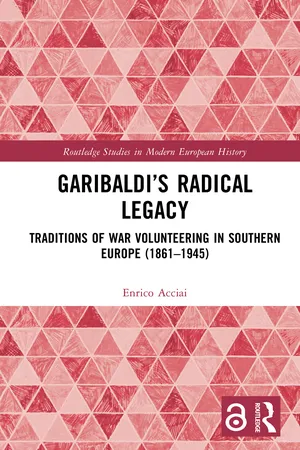
Garibaldi’s Radical Legacy
Traditions of War Volunteering in Southern Europe (1861–1945)
- 196 pages
- English
- ePUB (mobile friendly)
- Available on iOS & Android
eBook - ePub
Garibaldi’s Radical Legacy
Traditions of War Volunteering in Southern Europe (1861–1945)
About this book
Trusted by 375,005 students
Access to over 1.5 million titles for a fair monthly price.
Study more efficiently using our study tools.
Information
Topic
GeschichteSubtopic
Europäische Geschichte1 Fighting with Garibaldi
The first redshirt
25 June 1857, Genoa. In the late afternoon of a mild and damp early summer day, a group of around twenty men boarded the steamship Cagliari headed for Tunis. As soon as the boat had left the port, the men had no difficulty in overpowering the crew and taking control. Over the following hours, the Cagliari entered a dense fog, which prevented the hijackers from joining up with a boat intended to pass some weapons onto them. The undertaking continued. The group drafted a brief statement that began as follows: “We, the undersigned, confident of the justice of our cause and the strength of our character, hereby proclaim ourselves the initiators of the Italian revolution”.1
The leader of that makeshift military expedition, as well as the first signatory of the appeal, was a man of not yet forty from Naples who had spent the better part of the last decade of his life fighting for the revolution of the Italian people. His name was Carlo Pisacane. Over the previous years, he had had the opportunity to get to know all the leading figures of the Risorgimento up close, been exiled, enlisted in the French Foreign Legion and, in 1848, hastened to Milan to join the revolt against the Austrians, where he had served as a volunteer.2 The following year, he played a key role in the defence of the Roman Republic.3 Influenced in his thinking by the French anarchist Pierre-Jospeh Porudhon, Pisacane believed that the struggle for the Risorgimento in Italy had the potential to become a socialist revolution. In what was to be his political testament, Pisacane wrote:
The education of the people is an absurdity…. The only work a citizen can do for the good of the country is that of cooperating with the material revolution: therefore, conspiracies, plots, attempts etc., are that series of deeds through which Italy proceeds towards her goal.4
For Pisacane, this all hinged also on the impetus provided by a small group of armed volunteers.
Two days later, the Cagliari docked on Ponza Island. There, the insurgents proceeded to attack the fort where several dozen political prisoners involved in the struggles against the Bourbons in the previous decade were imprisoned. Thanks to a ruse orchestrated by Pisacane himself, the attack was a success and around 300 of the prisoners joined the expedition. The group seized the weapons sequestered in the watchtowers and, the following night, the steamship set out into the deep once again, headed for dry land. The insurgents disembarked near the small village of Sapri, in the Kingdom of the Two Sicilies: there, they were not met by an army of farmers ready to revolt, as they had been promised by several Neapolitan revolutionaries, but only by a great deal of distrust among the locals.5 After marching for several days, Pisacane and his men were confronted by Bourbonist troops. The day after the the insurgents disbanded, many were lynched by the people of the village of Sanza. Out of over 300 men that had disembarked in Sapri, no more than thirty survived, and they were imprisoned by the Bourbon forces. Pisacane was among the fallen.
As Franco Venturi stressed during a lecture at the University of Genoa in 1956, “Expeditions, insurrection, armed struggles by small groups were the only option available given the situation in Italy at the time”.6 The formation of the Italian State also involved a vast mobilisation of war volunteers. Pisacane was convinced of this, maintaining that classic armies were nothing more than a tool of political tyranny at the service of governments, while in a truly free society, the offspring of revolution, a standing army would no longer be required, inasmuch as it would have arisen voluntarily out of the “bowels of the nation”.7 Pisacane and his tragic expedition were not forgotten. Almost fifty years later, in 1904, the anarchist Luigi Fabbri dedicated a brief biographical profile to the Neapolitan revolutionary in the collection I precursori della Rivoluzione. According to Fabbri, Pisacane was one of the forerunners of the social revolution:
As Italians, we must be thankful for what he did to release us from the grip of the Bourbon cane, the papal muzzle and the German staff; as men fighting for the international brotherhood of the people, for true economic equality and complete freedom for all, we owe him even more gratitude; to he who taught us, by his own example, how to fight and lay down one’s life for an idea, he offered us, back then, the founding words of our socialist and libertarian ideas. Let us look to Carlo Pisacane, then, as the Master of thought and of action.8
For Nello Rosselli, too, one of his first biographers, Pisacane was a mirror of Italy at the time and the call for military action constituted one of the key elements of his biography.9 War volunteering was not only practised by members of left-wing political movements, then; there was in fact a long history of it, which, as we will see in this volume, regularly resurfaced throughout European history, spurring on new generations of volunteers to take up arms. A study of the existence, and persistence, of traditions of war volunteering in the varied world of political radicalism, and of its evolution in Europe between the nineteenth and twentieth centuries, cannot but take its cue from those who fought for the birth of the nation states. Pisacane’s landing in Sapri became engraved on people’s memories on account of its tragic epilogue: less than three years later, other volunteers landed on the coasts of the Kingdom of the Two Sicilies. That time, however, the revolutionaries were easily identifiable thanks to a colour detail: the majority of them wore a red shirt. At their command stood one of the most famous figures of the Italian Risorgimento: Giuseppe Garibaldi.
While it is unsurprising that an anarchist like Fabbri should have chosen to dedicate a small volume to Piscane, that another anarchist militant such as Roman Ettore Gnocchetti should do the same with the Hero of the Two Worlds may at first seem perplexing.
“Giuseppe Garibaldi was an anarchist”, wrote Gnocchetti, inasmuch as the grandeur of his character resonated with the boundless freedom of the people; so much so that that to the International Working Men’s Association, that sublime promoter of love and peace, which saw him as a true forerunner, he responded with that wonderful, irrefutable truth: the International is the light of the future.10
There was clearly a radical memory of Garibaldi and Garibaldinism too. Where did it come from?
The birth of Garibaldinism
In the collective memory, the birth of the modern Italian State is closely linked to the Garibaldian expedition that landed in Sicily in May 1860. Those 1,000 redshirts represented the vanguard of a vast movement whose aim was the political unification of the Italian peninsula. As is often the case in history, key moments become fixed in people’s memories, at the risk of becoming separate objects, disconnected from the flow of events. To some extent, this was the case with the Expedition of the Thousand. Garibaldi’s triumphant campaign in Sicily helped lead to an overlapping, indeed almost a fusion, between Garibaldinism, war volunteering, and the epic deeds of the Risorgimento. In the process, certain complexities of the Garibaldian tradition have been lost, which we will endeavour to reconstruct in the following pages.
In addition to rendering such terms as “people” and “nation” highly popular, Giuseppe Mazzini, a central figure of the Italian democratic and Risorgimento movement, also introduced expressions such as “thought and action” into the language of his contemporaries.11 Driven in part by this rhetoric, many people experienced the process leading to Italian unification as an armed movement of a revolutionary nature conducted voluntarily. The idea of an incursion by an armed band of revolutionaries sparking an uprising and bringing on a revolution had been a mainstay of Italian radicalism since the 1830s. This was not specific to Italy, however. When examining European history from the French Revolution onward, one cannot fail to note that this marked the start of a series of lasting phenomena. On the one hand, this was the beginning of the process that led, during the nineteenth century, to an unstoppable promulgation of the phenomenon of compulsory conscription. On the other hand, though, the historical break also marked the beginning of a connection between the decision to fight and political demands (be they the realisation of a national project or a broader, supranational one). The idea of the soldat-citoyen emerged with the French Revolution itself, before becoming associated, over the following decades, with the development of liberal states. It was in the summer of 1793, after the assassination of Marat, that the idea of the need for a mass call-up to defend the revolution began to circulate: “Que tous les Français se lèvent et marchent à la fois!”12 Despite this process, war volunteering did not disappear; it remained a central factor in many conflicts.13
During the nineteenth century, national causes were the primary cause of mobilisations. The first and most famous was the Greek cause in the 1920s, which led at least 1,000 European volunteers to mobilise. They were mainly German, English, French, and Italian, b...
Table of contents
- Cover
- Half Title
- Series
- Title
- Copyright
- Dedication
- Contents
- Acknowledgements
- List of abbreviations
- Introduction
- 1 Fighting with Garibaldi: the first redshirt
- 2 Becoming radicals
- 3 Greece, 1897: a new generation of redshirts
- 4 Tradition calls (again): a time of crisis for radical Garibaldinism
- 5 From redshirts to blackshirts: radical Garibaldinism between the two world wars
- Epilogue
- Bibliography
- Index
Frequently asked questions
Yes, you can cancel anytime from the Subscription tab in your account settings on the Perlego website. Your subscription will stay active until the end of your current billing period. Learn how to cancel your subscription
No, books cannot be downloaded as external files, such as PDFs, for use outside of Perlego. However, you can download books within the Perlego app for offline reading on mobile or tablet. Learn how to download books offline
Perlego offers two plans: Essential and Complete
- Essential is ideal for learners and professionals who enjoy exploring a wide range of subjects. Access the Essential Library with 800,000+ trusted titles and best-sellers across business, personal growth, and the humanities. Includes unlimited reading time and Standard Read Aloud voice.
- Complete: Perfect for advanced learners and researchers needing full, unrestricted access. Unlock 1.5M+ books across hundreds of subjects, including academic and specialized titles. The Complete Plan also includes advanced features like Premium Read Aloud and Research Assistant.
We are an online textbook subscription service, where you can get access to an entire online library for less than the price of a single book per month. With over 1.5 million books across 990+ topics, we’ve got you covered! Learn about our mission
Look out for the read-aloud symbol on your next book to see if you can listen to it. The read-aloud tool reads text aloud for you, highlighting the text as it is being read. You can pause it, speed it up and slow it down. Learn more about Read Aloud
Yes! You can use the Perlego app on both iOS and Android devices to read anytime, anywhere — even offline. Perfect for commutes or when you’re on the go.
Please note we cannot support devices running on iOS 13 and Android 7 or earlier. Learn more about using the app
Please note we cannot support devices running on iOS 13 and Android 7 or earlier. Learn more about using the app
Yes, you can access Garibaldi’s Radical Legacy by Enrico Acciai in PDF and/or ePUB format, as well as other popular books in Geschichte & Europäische Geschichte. We have over 1.5 million books available in our catalogue for you to explore.