This volume examines both historical developments and contemporary expressions of blasphemy across the world. The transgression of religious boundaries incurs more or less severe sanctions in various religious traditions. This book looks at how religious and political authorities use ideas about blasphemy as a means of control. In a globalised world where people of different faiths interact more than ever before and world-views are an increasingly important part of identity politics, religious boundaries are a source of controversy.
The book goes beyond many others in this field by widening its scope beyond the legal aspects of freedom of expression. Approaching blasphemy as effectivespeech, the chapters in this book focus on real-life situations and ask the following questions: who are the blasphemers, who are their accusers and what does blasphemy accomplish? Utilising case studies from Europe, the Middle East and Asia that encompass a wide variety of faith traditions, the book guides readers to a more nuanced appreciation of the historical roots, political implications and religious rationale of attitudes towards blasphemy.
Incorporating historical and contemporary approaches to blasphemy, this book will be of great use to academics in Religious Studies and the Sociology of Religion as well as Political Science, Media Studies, History.
Part I Background – theoretical reflections and historical discussions
1 Blasphemies compared. An overview
Anne Stensvold
In 1311, the king of France, Philip the Fair, accused the Knight Templars of blasphemy, sodomy and heresy. Seven hundred years later, in 2015, Islamic terrorists killed seven journalists at Charlie Hebdo. Much has happened to blasphemy between these two events. So much so, that we may ask if we are speaking about the same thing! Looking at the accusers, it seems not: the king of France used blasphemy as a political weapon and made his accusations in a bid to undermine the power of the pope (Jones 2017).1 In the Charlie Hebdo massacre, the terrorists acted on their own accord as self-proclaimed defenders of Islam.2 In the first case, blasphemy was political, while in the latter, blasphemy was framed as a religious crime, and, we might add, violence used as a way to express the power of religion. But if we look at the alleged crimes, we see that the underlying concept of blasphemy has remained much the same: blasphemers are those who fail to show respect for religion.
Blasphemy is a Greek word, which literally means profane speech; defamation; and slander. The case against the Knight Templars in 1311 is one of the first on record from the Medieval Period (see chapter 5). At that time, blasphemy was seen as a sign of heresy: to misuse the name of God (swearing) was blasphemous, or to claim that Mary was a whore was a violation of Church dogma as well as a blatant offence to common decency. In medieval Europe, the Jews were the first blasphemers (Cabantous 2002, 18). After the Protestant Reformation, there was a sharp increase in the number of blasphemy cases as “a Protestant was ipso facto a blasphemer in the eyes of many sixteenth century Catholics, and vice versa” (Tolan 2015, 40). Like heresy before, blasphemy accusations marked the boundaries between “us” and “them”. In other words, blasphemy was used as a means to enforce the boundaries of religions. As a working definition, we approach blasphemy as transgression of that which someone regards as sacred (Cabantous 2002; Cox 2017). This is a minimal definition, which has the advantage of referring to a generic “sacred” (in a Durkheimian sense of the word), which applies to all religious traditions.
Over the last decades, we have seen an increased focus on blasphemy. On the Indian sub-continent as well as in Muslim countries in the Middle East, there has been a considerable rise in blasphemy cases, while in Europe, many blasphemy laws have been abolished. Such contradictory policies need explaining. At a first glance, it is possible to claim that since Muslims are over-represented in contemporary blasphemy controversies, blasphemy is a particularly offensive crime in Islam. A historical glance at blasphemy through the ages effectively undermines such claims. Instead, the difference lies in the sociopolitical context: all over the world, blasphemy transgressions are socially disruptive and have the ability to provoke violent reactions, particularly among rural populations, but the way that blasphemy transgressions are handled varies (see chapter 15) – not just between religions but between urban/rural populations. Even a country such as Pakistan, which has a death penalty for blasphemy and where rural courts routinely condemn blasphemers to death, has higher courts which regularly overturn such verdicts. So far, in Pakistan, no convicted blasphemer has been executed. How political authorities implement religious rules obviously depends on how the religio-political power nexus is played out, including whether the country is a secular democracy (Denmark) or a religious totalitarian regime (Iran). The difference between blasphemy cases in various contexts, such as contemporary South Asia and Europe, therefore reflects deeper sociopolitical differences more than the particular religion in question.
Looking at the most publicised blasphemy cases today, it seems that artistic expressions and cartoons are particularly vulnerable to blasphemy accusations (Kolrud 2016; Plate 2006). Many Muslims as well as Christians, Hindus or Jews reportedly feel hurt by what they consider as blasphemous images (and which others regard as funny). Nevertheless, “hurt” is not a religious prerogative, and violations of secular values can also hurt those who treasure them. This may explain the outrage that free-speech activists express when their “sacred” is violated, for example, Danish free speech demonstration in connection with the Muhammad cartoon controversy in 2005.3 To define the sacred so broadly broaches religious notions, which tend to use “sacred” as synonymous with that which belongs to God. But in a study of blasphemy as a global religio-political phenomenon, we need an analytical concept that allows us to compare different cases of blasphemy. In other words, while the word is Greek, the concept is not restricted to Greek usage. It is not blasphemy as a theological idea, nor the meaning of blasphemy laws that are focused here. We are interested in blasphemy both as a sociopolitical and historical phenomenon and in what blasphemy means for both accusers and accused.
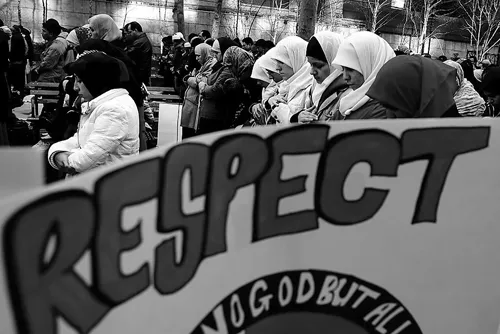
Figure 1.1 NEW YORK – FEBRUARY 17: Muslims participate in prayer February 17, 2006 during a protest against the offensive cartoons printed in numerous European newspapers in New York City. Hundreds of area Muslims attended the peaceful afternoon rally to show their disdain for the Danish cartoons depicting the Prophet. Many Muslims believe any depiction of the Prophet is blasphemous. (Photo by Spencer Platt/Getty Images).
The purpose of this book is to throw light on what blasphemy controversies are about: something that is said or done, which is perceived as offensive to God(s) or the sacred. It is sufficiently broad to allow for comparison of blasphemy across religions, and specific enough to exclude other kinds of speech, such as slander and lies. Since “the sacred” does not rely on a notion of deity or transcendence, the concept also applies to “ultimate values” of a secular kind, such as the right to free speech or justice (see chapter 2).
A conceptual history of blasphemy – Greek and Roman roots
Blasphemy originates in the Greek word blasphemia,4 which is translated as (1) word of evil omen; profane speech,5 (2) defamation or slander,6 (3) speaking impiously or irreverently of God.7 “In Hellenic culture, it was considered blasphemous to pronounce any word that may prove to be a bad omen – any word capable of having ill effect on an individual or god” (Cabantous 2002, 5). The opposite of blasphemy is euphemein or to give praise (from eu, good and phemein, speech).8 It is also a verb blasphêmein and an adjective blasphêmos.9 More important in the present context is the biblical prohibition against the misuse of God’s name in the second of the Ten Commandments: “Thou shalt not take the name of the Lord thy God in vain” (Exodus 20:7). What the King James Bible here renders as “to take the name of the Lord in vain”, the New Revised Standard Version (NRSV) translates as “misuse his name”.10 In other parts of the Greek translation of the Old Testament, the Septuagint (ca. 100 BC), the contested concept is not rendered as blasphemy, but as the Greek word epi’matai, to speak in a worthless way.11 Misuse of God’s name in cursing or swearing false oaths is at the core of the Christian concept of blasphemy (Cabantous 2002; Nash 2007). Nevertheless, “blasphemy” occurs only sparingly in the Septuagint, more frequently in 2.Maccabees (Soggin 1989, 469).12 Whereas epi’matai was blasphemy in a religious context, Greek philosophers employed “blasphemy” in a more general fashion. The Greek word “blasphemy” was transposed to Roman law and brought into Christianity where it gets the meaning “offence against God” (Berman 1983, 122).
In Roman law, blasphemy was a most serious offence, which could have disastrous consequences. Failure to punish blasphemy would cause famine, earthquake and pestilence (Levy 1995, 50). Thus, the Romans added a certain magical quality to the word. This view translated into Christianity where blasphemy means to offend or cause harm to God and thereby incur the “wrath of God” (Cabantous 2002). Blasphemy was a grave sin, which was believed to cause all kinds of natural disasters that would threaten the community. In Roman law, moreover, blasphemy was linked to the misuse of religious words, for instance, to speak of the gods in extra-religious contexts (e.g. outside prayer). We also find blasphemy in connection with offences against the cult of the emperor. Therefore, when the first Christian martyrs famously refused to pay tribute to the emperor, they committed blasphemy – refusing to give praise where praise was due.13 Interestingly, Roman blasphemy law did not only apply to the emperor but also to his images, which were to be treated with reverence as if they were the man himself. Thus, failing to give an icon of the emperor its due respect was blasphemy (Prusac 2014, 43). In Christianity, the distinction between idolatrous and appropriate cult of images hinges on a similar analogy between the image and the depicted person. The cult of images in Catholicism and Orthodox Christianity acknowledge that there is a likeness between an image and the holy person or the divine being it portrays. Idolatry, on the other hand, means that the image shares the essence of the depicted person (on images in Islam, see chapter 16). Authentic depiction or reflection of the real essence was a pictorial ideal in the High Middle Ages (Belting 1996, 215). More importantly in the present context, idolatry implies a faulty relationship with the sacred object. It is not just a question of appreciation of likeness of an innate object but a matter of how we engage with an object that is perceived as an agent in its own right (see chapter 3).
Christian blasphemy
Blasphemy found its way into the Code of Justinian (ca. 534 AD), which bridged the gap between the Roman law and the legal systems that developed in Western Europe between the end of Antiquity and the Reformation (Berman 1983). The biblical basis for legislation against blasphemy is sparse, but where it does occur, blasphemy is clearly a most serious crime, which led to a death sentence: “One who blasphemes the name of the Lord shall be put to death; the whole congregation shall stone the blasphemer. Aliens as well as citizens, when they blaspheme the Name, shall be put to death” (Leviticus 24:16). Interestingly, this passage does not distinguish between Jews and gentiles – they are equally to blame for blasphemy. This view relies on what we may call a “magical understanding”, whereby the prohibited words have an automatic effect of incurring the wrath of God when uttered – regardless of the speaker’s intention (see chapter 4). The same idea informs Gratian’s Decretum (compiled ca 1140), where Daniel 3:29 provides the textual basis for a universal prohibition against blasphemy:
Therefore I make a decree: Any people, nation, or language that utters blasphemy against the God of Shadrach, ...
Table of contents
Cover
Half Title
Series Page
Title Page
Copyright Page
Table of Contents
List of contributors
Introduction
Part I Background – theoretical reflections and historical discussions
Part II Case studies
Concluding remarks
Index
Trusted by 375,005 students
Access to over 1.5 million titles for a fair monthly price.
Study more efficiently using our study tools.
Frequently asked questions
Yes, you can cancel anytime from the Subscription tab in your account settings on the Perlego website. Your subscription will stay active until the end of your current billing period. Learn how to cancel your subscription
No, books cannot be downloaded as external files, such as PDFs, for use outside of Perlego. However, you can download books within the Perlego app for offline reading on mobile or tablet. Learn how to download books offline
Perlego offers two plans: Essential and Complete
Essential is ideal for learners and professionals who enjoy exploring a wide range of subjects. Access the Essential Library with 800,000+ trusted titles and best-sellers across business, personal growth, and the humanities. Includes unlimited reading time and Standard Read Aloud voice.
Complete: Perfect for advanced learners and researchers needing full, unrestricted access. Unlock 1.5M+ books across hundreds of subjects, including academic and specialized titles. The Complete Plan also includes advanced features like Premium Read Aloud and Research Assistant.
Both plans are available with monthly, semester, or annual billing cycles.
We are an online textbook subscription service, where you can get access to an entire online library for less than the price of a single book per month. With over 1.5 million books across 990+ topics, we’ve got you covered! Learn about our mission
Look out for the read-aloud symbol on your next book to see if you can listen to it. The read-aloud tool reads text aloud for you, highlighting the text as it is being read. You can pause it, speed it up and slow it down. Learn more about Read Aloud
Yes! You can use the Perlego app on both iOS and Android devices to read anytime, anywhere — even offline. Perfect for commutes or when you’re on the go. Please note we cannot support devices running on iOS 13 and Android 7 or earlier. Learn more about using the app
Yes, you can access Blasphemies Compared by Anne Stensvold in PDF and/or ePUB format, as well as other popular books in Politics & International Relations & Political Freedom. We have over 1.5 million books available in our catalogue for you to explore.