It is widely acknowledged that the hit franchise Game of Thrones is based on the Wars of the Roses, a bloody fifteenth-century civil war between feuding English families. In this book, Jeffrey R. Wilson shows how that connection was mediated by Shakespeare, and how a knowledge of the Shakespearean context enriches our understanding of the literary elements of Game of Thrones.
On the one hand, Shakespeare influenced Game of Thrones indirectly because his history plays significantly shaped the way the Wars of the Roses are now remembered, including the modern histories and historical fictions George R.R. Martin drew upon. On the other, Game of Thrones also responds to Shakespeare's first tetralogy directly by adapting several of its literary strategies (such as shifting perspectives, mixed genres, and metatheater) and tropes (including the stigmatized protagonist and the prince who was promised). Presenting new interviews with the Game of Thrones cast, and comparing contextual circumstances of composition—such as collaborative authorship and political currents—this book also lodges a series of provocations about writing and acting for the stage in the Elizabethan age and for the screen in the twenty-first century.
An essential read for fans of the franchise, as well as students and academics looking at Shakespeare and Renaissance literature in the context of modern media.
This briskly telescoped history of medieval English royalty shows how many of the same themes pop up in Game of Thrones: internal civil war and external foreign war, women in politics, church versus state, royal authority versus people’s rights, counselor in-fighting, the line of succession, the child king, and monarchy versus meritocracy, among others.1
The most important year in English history is 1066. King Edward the Confessor died with no children. After a skirmish among nobles, a bastard from Normandy (Northern France) was crowned King of England: William the Conqueror is famous for bringing high-class French culture to low-class England. And the addition of William’s lands in Normandy to the English territory created a centuries-long territorial dispute between England and France.
All politics was family politics. William the Conqueror’s grand-daughter, Empress Matilda (1102–67), laid claim to the crown in 1141, activating the question of women in politics early in England’s royal history. Matilda married a teenage Frenchman with golden red hair named Geoffrey, nicknamed Plantagenet (referring to the yellow flower of the broom shrub, or planta genista). The long line of monarchs descending from Matilda and Geoffrey is called the Plantagenet dynasty.
Matilda’s son, Henry II (1133–89), became the first Plantagenet king in 1154. His wife, Eleanor of Aquitaine, had divorced King Louis of France to marry Henry. With their lands combined, Henry and Eleanor controlled England and half of France, marking the start of the Angevin empire where Kings of England claimed French lands. Henry is most famous for ordering the death of his good friend, Thomas a Becket. The two were playboys in their youths, so Henry named Becket Archbishop of Canterbury to keep the power of the church in check. Becket turned on Henry and asserted the power of the church over the state, asking a famous question—“Will no one rid me of this meddlesome priest?”—which was understood to be a command, as dramatized in T.S. Eliot’s Murder in the Cathedral (1935) and quoted in, for example, former CIA director James Comey’s testimony about US President Donald Trump’s corruption.2 After Becket’s murder, the pope declared him a saint, Henry later performing a public walk of atonement to Canterbury Cathedral, throwing himself down on the church steps, allowing the clergy to beat him.
Henry’s crown was taken from him in 1189 by one of his sons, Richard I (1157–99), known as Richard the Lionheart. Richard fancied himself a hero, as he is portrayed in the Robin Hood stories. He spent most of his time on crusades in the holy land. Richard’s younger brother, King John, is the villain in the Robin Hood stories. That’s because John killed one of his nephews, Arthur, whom the French saw as the rightful heir. Wicked uncles unwilling to submit to their nephews are all over medieval English history. John was also seen as a villain—from the royal perspective—because he was forced by barons to sign the Magna Carta in 1215, which limited the power of the king, a precursor to modern political ideas of people’s rights. Most of all, John was remembered unfavorably because, after the death of Arthur, the French drove him and his English forces out of most of the land in France. This marked the end of the Angevin empire. The future was grim for the Plantagenets.
John’s son, Henry III (1207–72), crowned in 1216 when he was nine years old, is famous for building Westminster Abbey. In the wake of the Magna Carta, he created Parliament (further raising issues about royal authority versus people’s rights). In an episode called the Mad Parliament, Henry’s brother-in-law, a baron named Simon du Monfrey, even captured Henry and ruled the country for a while (sparking questions about who should rule, the monarch born into power or the representative of the people who most merits power). The throne passed to Henry’s son, Edward I (1239–1307)—an autocrat, cruel, even to his own children—and then to his son, Edward II (1284–1327). Edward II fell in love with one of his advisors, Pierce Gaveston, who wore the queen’s jewelry to Edward’s coronation. Feuding nobles killed Gaveston, leaving Edward devastated. Edward’s wife, Queen Isabella, rebelled against him and had him deposed. Legend has it that she eventually had Edward killed in a way that wouldn’t leave any marks of murder: he was stabbed through the anus with a red-hot poker. Isabella put her and Edward’s son on the throne—Edward III (1312–77), crowned in 1327. Like any good English king, Edward III went to war with France, increasing some of the lands lost at the end of the Angevin empire, losing them again by the end of his reign.
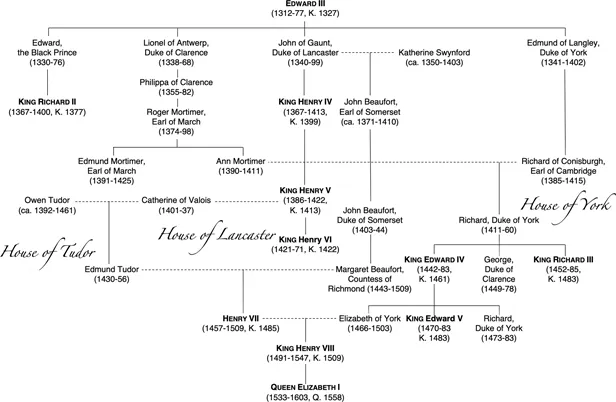
Here’s where things heat up as we look toward Game of Thrones, and where we’ll slow down. That’s because Martin did not adapt an objective historical account of the Wars of the Roses as much as he adapted the heavily politicized version memorably depicted in Shakespeare’s history plays, dubbed “the Tudor myth” by Shakespeare scholar E.M.W. Tillyard.3 As depicted in Figure 1.1, the Tudor myth began when Edward III’s eldest son and heir, Edward the Black Prince, died in 1376, one year before his father died in 1377. The line of royal succession passed to the eldest son’s eldest son, the Black Prince’s ten-year-old child, Richard II (1367–1400). Petulant, entitled, impulsive, weak, Joffrey-like, Richard’s inefficiency as a governor brought to the surface the tension in medieval English politics between traditionalists arguing for hereditary monarchy and innovators sympathetic to meritocracy: the problem of the child king always creates the problem of counselor in-fighting. Richard’s uncle, John of Gaunt, Duke of Lancaster, another of Edward III’s sons, believing he and his family could run the country better than Richard, organized a rebellion that deposed Richard and placed Gaunt’s son, Henry IV (1367–1413), on the throne in 1399. Henry’s son, Henry V (1386–1422), became king in 1413, his reign shifting attention from civil war to foreign war. Starting with the Battle of Agincourt, Henry V retook lands in Northern France, becoming a national hero. But those lands were lost again during the reign of his son, Henry VI (1421–71), as Shakespeare memorably captured in the “fatal prophecy … That ‘Henry born at Monmouth should win all, / And Henry born at Windsor should lose all’” (1 Henry VI, 3.1.194–98).
Figure 1.1 The Tudor myth: a genealogy.
Henry VI was an infant when crowned in 1422 after his father died at a young age. Again, the child king; again, counselor in-fighting, though a common enemy in the foreign war against France unified the English houses for a time, staving off civil war. English forces defeated the fierce French female warrior Joan of Arc, who was burned at the stake, but England lost most of its land in France. Attention turned back from foreign to civil war. Henry married a French queen, Margaret of Anjou, who came with no dowry, causing discord among Henry’s advisors. In Shakespeare’s version, Margaret has a secret love affair with one of her husband’s closest allies, the Duke of Suffolk, and Humphrey, Duke of Gloucester—the king’s noble uncle—is churned up in the chaos.
Factions emerged in England’s royal families, the tension between monarchy and meritocracy resurfacing. Henry, Margaret, their son Prince Edward, and the House of Lancaster (the descendants of John of Gaunt) argued in favor of monarchy and a hereditary line of succession. They were opposed by the House of York (the descendants of Edmund of Langley, Duke of York, the younger brother of Edward the Black Prince and John of Gaunt). Richard, Duke of York made a tenuous claim to the throne, arguing that the entire Lancastrian line was illegitimate due to the illegal rebellion of Henry IV against Richard II, but the York case was really based in meritocracy: they only seriously advanced the Duke of York’s claim to the throne when it became obvious that the weak Henry VI was running the nation into the ground. “This brawl,” in Shakespeare’s words, “Shall send between the red rose and the white / A thousand souls to death and deadly night” (1 Henry VI, 2.4.124–27).
Under pressure from the York faction, Henry VI named Richard, Duke of York his successor, disinheriting Prince Edward and really pissing off Queen Margaret. As the Wars of the Roses erupted, Henry became the subordinate member of his marriage, Margaret a political power-broker (think Cersei) and Lancastrian military leader (think Daenerys). She defeated Richard of York—his head Eddarded on a spike—but York’s children took up the family’s cause, eventually unseating Henry VI. In 1461, the eldest York brother became King Edward IV (1442–83), but further civil war ensued. There was internal tension within the York family because Edward pulled a Robb Stark and reneged on his promise to marry Lady Bona of France in a politically advantageous union, choosing instead to follow his heart and marry Elizabeth Woodville, a landless English widow. That internal feud within the York family spilled over into the external feud with the Lancasters. Edward’s younger brother George, Duke of Clarence, defected to the Lancastrian side; he later came back to the Yorks. The Earl of Warwick, another powerful Yorkist who helped seat Edward IV, also defected, marrying his daughter, Anne Neville, to Henry VI’s son Prince Edward, earning Warwick the title of “the kingmaker.” Henry VI won back the crown but, like Aerys Targaryen, deteriorated into madness.
According to Shakespeare, if you’re Edward and George’s youngest brother—Richard, Duke of Gloucester, the youngest living son of Richard, Duke of York—and you yourself want to be king, there’s only one option: kill everyone. That’s the man who becomes Shakespeare’s Richard III. First, in Shakespeare’s version, Richard and...
11 Eddard as Gloucester: De Casibus Virorum Illustrium
12 Wars of roses: a literary trope in social life
13 The stigmatized protagonist: the tragic model and the heroic model
14 Girl power: mimetic feminism and rhetorical misogyny
15 Generic bias: gender, race, criticism
16 The Bloody Hand: intertextual metatheater
17 The Targaryen myth
18 How George R.R. Martin changed the ending of Game of Thrones
19 Fandom as IKEA effect
Index
Trusted by 375,005 students
Access to over 1.5 million titles for a fair monthly price.
Study more efficiently using our study tools.
Frequently asked questions
Yes, you can cancel anytime from the Subscription tab in your account settings on the Perlego website. Your subscription will stay active until the end of your current billing period. Learn how to cancel your subscription
No, books cannot be downloaded as external files, such as PDFs, for use outside of Perlego. However, you can download books within the Perlego app for offline reading on mobile or tablet. Learn how to download books offline
Perlego offers two plans: Essential and Complete
Essential is ideal for learners and professionals who enjoy exploring a wide range of subjects. Access the Essential Library with 800,000+ trusted titles and best-sellers across business, personal growth, and the humanities. Includes unlimited reading time and Standard Read Aloud voice.
Complete: Perfect for advanced learners and researchers needing full, unrestricted access. Unlock 1.5M+ books across hundreds of subjects, including academic and specialized titles. The Complete Plan also includes advanced features like Premium Read Aloud and Research Assistant.
Both plans are available with monthly, semester, or annual billing cycles.
We are an online textbook subscription service, where you can get access to an entire online library for less than the price of a single book per month. With over 1.5 million books across 990+ topics, we’ve got you covered! Learn about our mission
Look out for the read-aloud symbol on your next book to see if you can listen to it. The read-aloud tool reads text aloud for you, highlighting the text as it is being read. You can pause it, speed it up and slow it down. Learn more about Read Aloud
Yes! You can use the Perlego app on both iOS and Android devices to read anytime, anywhere — even offline. Perfect for commutes or when you’re on the go. Please note we cannot support devices running on iOS 13 and Android 7 or earlier. Learn more about using the app
Yes, you can access Shakespeare and Game of Thrones by Jeffrey R. Wilson in PDF and/or ePUB format, as well as other popular books in Literature & Literary Criticism. We have over 1.5 million books available in our catalogue for you to explore.