As one of the first academic monographs on Keith Haring, this book uses the Pop Shop, a previously overlooked enterprise, and artist merchandising as tools to reconsider the significance and legacy of Haring's career as a whole.
Haring developed an alternative approach to both the marketing and the social efficacy of art: he controlled the sales and distribution of his merchandise, while also promulgating his belief in accessibility and community activism. He proved that mass-produced objects can be used strategically to form a community and create social change. Furthermore, looking beyond the 1980s, into the 1990s and 2000s, Haring and his shop prefigured artists' emerging, self-aware involvement with the mass media, and the art world's growing dependence on marketing and commercialism.
The book will be of interest to scholars or students studying art history, consumer culture, cultural studies, media studies, or market studies, as well as anyone with a curiosity about Haring and his work, the 1980s art scene in New York, the East Village, street art, art activism, and art merchandising.
“The public needs art, and it is the responsibility of a “self-proclaimed artist” to realize the public needs art, and not to make bourgeois art for a few and ignore the masses. Art is for everybody. To think that they—the public—do not appreciate art because they don’t understand it, and to continue to make art that they don’t understand and therefore become alienated from, may mean that the artist is the one who doesn’t understand or appreciate art and is thriving in this “self-proclaimed knowledge of art” that is actually bullshit.”
—Keith Haring, 19781
In 1978, one year after moving to New York City and enrolling at the School of Visual Arts, Keith Haring wrote this journal entry, already thinking about the disconnect between fine art and the public. As a young adult, Haring had encountered a variety of ideas that made him determined to become a fine artist, but that also made him question the art world, finding it to be closed and high-minded. Once he arrived in New York, he tried to pinpoint what being an artist meant to him, experimenting with conceptual videos, collages pasted on street posts, immersive installations, and chalk drawings in subway stations. At first glance, Haring’s early experiences might appear to have nothing in common with a store that sells T-shirts. On closer inspection, they each contributed toward the ultimate manifestation of the Pop Shop and shaped Haring’s populist philosophy, as well as his complicated ambivalence of commercialism.
As a teenager, Haring was introduced to populist concepts through the Jesus Freaks, the artist Robert Henri, and the band the Grateful Dead—influences he often cited in interviews and in his journals. When he moved to New York, his early work at the School of Visual Arts helped him learn the mechanics behind mass communication and display and how to interconnect his image and personality with his work. His subsequent street work in New York taught him the importance of a public audience and helped him to establish his signature style, as well as nurtured his skills as a self-promoter. These early activities were formative influences on Haring’s Pop Shop and engagement with everyday commercialism, along with his pursuit of inclusiveness in art.2
Jesus Freaks, Robert Henri, and the Grateful Dead
At age 13, Haring became involved with the radical, left-leaning Jesus Movement of the 1970s, whose followers were nicknamed the Jesus Freaks.3 Following Jesus’s teachings of universal love and peace, a great deal of the Jesus Freaks’ purpose was to provide relief for the poor and to oppose unchecked institutional materialism and corruption.4 Distrustful of authority and resolutely anti-fundamentalist, they aimed to make their organization less elitist and hierarchical and welcomed anyone, irrespective of background or education.5 Mainly populated by a younger generation of hippies and ex-drug addicts who sought a continuation of 1960s’ counterculture, the movement took on a purposefully populist approach to Christianity and adopted vernacular language such as “dig it” and “groovy.”6 They aimed to attract a large following, with straightforward goals and beliefs that have been described as superficial and unsophisticated, judgments that have also been imposed on Haring’s work.7
The Jesus Freaks propagated and funded their ideas by selling inexpensive promotional materials: buttons, bumper stickers, and clothing, printed with their slogan, like “high on Jesus” and “If you’re saved and you know it, clap your hands,” circulated on their merchandise as a tactic to reinforce community identification and to fund the movement.8 When Haring was an adolescent growing up in Kutztown, Pennsylvania, he described himself as a “Jesus Person” and recounted that his parents “were frightened because I was obsessive with it. I was considered a freak—a Jesus freak.”9 While his direct interaction with the movement ended in his late teens, its philosophies and strategies remained with him, “stuck in his head.”10
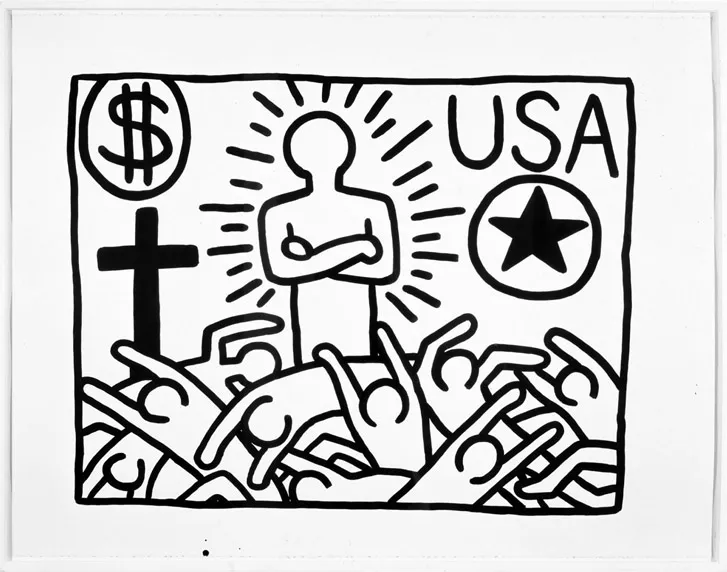
Haring endeavored to invite a broader public into the exclusive and esoteric contemporary art world, in much the same way that the Jesus Freaks attracted newcomers by countering the authority of organized religion, as well as governmental and corporate institutions. In addition, his overt critique of religion spanned his entire career, evident in the Christian imagery he relied on and duplicated across multiple media. Crosses were a favorite. Beginning in 1980, he surrounded them with scenes of death and conflict, a symbol of clerical corruption.11 He said, “Religion can often be perverted, used for the wrong reasons. … [D]octrine has been used for some people to attain things, to control groups of people.”12 The Jesus Freaks also help explain Haring’s attitude against money and material things. In his work, he regularly depicted corruption caused by money, including dollar signs on televisions, hovering over dead figures, or overtaking a person’s insides (Figure 1.1). He also criticized the art market as “one of the most dangerous, parasitic, corrupt organizations in the world, next to the Roman Catholic Church or the Justice system in the U.S.,” opting instead at the start of his career to show his art in the street and organize his own shows in alternative spaces without dealer representation.13
To afford to create art full time, however, Haring eventually joined the Tony Shafrazi Gallery in 1982. But stemming from his inner (Jesus Freak) guilt, he continued to find alternate ways to spread his work to more people. Often noted for his generosity, he did many charitable events and art projects for free and spent much of his earnings on friends.14 He also invested in popular commercial activities, like art merchandising, in line with Jesus Freaks tactics. He was, nonetheless, fully aware that his intentions were easily misinterpreted. As he contemplated his rise, he explained,
My introduction into the commercial side of things has been totally misunderstood and misrepresented, especially by art critics. … People do not understand that there could possibly be any other motivation to do something that reaches a lot of people or to communicate in a different new way, a new medium or technique.15
Haring’s populism and antimaterialism were also heavily influenced by the artist Robert Henri and his book The Art Spirit (1923), a book that “changed his life completely.”16 He cited it as the reason for leaving the Ivy School of Professional Art in Pittsburgh in 1977 after only six months, a school that taught commercial art skills. Calling the school “terrible,” Haring decided that he wanted to become a fine artist instead.17 Henri, also a New York artist, is well known for his early-20th-century portrait and genre paintings, his active role in the Ashcan School of American Realism, and as the organizer of the Eight, a group of Ashcan artists who protested the restrictive exhibition practices of the National Academy of Design by staging their own exhibitions.18 After encountering socialist ideas in late-19th-century French art, Henri began to paint scenes of everyday life, such as portraits of the lower class—a radical subject matter in American painting at the time.19 His contemporaries saw this work as informed and influenced by his left-leaning political views of liberalism and institutional corruption, views acquired by Haring.20 Widely known for his talent as a teacher, Henri was regarded in the early 20th century as a huge influence in American art, inspiring a younger generation of artists who felt restrained by the art academy.21
The Art Spirit is based on a series of lectures Henri gave at the Art Students League of New York from 1915 to 1927, where his most prominent advice is to follow one’s own passion and artistic talent. It mentions and derides commercialism in the following terms: “art study should not be directed towards a commercial end. Educational institutions should assist the student and the public to a better understanding of the meaning of the word ‘art’ and the need of study and individual development.”22 And: “in a commercial world there are thousands of lives wasted doing things not worth doing. Human spirit is sacrificed.”23 Henri clearly saw art as a salve for capitalism. Yet he did not aim to sever art from the world at large but to imbue it with a critical and social purpose. The Ashcan School, for example, depicted urban life without idealization to challenge accepted conventions of the American art academy and to elevate everyday life to the status of art—in Henri’s words, “art for life’s sake,” rather than “art for art’s sake.”24 Above all, Henri emphasized creative independence and individual artistic expression.
More than 60 years later, these ideas fostered Haring’s aversion to commercial work for hire and shaped his desire to pursue his own voice and passion as a fine artist. He specifically recited Henri’s philosophy in one early interview, say...
Table of contents
Cover
Half Title
Series Page
Title Page
Copyright Page
Dedication Page
Contents
List of Figures and Illustrations
Acknowledgments
Introduction
1 Hitting the Streets: Early Lessons in Populism and Advertising
2 The Downtown Scene and Artist-Run Shops of the 1980s
3 The Pop Shop
4 Art Merchandise and Mass Media as Activist Strategies
5 The Post–Pop Shop: Its Life After Haring’s Death
6 Pop Shop Chain Reaction: Artist Merchandising in the 2000s
Epilogue: Populist Art for a Populist World
Bibliography
Index
Trusted by 375,005 students
Access to over 1.5 million titles for a fair monthly price.
Study more efficiently using our study tools.
Frequently asked questions
Yes, you can cancel anytime from the Subscription tab in your account settings on the Perlego website. Your subscription will stay active until the end of your current billing period. Learn how to cancel your subscription
No, books cannot be downloaded as external files, such as PDFs, for use outside of Perlego. However, you can download books within the Perlego app for offline reading on mobile or tablet. Learn how to download books offline
Perlego offers two plans: Essential and Complete
Essential is ideal for learners and professionals who enjoy exploring a wide range of subjects. Access the Essential Library with 800,000+ trusted titles and best-sellers across business, personal growth, and the humanities. Includes unlimited reading time and Standard Read Aloud voice.
Complete: Perfect for advanced learners and researchers needing full, unrestricted access. Unlock 1.5M+ books across hundreds of subjects, including academic and specialized titles. The Complete Plan also includes advanced features like Premium Read Aloud and Research Assistant.
Both plans are available with monthly, semester, or annual billing cycles.
We are an online textbook subscription service, where you can get access to an entire online library for less than the price of a single book per month. With over 1.5 million books across 990+ topics, we’ve got you covered! Learn about our mission
Look out for the read-aloud symbol on your next book to see if you can listen to it. The read-aloud tool reads text aloud for you, highlighting the text as it is being read. You can pause it, speed it up and slow it down. Learn more about Read Aloud
Yes! You can use the Perlego app on both iOS and Android devices to read anytime, anywhere — even offline. Perfect for commutes or when you’re on the go. Please note we cannot support devices running on iOS 13 and Android 7 or earlier. Learn more about using the app
Yes, you can access Art and Merchandise in Keith Haring’s Pop Shop by Amy Raffel in PDF and/or ePUB format, as well as other popular books in Art & History of Art. We have over 1.5 million books available in our catalogue for you to explore.