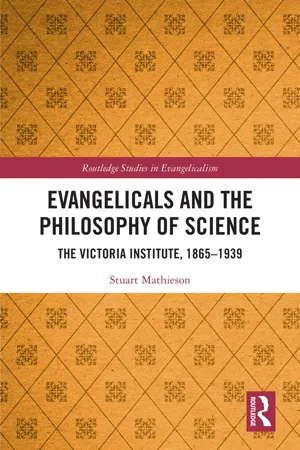
Evangelicals and the Philosophy of Science
eBook - ePub

Evangelicals and the Philosophy of Science

The Victoria Institute, 1865-1939

  1. 172 pages
  2. English
  3. ePUB (mobile friendly)
  4. Available on iOS & Android
eBook - ePub

Evangelicals and the Philosophy of Science

The Victoria Institute, 1865-1939

About this book

This book investigates the debates around religion and science at the influential Victoria Institute. Founded in London in 1865, and largely drawn from the evangelical wing of the Church of England, it had as its prime objective the defence of 'the great truths revealed in Holy Scripture' from 'the opposition of science, falsely so called'. The conflict for them was not between science and religion directly, but what exactly constituted true science.

Chapters cover the Victoria Institute's formation, its heyday in the late nineteenth century, and its decline in the years following the First World War. They show that at stake was more than any particular theory; rather, it was an entire worldview, combining theology, epistemology, and philosophy of science. Therefore, instead of simply offering a survey of religious responses to evolutionary theory, this study demonstrates the complex relationship between science, evangelical religion, and society in the years after Darwin's Origin of Species. It also offers some insight as to why conservative evangelicals did not display the militancy of some American fundamentalists with whom they shared so many of their intellectual commitments.

Filling in a significant gap in the literature around modern attitudes to religion and science, this book will be of keen interest to scholars of Religious Studies, the History of Religion, and Science and Religion.

Trusted by 375,005 students

Access to over 1.5 million titles for a fair monthly price.

Study more efficiently using our study tools.

Information

Publisher
Routledge
Year
2020
Print ISBN
9780367856700
eBook ISBN
9781000296211

1 A safe haven for true science

‘Nobody of note in science, in literature, or theology is likely to be induced to embark his name or his reputation in the adventure’. It is safe to say that the editorial staff at the Birmingham Daily Post were unimpressed at having received a document which ‘has made us rub our eyes and ask if the thing can be a reality, or if it is nothing more than a very ponderous joke’. The offending document was a circular announcing the formation of the Victoria Institute, or Philosophical Society of Great Britain, and which detailed its membership, its plans, and its objectives. The Post questioned the quality of the Victoria Institute’s membership, apart from the Earl of Shaftesbury, mocked its grandiose ambitions, and disapproved of its ‘foolish impression that science and religion are antagonistic’.1 Some of these criticisms were entirely reasonable. The Victoria Institute failed to reach many of its lofty goals, such as obtaining a royal warrant, Queen Victoria agreeing to become its patron, her husband Prince Albert accepting its honorary presidency, or a series of likeminded sister institutes appearing across the world. Its early belligerence and unnecessary combativeness dissuaded several distinguished figures from joining or continuing their membership. Yet some notable names could be found among the almost 200 on its initial membership list. Shaftesbury, a ubiquitous figure on the councils of evangelical societies, was certainly the best known, but there were others from his circle of philanthropic gentleman evangelists, such as John Derby Allcroft, Benjamin Bond Cabbell, and the Earl of Carnarvon. There were also well-known evangelical ministers, such as William Arthur and William Pennefather, while Joseph Baylee and Edward Garbett would have been familiar to readers of the Record, the newspaper of the evangelical party within the Church of England.2 Fewer scientists had signed up, although the entomologist Thomas Vernon Wollaston and the chemists George Warington and John Hall Gladstone were fairly well known for their religious beliefs, whereas Philip Henry Gosse, the Brethren naturalist and popular science writer, was famous both for sparking an aquarium craze and for his controversial attempt to unite Genesis and geology, Omphalos (1857).3 Eventually, however, the Victoria Institute could count among its members the physicists Sir George Gabriel Stokes and Lord Kelvin, the surgeon Joseph Lister, the archaeologist Flinders Petrie, the Assyriologist Archibald Henry Sayce, the Lord Chancellor, the Archbishop of Canterbury, and dozens of prominent evangelical theologians, including Handley Moule, Henry Wace, James Iverach, and Francis Landey Patton. While its more ambitious aims were never realised, the Victoria Institute was nevertheless a qualified success. During its heyday in the 1880s, it had nearly 2,000 members scattered across the Anglophone world. Its journal, Journal of the Transactions of the Victoria Institute (JTVI), was printed in London, Paris, Melbourne, Toronto, New York, Calcutta, and Cape Town and contained verbatim accounts of the papers presented at its London premises, where it also kept a library and reading room. It exchanged transactions with dozens of learned societies and institutions, from the Royal Society to the United States Geological Survey. Remarkably, despite declining fortunes and a collapse in membership following the First World War, the Victoria Institute still exists today, using the working name Faith and Thought.4

1 Birmingham Daily Post, 1 June 1865.
2 John Wolffe, Recordites (act. 1828-c. 1860), ODNB.
3 For an excellent biography of Gosse, see Ann Thwaite, Glimpses of the wonderful: the life of Philip Henry Gosse, 1810–1888 (London, 2002). Thwaite heavily revises the image of Gosse that is presented in the autobiography of his son: Edmund Gosse, Father and son: a study of two temperaments (London, 1907).
4 Its journal, JTVI, was renamed Faith and Thought in 1958, and in 1988 merged into Science and Christian Belief, a cooperative effort with the evangelical group Christians in Science.

Being mocked in the pages of a provincial newspaper is an inauspicious beginning for any society, but the Victoria Institute managed to overcome this hurdle and, eventually, to thrive. Along the way, it had to contend with various obstacles, frequently self-inflicted, including precarious finances, overambitious goals, and one particularly bellicose council member who dominated proceedings and who refused to accept Newton’s theory of gravity. How and why did a circular announcing the formation of a society ‘to defend the revealed truth of Holy Scripture against objections arising, not from real science, but from pseudoscience’ arrive in the newsrooms of England’s regional press in the summer of 1865?5 The long-term causes were a result of the intellectual environment described in the preceding chapter, culminating in the near-simultaneous publication of Essays and Reviews and Origin of Species. One of the more immediate causes, however, was a meeting of the Anthropological Society of London on 16 May 1865, at which John William Colenso, the bishop of Natal, presented a paper ‘On the efforts of missionaries among savages’.6 Colenso was a controversial figure, particularly among evangelicals. The Record had criticised him for dedicating a book of sermons to the theologian Frederick Denison Maurice, who had been dismissed from Kings College, London, for heterodox views. Colenso’s biblical criticism, particularly evident in his The Pentateuch and the Book of Joshua, Critically Examined (1862), had seen him tried for heresy and deposed from his South African bishopric, a decision he had successfully appealed to the Privy Council.7 At the Anthropological Society, however, the controversy came from Colenso’s suggestion that ‘the elementary truths of geological science… flatly contradict the accounts of the Creation and the Deluge’ and his invocation of Frederick Temple, a contributor to Essays and Reviews, to argue that ‘the simple facts revealed by Modern Science… are utterly irreconcilable with Scripture statements, if these are taken as announcing literal historical truth’.8 This outraged some members of the audience, several of whom would form the nucleus of the early Victoria Institute. James Reddie, a senior civil servant at the Admiralty, and the Revd William Josiah Irons, prebendary of St Paul’s Cathedral and vicar of Holy Trinity, Brompton, were so incensed that they castigated Colenso in the discussion after his lecture. Irons was unusual among early Victoria Institute members for his High Church views, but he had produced a blistering response to Essays and Reviews in 1862, over which he and Reddie made common cause.9 The two dominated the post-lecture debate to the extent that proceedings were brought to a close with several other Victoria Institute members, including Captain Edmund Gardiner Fishbourne and H. Burnard Owen, on their feet waiting to speak. Reddie and Irons had frequently discussed the necessity ‘of a philosophical union among all “who name the Name of Christ,” our common Lord, to confront the devastating literature which, in new and various forms, ultimately denies that Name’, and, within a week, plans to realise this ambition were set in motion.10

5 James Reddie, Scientia scientiarum: being some account of the origin and objects of the Victoria Institute, or Philosophical Society of Great Britain (London, 1866), p. 1.
6 J. W. Colenso, ‘On the efforts of missionaries among savages’, Journal of the Anthropological Society of London 3 (1865), pp. ccxlviii–­cclxxxix.
7 Timothy Larsen, ‘Bishop Colenso and his critics: the strange emergence of biblical ­criticism in Victorian Britain’, Scottish Journal of Theology 50 (1997), pp. 433–58.
8 Colenso, ‘On the efforts of missionaries among savages’, p. cclxxiv.
9 E. M. Goulburn, H. J. Rose, C. A. Heurtley, W. J. Irons, G. Rorison, A. W. Haddan, and C. Wordsworth, Replies to Essays and Reviews (Oxford, 1862).
10 W. J. Irons, ‘Annual address’, JTVI 6 (1873), p. 284.

The first committee

On 24 May 1865, a circular was printed and distributed to public figures and newspapers, announcing the proposed formation of ‘a new Philosophical Society for Great Britain’ whose members were to be ‘professedly Christians, and the great object of which will be to defend revealed truth from “the opposition of science, falsely so-called”’.11 If the choice of date was accidental, it was certainly fortuitous: it was the birthday of Queen Victoria, and therefore, immediately drew attention to the name of this new society. Some regional newspapers, such as the Hull Packet and East Riding Times, were less critical than the Birmingham Daily Post and simply announced ‘A Christian Scientific Society’, without additional commentary.12 Other responses were explicitly positive and, buoyed, the group that had commissioned the first circular issued another, inviting interested parties to a meeting on 16 June 1865. At this meeting, presided over by Shaftesbury, a provisional committee was formed, with responsibility for drawing up the objects, constitution, and terms of membership for the new society. This steeri...

Table of contents

  1. Cover
  2. Half Title
  3. Series Page
  4. Title Page
  5. Copyright Page
  6. Dedication
  7. Table of Contents
  8. Acknowledgements
  9. Abbreviations
  10. Introduction
  11. 1 A safe haven for true science
  12. 2 Reading God’s two books: conflict, harmony, and natural theology
  13. 3 Darwin, Darwinism, and the Darwinists
  14. 4 Rock of ages: genesis, geology, and human antiquity
  15. 5 Confronting the higher critics: scriptural geography and biblical archaeology
  16. 6 Between the wars: fundamentalism and decline
  17. Conclusion
  18. Bibliography
  19. Index

Frequently asked questions

Yes, you can cancel anytime from the Subscription tab in your account settings on the Perlego website. Your subscription will stay active until the end of your current billing period. Learn how to cancel your subscription
No, books cannot be downloaded as external files, such as PDFs, for use outside of Perlego. However, you can download books within the Perlego app for offline reading on mobile or tablet. Learn how to download books offline
Perlego offers two plans: Essential and Complete
  • Essential is ideal for learners and professionals who enjoy exploring a wide range of subjects. Access the Essential Library with 800,000+ trusted titles and best-sellers across business, personal growth, and the humanities. Includes unlimited reading time and Standard Read Aloud voice.
  • Complete: Perfect for advanced learners and researchers needing full, unrestricted access. Unlock 1.5M+ books across hundreds of subjects, including academic and specialized titles. The Complete Plan also includes advanced features like Premium Read Aloud and Research Assistant.
Both plans are available with monthly, semester, or annual billing cycles.
We are an online textbook subscription service, where you can get access to an entire online library for less than the price of a single book per month. With over 1.5 million books across 990+ topics, we’ve got you covered! Learn about our mission
Look out for the read-aloud symbol on your next book to see if you can listen to it. The read-aloud tool reads text aloud for you, highlighting the text as it is being read. You can pause it, speed it up and slow it down. Learn more about Read Aloud
Yes! You can use the Perlego app on both iOS and Android devices to read anytime, anywhere — even offline. Perfect for commutes or when you’re on the go.
Please note we cannot support devices running on iOS 13 and Android 7 or earlier. Learn more about using the app
Yes, you can access Evangelicals and the Philosophy of Science by Stuart Mathieson in PDF and/or ePUB format, as well as other popular books in Theology & Religion & 19th Century History. We have over 1.5 million books available in our catalogue for you to explore.