- 392 pages
- English
- ePUB (mobile friendly)
- Available on iOS & Android
eBook - ePub
About this book
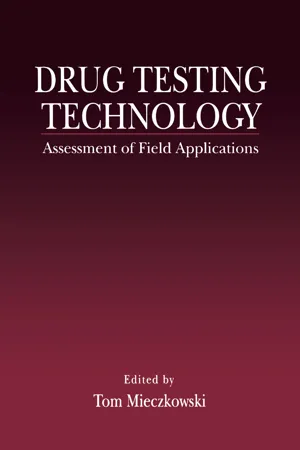
Covering a wide range of research currently being done in drug analysis, Drug Testing Technology: Assessment of Field Applications compares and evaluates various methods used to determine abused drugs taken by individuals, and their application in various programs and contexts.
Controversies associated with various methods, including urine analysis and hair analysis, are examined. Contributors from a wide diversity of disciplines offer advanced knowledge, encompassing work which is technical as well as markedly philosophical.
Chapters provide overviews of drug incorporation into hair; the use of hair analysis for compliance measurement in the use of anti-epileptic medications; and the application of drug testing to the psychiatric treatment of substance abuse disorders.
Drug Testing Technology: Assessment of Field Applications provides information useful in medical applications, workplace testing, criminal justice monitoring community epidemiology, and drug treatment assessment.
1 The Assessment of Therapeutic Compliance Based upon the Analysis of Drug Concentrations in Hair
John Williams, Ph.D.
CONTENTS
1.1 Major Issues of Therapeutic Noncompliance
1.2 Established Methods of Monitoring Therapeutic Compliance
1.2.1 Indirect Methods of Assessment
1.2.2 Direct Methods of Assessment
1.3 History of the Use of Hair in the Detection of Drugs
1.4 Physiology of Hair
1.5 Mechanism of Drug Incorporation into Hair
1.6 Studies on the Relationship between Drug Intake and Hair Concentration
1.7 A Prospective Study to Assess the Relationship between the Prescribed Dose of Carbamazepine and the Concentration of the Drug in Respective Samples of Hair and Plasma
1.8 Segmental Analysis of Hair and Its Temporal Relationship to Drug Taking
1.9 Overall Assessment of the Technique
References
1.1 MAJOR ISSUES OF THERAPEUTIC NONCOMPLIANCE
Compliance has been defined as “the extent to which a patient’s behavior (in terms of medications, following diets, or executing life-style changes) coincides with the medical or health advice given.” In terms of therapeutic compliance, it relates to the taking of the prescribed medication as instructed by the clinician. Failure to adhere to these instructions, whether deliberately or unintentionally, is referred to as noncompliance.
This problem is not just a feature of recent times. The Greek physician Hippocrates wrote, “Keep watch also on the fault of patients which often make them lie about the taking of things prescribed,” as early as the 5th century B.C.
The reasons for noncompliance are diverse and are influenced by a variety of mitigating factors. In many cases, it is attributed to unintentional factors such as forgetfulness, particularly in the elderly where the problem can be further exacerbated by the complexity of the regimen. The greater the frequency that medication has to be taken, the greater the degree of noncompliance.1 Where patients are being treated for more than one clinical condition, noncompliance is invariably exacerbated.
In many cases, patients contradict the clinical diagnosis and become convinced that the medication is unnecessary. In a 1982 study, the American Association of Retired Persons,2 reported that 21 percent of patients over 45 years of age chose not to follow the recommendations of the physician from the outset and in effect became the primary decision makers.
Other reasons for noncompliance are that the patient perceives that the condition has improved. Very often there is concern about side effects either from personal experience or emanating from information published in newspapers or highlighted on television. About 10 percent can be attributed to the cost of the medication.
There is however little evidence to suggest that noncompliance is related to income, social class, occupation, or educational background.3
Whatever the reason for noncompliance, it presents a major problem in many areas of therapeutic medicine, and although technology and the pharmaceutical industries have gone to great lengths to devise methods of improving compliance, noncompliance remains as ...
Table of contents
- Cover
- Half Title
- Title Page
- Copyright Page
- Preface
- Author
- Contributors
- Acknowledgement
- Table of Contents
- Chapter 1 The Assessment of Therapeutic Compliance Based upon the Analysis of Drug Concentrations in Hair
- Chapter 2 Novel Biological and Mechanical Analysis Techniques for Alcohol and Other Drugs of Abuse: Their Role in Addiction Management and Psychiatric Treatment
- Chapter 3 The Effects of Physiochemical Factors on Incorporation of Drugs into Hair and Behavior of Drugs in Hair Root
- Chapter 4 The Utilization of Ion Mobility Spectrometry in a Criminal Justice Field Application
- Chapter 5 A Comparison of Self-Report, Urine Sample, and Hair Sample Testing for Drug Use: A Longitudinal Study
- Chapter 6 Validation of the Substance Abuse Subtle Screening Inventory (SASSI) with Female Juvenile Detainees
- Chapter 7 Drug Monitoring in the Field: Applying Hair Assays and Urinalysis for Cocaine to Probationers
- Chapter 8 Drug Testing Applications in an Offender Diversion Program
- Chapter 9 Testing for Drugs of Abuse in the Pediatric Population
- Chapter 10 Hair Samples for Documenting the Impact of Gestational Cocaine Exposure on Children and Mothers
- Chapter 11 Improving the Validity of Behavioral Drug Abuse Research through Drug Testing
- Chapter 12 The Feasibility of Hair Testing in a Household Survey on Drug Abuse
- Chapter 13 Drug Assessment Methods in the Workplace
- Chapter 14 Workplace Drug Testing by Hair Analysis: Advantages and Issues
- Chapter 15 An Analysis of the Racial Bias Controversy in the Use of Hair Assays
- Chapter 16 The Missing Strand: A Feminist Analysis of Hair Testing Women in Research Protocols
- Index
Trusted by 375,005 students
Access to over 1.5 million titles for a fair monthly price.
Study more efficiently using our study tools.
Frequently asked questions
Yes, you can cancel anytime from the Subscription tab in your account settings on the Perlego website. Your subscription will stay active until the end of your current billing period. Learn how to cancel your subscription
No, books cannot be downloaded as external files, such as PDFs, for use outside of Perlego. However, you can download books within the Perlego app for offline reading on mobile or tablet. Learn how to download books offline
Perlego offers two plans: Essential and Complete
- Essential is ideal for learners and professionals who enjoy exploring a wide range of subjects. Access the Essential Library with 800,000+ trusted titles and best-sellers across business, personal growth, and the humanities. Includes unlimited reading time and Standard Read Aloud voice.
- Complete: Perfect for advanced learners and researchers needing full, unrestricted access. Unlock 1.5M+ books across hundreds of subjects, including academic and specialized titles. The Complete Plan also includes advanced features like Premium Read Aloud and Research Assistant.
We are an online textbook subscription service, where you can get access to an entire online library for less than the price of a single book per month. With over 1.5 million books across 990+ topics, we’ve got you covered! Learn about our mission
Look out for the read-aloud symbol on your next book to see if you can listen to it. The read-aloud tool reads text aloud for you, highlighting the text as it is being read. You can pause it, speed it up and slow it down. Learn more about Read Aloud
Yes! You can use the Perlego app on both iOS and Android devices to read anytime, anywhere — even offline. Perfect for commutes or when you’re on the go.
Please note we cannot support devices running on iOS 13 and Android 7 or earlier. Learn more about using the app
Please note we cannot support devices running on iOS 13 and Android 7 or earlier. Learn more about using the app
Yes, you can access Drug Testing Technology by Tom Mieczkowski in PDF and/or ePUB format, as well as other popular books in Law & Forensic Science. We have over 1.5 million books available in our catalogue for you to explore.