This book reflects multidisciplinary and cross-jurisdictional analysis of issues surrounding Fetal Alcohol Spectrum Disorders (FASD) and the criminal justice system, and the impact on Aboriginal children, young people, and their families.
This book provides the first comprehensive and multidisciplinary account of FASD and its implications for the criminal justice system – from prevalence and diagnosis to sentencing and culturally secure training for custodial officers. Situated within a 'decolonising' approach, the authors explore the potential for increased diversion into Aboriginal community-managed, on-country programmes, enabled through innovation at the point of first contact with the police, and non-adversarial, needs-focussed courts. Bringing together advanced thinking in criminology, Aboriginal justice issues, law, paediatrics, social work, and Indigenous mental health and well-being, the book is grounded in research undertaken in Australia, Canada, and New Zealand. The authors argue for the radical recalibration of both theory and practice around diversion, intervention, and the role of courts to significantly lower rates of incarceration; that Aboriginal communities and families are best placed to construct the social and cultural scaffolding around vulnerable youth that could prevent damaging contact with the mainstream justice system; and that early diagnosis and assessment of FASD may make a crucial difference to the life chances of Aboriginal youth and their families.
Exploring how, far from providing solutions to FASD, the mainstream criminal justice system increases the likelihood of adverse outcomes for children with FASD and their families, this innovative book will be of great value to researchers and students worldwide interested in criminal and social justice, criminology, youth justice, social work, and education.
eBook - ePub
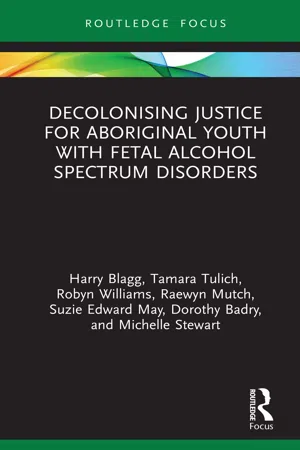
Decolonising Justice for Aboriginal youth with Fetal Alcohol Spectrum Disorders
- 188 pages
- English
- ePUB (mobile friendly)
- Available on iOS & Android
eBook - ePub
Decolonising Justice for Aboriginal youth with Fetal Alcohol Spectrum Disorders
About this book
1 Introduction
Tamara Tulich, Harry Blagg, Robyn Williams, Dorothy Badry, Michelle Stewart, Raewyn Mutch, and Suzie Edward May
Introduction
Aboriginal youth with Fetal Alcohol Spectrum Disorders (FASD) are worryingly overrepresented in the criminal justice system in Australia, mirroring the experience in other settler states including Canada, New Zealand, and the United States. FASD results from exposure to alcohol in utero, leading to cognitive, social, and behavioural difficulties, including difficulties with language, memory, impulse control, and linking actions to consequences (Douglas, 2010). American research suggests that over half of persons with FASD will interact with the criminal justice system: around 60% will be arrested, charged, or convicted of a criminal offence, and about half will have spent time in juvenile detention, prison, inpatient treatment, or mental health detention (Streissguth, Barr, Kogan & Bookstein, 1997; Streissguth, Bookstein & Barr, 2004). Canadian research indicates that young people with FASD are 19 times more likely to be arrested than their peers (Popova, Lange, Bekmuradov, Mihic & Rehm, 2011). A recent study undertaken in Western Australia’s juvenile detention centre found that 36 out of 100 youth detainees had FASD, with 34 of the 36 identifying as Aboriginal. This is ‘the highest reported prevalence of FASD in a youth setting worldwide’ (Bower et al., 2018, p. 7). Repeated contact with the criminal justice system compounds the condition and causes contributory outcomes, such as psychiatric disorders (O’Malley, 2007), reinforcing the vulnerability of a person with FASD to contact with the criminal justice system (as victims and offenders) (Blagg & Tulich, 2018; Blagg, Tulich & Bush, 2016, 2017; Koren, 2004). At the same time, there is a growing collection of parliamentary reports, case law, and commentary highlighting the inadequate accommodation of FASD-associated impairments within the criminal justice system in Australia, particularly for Aboriginal youth.
The aim of this book is to provide a multidisciplinary and cross-jurisdictional analysis of issues surrounding FASD and the criminal justice system, and its impact on Aboriginal children, young people, and their families. It is largely based on research in Australia and Canada; however, it also makes reference to the experience in the USA and New Zealand, especially the latter, due to its commitment to legislative reform and Indigenous empowerment. One of the key themes through the text is that, far from providing solutions to FASD, the mainstream criminal justice system increases the likelihood of adverse outcomes for children with FASD and their families. Over the last few decades youth justice systems in many Western societies have been increasingly modelled on the adult criminal justice system, as part of a US-initiated ‘punitive turn’ in sentencing (Simon, 2007). There is a much greater focus than hitherto on risk management, punishment, and offender accountability, eclipsing the previous interest in child welfare and development. What John Muncie (2008) calls a populist ‘resurgent authoritarianism’ in criminal justice policy, is dissolving the difference between the adult and the youth justice systems in some jurisdictions. However, this is not a uniform process, and not every element of the US punitive populist agenda has been copied by other jurisdictions. New Zealand, in particular, has maintained a commitment to a child-centred approach, coupled with a commitment to involving family (whānau) in decision making at every stage of contact with the criminal justice system. There are also differences in the approach taken in different Australian states, and territories in Canada, regarding youth justice. In Australia, the state of Victoria has had a relatively low rate of imprisonment for young people, while the Northern Territory and Western Australia have relatively high rates of detention: they also have the highest rate of Indigenous youth incarceration in Australia. This is not surprising since issues of race have fuelled the punitive turn in sentencing according to criminologists (Cunneen 2006, 2018; Simon, 2007; Wacquant 2010, 2014).
The over-representation of Indigenous youth with FASD in the justice systems in settler states is about intersecting forms of oppression that are founded in, and sustained by, settler colonialism. High rates of FASD in Aboriginal communities in Australia are the consequence of unhealed intergenerational and transgenerational trauma linked to colonial violence and dispossession and its pervasive impact on social, emotional, and cultural well-being of individuals, families, and communities (Blagg & Tulich, 2018; Blagg et al., 2016, 2017; Dudgeon, Milroy & Walker, 2014; Williams, 2018). Intergenerational and transgenerational trauma convey the extent to which the pain and trauma associated with colonial dispossession and colonial practices are transmitted from one generation to the next generation and across generations (Atkinson, Nelson, Brooks, Atkinson & Ryan, 2014). The ‘founding violence’ of colonisation has cascaded through time leaving destruction in its wake, and in the words of Professor Judy Atkinson, of the Jiman and Bundjalung peoples, ‘trauma trails’ that ‘run across country and generations’ (Atkinson, 2002, p. 88). The transgenerational impacts of colonisation and colonial trauma were amplified when generations of Aboriginal and Torres Strait Islander children were stolen from their parents and assimilated into statutory systems (Atkinson, 2002). The colonial-trauma is iterative across statutory systems and the impacts are intergenerational and intracellular.
Intergenerational and transgenerational trauma involve many coping mechanisms including alcohol consumption. Maria Yellow Horse Brave Heart (2011) (Hunkpapa and Oglala Lakota) discusses the cumulative impacts of trauma across the life of an individual and across generations, which can result in self-medicating with substances to avoid these painful memories or experiences. Emily Carter (2017, Weston & Thomas, 2018, p. 4), a Gooniyandi Kija woman from the central Kimberley, and CEO of Marninwarntikura Women’s Resource Centre in Fitzroy Crossing, explains:
We can’t understand anything about FASD without understanding trauma. Many in the Fitzroy Valley drink so they don’t have to feel the overwhelming emotions triggered by trauma. Instead of judging people for the outcome of their actions we must start asking what has happened. As soon as we look beyond the judgement, we can start changing the outcome and create better futures.
This requires us to decolonise FASD as a disability: to recognise the connection between FASD and inherited disparity as a consequence of colonisation, and the role of colonisation in the production of impairment and disability (Chisholm, Tulich & Blagg, 2017; Grech & Soldatic, 2015; Hollingsworth, 2013; Jaffee, 2016; Meekosha, 2011; Soldatic, 2013, 2015). Disability compounds the disparities confronting Indigenous populations, and racism further contributes to the disproportionate social, health, and economic disadvantages (Green et al., 2018; see also Macedo, Smithers, Roberts, Paradies & Jamieson, 2019). This continues to be reflected in the higher prevalence rate of disability amongst Indigenous populations than the settler mainstream in Australia, Canada, and the United States (Fitts & Soldatic, 2020), and the higher prevalence rate of First Nations peoples with disability in the criminal justice systems in settler states (Australian Law Reform Commission [ALRC], 2018; Australian Institute of Health and Welfare [AIHW], 2018). The over-representation of impairment amongst Aboriginal peoples in Australian is both a product of, and continuously produced by, the settler state. Soldatic (2015, p. 64) explains:
It has been suggested that the over-representation of impairment is a reflection of Aboriginal Australians’ dispossession, or to use a term from Deborah Rose (2006), a ‘double death’ – the interstice of white-settler disabling societies and colonizing violence and dispossession – producing impairment and disablement.
Increasingly Indigenous peoples in settler colonial societies maintain that meaningful change requires a process of decolonisation, rather than the reform, of the criminal justice process (Agozino, 2004; Anthony, 2013; Cunneen & Tauri, 2017, 2019; Jackson, 1987; Park, 2015; Tauri, 2016a, b). In opposition to the ‘correctionalisation’ of youth justice, we advocate for an approach that recognises the unique needs of children and young people, and strengths of First Nations communities, and that is situated in a decolonising perspective. Dr Ambelin Kwaymullina (2020, pp. 62–63), of the Palyku people of the Pilbara region in Western Australia, explains a strengths-based approach:
A strengths-based approachrecognisesthe great giftsresilienceknowledgesof Indigenous peoplesAnd seeks to build uponcelebrateutilisethese strengthsA strengths-based approachrecognisesthat the cause of Indigenous disadvantageis dispossessionand all that was doneto achieve itsustain itjustify itWe are not a problem to be solvedwe are partners on pathwaysto all the knowledgesinventionsjoyswondersthat will come out of respectful relationships
We argue for a strategic framework for the management of FASD that is multidisciplinary and community-focussed, prioritising diversion from the criminal justice system into community-owned networks of care and support. It is not enough to develop multidisciplinary approaches and multi-disciplinary teamwork if Indigenous knowledges are excluded from the process. Initiatives on a local level must be initiated from the bottom up, not the top down, be led by Aboriginal and Torres Strait Islander peoples and centre Aboriginal and Torres Strai...
Table of contents
- Cover
- Half Title
- Series Page
- Title Page
- Copyright Page
- Dedication
- Table of Contents
- Author biographies
- Foreword
- Acknowledgements
- 1 Introduction
- 2 Children, adolescents, and FASD in the criminal justice system
- 3 FASD prevalence and assessment
- 4 FASD in the courts: fitness to stand trial
- 5 Sentencing and courts
- 6 A decolonising and human rights approach to FASD training, knowledge, and case practice for justice involved youth in correctional contexts
- 7 FASD, the criminal justice system, and Indigenous people: diversionary pathways and decolonising strategies
- 8 FASD, justice, decolonisation, and the dis-ease of settler colonialism: contemporary justice issues in Canada
- 9 Conclusion
- Index
Trusted by 375,005 students
Access to over 1.5 million titles for a fair monthly price.
Study more efficiently using our study tools.
Frequently asked questions
Yes, you can cancel anytime from the Subscription tab in your account settings on the Perlego website. Your subscription will stay active until the end of your current billing period. Learn how to cancel your subscription
No, books cannot be downloaded as external files, such as PDFs, for use outside of Perlego. However, you can download books within the Perlego app for offline reading on mobile or tablet. Learn how to download books offline
Perlego offers two plans: Essential and Complete
- Essential is ideal for learners and professionals who enjoy exploring a wide range of subjects. Access the Essential Library with 800,000+ trusted titles and best-sellers across business, personal growth, and the humanities. Includes unlimited reading time and Standard Read Aloud voice.
- Complete: Perfect for advanced learners and researchers needing full, unrestricted access. Unlock 1.5M+ books across hundreds of subjects, including academic and specialized titles. The Complete Plan also includes advanced features like Premium Read Aloud and Research Assistant.
We are an online textbook subscription service, where you can get access to an entire online library for less than the price of a single book per month. With over 1.5 million books across 990+ topics, we’ve got you covered! Learn about our mission
Look out for the read-aloud symbol on your next book to see if you can listen to it. The read-aloud tool reads text aloud for you, highlighting the text as it is being read. You can pause it, speed it up and slow it down. Learn more about Read Aloud
Yes! You can use the Perlego app on both iOS and Android devices to read anytime, anywhere — even offline. Perfect for commutes or when you’re on the go.
Please note we cannot support devices running on iOS 13 and Android 7 or earlier. Learn more about using the app
Please note we cannot support devices running on iOS 13 and Android 7 or earlier. Learn more about using the app
Yes, you can access Decolonising Justice for Aboriginal youth with Fetal Alcohol Spectrum Disorders by Harry Blagg,Tamara Tulich,Robyn Williams,Raewyn Mutch,Suzie Edward May,Dorothy Badry,Michelle Stewart in PDF and/or ePUB format, as well as other popular books in Law & Criminal Law. We have over 1.5 million books available in our catalogue for you to explore.