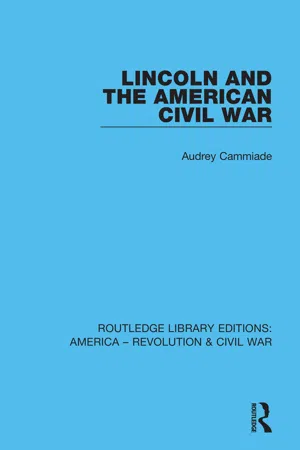
Originally published in 1967, this book is a concise and ideal study of one of the most important periods of American history and is ideal for A Level students and as an introduction for undergraduates. It discusses the social, economic and political context for Lincoln's meteoric rise and the legacy of his many achievements including the abolition of slavery.
- 94 pages
- English
- ePUB (mobile friendly)
- Available on iOS & Android
eBook - ePub
Lincoln and the American Civil War
LINCOLN AND THE CIVIL WAR
To create an ideal form of government is all very well provided you can also create the men to be governed and the country they are to live in. The Founding Fathers who drew up the Constitution of the United States had to take the men and the country ready-made. As delegates of all the thirteen original States except Rhode Island, they met in Philadelphia in 1787 to “revise the Articles of Confederation”, but found themselves involved in an even bigger task. What they really did was to weld the States into one nation.
It was difficult because the States were so unalike. Their climates were different, for they were strung out over more than a thousand miles of coastline. They had been colonised at different times and for different reasons. They were different in size and in strength, in soil and in ways of living.
The most northerly had a hardworking, puritanical population mainly from England. Winters were cold there and life was strenuous; industries were growing fast. But in the South the planters lived the easy, spacious lives of country gentlefolk, with Negro slaves to do most of the manual work. Between these two extremes was a land of mixed races, of small farms and thriving towns. Merchants and professional men and shipbuilders could have very much the same kind of social life as they would have had in western Europe. Negro slaves were much rarer there than in the South, but there were plenty of indentured servants – men and women whose passages from Europe had been paid for them by their employers, and who were still working off their debt.
Beyond all this, to the west, were enormous regions still to be developed. Farms were being hacked out of the primeval forest by families of settlers – men, women and children working to the limits of their strength. Soap, candles and cloth were not bought from shops in those parts, but made by the women in their log cabins. Meat did not come from a butcher but was stalked by father – or perhaps by mother – with a gun. This great hinterland had to be borne very much in mind, for as time went on it, too, would become part of the Union.
Unity
The people of all these regions could not be expected to live in exactly the same way or obey exactly the same laws. Each State drew up its own Constitution. Within limits it dealt with things like roadmaking, education, crime and punishment, as suited it best. What the Founding Fathers had to do was to provide a central Constitution for them all, and to set up a Federal Government that would control the things by which all of them were affected. Customs duties, postal services, the Army and Navy, foreign affairs – these must be controlled on behalf of the whole country, by representatives of the whole country. And certain individual rights must be assured to every citizen, no matter what State he belonged to. So the Constitution was drawn up, in the name of “the People”, as a solemn contract, entered into by every citizen on behalf of himself and his descendants.
If individual States were to break the contract and set up on their own, then, as the Founding Fathers saw it, those States would destroy themselves and each other. They would go to war just as neighbouring countries in Europe went to war. Each would have to keep a standing army of its own, at a great sacrifice of money and personal liberty; and the weaker would still be in danger from the stronger, the stronger in danger from outside attack. Whatever happened, the Union must stay united. This was an article of faith for future Americans, among them Abraham Lincoln.
Between 1789, when the Constitution went into effect, and the outbreak of the Civil War, several States did consider breaking away – seceding, as it was called. But the Union held good and no State did actually secede, until December 1860.
Slavery
The Founding Fathers had to accept slavery whether they liked it or not. Some admitted privately that they did not like it at all, but they could not simply do away with it by law. The Southern States had depended on it for about a hundred and fifty years, and would certainly refuse to join a Union in which it was forbidden. Accordingly, the Fathers, without using the word “slavery”, laid down that if “a person held to service” in one State escaped to another, he was to be “delivered up on claim of the party to whom such service or labour might be due”. In other words, runaway slaves were to be handed back to their masters. Nothing was said about who was responsible for handing them back: and later on Governors of non-slave States were apt to say that this was no duty of theirs – the Federal Government must see to it.
The Constitution also declared that after the end of 1807 Congress might prevent “the imigration or importation” of certain classes of “persons”. Congress did, in fact, make the slave-trade illegal after that date. So shipbuilders and shipowners could no longer make fortunes out of it – at least, not openly. Many did very well out of it in secret. In theory, sea captains could be put to death for it: in practice, not one of them was, until Abraham Lincoln, as President, decided not to reprieve a contraband slave-trader called Gordon. Lincoln, most merciful of men, was widely blamed for this piece of “brutality”.
Perhaps Lincoln was right in his belief that the Founding Fathers counted on slavery’s dying out of its own accord. But nothing of the sort happened. In 1790 there were about 700,000 slaves in the Union: in 1860 there were about 3,500,000, and South Carolina had two Negroes to every white. But there were far fewer in the North, and those few were free. The Northern climate, and the Northerners’ work, were less suitable for them. Besides, white workers were pouring in from Europe, and did not want slave labour to compete with. The North not only did not want the Negro as a slave: it did not want him at all. But the South felt it couldn’t carry on without him.
The Southern planter would point out that his Negroes were better fed, better cared for, safer and happier than the factory workers of the North. He gave them meat and corn, shoes in winter, cabins to live in, and medical treatment when they were ill. They could not marry without his consent – but he usually consented, because he liked them to marry and have children, since the children were also his property. They might be beaten – but they were seldom beaten severely, because he liked them to be fit for work. They might have long hours – but so had the factory hands. They might be kept ignorant, and indeed in South Carolina it was unlawful to teach them to read – but children seldom complain of not having lessons, and grown Negroes in those days were often very like children. They might be too dependent on their owner’s will – but the big plantation-owner, as a rule, was not a brute. He was often a very pleasant person indeed. He naturally preferred to be surrounded by gaiety and affection, if he could afford it.

A slave auction
It was when he could not afford it that his Negroes’ troubles were worst. In her famous novel, Uncle Tom’s Cabin, published in the 1850s, Harriet Beecher Stowe described the sufferings of helpless slaves whose master had to sell them. They were bundled off in chains to slave-markets like cattle, or like men guilty of hideous crime. Families were often separated and small children made to work for strangers. Young girls were publicly humiliated as auctioneers showed them off to the crowd, commenting on their beauty or strength. And though extreme cruelty was punishable by law, a Negro could not give evidence in court against a white man, even in free States such as Illinois. If he were ill-treated, he had to put up with it unless another white man chose to intervene.
The Territories
Meanwhile the Union was expanding to the west and south. In 1803, by the Louisiana Purchase, it bought from France an enormous territory stretching from the Gulf of Mexico to the Canadian border. Later it acquired another huge chunk in the south-west as the result of a short war with Mexico. These lands had to be settled and developed and then, as their populations grew, admitted bit by bit to the Union. For instance, out of part of the Louisiana Purchase were carved the two new States of Arkansas and Missouri. These two became slave States because of their position and climate, but the fate of the lands to the north of them had to be decided. Should slavery be allowed there, or should it not? In 1820 a statesman called Henry Clay suggested the “Missouri Compromise”, by which there should be no slavery in the newly acquired country north of the parallel 36° 40'. This parallel is, in fact, the southern boundary of Missouri itself, but the Compromise did not affect the State, which had already been dealt with.
So far, so good: but the question soon cropped up again. The new land was being populated fast. Many slaveowners wanted to move in, taking their Negroes with them. At the same time, those who stayed in Missouri complained that they were now surrounded on three sides by “free” country to which their slaves could easily escape. And once gone, they were gone for ever. A chain of anti-slavery enthusiasts was ready to shelter them, passing them from family to family and smuggling them in due course over the border into Canada. So the South wanted the Missouri Compromise done away with. The time was coming when two more States would be formed in that area – Kansas and Nebraska. The argument was reopened. Should Kansas and Nebraska be slave States, or free?
The North insisted that they should be free, partly on moral grounds, partly because the poorer Northerners objected very much to seeing the work they wanted for themselves performed by unpaid labour.
In 1850 Clay again tried to solve the problem, without much success. It was becoming more and more urgent. Politicians and businessmen, including the astute Stephen Douglas, who was both, had schemes for Kansas and Nebraska, and wanted to see them achieve statehood and forge ahead. Douglas suggested that the people of the two future States should themselves decide by vote whether to allow slavery or not. He got a Bill to that effect through Congress. Then there was a wild race between North and South to send enough settlers – especially into Kansas – to sway the vote. There was rioting and violence and a certain amount of bloodshed. Five anti-slavery men were killed, and a fiery Northerner named John Brown set out to avenge them. Four of his sons helped him to drag five victims from their cabins and hack them to death with cutlasses. They turned out not to be pro-slavery agitators at all, but that was too bad. John Brown had simply acted as the spirit moved him.
Brown was heard of again a year later, when he tried to rouse the Negroes of Virginia to revolt. He and some twenty followers raided the United States arsenal at Harper’s Ferry, fifty miles or so from Washington. They killed a Negro railway employee this time. Brown was duly caught and hanged, but the North made a hero of him. During the Civil War a Federal Army was to spread destruction in the South, singing as it went:
John Browns body lies a-mouldering in the grave,But his soul goes marching on.
Two more incidents show how tempers were roused over the slavery question. A Negro called Dred Scott was taken by his owner to live in a free State, and it was claimed that he could not legally be carted back to Missouri and re-enslaved. The case came before Chief Justice Taney, who ruled that Scott, like other slaves, had “no rights that the white man was bound to respect” and “might lawfully be treated as an ordinary article of merchandise and traffic whenever a profit could be made by it”. A famous abolitionist, William Lloyd Garrison, declared that if the Dred Scott decision accorded with the Constitution, the Constitution was “a covenant with death and an agreement with hell”. The fact that Scott was soon bought, freed, and installed in a decent job, did not alter what had been said.
Then a Senator, Charles Sumner, made a violently offensive speech about certain slaveowners. He refused to hear the other side of the question, declaring that there was no other side. So a nephew of one of the slaveowners caught him in the Senate when it was almost deserted, and bashed him over the head and back with a cane, so mercilessly that he was an invalid for the next five years. The young man was much applauded for what he had done. He himself said at last that he was tired of being a hero to every bully in the South.

John Brown on the way to his execution
In short, both sides had their heroes – or bullies, whichever way you looked at it. The 1850s were troubled times in America. And in those years Americans first became familiar with the name of Abraham Lincoln.
The Rise of Lincoln
Lincoln was born in 1809 in Kentucky and grew up on a series of farms in the pioneer States of the Middle West. He was good with his fists and good with an axe, but not much use with a gun. He did not seem to like killing things. Local boys accepted him as a leader, partly because he was strong a...
Table of contents
- Cover
- Half Title
- Title Page
- Copyright Page
- Original Half Title
- Frontispiece
- Original Title Page
- Original Copyright Page
- Table of Contents
- Lincoln and the Civil War
- Order of Events
- A Select Book List
- Index
Trusted by 375,005 students
Access to over 1.5 million titles for a fair monthly price.
Study more efficiently using our study tools.
Frequently asked questions
Yes, you can cancel anytime from the Subscription tab in your account settings on the Perlego website. Your subscription will stay active until the end of your current billing period. Learn how to cancel your subscription
No, books cannot be downloaded as external files, such as PDFs, for use outside of Perlego. However, you can download books within the Perlego app for offline reading on mobile or tablet. Learn how to download books offline
Perlego offers two plans: Essential and Complete
- Essential is ideal for learners and professionals who enjoy exploring a wide range of subjects. Access the Essential Library with 800,000+ trusted titles and best-sellers across business, personal growth, and the humanities. Includes unlimited reading time and Standard Read Aloud voice.
- Complete: Perfect for advanced learners and researchers needing full, unrestricted access. Unlock 1.5M+ books across hundreds of subjects, including academic and specialized titles. The Complete Plan also includes advanced features like Premium Read Aloud and Research Assistant.
We are an online textbook subscription service, where you can get access to an entire online library for less than the price of a single book per month. With over 1.5 million books across 990+ topics, we’ve got you covered! Learn about our mission
Look out for the read-aloud symbol on your next book to see if you can listen to it. The read-aloud tool reads text aloud for you, highlighting the text as it is being read. You can pause it, speed it up and slow it down. Learn more about Read Aloud
Yes! You can use the Perlego app on both iOS and Android devices to read anytime, anywhere — even offline. Perfect for commutes or when you’re on the go.
Please note we cannot support devices running on iOS 13 and Android 7 or earlier. Learn more about using the app
Please note we cannot support devices running on iOS 13 and Android 7 or earlier. Learn more about using the app
Yes, you can access Lincoln and the American Civil War by Audrey Cammiade in PDF and/or ePUB format, as well as other popular books in History & American Civil War History. We have over 1.5 million books available in our catalogue for you to explore.