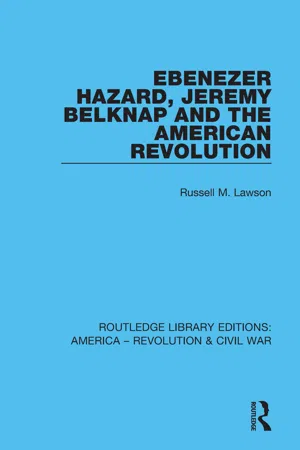
Originally published in 2011, this volume publishes the letters of Jeremy Belknap and Ebenezer Hazard. The letters encompassed twenty years, from 1779 to 1798, during a time when the United States was warring against England, establishing new governments, building a national identity, exploring the hinterland, and refining an American identity in prose and verse. The letters of Hazard and Belknap tell of an age when science and religion had not yet divorced due to irreconcilable differences, when the most profound philosophy nestled comfortably next to a childlike fascination with the remarkable. The two friends explored in their epistles the nature of love, death, and piety; the best way for humans to govern themselves; matters of religious and scientific truth and the best means to arrive at it; the methods and writing of history; human credulity; and the wonders of nature.
eBook - ePub
Ebenezer Hazard, Jeremy Belknap and the American Revolution
- 246 pages
- English
- ePUB (mobile friendly)
- Available on iOS & Android
eBook - ePub
Ebenezer Hazard, Jeremy Belknap and the American Revolution
1 COMMENCEMENT OF A CIVIL WAR
Travellers aboard Knight’s Ferry felt the reluctance of spring to command winter in the icy breeze skimming the cold water of the Piscataqua River. Knight operated his ferry year-round, even during the coldest months of winter, courtesy of the rapid, fluctuating currents of the river, which rarely froze. The waters of half a dozen rivers of New Hampshire and Maine meet off Dover Point, which divides the currents flowing from the Squamscot, Lamprey, Back and Oyster rivers, which mingle in the estuaries known as the Great Bay and Little Bay, from the Piscataqua, formed from the Cocheco and Salmon Falls rivers. Added to the churning mix is the tidal brine of the Atlantic, which inexorably rises and falls through the maze of islands and narrows that mark the Piscataqua between Dover Point and the mouth of the river. Twenty years in the future the Piscat-aqua Bridge would make the ferry obsolete, but until then Knight’s Ferry was the only way for the traveller to cross the river from the southern shores of Newington by way of Bloody Point to Dover Point. This year, 1775, was the seventieth that the Knight family had operated the ferry, the right to which Captain John Knight obtained in 1705.1
Belknap was frequently at Knight’s Ferry coming or going, as he was on Thursday 20 April. Belknap regularly travelled by horseback or on foot to Portsmouth from his home built near the Cocheco Falls; the road led through Dover Point to the confluence of the Piscataqua and waters of the Great Bay, across which was Bloody Point, reached only by means of the ferry. The pastor had many friends and colleagues in Portsmouth and the neighbouring towns of Greenland, Kittery and Newington, having lived in Portsmouth and outlying towns since 1764, initially teaching primary school and studying for his Master’s degree under two local ministers, Samuel Haven of Portsmouth and Samuel MacClintock of Greenland. He was influenced by other divines as well, such as Samuel Langdon, pastor of Portsmouth’s North Parish, later president of Harvard College. Belknap became pastor of the First Parish of Dover in 1767. Once established in Piscataqua society, Belknap became friends with local leaders such as Captain Thomas Waldron of Dover, Theodore Atkinson of Portsmouth, and most notably, Governor John Wentworth. The governor and pastor shared an interest in natural and human history. When in 1773 Belknap had deposed on the Governor’s behalf with the statement that New Hampshirans were ‘equally loyal to their King and jealous of encroachments on their rights and priviledges [sic]’, he doubtless thought that Wentworth would agree. The two had conversed at length over the natural and political history of New Hampshire, and Governor Wentworth had assisted Belknap in acquiring sources for the latter’s work-in-progress, the History of New-Hampshire; indeed, Wentworth had recently read with a critical eye initial chapters of the manuscript, and had sent it back to the minister with his complements.2
On his many visits to Portsmouth, the conservative Belknap sensed the tension felt by the inhabitants brought about by the political debate raging for over a decade regarding the role of the colonies in the British Empire. Townspeople believed that the attack upon Fort William and Mary during the winter of 1774 by local militia not only presaged the beginning of conflict but also provided an apt motive for revenge. The fort, situated on the northern extreme of Newcastle Island overlooking the entrance to Portsmouth Harbor, had been fortified by the British for decades going back to the initial wars with the French for control of North America. In the wake of protests to British policies (such as the Stamp Act in 1765) among the populace and non-importation agreements enforced by Piscataqua merchants directed particularly against the British Tea Act of 1773, the British had determined to reinforce Fort William and Mary and had sent the frigate Scarborough to patrol the mouth of the river and Portsmouth Harbor. Patriots led by John Sullivan and John Langdon had anticipated the renewed British presence by attacking the fort in mid-December, confiscating the guns and ammo and disarming the garrison. Belknap considered the aggressive action too hasty and provocative, and had sympathized with his friend Governor Wentworth who had branded the action treasonous and demanded the arrest of the perpetrators – to no avail. Instead, a revolutionary assembly met at Exeter upriver from Portsmouth on the Squamscot River to determine what to do next to agitate for freedom. Belknap feared what war would bring to the colonies, and that the sometimes misguided order of British authority would give way to the misguided disorder of a rebellious rabble. Belknap considered John Wentworth a worthy man and governor, and could hardly imagine a revolutionary committee equal to his friend’s discretion and benevolence.3
More dangerous to the cause of peace were the activities occurring in Massachusetts, especially during recent years – the Tea Party and the harsh British response, the Coercive Acts (Port Bill). The Boston native Belknap had many friends in Boston with whom he corresponded about recent occurrences. Likewise his father and mother and only sibling, a sister Nabby, lived in the city. The Boston Port Bill, which led to martial law, the arrival of the military governor General Gage, the fortification of the only land entrance and exit to and from the city – the Neck – ‘occasioned’, Belknap wrote, ‘a melancholy prospect of the total ruin of the Town’. One of Belknap’s favourite Boston correspondents was John Eliot. Clever and witty, wearing his heart on his sleeve in his letters and among his friends and family, Eliot tried to keep Belknap abreast of happenings in Boston during the months of growing conflict in the wake of the Tea Party. Eliot shared with Belknap foreboding over the disorderly acts of the inhabitants and overly forceful response of the British ministry. Well informed of political news coming from London, Eliot believed that King George had the Lords and Commons in his pocket, and that a new Parliament in late 1774 meant nothing. Neither Eliot nor Belknap considered independence a worthy alternative to repairing the relationship of the colonies to the Empire. Eliot had met and been entertained by Governor Wentworth during a visit to New Hampshire and, like Belknap, respected and honoured the man. During the early months of 1775, writing either from his father Andrew Eliot’s home in Boston or from Cambridge across the Charles River from Boston, where he was working on his Master’s degree at Harvard, Eliot informed Belknap of the disturbing happenings in Boston and surrounding communities. Eliot, like most residents of Massachusetts, felt uneasy with the presence of the British regular army patrolling the streets. The soldiery and populace were on edge, and sporadic disagreements and conflicts frequently erupted. Eliot befriended a British Lieutenant, Henry Barry, who had entered the pamphlet war over the dispute between the colonies and Empire. Barry argued that the colonies should be glad in their relationship with England; Eliot thought he had some good points, and passed his pamphlets on to Belknap, who responded more critically. Other Americans, less moderate, were vehemently opposed to any kind of economic or political advantages to be gained from membership in the Empire. Arguments and counter-arguments in an atmosphere of intransigence on both sides, the shortage of cool heads of moderation and conciliation, the lack of a disinterested moderator among the powers of Europe, pointed to an ultimate decision by ‘the supreme arbiter of nations’. Even so, the friends of order awaited the arrival of ships from London in early spring bringing words of encouragement. These came and went, with some positive news from the Crown, only to be replaced by further demands from Parliament. Eliot encouraged Belknap to continue behaving as a ‘good politician, gliding between the shoals of Scylla & Carybdis’, working for a peaceful solution in New Hampshire.4
The fatigue of late winter in New England added to the situation in Boston that, John Eliot believed, as he wrote Belknap, presaged war. Bloodshed was coming and little could be done to stop it. The resolutions of the Continental Congress demanding that Parliament restore American rights to their pre-1763 state, denying parliamentary sovereignty in American affairs, were a declaration of war against Britain, according to disillusioned and angry Redcoats such as Lieutenant Barry. Likewise, the hesitant arrival of spring in the Piscataqua Valley did not dispel the gloom that Belknap felt during the first months of 1775. It had become almost certain that a clash between the Redcoats and Patriots much more serious than the attack on Fort William and Mary was shortly to occur. General and Governor of Massachusetts Thomas Gage had convinced himself that the Americans would not respond to British imposition of order. Indeed, Gage wrote to friends in January indicating that American opposition to coercive measures was fading. Meanwhile committees of correspondence were establishing logistics of communication and storing black powder and balls so that the colonials could react to British aggression with a defiant response.5
Like many Bostonians who stayed in the city during the undisguised military occupation, Eliot read with interest the newspaper dialogue between Massachusettensis and Novanglus. With his moderate political views, Eliot suspended judgment on which of the two anonymous debaters carried the day. Massachusettensis ably contended that there could be but one sovereign power in America, and that for rational and historical reasons the colonial legislatures must respect the superiority of Parliament. Although the distance from America to the British Isles forbade actual representations of Americans in the British Parliament, nevertheless Americans were as ably represented by the broad-minded members of Parliament as English subjects in other parts of the empire. How besides, if the American colonies were independently sovereign, could the sovereignty of the British Crown be maintained? Should each colony have its own king? Novanglus responded that the sovereignty of king and Parliament in America had merely been assumed, never agreed upon, especially since the Glorious Revolution of 1689 and its fundamental alteration of the British Constitution. Historical experience and the logic of time and place had led the provincial assemblies to assume sovereignty in domestic affairs, though the Americans, as appendages of empire, respected the authority of the Crown to direct military and commercial affairs. The Americans had been and continued to welcome a relationship with Britain as separate but equal members of a worldwide commonwealth. But that Parliament and the King proclaim themselves sovereign and back it with armed force was absurd, inviting revolution.6
These arguments, along with Lieutenant Barry’s, as relayed by Eliot to Belknap, led the Dover minister to contemplate a possible solution. He thought he had a temporary fix that could stave off war in the suggestion that the colonies agree to help pay England’s war debt from the French-Indian War. But by the time Belknap sent Eliot his idea the latter responded that political and military events were taking over all rational plans and benevolent ideas. Although by the spring of 1775 Belknap realized the apparent imminence of war, he was like other moderate Congregational ministers wavering as to whether or not Americans should strive to be independent from the British. John Eliot, although still a student and younger than Belknap by ten years, similarly felt uncertain about the best course for Americans to take. Eliot was perhaps mirroring the attitude of his father, the Rev. Andrew Eliot, pastor of the New-North Church, to whom Belknap also looked up to. Reading liberal Whig thinkers of the early 1700s especially inspired Andrew Eliot to believe that the British were rejecting their own traditions of liberty and the rule of law; at the same time he could barely contemplate the logical consequence of Whig thought: American independence. Similarly, as late as 1774, Belknap had written a letter to the elder Eliot that included a prayer in which he asked blessings upon ‘the British Nation & all its Dependencies’ as well as ‘the king’, and to ‘give wisdom to his ministry & Parliament & may they seek and pursue the true Interests of the whole Empire’. Belknap prayed that God
let not those dreadful Judgments come upon them which thou has in thy holy word denounced against the throne of Iniquity which frameth mischief by a Law & against those who decree unrighteous decrees.
May the British ‘act with moderation & peace toward all their Subjects that they may not bring the guilt of inocent [sic] blood upon their heads.
Further, ‘mercifully regard this American Continent in our present Distress & Difficulty & pity thy people in the Capital of a neighbouring Province who are suffering oppression and affliction’. Belknap prayed that the people of Boston ‘may … be inclined to comply with what is reasonably required of them’. Although Belknap as early as 1770 had branded the reign of George III as ‘despotic’, he had continued to believe that a ‘divorce’ from England was not the bes...
Table of contents
- Cover
- Half Title
- Title Page
- Copyright Page
- Original Title Page
- Original Copyright Page
- Table of Contents
- Acknowledgements
- Dedication
- Prologue: Epistlers of the Revolution
- 1 Commencement of a Civil War
- 2 Melted Majesty
- 3 Barren as a Pitch-Pine Plain
- 4 Life of a Cabbage
- 5 Hurried Through Life on Horseback
- 6 Touch and Go is a Good Pilot
- 7 War and Greet Brittain
- 8 Keeping the Belly and Back from Grumbling, and the Kitchen-Fire from Going Out
- 9 The Mysteries of Lucina
- 10 Patience and Flannel
- Epilogue: Let Passion be Restrain’d within thy Soul
- Notes
- Works Cited
- Index
Trusted by 375,005 students
Access to over 1.5 million titles for a fair monthly price.
Study more efficiently using our study tools.
Frequently asked questions
Yes, you can cancel anytime from the Subscription tab in your account settings on the Perlego website. Your subscription will stay active until the end of your current billing period. Learn how to cancel your subscription
No, books cannot be downloaded as external files, such as PDFs, for use outside of Perlego. However, you can download books within the Perlego app for offline reading on mobile or tablet. Learn how to download books offline
Perlego offers two plans: Essential and Complete
- Essential is ideal for learners and professionals who enjoy exploring a wide range of subjects. Access the Essential Library with 800,000+ trusted titles and best-sellers across business, personal growth, and the humanities. Includes unlimited reading time and Standard Read Aloud voice.
- Complete: Perfect for advanced learners and researchers needing full, unrestricted access. Unlock 1.5M+ books across hundreds of subjects, including academic and specialized titles. The Complete Plan also includes advanced features like Premium Read Aloud and Research Assistant.
We are an online textbook subscription service, where you can get access to an entire online library for less than the price of a single book per month. With over 1.5 million books across 990+ topics, we’ve got you covered! Learn about our mission
Look out for the read-aloud symbol on your next book to see if you can listen to it. The read-aloud tool reads text aloud for you, highlighting the text as it is being read. You can pause it, speed it up and slow it down. Learn more about Read Aloud
Yes! You can use the Perlego app on both iOS and Android devices to read anytime, anywhere — even offline. Perfect for commutes or when you’re on the go.
Please note we cannot support devices running on iOS 13 and Android 7 or earlier. Learn more about using the app
Please note we cannot support devices running on iOS 13 and Android 7 or earlier. Learn more about using the app
Yes, you can access Ebenezer Hazard, Jeremy Belknap and the American Revolution by Russell M. Lawson,Russell Lawson in PDF and/or ePUB format, as well as other popular books in History & Early American History. We have over 1.5 million books available in our catalogue for you to explore.