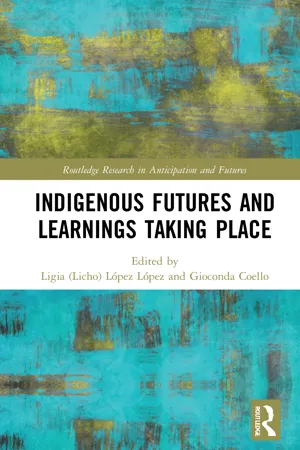
Singularizing progressive time binds pasts, presents, and futures to cause-effect chains overdetermining existence in education and social life more broadly. Indigenous Futures and Learnings Taking Place disrupts the common sense of "futures" in education or "knowledge for the future" by examining the multiplicity of possible destinies in coexistent experiences of living and learning.
Taking place is the intention this book has to embody and world multiplicity across the landscapes that sustain life. The book contends that Indigenous perspectives open spaces for new forms of sociality and relationships with knowledge, time, and landscapes. Through Goanna walking and caring for Country; conjuring encounters between forests, humans, and the more-than-human; dreams, dream literacies, and planes of existence; the spirit realm taking place; ancestral luchas; Musquem h?n?q??min??m? Land pedagogies; and resoluteness and gratitude for atunhetsla/the spirit within, the chapters in the collection become politicocultural and (hi)storical statements challenging the singular order of the future towards multiple encounters of all that is to come. In doing so, Indigenous Futures and Learnings Taking Place offers various points of departure to (hi)story educational futures more responsive to the multiplicities of lives in what has not yet become. The contributors in this volume are Indigenous women, women of Indigenous backgrounds, Black, Red, and Brown women, and women whose scholarship is committed to Indigenous matters across spaces and times. Their work in the chapters often defies prescriptions of academic conventions, and at times occupies them to enunciate ontologies of the not yet. As people historically fabricated "women," their scholarly production critically intervenes on time to break teleological education that births patriarchal-ized and master-ized forms of living. What emerges are presences that undiscipline education and educationalized social life breaking futures out of time.
This book will be of great interest to students and scholars of Indigenous studies, future studies, post-colonial studies in education, settler colonialism and coloniality, diversity and multiculturalism in education, and international comparative education.
Weaving ancestral values, stories and connections with/in/as contemporary presences, places, and practices, seven Dharug women’s yarnings undertaken for the doctoral research project: Country Tracking Voices: Dharug women’s perspectives on presences, places and practices (Rey, 2019), produced a Dharug Ngurra web of belonging, caring, and connecting. Through puppetry, art, dance, song, poetry and yarning, in places of ancestral significance, agentic Ngurra wove presences, places and practices into futures and learnings. In this chapter, Goanna walks us through new relationships with Ngurra-as-city within the academy that revive Dharug Aboriginal cultural ways of knowing, being and doing.
When Dharug Ngurra (Dharug Country) is the majority of cosmopolitan Sydney, Australia, pressures on ecological systems demand our attention as we witness places, presences and ecological processes being dangerously undermined. Recognizing reciprocity as an overriding moral human imperative to care for Country, so that sustainable futures foster continuing presences, is no longer only an Aboriginal custodial obligation. In the Anthropocene, and with devastating climate crises across the globe, all humanity is called to address this imperative.
Apprehending this need requires alternative ways of knowing, doing and being. Finding such alternatives requires relating ourselves in the Universe differently. Arabena positions this as “indigenizing” ourselves to the Universe, so that we can recognize our relational presence and dependency within the cosmos.2 Such an approach opens pathways that decompose human-centric binaried narratives and their extinction industries. Using methodological knowledges gained from earlier research (known as “Goanna3 walking”) it is recognized and demonstrated how alternative ways of knowing, doing and being are continuing in Dharug Ngurra-as-city.4
“Goanna walking” is a third way approach that weaves between ancient sustainable values and those of existing human-centric paradigms and modernity5. It requires walking with steps on the left, those Indigenous ways of knowing, doing and being, wisdoms that have sustained Ngurra for millennia, and walking with steps on the right, involving modernity: the outcome of patriarchal, hierarchical and human-centric methods that continue to underpin globalizing systems that are driving extinctions today.
As such Goanna’s trailing tail-tale opens a third place that recognizes the intercultural nature of existence, as embedded diversity within locales. Further, Goanna walking brings other-than-humans directly into pedagogical domains as an opportunity for diversity-agency. It opens conceptions of Country-as-city for dissolving binaried hierarchies and allows equitable justices across domains. Beyond this, it spreads transformative trailing tail-tales fostering future co-becomings and learning(s) that can be shared locally, nationally and internationally for the benefit of all sentient beings.
This chapter undertakes such a “Goanna walk” to demonstrate how walking towards sustainable and ethical futures can open possibilities for decolonized coexistences, even when Country is a city.6 Such a decolonization process involves pedagogy as ethical ecological relationships. Three examples of place-based, experiential engagement illustrate the processes and knowledges that are being uncovered. They include site-based research at Shaw’s Creek at the foot of the Blue Mountains, undergraduate site-based experiential-learning at Macquarie University, and the journey that resulted in the return of the Blacktown Native Institution, at Oakhurst to Dharug custodians in 2018. They involve past-presences, weaving reflexive in-situ webs of connection through shared times-tellings, and active public participations. Together this journey demonstrates Dharug revival, return of custodial Country and along the “Goanna walk” provides cultural purpose for perpetuity.
Opening Place
Perspective 1
All that has been has changed,
All that will be, will change,
It’s how we manage the changes,
That makes the difference.
(Someone, sometime, somewhere)
Perspective 2
Always was, always will be, Aboriginal land.
(Many, sometimes, somewheres)
Perspective 3
Walking between: a third way
Dharug Ngurra (Country) as city: taking place
Warami Mittigar. Welcome into Dharug Ngurra. It is the place of belonging and the Country of the Dharug-speaking peoples. I acknowledge and pay my respects to Ancestors and Elders, past, present and emerging, and remember that they always have been, and always will be caring for Country.
Figure 1.1Goanna Research Journey: Dharug Doctoral Thesis map burnt on Possum Skin. Jo Anne Rey, 2019
Dharug have been, for many thousands of years, and continue to be, the first custodians of the lands, seas, sky, all the physical diversities, and all the metaphysical spiritualities within the area that covers the majority of the cosmopolitan metropolis of Sydney, NSW, Australia. Flying as a hawk around the boundaries of Ngurra, you would see below, the Pacific Ocean in the east, the northern shoreline of Botany Bay in the south, and the coastline heading north to the mouth of the Hawkesbury River at Broken Bay. Heading inland above the Hawkesbury River (previously known in Dharug language as the Deerubbin) you fly until reaching, in the north-west, the Colo River. Follow the Colo and then cross the land following the early afternoon sun, towards the western rim of the Blue Mountains and its east-west ridgeline. Today spread below are the townships of Medlow Bath and Blackheath. Turn toward the morning sun, following this ridgeline down to the Nepean River (still the Deerubbin in our language), and follow the river to where it turns east. Flying easterly overland you will reach the George’s River, at which point you will turn and follow it back to Botany Bay on the coast. All within, and above, these mainly water boundaries is Dharug Ngurra. Caring for everything within this space is the traditional custodial responsibility of Dharug peoples and guiding the stewardship of this area is a continuing cultural practice, principle and imperative. Together, with the storying, the knowledges, the connections to places, the ceremony, Law and our Ancestors, Dharug cultural authority is maintained.
Following the associated dual impacts of colonial-settler invasion (post-1788) and the outbreak of smallpox (1789), Dharug community, culture, practices, connections to food sources and language was decimated, but not wiped out. Dharug Ngurra today has a population of approximately five million human beings. Of these around 27,000 identify as Aboriginal and/or Torres Strait Island people.7 Dharug custodians, who identify, represent a small percentage of these. Traditional custodial caring for Country in the city, therefore, is a major challenge.
Figure 1.2Dharug Ngurra Map. Christopher Tobin, 2015
In spite of the re-colonizing bureaucracies that are dominating many sectors of Aboriginal political space today, the Dharug community has been working diligently at getting on with the business of enacting Dharug cultural practices, yarning-up Dharug places of significance, conducting ceremony, educating our children, and continuing cultural authority that has been here for many thousands of years. Dharug community is re-taking its place, for futures and learnings.
It is with great pride that we can say that, for the first time in 231 years, on 13th October, 2018, several hectares of land were returned at Blacktown in Sydney’s west—returned to Dharug community, the traditional custodians of the majority of the Sydney Basin. These hectares are the site of what was the Black(s) Town Native Institution (BNI), which, together with the failed Parramatta Native Institution (PNI), was the start of the forced removal of Dharug and other non-white children from their parents. These removal practices later became known as “The Stolen Generations”.8 The process of seeking its return (in its most recent iteration) took five years of engagement with the NSW Government (Landcom) to achieve this goal, with all Dharug people on the committee being descendants of children who survived the PNI/BNI institutionalization. It is important to note that many didn’t. This return is the first time that land has been given back to the traditional custodians of Sydney since early land grants to Nurrungingy, Colebee and Maria Lock were taken from their descendants by the Aboriginal Protection Board in 1920.9 It is the first time that Dharug have been recognized as the rightful custodians of place. Aboriginal Land Councils can no longer say we don’t exist. This is the leadership that will carry Dharug custodians into the future, bringing cultural authority, rather than bureaucratic power, which will be the hallmark of respected Aboriginal futures.10 We are definitely taking our place and having our presence recognized. We are working towards having it respected for sustainable futures.
This chapter will introduce understandings of Indigenous presences, places and practices, through a Dharug lens, in order to privilege custodial concepts of caring for Country, connecting and belonging for sustainable outcomes when Dharug Ngurra is a cosmopolitan city. By weaving three examples (research, undergraduate teaching and learning and land return), it shows how Dharug Ngurra is activating, engaging and rejuvenating Dharug continuity through reflexive, experiential, network learning and empowerment. It argues that the educational praxis of Aboriginal yarning—as shared times/tellings, relevant to Country, and including Country—establishes the context that enables sustainable reflexivity for transformative learning and action when supported by experiential practices. Such a weaving is expressed as Goanna walking—a method that alerts us to our other-than-human partners-in-place. As we see massive bushfires and dried-up rivers across several states of Australia, which demonstrate humanity’s neglect of landscapes, bio-diversities, and Indigenous cultural knowledges, it is argued here that reframing...
Table of contents
Cover
Half Title
Title
Copyright
Dedication
Contents
List of figures
List of contributors
Acknowledgements
My Heart Listens: A Foreword by Inés Hernández-Ávila
Futures taking place
1 Changing places: Weaving city learnings into Country futures
2 Kichwa stories of future(s): Narratives for otherwise good living
3 Chi uwach loq’alaj q’ij saq: The sacred existing in knowing/learning from space/time
4 Spirits and serpents: Buddhist prosperity in the ‘Snake Temples’ (Mway Paya) of Myanmar
5 Dreaming of the future(s): An exploration of the dreams and resistance of the Obo-Manobo
6 Qishpikayqa aham: The hardships of becoming
7 Preparing Teachers Through Land Education: Indigenous Erasure, Reclamation, and Resurgence in Campus Spaces
8 The Haudenosaunee Thanksgiving Address and its relevance for futures and learnings
9 Brown, Red, and Black to the Futures
Index
Trusted by 375,005 students
Access to over 1.5 million titles for a fair monthly price.
Study more efficiently using our study tools.
Frequently asked questions
Yes, you can cancel anytime from the Subscription tab in your account settings on the Perlego website. Your subscription will stay active until the end of your current billing period. Learn how to cancel your subscription
No, books cannot be downloaded as external files, such as PDFs, for use outside of Perlego. However, you can download books within the Perlego app for offline reading on mobile or tablet. Learn how to download books offline
Perlego offers two plans: Essential and Complete
Essential is ideal for learners and professionals who enjoy exploring a wide range of subjects. Access the Essential Library with 800,000+ trusted titles and best-sellers across business, personal growth, and the humanities. Includes unlimited reading time and Standard Read Aloud voice.
Complete: Perfect for advanced learners and researchers needing full, unrestricted access. Unlock 1.5M+ books across hundreds of subjects, including academic and specialized titles. The Complete Plan also includes advanced features like Premium Read Aloud and Research Assistant.
Both plans are available with monthly, semester, or annual billing cycles.
We are an online textbook subscription service, where you can get access to an entire online library for less than the price of a single book per month. With over 1.5 million books across 990+ topics, we’ve got you covered! Learn about our mission
Look out for the read-aloud symbol on your next book to see if you can listen to it. The read-aloud tool reads text aloud for you, highlighting the text as it is being read. You can pause it, speed it up and slow it down. Learn more about Read Aloud
Yes! You can use the Perlego app on both iOS and Android devices to read anytime, anywhere — even offline. Perfect for commutes or when you’re on the go. Please note we cannot support devices running on iOS 13 and Android 7 or earlier. Learn more about using the app
Yes, you can access Indigenous Futures and Learnings Taking Place by Ligia (Licho) López López, Gioconda Coello, Ligia (Licho) López López,Gioconda Coello in PDF and/or ePUB format, as well as other popular books in Education & Education General. We have over 1.5 million books available in our catalogue for you to explore.