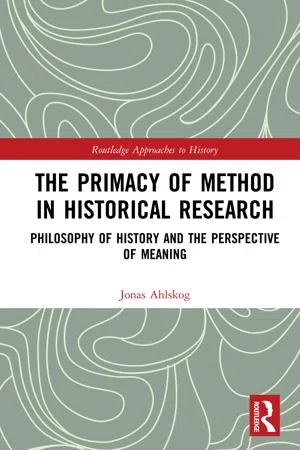
How does history relate to the past? According to leading historical theorists, the relation to the past in history is reducible to evidential, psychological, practical and retrospective concerns. In contrast, this volume claims that historical relations to the past are irreducible products of the logical commitments of history as method. Ahlskog argues that the method of history shapes and enables relations to the past in historical research by invoking past perspectives of meaning for rendering reality intelligible. The book provides a much-needed philosophical clarification of key concepts in one of the most fundamental debates within the humanities today.
eBook - ePub
The Primacy of Method in Historical Research
Philosophy of History and the Perspective of Meaning
- 210 pages
- English
- ePUB (mobile friendly)
- Available on iOS & Android
eBook - ePub
The Primacy of Method in Historical Research
Philosophy of History and the Perspective of Meaning
1 The Primacy of Method in Historical Research
Introduction
This book aims to answer the following question: how should one understand the relation between past and present in historical research? This question was a fundamental concern for philosophy of history already at its inception, and it certainly became a seminal issue in the field during the past two decades. Consequently, the originality of the present book stems not from the fact that it poses this fundamental question but from the ways it goes about answering it. The general spirit of this book differs greatly from most contemporary work in the philosophy and theory of history. Against the current turn toward experience, materiality and presence, this book argues for the importance of agency and understanding. In contrast with the trend of focusing on temporality, retrospectivity and narration, the present book claims that all of our relations to the past in historical research are most fundamentally mediated by the logical commitments of history as method, not by concepts of time and literary form. Contrary to revisionary projects for offering psychologistic or empiricist theories for explaining historical relations to the past, this book understands the task of philosophy as a descriptive one of explicating the presuppositions, conditions and a priori concepts of the historical method. In addition, and perhaps most controversially, the book claims that contemporary philosophy of history still has much to learn from classical work in the field by R. G. Collingwood, Michael Oakeshott and Peter Winch. This introduction will further substantiate the untimely nature of the present work.
As Ludwig Wittgenstein (1953, II, 225) has emphasized, the word ‘methodology’ has a double meaning. On the one hand, one may by ‘methodology’ mean investigations of the techniques of inquiry in any given epistemic practice, say chemistry or paleontology. This is also the way that ’method’ is most often used in relation to historical research. A book on historical method is, therefore, typically a book about the accuracy and reliability of the critical tools that historians use in their study of the past. Thus, what one expects to find in books on historical method are discussions about internal and external source criticism, primary and secondary material, and practical tips for finding and examining archives. However, as Wittgenstein pointed out, by ‘methodology’ one need not mean only investigations of the techniques of inquiry – one may instead denote a conceptual investigation of the ideas that must stay in place as the logical condition for a form of inquiry to be what it is. This is the sense in which the present book investigates the method of history. While Wittgenstein often investigated ideas about the natural world that must logically stay in place for induction and measuring to be possible, this book investigates ideas about the world that must logically stay in place for historical understanding to be possible.
As Wittgenstein (1969, § 105) also wrote, “[a]ll testing, all confirmation and disconfirmation of a hypothesis takes place already within a system.” The investigation of historical method in this book is an investigation of the most fundamental conceptual commitment of history as an organized system of knowledge. As will be argued throughout the book, the most fundamental conceptual commitment of the system of history – the idea that needs to stay in place as the logical condition for history – is that human phenomena are rendered intelligible by invoking the perspective of meaning of historical agents. The possibility of understanding foreign perspectives of meaning is, in turn, a condition for the possibility of knowing the historical past. In other words, all confirmation and disconfirmation of a historical hypothesis takes place already within a system of knowledge: the historical method of invoking perspectives of meaning of historical agents.
Furthermore, this book approaches questions about our relations to the past in historical research by utilizing central insights from so-called idealist1 philosophy of history. Importantly, the idealism that informs the book is not the causal or genetic idealism of George Berkeley, nor the absolute idealism of G. W. F. Hegel, but rather the methodological idealism of R. G. Collingwood and Michael Oakeshott. For the latter authors, idealism is not an ontological theory about the supposed immaterial nature of the world but rather denotes the fundamental contention that our understanding of reality is shaped by different methods of inquiry.2 This means that there is an intimate interconnection between how one knows and what one knows. Collingwood famously addressed this contention by emphasizing absolute presuppositions and that knowing makes a difference to what is known,3 while Oakeshott made the same point with his dictum that method determines subject matter.4 By such claims, Collingwood and Oakeshott argued for a central idealist insight – the primacy of method in all forms of knowing. Thus, (natural) scientists do not reveal metaphysical truths about nature as it is in-itself but offer products of knowledge governed by the presuppositions and principles of natural science. Equally, historians do not uncover the past as it is in-itself but offer knowledge of the ‘historically understood’ past, that is, the historical past, which is the correlate product of the postulates and presuppositions internal to the method of historical research. The task of philosophy is to explicate ‘the idea’ of different forms of inquiry, and this entails a conceptual investigation of the logical conditions that govern a particular kind of knowing and understanding. As Peter Winch (1990, 9) wrote, such conceptual investigations do not reveal reality as it supposedly is in-itself but rather “the force of the concept of reality” within different ways of knowing the world.
Before elaborating the uses of this idealist insight in the book, it will be pertinent to acknowledge some of its consequences right off the bat. Considering the focus on logical conditions, the subject matter of the present book is conceptual and not epistemological or ontological. Thus, the book does not partake in the extensive debates between realists and anti-realists about the ontological status of the past, nor in the epistemological discussion about the justification of narratives and beliefs about the past in historical research. In other words, the book is an answer not to questions such as ‘is the past real or unreal?’ or ‘how can we prove that narratives about the past are true?’ but to the question ‘what does it mean to understand the past historically?’ Consequently, and similar to the work of Collingwood, Oakeshott and Winch, this book offers no guidance for defeating skeptical claims about the very possibility of knowing or understanding the past in historical research at all. Rather, the aim is to show how historical understanding is possible by explicating the a priori concepts and presuppositions of history as a form of knowledge and thought. Oakeshott articulates this conceptual focus in the following way:
I am concerned with what may, perhaps, be called the logic of historical enquiry, ‘logic’ being understood as a concern not with the truth of conclusions but with the conditions in terms of which they may be recognized to be conclusions.
(Oakeshott 1983, 5)
This conceptual focus does not mean that one simply sidesteps skeptical concerns stemming from epistemological or ontological domains. Instead, one deconstructs the status of skeptical concerns as supposedly perennial problems by exposing the unwarranted suppositions of skepticism about historical knowledge acquisition. This is the unwarranted supposition that a mode of understanding, such as history, must justify its claims to knowledge by appealing to some other, more ontologically basic, level of justification. However, to accept this assumption would be already to stray from the idealist insight about the primacy of method by introducing a gap between reality and the ways in which we know it. It is through that gap that skepticism may enter.
In philosophy of history, the by-now classical way to introduce the illicit skeptical gap between method and subject matter is by, implicitly or explicitly, appealing to the idea of observation as an ontologically basic source of justification. History is allegedly epistemologically impaired from the fact that historians can never directly observe their subject matter.5 This idea can only seem attractive if one believes that direct observation is indeed the urform of all knowledge acquisition, which would imply that not only history but also much of the social and natural sciences are second-rate epistemic practices. If one accepts the idea of observation as the urform of knowledge acquisition, then the necessary mediation of historical knowledge will always seem as an epistemic shortcoming compared to beliefs that one may check by observation. In contrast, this book views mediation not as a drawback but as an integral part of the historical mode of knowing and understanding the human world. History is not an inadequate version of knowledge by observation but a sui generis and sufficient form of knowledge and understanding in its own right.
A different way to introduce the skeptical gap between method and subject matter in history is by appealing to the supposed opaqueness of language. Influential theorists of history, such as Hayden White and Frank Ankersmit, have argued that historical narratives are essentially linguistic constructs without any controllable referential relations to “the real” (cf. Lorenz 2011, 26; Partner 2013, 2). The philosophical background is a form of structuralism in which language becomes a self-referential system, and this contention is embraced together with the supposition that language itself limits the ways in which we can know and represent the world (cf. Kellner 1995, 14). On this line of thought, relations to the past in history are reducible to problems about the nontransparent relation between language and reality. In the present book, I will entirely bypass this alleged skeptical problem. The reason is that the problem itself rests on an unwarranted assumption, namely that there is such a thing as the general relation between language and reality that one can first settle in the abstract and then apply to different human practices. However, this is certainly putting the cart before the horse. For the only meaningful way to understand questions about ‘reference’ and ‘meaning’ – or the ‘real’ and the ‘unreal’ – is by attending to language in the particular contexts and practices in which it is employed.6 Thus, understanding the role of language in history is inseparably connected with understanding the idea of history as a certain kind of inquiry. In other words, it is by understanding the ways in which history is a certain kind of practice, with peculiar methodological commitments, presuppositions and principles, that questions about language in historical research will be clarified – not the other way around.
Collingwood and Oakeshott argued against the illicit skeptical gap between method and subject matter throughout their works. As Giuseppina D’Oro (2015, 192) frames their central contention “[that since] the concept of reality is logically or conceptually dependent upon forms of understanding, there can be no epistemic gap between reality as it is in-itself and reality as it is disclosed within a particular form of experience.” These insights about the primacy of method for all forms of knowing are expressed also by Winch (1972, 12) in his (in)famous quote that “[r]eality is not what gives language sense. What is real and unreal shows itself in the sense that language has.” The upshot of the primacy of method is that questions about the real and the unreal are meaningful only from within given practices and forms of inquiry, and that such practices and inquiries supply postulates and presuppositions for making judgments about claims to knowledge. In other words, skepticism about knowing reality in-itself is not defeated but shown to rely on the unwarranted assumption that there can be presuppositionless knowledge.7
The Historical Past and the Primacy of Method
The primacy of method is of crucial importance for approaching the formative question of this book: how should one understand the relation between past and present in historical research? Considering that subject matter is the correlate product of method, history is not about the past as such but about the past as historically understood through the method of historical research. The past in-itself is neither historical nor nonhistorical, and it is therefore possible successfully to study the past by many different methods. The fact that paleontologists and evolutionary biologists also produce knowledge about the past does not make them historians. If the past is not the exclusive territory of historians, then one should also conclude that the predicate ‘historical’ denotes a feature of our understanding and not features of the past as it is in-itself. Human ways of understanding may or may not be historical, but the past in-itself has no features of its own.8 This view, that the historical past is the past understood through the method of history, contrasts with the more popular view that temporality or the human subject matter as such distinguishes the historical past.9 For instance, Marc Bloch (1954, 23) famously claimed that the subject matter of history is ‘men in time,’ and Jeffrey Andrew Barash (2016, 172) has recently argued that it is a sense of temporal remoteness, compared with the recent past of collective memory, that distinguishes the historical past. Both claims are true as far as they go. However, considering that natural selection and fossilization may also be about human beings remote from us in time, neither temporal distance nor a human subject matter will distinctly set history apart from other ways of knowing the past. The present book treats the historical past not as an ontological entity but as the correlate of the method of historical knowing and understanding. In other words, the term ‘history’ denotes not a position in time nor a human subject matter but a distinct way of understanding reality.
Placing the notion of method at center stage offers an alternative framework for approaching the issue of relations to past in historical research. From a methodological perspective, our understanding of relations to the past in history will not be furthered by general theories about the nature of time or ‘the past’ – for history does not relate to time or the past as such. Thus, relations to the past in history are properly investigated only through philosophical elucidation of the conceptual and methodological commitments of history as a particular mode of understanding. In other words, understanding relations to the past in historical research...
Table of contents
- Cover
- Half Title
- Series
- Title
- Copyright
- Dedication
- Contents
- Acknowledgments
- 1 The Primacy of Method in Historical Research
- 2 Metaphilosophy, Empiricism and the Historical Past
- 3 Narrativism and the Reality of the Historical Past
- 4 The Internal Relation Between Practice and History
- 5 The Presence of the Past
- 6 The Existential Relevance of the Historical Past
- 7 Historical Evidence and the Perspective of Meaning
- 8 Testimonial Knowledge and the Method of History
- 9 Historical Method and the Limits of Hermeneutics of Suspicion
- 10 Conclusion: History as the Primacy of Method
- Index
Trusted by 375,005 students
Access to over 1.5 million titles for a fair monthly price.
Study more efficiently using our study tools.
Frequently asked questions
Yes, you can cancel anytime from the Subscription tab in your account settings on the Perlego website. Your subscription will stay active until the end of your current billing period. Learn how to cancel your subscription
No, books cannot be downloaded as external files, such as PDFs, for use outside of Perlego. However, you can download books within the Perlego app for offline reading on mobile or tablet. Learn how to download books offline
We are an online textbook subscription service, where you can get access to an entire online library for less than the price of a single book per month. With over 1.5 million books across 990+ topics, we’ve got you covered! Learn about our mission
Look out for the read-aloud symbol on your next book to see if you can listen to it. The read-aloud tool reads text aloud for you, highlighting the text as it is being read. You can pause it, speed it up and slow it down. Learn more about Read Aloud
Yes! You can use the Perlego app on both iOS and Android devices to read anytime, anywhere — even offline. Perfect for commutes or when you’re on the go.
Please note we cannot support devices running on iOS 13 and Android 7 or earlier. Learn more about using the app
Please note we cannot support devices running on iOS 13 and Android 7 or earlier. Learn more about using the app
Yes, you can access The Primacy of Method in Historical Research by Jonas Ahlskog in PDF and/or ePUB format, as well as other popular books in History & Historiography. We have over 1.5 million books available in our catalogue for you to explore.