This interdisciplinary and accessible new volume presents a broad range of application-based green chemistry and engineering research. The book familiarizes readers with the integration of tools and spell out the approaches for green engineering of new processes as well as improving the environmental risks of existing processes. The expert authors discuss the myriad opportunities and the challenges facing green chemistry today in both its theoretical and practical implementation. The book expands upon green chemistry concepts with the latest research and new and innovative applications, providing both the breadth and depth researchers need.
Topics include solar energy, electrospinning of bio-based polymeric nanofibers, biotransformation, engineered nanomaterials in environmental protection, and much more.
CHAPTER 1 Electrospinning of Bio-Based Polymeric Nanofibers for Biomedical and Healthcare Applications
RINKY GHOSH,1 VEERESHGOUDA SHEKHARAGOUDA NARAGUND,2 and NEHA KANWAR RAWAT3, 4
1Department of Materials Science and Engineering, Indian Institute of Technology Kanpur, Kanpur – 208016, India
2Materials Science Division, CSIR-National Aerospace Laboratories, Bangalore, India
3Senior Lecturer, Chemistry, Haryana Education Services, Haryana, India
4Materials Research Laboratory, Department of Chemistry, Jamia Millia Islamia, New Delhi, India, E-mail: [email protected]
ABSTRACT
The interest in the electrospinning process for the medicinal chemistry and nanotechnology field has escalated recently. This is because of simplicity in its design, cost-effectiveness, and interconnected porosity, better encapsulation of therapeutic agents, thermal consistency, higher loading capacity, and controlled release of drugs/gene carriers. Electrospun scaffolds recently have high behest for successful fabrications of scaffolds due to its significant endocytosis interactions with the cells and suitable degradation profile, tremendously exposed in the implants surgery and tissue regenerations.
Scaffolds of biocompatible nanofibers offer an efficient sustainable route for easy production of and facilitate the tailoring of surface properties by grafting and functionalization with bioactive agents. The biological studies have shown high potential in applications of biocompatible and biodegradable nanofiber scaffolds for wound dressing patches and drug delivery. This chapter briefly discusses the electrospinning fundamental approaches to produced nanofibers scaffolds, biocompatible properties, drug-releasing rate kinetics, and its various applications in the interdisciplinary field of medicinal science.
1.1INTRODUCTION
Innovative and scientific technologies focused around bio-based materials have gained considerable attention recently. They are currently at a peak of exigency to decline the usage of petroleum products and to raise the demands for bioplastics. The petrochemical products are now an integral and substantial part of society. The fossil fuel-based products can also be termed as never-ending life cycle [1] products causing a devastating effect to the natural habitat leading to climate changes, which create an environment pressure are now escalating day-by-day and the crude oil reserve prevalent currently coming to an end. The overall growth in the petro-chemicals products is underpinning due to difficulty in finding an alternative for various structural applications. With consistent rise in demand of plastics on the per capita basis has lead to some major consequences around the globe creating permanent environmental pollution which needs to be addressed immediately. This has forced governments to curb the single-use plastics and focus more value chain of production activities to minimized effluents, wastage, and emissions rate during conversion of crude oil to the desired plastics products. The need for imposing a strict rule for waste management and recycling process is an urgent need that will not only maintain ecological balance but also helps in sustainable growth [1]. Today bio-based polymers are of pivotal importance and a popular choice for number of applications due to its sustainable benefits. High-performance properties of the bioplastics can be achieved by significant use of the nano-fibers or biofibers [2] as composite materials or filler particles or as an additive. Before the starting of this new era, nanofibers are of vital importance and have gained growing scientific recognition, technological importance in the field of aviation, automobile, biomedical, etc. Electrospinning has been successfully used in the past few decades to produce nanofibers ranging from few micrometers to nanometers. It provides an opportunity for blending, incorporation of nanofillers into electrospun nanofibers; tune the surface properties and making fabrication more economically feasible and cheaper.
1.2HISTORICAL EVIDENCE
It was unfamiliar for most of the researchers around the world during the beginning of this new era that electrospinning can enable to us produce nanofibers in the form of continuous filaments with diameter ranges from submicron to nanometers. The word ‘electrospinning’ has been derived from the term ‘electrostatic spinning’ and this process was first patented by Anton Formhals in the year 1934. He disclosed complete setup to produce polymeric filaments from the polymeric solution of cellulose acetate using a phenomenon of opposite polarity effects that generates an electrostatic effect.
1.3A BRIEF ABOUT ELECTROSPINNING FUNDAMENTALS AND ITS VARIOUS PARAMETERS
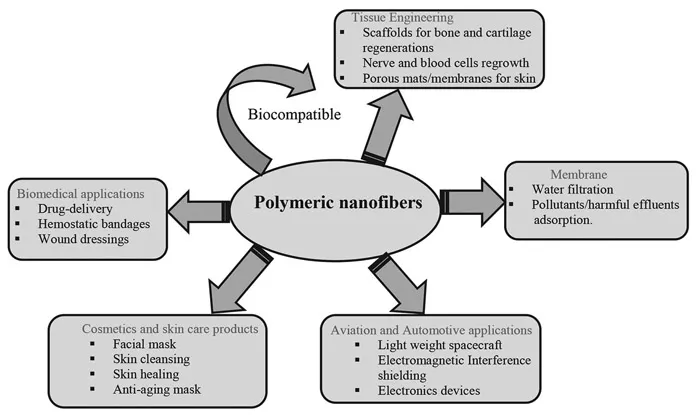
The electrospinning set up mainly consists of two electrodes: one dipped into the polymeric solution and the other connected to the collector/rotatory plate. With the application of high voltage ranging from 10–25 kV to the polymeric solution, the electrical charges flow through the spinneret to the tip of the capillary tube. As the electric current encounters the solution at the tip end, this induced separation of charges on the surface of the droplet leads to the deformation of the hemispherical surface to the conical shaped (Taylor Cone). Once it exceeded the cohesive force or surface tension of the liquid, a thin jet emerges out and subdivides collecting on the moving rotatory drum which is kept at some suitable distance. Based on the reported articles, spinneret has been considered as an essential part of nanofibers production. Nanofibers with various diameters and multiple configurations can be obtained by slight variations in the processing parameters and core-shell implementation of the spinneret part. The salient features of electrospun nanofibers are dependent on various parameters-viscosity, voltage, surface tension, flow-rate, tip-to-collector (TCD) distance, temperature, and relative humidity. These essential parameters have a major impact on the diameter and morphology as well as the mechanical properties of the produced nanofibers. Through carefully conducted experiments and optimizations of the experimental set up allow hindering the possible contamination of produced nanofibers useful in wound healing treatment and its effective interconnected porous feature promotes cell adhesion-vital important phenomenon to improve biological functions and improved wound healing rate [12–16]. Figure 1.1 illustrates the application of electrospun nanofibers in various fields.
FIGURE 1.1 Various properties and applications of electrospun polymeric nanofibers.
The unoriented fibrous structure and high SVR mimicking the morphological 3D characteristics of the skin’s extracellular matrix [17, 18] is useful for muscles and nervous tissue regeneration and nourishes wound segments thereby provide a moist environment for collagen resynthesis and enhancement of angiogenesis.
1.3.1ELECTROSPINNING PROCESS
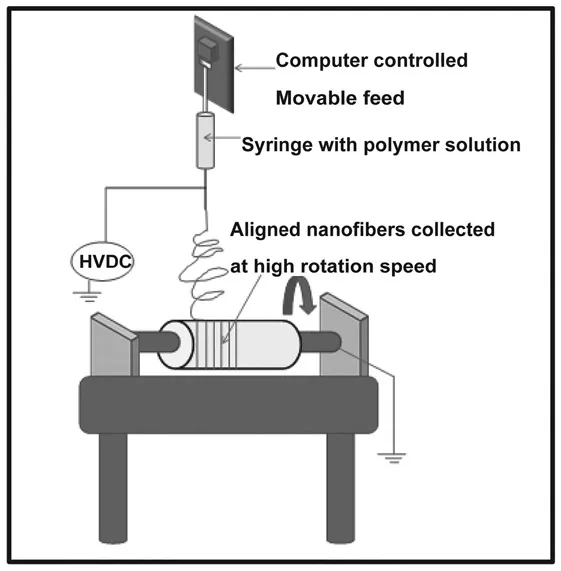
A schematic of an electrospinning setup is shown in Figure 1.2. In an electrospinning process, a high voltage electric field (EF) is applied between a polymer solution and a metallic collector. When the voltage crosses a limiting value, the charges in the polymer solution overcome the surface tension forces and a jet is ejected. The jet due to its hydrodynamic instabilities subdivides into millions of nanofibers as it travels towards the collector. The solvent evaporates quickly due to the large surface area of nanofibers and fibers are collected on the collector. With increasing time, the membrane thickness increases and can be peeled off from the collector.
FIGURE ...
Table of contents
Cover
Half Title
Title Page
Copyright Page
About the Editors
Contents
Contributors
Abbreviations
Preface
1. Electrospinning of Bio-Based Polymeric Nanofibers for Biomedical and Healthcare Applications
2. Solar Energy for Green Engineering Using a Multicomponent Absorption Power Cycle
3. Characterization Techniques for Bio‑Nanocomposites
4. Chemistry Matrices of Biotransformation
5. Sustainable Chemistry and Pharmacy
6. Magnetism, Polyoxometalates, Layered Materials, and Graphene
7. Plasma, Photo/Radiochemical Reactions, and Relativity Theories
8. Mesoporous, Graphene Composite, Li‑Battery, Topology, and Periodicity
9. Boom for Circular Economy and Creativity: Chemistry to Improve Life
10. Application of Engineered Nanomaterials in Environmental Protection and the Visionary Future
11. Chemistry and Sustainable Development
12. Manganese Porphyrins as Pro‑Oxidants in High‑Molar‑Mass Hyaluronan Oxidative Degradation
13. Modified Magnetic Metal-Carbon Mesoscopic Composites with Bioactive Substances
14. Pre-Treatment of Rusted Steel Surfaces with Phosphoric Acid Solutions
15. Transport Phenomena of Electrolytes in Aqueous Solutions: Concepts, Approaches, and Techniques
Index
Trusted by 375,005 students
Access to over 1.5 million titles for a fair monthly price.
Study more efficiently using our study tools.
Frequently asked questions
Yes, you can cancel anytime from the Subscription tab in your account settings on the Perlego website. Your subscription will stay active until the end of your current billing period. Learn how to cancel your subscription
No, books cannot be downloaded as external files, such as PDFs, for use outside of Perlego. However, you can download books within the Perlego app for offline reading on mobile or tablet. Learn how to download books offline
Perlego offers two plans: Essential and Complete
Essential is ideal for learners and professionals who enjoy exploring a wide range of subjects. Access the Essential Library with 800,000+ trusted titles and best-sellers across business, personal growth, and the humanities. Includes unlimited reading time and Standard Read Aloud voice.
Complete: Perfect for advanced learners and researchers needing full, unrestricted access. Unlock 1.5M+ books across hundreds of subjects, including academic and specialized titles. The Complete Plan also includes advanced features like Premium Read Aloud and Research Assistant.
Both plans are available with monthly, semester, or annual billing cycles.
We are an online textbook subscription service, where you can get access to an entire online library for less than the price of a single book per month. With over 1.5 million books across 990+ topics, we’ve got you covered! Learn about our mission
Look out for the read-aloud symbol on your next book to see if you can listen to it. The read-aloud tool reads text aloud for you, highlighting the text as it is being read. You can pause it, speed it up and slow it down. Learn more about Read Aloud
Yes! You can use the Perlego app on both iOS and Android devices to read anytime, anywhere — even offline. Perfect for commutes or when you’re on the go. Please note we cannot support devices running on iOS 13 and Android 7 or earlier. Learn more about using the app
Yes, you can access Green Chemistry and Green Engineering by Shrikaant Kulkarni, Neha Kanwar Rawat, A. K. Haghi, Shrikaant Kulkarni,Neha Kanwar Rawat,A. K. Haghi in PDF and/or ePUB format, as well as other popular books in Architecture & Sustainability in Architecture. We have over 1.5 million books available in our catalogue for you to explore.