Featuring chapters by an international group of scholars and academics, Rural Youth at the Crossroads discusses the challenges and contexts facing youth from rural communities in countries with legacies of socialism undergoing social, political, and economic transition.
The chapters employ a variety of sources and approaches to examine rural youth outcomes, and the well-being and sustainability of rural areas. The book focuses particularly on career and educational goals, the often contradictory relations between rural schools and communities, majority-minoritized group relations, community engagement, and political attitudes. Individual chapters examine these questions and dynamics within Croatia, Czechia, Hungary, Romania, Russia, Serbia, and Vietnam. In total the volume represents a unique and timely comparative discussion of the relationship between youth and rural development within transitional societies, and the challenges and opportunities for enhancing the well-being and sustainability of rural communities.
Aimed at informing strategies to revitalize rural social space, this book is targeted towards social scientists with interest in sociology and rural sociology, demography, education, youth development, community/regional development, rurality, public policy, and identity formation in transitional contexts. As such, this book will have international appeal to researchers, educators, and policymakers in transitional countries, and to those interested in these topics, regions, and communities.
Out-migration and aging pose some of the most significant challenges to rural and regional development in Croatia (Borozan & Barković Bojanić, 2015; Jukić & Khan, 2015). According to the World Population Prospects (2017) Croatia is among nine countries1 whose populations are expected to decrease by more than 15% by 2050 based on projected fertility rates (2017, p. 13). Recent figures released by the Croatian Central Bureau of Statistics reported that the estimated total population of Croatia was 4,124,531 in mid-2017, down from 4,284,000 in 2011—the lowest level of total population since Croatia established its independence (Croatian Bureau of Statistics, 2018). Despite declining fertility rates and population aging, the largest driver of population decline is emigration, and this has particularly been the case since Croatia’s accession to the European Union in 2013 (Čipin & Ilieva, 2017). Population aging and out-migration have been particularly pronounced in rural Croatia (Nejašmić & Štambuk, 2003; Štambuk, 2002). Unofficial estimates suggest the total population is even lower, however, because Croatian emigrants under-report official changes of residence.
1Other countries included are Bulgaria, Latvia, Lithuania, Poland, the Republic of Moldova, Romania, Serbia, and Ukraine (World Population Prospects, 2017).
In sum, between 2011 and 2018, the number of Croatians under the age of 14 fell by a total of 60,000 persons to 590,600 and the number of Croatians over age 65 increased by 74,000 persons to 833,300, raising serious questions about the country’s health and pension system, as well as its ability to maintain schools, especially in rural areas (Mihaljević, 2019). The demographic circumstances in Croatia have increasingly been described as a “depopulation crisis,” with (then) President Kolinda Grabar-Kitarović pointing out in 2018 that Croatia has lost more than 20 times as many people because of depopulation than in 1991–95 during the Homeland War (Hina, 2018). In February 2018, Prime Minister Andrej Plenković reiterated the government’s concern about Croatia’s negative fertility rates and the areas of the country experiencing serious and sustained out-migration and aging, calling for European Union (EU) support to address demographic trends experienced by Croatia and elsewhere in Central Europe.
Although these demographic trends have attracted recent attention, Croatian rural depopulation is not a new phenomenon (Nejašmić, 2014, p. 409). From 1900 to 1948, Croatia experienced a sustained out-migration of rural populations overseas, mostly to the Americas. Farmers became impoverished because agricultural production was destroyed by droughts and diseases, spurring mass emigration in search of economic opportunity. The second emigration wave occurred between 1948 and 1991 in three directions: a) permanent emigration to Italy (1948–1961); b) a temporary emigration to Germany—after the “opening up” of the borders, from 1961 to 1991, 450,000 Croatian residents (mostly men), out-migrated as gastarbeiters (guest workers) for temporary work, with the intention to ultimately return to Croatia. Some returned, but over time many temporary migrant workers became permanent emigrants; c) from 1948 to 1991 about 350,000 residents migrated to other republics of ex-Yugoslavia. The third wave was from 1991 to 2001, when about 500,000 people left Croatia, or 11.5% of the total population—the majority (270,000) being Serbs. This wave of emigration was caused mostly by war, but also by economic and social circumstances, with emigration towards European, ex-Yugoslavian, and overseas countries (Nejašmić, 2014).
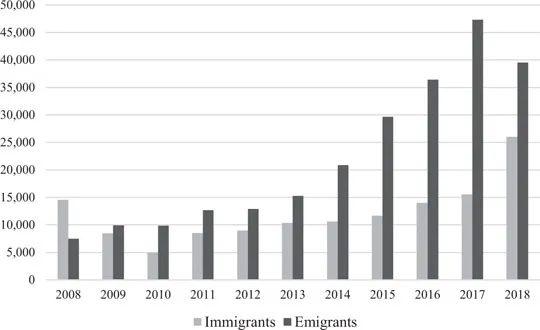
It could be argued that today Croatia is faced with a fourth period of out-migration, intensified since 2013 and EU accession. Between 2012 and 2018, Croatia had nearly 97,000 in-migrants, but about 202,000 out-migrants, with out-migration levels increasing post-accession (Figure 1.1) (CBS, 2017, 2019). Migration out-flows are mainly towards Western European countries, and mostly to Germany (Jurić, 2017). Official statistics on the number of out-migrants are based on the data only for persons who have registered their emigration. Therefore, estimates of the “real” outflow are even more troubling. A study conducted on the demographic development of Croatia (see Šterc, 2017) reports that the number of out-migrants from Croatia is at least three times higher than official statistics. This study also estimates that the total number of out-migrants in 2016 was 80,000, and of that group, roughly 57,000 moved to Germany (Šterc, 2017).2 With reference to the report of the Federal Statistical Office in Wiesbaden, Šterc claims that the number of migrants from Croatia to Germany is much higher than that of official Croatian statistics. According to the report, 55,970 Croatian citizens migrated to Germany in 2016. During the same year, there were a total of 332,605 Croatian citizens who reported their residence in Germany (Hina, 2017). According to the Croatian Bureau of Statistics, in 2017, migrants were almost equally men (55.4%) and women (45.6%), and the majority—nearly half—were aged 20 to 39 (CBS, 2018; Šterc, 2017).
2Jurić (2017) states that the number of migrants from Croatia to Germany was 37,060 in 2014, 50,628 in 2015, and 51,163 in 2016.
Figure 1.1 Number of immigrants and emigrants, Croatia, 2008–2018
Source: Croatian Bureau of Statistics (CBS, 2017, 2018, 2019)
Because of the ways in which rural areas in Croatia disproportionately experience the brunt of these demographic trends, one of the main problems of contemporary Croatian villages is the loss of human capital (Nejašmić & Štambuk, 2003; Štambuk, 2002). According to the Croatian Bureau of Stat...
Table of contents
Cover
Half Title
Series
Title
Copyright
Contents
List of figures
List of tables
List of contributors
Acknowledgements
Introduction: Rural youth and societies within post-socialist and transitional contexts
1 Leaving the Croatian countryside: local context and rural youth aspirations
2 Uneven demographic development within Croatia, 1950s–present: implications for rural quality of life and youth out-migration
3 Rural youth and school-based political socialization: the case of Croatia
4 Sociocultural capital among rural youth in Croatia
5 Coming of age in the Czech countryside: life and educational transition contexts for rural youth
6 The contradictions of education in Russia: resilient and struggling schools in the context of rural depopulation and decline
7 The case of Serbia: the orientations of rural young adults towards education, work, and emigration
8 Diverse migration processes of rural youth and young adults in Hungary
9 Roma youth and on-the-ground implementation of Roma education policies in rural Romania
10 Vietnamese youth, schools, and communities in transition: a decade after the administrative boundary extension of Hanoi
Conclusion: Rural people and places in transitional societies: leaning into an uncertain future
Index
Trusted by 375,005 students
Access to over 1.5 million titles for a fair monthly price.
Study more efficiently using our study tools.
Frequently asked questions
Yes, you can cancel anytime from the Subscription tab in your account settings on the Perlego website. Your subscription will stay active until the end of your current billing period. Learn how to cancel your subscription
No, books cannot be downloaded as external files, such as PDFs, for use outside of Perlego. However, you can download books within the Perlego app for offline reading on mobile or tablet. Learn how to download books offline
Perlego offers two plans: Essential and Complete
Essential is ideal for learners and professionals who enjoy exploring a wide range of subjects. Access the Essential Library with 800,000+ trusted titles and best-sellers across business, personal growth, and the humanities. Includes unlimited reading time and Standard Read Aloud voice.
Complete: Perfect for advanced learners and researchers needing full, unrestricted access. Unlock 1.5M+ books across hundreds of subjects, including academic and specialized titles. The Complete Plan also includes advanced features like Premium Read Aloud and Research Assistant.
Both plans are available with monthly, semester, or annual billing cycles.
We are an online textbook subscription service, where you can get access to an entire online library for less than the price of a single book per month. With over 1.5 million books across 990+ topics, we’ve got you covered! Learn about our mission
Look out for the read-aloud symbol on your next book to see if you can listen to it. The read-aloud tool reads text aloud for you, highlighting the text as it is being read. You can pause it, speed it up and slow it down. Learn more about Read Aloud
Yes! You can use the Perlego app on both iOS and Android devices to read anytime, anywhere — even offline. Perfect for commutes or when you’re on the go. Please note we cannot support devices running on iOS 13 and Android 7 or earlier. Learn more about using the app
Yes, you can access Rural Youth at the Crossroads by Kai. A Schafft,Renata Horvatek,Annie Maselli,Sanja Stanić in PDF and/or ePUB format, as well as other popular books in Education & Inclusive Education. We have over 1.5 million books available in our catalogue for you to explore.