Trade connections and cultural exchange between Africa and the rest of the global South have existed for centuries. Since the end of the Cold War, these connections have expanded and diversified dramatically, with emerging economies such as China, India, and Brazil becoming increasingly important both as sources of trade and as a destination for African migrants. But while these trends have attracted growing scholarly attention, there has so far been little appreciation of the sheer breadth and variety of this exchange, or of its deeper social impact.
This collection brings together a wide array of scholarly perspectives to explore the movement of people, commodities, and ideas between Africa and the wider global South, with rich empirical case studies ranging from Senegalese migrants in Argentina to Lebanese traders in Nigeria. The contributors argue that this exchange represents a form of 'globalization from below' which defies many of the prevailing Western assumptions about migration and development, and which can only be understood if we consider the full range and complexity of migrant experiences.
Multidisciplinary in scope, Mobility between Africa, Asia and Latin America is essential reading for students and scholars across the social sciences interested in the interconnected economic and social make-up of the global South.
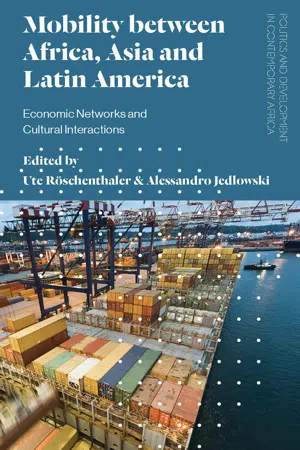
eBook - ePub
Mobility between Africa, Asia and Latin America
Economic Networks and Cultural Interactions
- English
- ePUB (mobile friendly)
- Available on iOS & Android
eBook - ePub
Mobility between Africa, Asia and Latin America
Economic Networks and Cultural Interactions
About this book
Information
1
Introduction: landscapes of opportunity, mobility and entrepreneurial perspectives
Introduction: landscapes of opportunity, mobility and entrepreneurial perspectives
South–South connections between Africa and other regions of what has come to be known as the Global South have existed for centuries. Since the end of the Cold War, however, new patterns of South–South interaction have emerged. These patterns become visible on two levels. First, on the inter- or multinational level on which countries such as China, India and Brazil currently define emerging political, economic and cultural scenarios throughout the African continent (Carmody 2013; Taylor 2014). Second, on the individual level, the movement of people with their own private undertakings has increased significantly over the same period, particularly between Africa, Asia and Latin America. While these two levels are mutually intertwined, this volume focuses explicitly on the second level of individual undertakings, which has received insufficient scholarly attention to date.
Studies on globalization and South–South connections tend to focus on dominant forms of transnational interactions from a macro perspective (Brunet 2014; Cheru and Modi 2013; Huynh 2013; King 2013; Li Xing et al. 2013; Modi 2011a; Shinn and Eisenman 2012). Beyond the macro-narratives, a much less investigated universe of interactions, transactions and movements of people, objects, stories and ideas successfully proliferates. We argue that individuals rarely leave home with the objective of integrating into a foreign host society. Many move along with trade goods, powerful ideas and accumulated knowledge that they carry with them from Africa towards Asia and Latin America, and vice versa, to establish network-like connections. Similarly, individuals from Latin America and Asia have moved to Africa in the hope of finding suitable opportunities to establish a venture. Such movements in both directions have increased considerably since the 1990s.
The scope and significance of these movements become clearer when the actors’ sociocultural contexts are examined and put into context with the existing framework of historical relationships and economic networks that have emerged between these geographical areas in recent centuries (Bredeloup 2013; Cissé 2015; Marfaing and Thiel 2015). Of similar importance are the biographies of individual actors who move between these places, transferring knowledge and cultural practices. Particularly relevant are the motivations behind the choices that lead Africans (as well as Asians and Latin Americans) to leave their homes and set out to other places, including their visions, aspirations for success abroad, and the conditions in the host countries into which they move and in which they often manage to survive more or less successfully. We focus on the past three decades because the structural adjustment policies introduced in most African countries throughout the 1980s have accelerated socio-economic transformations and people’s movements. Particularly, young people were pushed to invent new strategies of survival (Banégas and Warnier 2001; Röschenthaler and Schulz 2016), which often encouraged them to leave their home communities (Collier and Gunning 2008; Zeleza 1989).
This edited volume explores this arena through the stories of individual actors, the goods they trade, the pathways they take, and the enterprises that some of them establish. It studies the movements of individuals between Africa, Asia and Latin America, focusing particularly on the concerns of these actors and the impact their activities have on their home and host societies. The volume explores what happens at the contact zones of these intercultural encounters and at the intersections of foreign and local norms that are potentially contested and conflicting. It also investigates the influence that the presence of individual mobile actors has on cultural, economic or political sectors in the different destination countries.
Looking at mobility between Africa, Asia and Latin America together opens up a number of benefits that enhance our understanding of globalization and present-day mobility. Five benefits will be briefly outlined here and are further elaborated over the course of this introduction.
First, our endeavour is to overcome established analytical dichotomies that form part of a ‘North–South’ conceptual framework. While the binary oppositions ‘North vs South’, ‘above vs below’, ‘formal vs informal’, ‘high end vs low end’, ‘hegemonic vs subaltern’ spell out power asymmetries and emphasize the underdevelopment of countries in the South, they hide the existence and greater complexity of the social, economic and political dynamics that ground South–South patterns of mobility. For instance, African contributions to globalization and mobility fall not merely into the categories of ‘informal’, ‘from below’ or ‘illegal’; many African traders and entrepreneurs also make use of formal institutions and networks of economic and political enterprise. That is, both formal and informal go together in the context of South–South mobility. Container trade, for example, would not be possible without the use of formal institutions.
Secondly, the dominating analytical models for the understanding of migration and development are normally elaborated from the vantage point of the West, and favour it as the main destination of migration fluxes without considering the perspective of those who are moving to other places. The mobility of people and the cultural exchanges between Africa, Asia and Latin America cannot be fully understood if they are measured against the backdrop of Western assumptions about migration and development. Individual actors’ motivations and experiences are far more varied and complex than macroeconomic theories depict. Many of these travellers do not leave with the intention of remaining in the host society, but aspire instead to become transnational business people or carry out work that allows them to remain mobile (Pelican and Şaul 2014). Migration laws and politicians’ assumptions about ‘migrants’, however, render such projects complicated, particularly for those who do not have huge sums of money at their disposal. They cannot talk about their true project officially but have to comply with the local legal models of integration and corroborate the host society’s assumptions about them in order to stay (and apply, for example, for asylum) (Beneduce 2015).
Thirdly, this book’s micro-perspective relates the individual life histories to the normative frameworks that confront these actors and influence their decisions and actions in order to highlight the original strategies by which they become agents – agency being the capacity to affect things (Ortner 2006: 137) – and shape their life trajectories. If pull and push factors play a role in determining individuals’ movements, international and national frameworks influence the direction of such movements, pushing people to opt for a particular destination over another. Individual decisions are not fully predictable and, as the chapters of this book highlight, talking about mobility in a general sense obscures the local political and legal specificities that drive people’s movement.
Fourthly, this volume proposes to study globalization from the vantage point of an African or ‘Southern’ perspective, and particularly from the perspectives of the individuals themselves moving within places that belong to the so-called Global South. When individuals feel the urge to move, many directions of movement are possible. These options create what we can conceptualize as a ‘landscape of opportunities’ and do not – and never did – only include movement to Europe and North America. For Africans, these options include – apart from a range of countries in Africa – China, India, Brazil, Argentina, Thailand or Korea, just to name the most significant among them. Choosing one option over another depends on personal networks, legal frameworks and international conditions, such as diplomatic and trade agreements. This means that the actors involved in the mobile trajectories that are analysed in this volume are considered subjects who actively shape specific itineraries of mobility to respond to the multiple – and at times conflicting – factors that influence their lives: from political and economic constraints to personal ambitions, from economic calculation to desires for adventure, from media-generated imaginaries to transnational love relationships.
Fifthly, the movements from Africa to Asia and Latin America and vice versa need to be examined in connection with the repercussions that these movements have at home as well as in the host countries (in terms of investments, creation of employment, cultural influence, etc.). Large amounts of money are sent to develop the home country using means acquired abroad, and a large body of work analyses the economic and socio-political consequences of these remittances (Elie et al. 2011; Mercer et al. 2008; Peil 1995); far less work exists on the contribution that migrants offer to their host countries. Investment in the host countries is not the predominant way to look at the topic, except for the entrepreneurial involvement of ethnic minorities that has been described in Africa (Olaniyan, Li and Oonk, this volume), but not in what concerns Africans abroad. In this sense, this volume is particularly concerned with the relational, shifting nature of the processes through which specific patterns of mobility are shaped as well as with the social and cultural transformations from which they emerge and which they provoke.
In short, this volume connects the larger analytical frameworks related to the analysis of transnational mobility, economic networks and cultural transfer to a particular concern for people’s perspectives and, in methodological terms, for the application of a biographical approach to people and goods involved in South–South mobilities. To bring out this complexity and dynamism, this book focuses on the perspectives of individual entrepreneurial actors, their movements, activities and aspirations. It studies their biographies in the cultural and historical contexts in which they have emerged and were realized, and investigates the motivations that push individuals to opt for a specific destination within the landscape of opportunities that are open to them.
The Global South and globalization from below
At first glance, the term ‘Global South’ sounds refreshing and appears to represent an attempt to redefine global constellations. A closer look, however, reveals that, by creating an ideological opposition between the ‘South’ and the ‘North’, this term merely replaces older concepts that imply a radical, oversimplified distinction between the two regions. This is evident when the concept is considered from a geographical perspective. The majority of countries to which the term refers are in the geographical South, but some are also clearly in the northern hemisphere. Still others, such as Australia, count as ‘North’. When the terms ‘South’ and ‘North’ are used to refer to ideological spaces, the definition of who belongs to which side of the dividing line does not become less complicated (see also Marfaing and Thiel, this volume), and it inevitably obscures the multitude of interactions and activities that take place beyond the dichotomy that the use of these terms suggests.
The history of such conceptualizations reaches back at least to the era of European colonization and to the emergence of Eurocentric ideas used to legitimize Europeans’ movement towards the ‘South’. In this sense, precursors of this dichotomous definition are racial concepts that divide the global population hierarchically into active and passive races. This evolutionary theory was reformulated in the modernization, dependency and world systems theories, which ordered peoples and states into a system characterized by an economic and political centre (the First World) with various peripheries (Wallerstein 1974; Escobar 2004). The prospect of an economic integration of the peripheries was supported by new forms of global politics of mercantilism, which Sven Beckert (2014) calls ‘war capitalism’. The political and economic practices that this form of capitalism entails embody the fundamentals of economic exploitation of which the expansion of the cotton industry, together with the sugar and the tea industries, are illustrative examples (Hobhouse 2005 [1985]; Mintz 1985). Following the end of the Cold War there was impetus for a general reorientation of the ideological cardinal points grounding the existing definitions, and terms like the ‘Global North’ and the ‘Global South’ emerged to redefine the new constellation. Notwithstanding, ongoing forms of explo...
Table of contents
- Cover
- About the editors
- Title
- Copyright
- Contents
- Figures and tables
- About the contributors
- Preface
- 1. Introduction: landscapes of opportunity, mobility and entrepreneurial perspectives
- Part I: Historical relationships and economic networks
- Part II: Biographies of mobility and aspirations of success
- Part III: Knowledge transfer and cultural interactions
- Index
Trusted by 375,005 students
Access to over 1.5 million titles for a fair monthly price.
Study more efficiently using our study tools.
Frequently asked questions
Yes, you can cancel anytime from the Subscription tab in your account settings on the Perlego website. Your subscription will stay active until the end of your current billing period. Learn how to cancel your subscription
No, books cannot be downloaded as external files, such as PDFs, for use outside of Perlego. However, you can download books within the Perlego app for offline reading on mobile or tablet. Learn how to download books offline
Perlego offers two plans: Essential and Complete
- Essential is ideal for learners and professionals who enjoy exploring a wide range of subjects. Access the Essential Library with 800,000+ trusted titles and best-sellers across business, personal growth, and the humanities. Includes unlimited reading time and Standard Read Aloud voice.
- Complete: Perfect for advanced learners and researchers needing full, unrestricted access. Unlock 1.5M+ books across hundreds of subjects, including academic and specialized titles. The Complete Plan also includes advanced features like Premium Read Aloud and Research Assistant.
We are an online textbook subscription service, where you can get access to an entire online library for less than the price of a single book per month. With over 1.5 million books across 990+ topics, we’ve got you covered! Learn about our mission
Look out for the read-aloud symbol on your next book to see if you can listen to it. The read-aloud tool reads text aloud for you, highlighting the text as it is being read. You can pause it, speed it up and slow it down. Learn more about Read Aloud
Yes! You can use the Perlego app on both iOS and Android devices to read anytime, anywhere — even offline. Perfect for commutes or when you’re on the go.
Please note we cannot support devices running on iOS 13 and Android 7 or earlier. Learn more about using the app
Please note we cannot support devices running on iOS 13 and Android 7 or earlier. Learn more about using the app
Yes, you can access Mobility between Africa, Asia and Latin America by Ute Röschenthaler, Alessandro Jedlowski, Ute Röschenthaler,Alessandro Jedlowski in PDF and/or ePUB format, as well as other popular books in Politics & International Relations & Development Economics. We have over 1.5 million books available in our catalogue for you to explore.