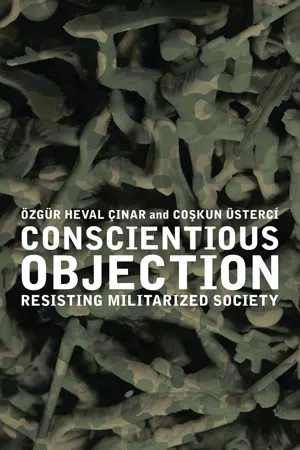
Refusing to take part in war is as old as war itself. This wide-ranging and original book brings together four different bodies of knowledge to examine the practice of conscientious objection: historical and philosophical analyses of conscientious objection as a critique of compulsory military service and militarization; feminist, LGBT and queer analyses of conscientious objection as a critique of patriarchy, sexism, and heterosexism; activist and academic analyses of conscientious objection as a social movement and individual act of resistance; legal analyses of the status of conscientious objection in international and national law.
Conscientious objection is an increasingly important subject of academic and political debate in countries including the US, Israel and Turkey. This book provides a much needed introduction and tool for making sense of the history of nation-states in the 20th century and understanding the political developments of the early 21st century.
eBook - ePub
Conscientious Objection
Resisting Militarized Society
- English
- ePUB (mobile friendly)
- Available on iOS & Android
eBook - ePub
Conscientious Objection
Resisting Militarized Society
About this book
Information
FOUR | Conscientious objection and law
A International law
18 | A view on international implementation of the right to conscientious objection
ÖZGÜR HEVAL ÇINAR
§ The right to conscientious objection is evaluated under the right to ‘freedom of thought, conscience and religion’ elaborated under Article 9 of the European Convention on Human Rights and Article 18 of the International Covenant on Civil and Political Rights (ICCPR), as well as the Universal Declaration of Human Rights. Indeed, the first article of the Universal Declaration of Human Rights firmly asserts that ‘All human beings are endowed with reason and conscience’. In addition, Article 18 of the ICCPR proclaims that:
Everyone shall have the right to freedom of thought, conscience and religion. This right shall include freedom to have or to adopt a religion or belief of his choice, and freedom, either individually or in community with others and in public or private, to manifest his religion or belief in worship, observance, practice and teaching.
In practice, the United Nations (UN), European Union (EU) and Council of Europe (CoE) have also, in their numerous resolutions, comments and recommendations, declared that this right is in fact connected to freedom of thought, conscience and religion.1 For instance, the Committee of Ministers of the Council of Europe, in Recommendation R(87)8 in 1987, requests of member states that ‘anyone liable to conscription for military service who, for compelling reasons of conscience, refuses to be involved in the use of arms, shall have the right to be released from the obligation to perform such service …’ It continues as follows: ‘the government of member states, insofar as they have not already done so, [should] bring their national law and practice into line …’
Presently, there are no armed forces in twenty-seven countries in the world.2 Of the 192 UN members, however, 168 still have armed forces, which are either professional or based on compulsory military service.3 As I have mentioned above, the right to conscientious objection is recognized by most international instruments and over 35 per cent of the 168 countries with armed forces have recognized conscientious objection as a right.4 This percentage is significantly higher in Europe, however.5 Moreover, nineteen of the forty-seven member states of the CoE, in addition to recognition of conscientious objection, have an alternative service, which should be civilian in accordance with international law.6 It is very important to understand why alternative service was created, and what the difference between military and alternative service is as regards duration. This chapter focuses on which countries have a civilian alternative service and considers by whom the alternative service is coordinated.
More than eighty of the 192 members of the United Nations have a professional army instead of a system of compulsory military service.7 It is important to know, however, which countries have recognized conscientious objection as a right for professional soldiers. Therefore, this chapter also focuses on this issue.
When we focus on Europe in particular, we see that in twenty-six of the members of the Council of Europe (in twenty-one of which there is a professional army) there is no compulsory system of military service. These are Belgium, Bosnia-Herzegovina, Bulgaria, Croatia, the Czech Republic, France, Hungary, Ireland, Italy, Latvia, Luxembourg, Macedonia, Malta, Montenegro, the Netherlands, Portugal, Romania, Slovakia, Slovenia, Spain and the United Kingdom. Andorra, Iceland, Liechtenstein, Monaco and San Marino have no armed forces.
Nineteen member states of the Council of Europe do, however, have a system of compulsory military service, and the right to conscientious objection is recognized. In addition, conscientious objectors in these countries are provided with an alternative service. These countries are Albania, Armenia, Austria, Cyprus, Denmark, Estonia, Finland, Georgia, Germany, Greece, Lithuania, Moldova, Norway, Poland, the Russian Federation, Serbia, Sweden, Switzerland and Ukraine. Of the forty-seven members of the Council of Europe, only Turkey does not recognize the right to conscientious objection. In addition, in Azerbaijan this issue is complicated. Outside the Council of Europe, there are other countries such as Belarus,8 Colombia, the Republic of Korea, Singapore and Turkmenistan that are in a similar situation to Turkey and Azerbaijan.9
In Azerbaijan, the regular period of military duty is eighteen months, whereas for university graduates the period is twelve months. Despite Article 76 of Azerbaijan’s 1995 constitution (amended in 2002), which explicitly acknowledges the right to alternative service, there is no further law that recognizes the right to conscientious objection. In that respect, there is neither an application procedure for the right to conscientious objection nor an alternative service. In 2004, however, a draft law for the right to conscientious objection was prepared, although this law has not yet been adopted by the parliament of Azerbaijan.
In Turkey, Article 72 of the 1982 constitution entitled ‘National Service’ explains the legal side of military service in its most basic form. It states that ‘national service is the right and duty of every Turk …’ In addition, the 1927 Military Service Act no. 1111 proclaims: ‘All male subjects of the Republic of Turkey must perform military service in accordance with this law.’ In Turkey, the regular period of military duty is fifteen months, whereas for university graduates the period is twelve months as an officer, or alternatively six months as a soldier. The right to conscientious objection is not recognized, however, and there is no alternative service in Turkey.
Non-armed countries and the right to conscientious objection for professional soldiers in Europe
In this section, we will examine whether the members of the Council of Europe do or do not provide the right to conscientious objection for professional soldiers in their regulations. In addition, we will touch upon the reasons for the absence of an army and the conditions under which compulsory military service is exercised in some of these countries and some sample countries from other parts of the world.10
There are no armed forces in Andorra, as France and Spain provide its external security.
Belgium made a full transition to a professional army in 1995. In Bulgaria, there has been no compulsory military service since 2008.11 There are, however, no regulations for conscientious objection for professional soldiers in either country.
Bosnia-Herzegovina has had no compulsory military service since 2006.12 Prior to abolishing compulsory military service, the right to conscientious objection had been recognized. There are, however, no sources to date (June 2008) to confirm whether professional soldiers can benefit from the previous law or recent regulations.
In Croatia, there has been no compulsory military service since 2008.13 In addition, in the Czech Republic, since 1 January 2005, in France, since 2002, and in Hungary, since December 2004, the army has consisted of professional soldiers. There are, however, no regulations for conscientious objection for professional soldiers in these countries.
In Iceland, neither conscription nor armed forces exist. This country’s defence is provided by the United States under the joint defence agreement signed in 1951 and by NATO. In addition, the USA has a base in Iceland. Furthermore, in accordance with Article 75 of the 1944 constitution, conscription may be introduced only in circumstances constituting a threat to the nation.
Compulsory military service has never been utilized in Ireland. According to Article 28 of the 1937 constitution (amended in 1992 and 1995) and Article 54 of the 1954 Defence Act, conscription may be enabled in circumstances of national emergency. There are, however, no regulations regarding the right to conscientious objection for professional soldiers.
Since 1 January 2005, Italy has had a professional army. No regulations regarding professional soldiers exist, however.
In Latvia, the army has consisted of professional soldiers since 2007. Latvia had recognized conscientious objection as a right through the Law on Alternative Service in 2002. This was only for conscripted soldiers, however. Since compulsory military service was abolished, there have been no sources indicating whether there have been recent regulations for conscientious objection for professional soldiers.
Liechtenstein does not have armed forces. According to Article 44 of the 1921 constitution (amended in 2003), conscription is not exercised except in time of war or emergency.
Luxembourg abolished conscription in 1967. The country has an army of 900 professional soldiers. There has not been a case of conscientious objection among professional soldiers and no legal regulations exist regarding such objection.
Since 2006, there has been no compulsory military service in Macedonia. Macedonia had recognized the right to conscientious objection through the Law on Defence promulgated in 2001. The law was only for conscripted soldiers, however. There are no regulations regarding the right to conscientious objection for professional soldiers.14
Malta has never had compulsory military service. Only 2,140 professional soldiers remain. Once again, there are no regulations regarding the right to conscientious objection for professional soldiers.
Since its external security is provided by the French armed forces, Monaco has no army.
In Montenegro, there has been no compulsory military service since 2006. In addition, since 11 May 2007, Montenegro, as a member of the CoE, separated from Serbia. Prior to this separation, regulations regarding conscription, conscientious objection and alternative service were the same as Serbia’s. There were no regulations regarding the right to conscientious objection for professional soldiers. Since the separation, there have been no sources to confirm whether professional soldiers do or do not have any right to conscientious objection.
In the Netherlands, the army has consisted of professional soldiers since January 1997. According to Article 3 of the 1962 Law on Conscientious Objection, it is possible for professional soldiers to withdraw from military service by declaring their objection. The Ministry of Defence declared in 2004, however, that under certain conditions, such as the Iraq war, bringing forward such an objection would not be considered an appropriate reason.15
Since November 2004, the Portuguese army has consisted of professional soldiers. No regulations exist, however, regarding the right to conscientious objection for professional soldiers.
Romania abolished conscription in 2007, having recognized the right to conscientious objection by the 1996 Law on the Preparation of the Population for Defence (Law no. 46/1996) and the 1997 Government Decree (Law no. 618/1997). There are, however, no regulations regarding the right to conscientious objection for professional soldiers.16
San Marino has no army.17 Conscription may be exercised only in times of war or emergency.
In Slovakia, there has been no compulsory military service since 2005. Prior to the transition to a professional army, the right to conscientious objection was accepted on the basis of religion and conscience. This right was not provided for professional soldiers, however. There are still no regulations regarding the right to conscientious objection for professional soldiers.18
Since 2004, the Slovenian army has consisted of professional soldiers. The right to conscientious objection has been recognized since 1992. According t...
Table of contents
- Cover
- About the Editors
- Title
- Copyright
- Contents
- Acknowledgements
- Preface
- Introduction
- ONE | Conscription and resisting conscription in a militarized society
- TWO | Conscientious objection as a critique of patriarchy, sexism and heterosexism
- THREE | Conscientious objection in the world: experiences and problems
- FOUR | Conscientious objection and law
- Notes on contributors
- Index
Trusted by 375,005 students
Access to over 1.5 million titles for a fair monthly price.
Study more efficiently using our study tools.
Frequently asked questions
Yes, you can cancel anytime from the Subscription tab in your account settings on the Perlego website. Your subscription will stay active until the end of your current billing period. Learn how to cancel your subscription
No, books cannot be downloaded as external files, such as PDFs, for use outside of Perlego. However, you can download books within the Perlego app for offline reading on mobile or tablet. Learn how to download books offline
Perlego offers two plans: Essential and Complete
- Essential is ideal for learners and professionals who enjoy exploring a wide range of subjects. Access the Essential Library with 800,000+ trusted titles and best-sellers across business, personal growth, and the humanities. Includes unlimited reading time and Standard Read Aloud voice.
- Complete: Perfect for advanced learners and researchers needing full, unrestricted access. Unlock 1.5M+ books across hundreds of subjects, including academic and specialized titles. The Complete Plan also includes advanced features like Premium Read Aloud and Research Assistant.
We are an online textbook subscription service, where you can get access to an entire online library for less than the price of a single book per month. With over 1.5 million books across 990+ topics, we’ve got you covered! Learn about our mission
Look out for the read-aloud symbol on your next book to see if you can listen to it. The read-aloud tool reads text aloud for you, highlighting the text as it is being read. You can pause it, speed it up and slow it down. Learn more about Read Aloud
Yes! You can use the Perlego app on both iOS and Android devices to read anytime, anywhere — even offline. Perfect for commutes or when you’re on the go.
Please note we cannot support devices running on iOS 13 and Android 7 or earlier. Learn more about using the app
Please note we cannot support devices running on iOS 13 and Android 7 or earlier. Learn more about using the app
Yes, you can access Conscientious Objection by Özgür Heval Çinar, Coskun Üsterci, Özgür Heval Çinar,Coskun Üsterci in PDF and/or ePUB format, as well as other popular books in Politics & International Relations & Political History & Theory. We have over 1.5 million books available in our catalogue for you to explore.