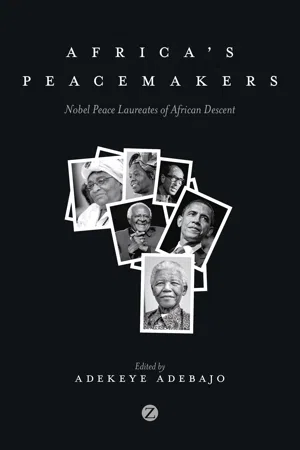
As Africa and its diaspora commemorate fifty years of post-independence Pan-Africanism, this unique volume provides profound insight into the thirteen prominent individuals of African descent who have won the Nobel Peace Prize since 1950.
From the first American president of African descent, Barack Obama, whose career was inspired by the civil rights and anti-apartheid struggles promoted by fellow Nobel Peace laureates Martin Luther King, Jr., Nelson Mandela, Desmond Tutu, and Albert Luthuli; to influential figures in peacemaking such as Ralph Bunche, Anwar Sadat, Kofi Annan, and F.W. De Klerk; as well as Ellen Johnson Sirleaf, Leymah Gbowee, Wangari Maathai, and Mohamed El-Baradei, who have been variously involved in women's rights, environmental protection, and nuclear disarmament, Africa's Peacemakers reveals how this remarkable collection of individuals have changed the world - for better or worse.
- English
- ePUB (mobile friendly)
- Available on iOS & Android
eBook - ePub
About this book
Information
PART ONE
INTRODUCTION
ONE
OBAMA’S NOBEL ANCESTORS: FROM BUNCHE TO BARACK AND BEYOND
ADEKEYE ADEBAJO
The political liberation of Africa was complete in May 1994 when Nelson Mandela became president of a democratic South Africa. In a speech to the US Congress five months later, Mandela quoted his fellow Nobel peace laureate Martin Luther King Jr’s famous words from an old Negro spiritual, uttered during his 1963 speech commemorating the March on Washington DC: ‘Free at last, free at last, thank God Almighty we are free at last!’ Two of the twentieth century’s greatest pan-African struggles – the civil rights and anti-apartheid battles – were thus inextricably linked. Both of these liberation struggles, in Africa and the United States, focused on combating racial injustice and social inequality. The black ghettos of the American civil rights struggle mirrored the black townships of the anti-apartheid struggle as the major cauldrons of these battles.
In 2013 the African Union (AU) commemorated fifty years since the birth of its predecessor, the Organisation of African Unity (OAU), which embodied the quest for pan-African unity. The AU has also designated the African diaspora a sixth subregion (along with Southern, Central, West, East and North Africa), thus recognising the continuing relevance of this historical relationship in which towering figures of the pan-African movement, like America’s W.E.B. DuBois, Trinidad’s Henry Sylvester-Williams and George Padmore, Jamaica’s Marcus Garvey, and Martinique’s Frantz Fanon played a major role1 (see Mazrui, Chapter 2 in this volume). The continent has also embarked since 1960 on a quest for what Kenyan scholar Ali Mazrui famously described in 1967 as a ‘Pax Africana’: creating and consolidating an African-owned peace.2 The thirteen Nobel peace laureates examined in this volume are thus, in a real sense, prophets of Pax Africana.
This volume seeks to draw lessons for peacemaking, civil rights, socio-economic justice, environmental protection, nuclear disarmament and women’s rights, based on the rich experiences of the thirteen Nobel peace laureates of African descent who won the prize between 1950 and 2011. These Nobel laureates come from diverse backgrounds, but have waged similar struggles for peace, justice and freedom. This collection of lucid, jargon-free essays, written by an interdisciplinary team of fourteen prominent African and African American scholars and practitioners, is the first book comprehensively to address this important topic.
African Americans like Nobel peace laureates Ralph Bunche (who won the prize in 1950) and Martin Luther King Jr (1964) played an important role in the pan-African struggle, with Bunche leading the creation of the United Nations Trusteeship Council by 1947 and King championing decolonisation efforts. Both attended Kwame Nkrumah’s independence celebration in Accra in March 1957. South Africa was the last African country to gain political independence from colonial rule, in 1994, in this thirty-year struggle, and it is appropriate that four of its citizens have won the Nobel Peace Prize: Albert Luthuli (1960), Desmond Tutu (1984), Nelson Mandela (1993) and Frederik Willem de Klerk (1993). The ancient civilisation of Egypt has produced two Nobel peace laureates – Anwar Sadat (1978) and Mohamed ElBaradei (2005) – honoured for peacemaking and nuclear disarmament respectively.
Ghana, which produced one of the greatest prophets of Pax Africana in Kwame Nkrumah, has been honoured with the award of the Nobel Peace Prize to Kofi Annan (2001), the UN Secretary General between 1997 and 2006. Kenya, the site of one of Africa’s greatest indigenous anti-colonial struggles, the Mau Mau resistance to British rule of 1952–1960, has produced a Nobel peace laureate in Wangari Maathai (2004), who devoted her life to environmental campaigning. Liberia, one of Africa’s oldest republics, founded in 1847 by freed American slaves, has produced the two most recent African Nobel peace laureates: Ellen Johnson Sirleaf and Leymah Gbowee (both in 2011) for their role in the struggle for women’s rights.
The first American president of African descent, Barack Obama (whose father was Kenyan), won the Nobel Peace Prize in 2009, and his career was inspired by Martin Luther King Jr’s civil rights struggle.3 Obama was also the direct beneficiary of this struggle, waged by King as well as Ralph Bunche. As a young student in the United States, Obama first became politically active when he engaged in the anti-apartheid struggle that sought to impose sanctions on the racist albinocracy in South Africa. He started a second and final presidential term in January 2013 in which he was expected to show more engagement with his ancestral continent. Obama therefore visited South Africa, Tanzania and Senegal six months into his second term.
This book will thus examine the contributions of three prominent African Americans, four South African priests and politicians, three peacemakers from Egypt and Ghana, and three women activists from Kenya and Liberia.
The Nobel Peace Prize was established, ironically, by Alfred Nobel (1833–1896), the Swedish inventor of dynamite, who willed his fortune to the endeavour for peace in 1895. The first Peace Prize was awarded in 1901 (other prizes are awarded for literature, medicine, physics, chemistry and economics). Five individuals chosen by the Norwegian parliament elect the annual winner, based on nominations from previous Nobel laureates; current or former members of the Nobel Peace Committee; members of national assemblies and of organisations such as the International Court of Justice, the International Court of Arbitration and the Inter-Parliamentary Union; and university professors of political science, law, history and philosophy.4 The decision is announced in October each year, and the award is presented in Oslo in December. India’s politico-spiritual leader Mohandas ‘Mahatma’ Gandhi was nominated for the prize five times and shortlisted three times, but was controversially never awarded it due to the political clout of the British Empire (Britain has had close ties to Norway), against which he waged a successful liberation struggle.5 Gandhi’s non-violent struggle, however, served as an inspiration to eight of our thirteen Nobel peace laureates of African descent: Ralph Bunche, Albert Luthuli, Martin Luther King Jr, Anwar Sadat, Desmond Tutu, Nelson Mandela, Barack Obama and Leymah Gbowee (see also Mazrui, Chapter 2 in this volume.)
Outline of the Book
The book begins with two introductory essays. The first, the present chapter, seeks to explain how the struggles for civil rights, peacemaking, environmental protection, nuclear disarmament and women’s rights link together, as well as identify the achievements of the thirteen Nobel peace laureates of African descent who led these struggles. The second framing chapter, by Kenyan scholar Ali Mazrui, explains the significance of Barack Obama being awarded the Peace Prize in the context of Mahatma Gandhi and the twelve Nobel peace laureates of African descent who came before and after him.
Next, in Part Two, three chapters by African American analysts Pearl Robinson (Chapter 3) and Lee Daniels (Chapter 5) and Sierra Leonean scholar-diplomat James Jonah (who was mentored by Ralph Bunche at the UN, Chapter 4) assess the three African-American Nobel peace laureates: Ralph Bunche, Martin Luther King Jr and Barack Obama. Both Bunche and King were involved in America’s civil rights struggle, though Bunche won the prize chiefly for his peacemaking role in the Middle East with the United Nations. Connections between these struggles are made, while one of the chapters – by Pearl Robinson – innovatively compares and contrasts the perspectives of Bunche, King and Obama on war and peace, using their Nobel Peace Prize speeches and other sources.
In Part Three, the anti-apartheid and peacemaking legacies of four South African Nobel laureates are examined by four South African authors – Chris Saunders (Chapter 6), Maureen Isaacson (Chapter 7), Elleke Boehmer (Chapter 8) and Gregory Houston (Chapter 9). Albert Luthuli, the president of the African National Congress (ANC) between 1951 and 1967 and a traditional chief and former lay preacher, was the first African Nobel peace laureate, in 1960. In 1984, another ‘troublesome priest’, Archbishop Desmond Tutu, won the prize. Like Luthuli, Tutu used the Nobel platform in Oslo to protest against the repression of the racist government in Pretoria. Thus Saunders and Isaacson richly analyse the struggles of both Luthuli and Tutu. Nelson Mandela, another ANC chieftain, became one of the twentieth century’s greatest moral leaders. Boehmer’s eloquent essay examines Mandela’s use of oratory in waging the anti-apartheid struggle, offering a rich comparison with Barack Obama. Apartheid’s last leader, Frederik Willem de Klerk, was a ‘pragmatic peacemaker’ who controversially shared the Nobel Peace Prize with Mandela in 1993. Houston’s historical essay traces de Klerk’s peacemaking contributions to South Africa’s transformation into a democratic state by 1994.
In Part Four, two Egyptian authors – Boutros Boutros-Ghali (Chapter 10) and Morad Abou-Sabé (Chapter 11) – examine the legacy of the two Egyptian Nobel peace laureates. Boutros-Ghali, former Egyptian minister of state for foreign affairs and former UN Secretary General (1992–96), explains the significance of President Anwar Sadat’s historic trip to Jerusalem in 1977, which led to his assassination four years later, having won the Nobel Peace Prize in 1978.6 Egypt’s second Nobel peace laureate, in 2005, was Mohamed ElBaradei, who headed the UN’s International Atomic Energy Agency (IAEA) between 1997 and 2009, and has more recently been involved in civic struggles to promote democratic governance in Egypt, efforts that are analysed by Abou-Sabé in his essay.
Part Five assesses the environmental and peacemaking efforts of two Nobel laureates. South African scholar Janice Golding assesses the contributions of Kenyan environmental campaigner and ‘Earth Mother’ Wangari Maathai, who became the first African woman to be awarded the Nobel Peace Prize, in 2004 (Chapter 12). Another African-American scholar, Gwendolyn Mikell, examines the peacemaking legacy of Ghana’s Kofi Annan, who served as UN Secretary General between 1997 and 2006 (Chapter 13).
Concluding the book, Part Six examines the two Liberian women who were jointly awarded the Nobel Peace Prize in 2011: President Ellen Johnson Sirleaf, dubbed the ‘Iron Lady’; and civil society activist Leymah Gbowee, described as ‘the prayerful peace warrior’. Both fought actively for women’s and civil rights in Liberia, and the two chapters here, by Nigerian analysts Adekeye Adebajo (Chapter 14) and Rosaline Daniel (Chapter 15) respectively, chronicle these struggles. Adebajo, however, is critical of Sirleaf being awarded the Peace Prize, due partly to her ambiguous role in Liberia’s first civil war between 1989 and 1997.
Connections and Contrasts
These fifteen essays seek to make connections between the struggles for peace, justice and freedom and the thirteen individuals of African descent who have won the Nobel Peace Prize. Ralph Bunche and Martin Luther King Jr marched together during the civil rights struggles of the 1950s and 1960s; Albert Luthuli and King issued a joint declaration against apartheid in 1962; Luthuli and Nelson Mandela worked together against apartheid within the ANC in the 1950s and early 1960s; Mandela appointed Desmond Tutu head of South Africa’s Truth and Reconciliation Commission (TRC), which submitted its report in 1996; Luthuli and Tutu were both priests who were forced into politics by the inequities of apartheid; King, Luthuli, Tutu and Mandela were all skilful performers who understood the importance of dramatic speeches and gestures; while F.W. de Klerk, as a young apartheid-supporting student leader, invited Luthuli to address fellow students at South Africa’s Potchefstroom University in 1961.
There are other interactions and connections between our thirteen Nobel laureates. Barack Obama met Tutu in South Africa as a US senator in 2006, and as president honoured Tutu with America’s Medal of Freedom in August 2009; Obama and Mandela both embodied a charismatic leadership style in pursuing their goals (see Boehmer, Chapter 8 in this volume); Kofi Annan and Mohamed ElBaradei were both self-effacing technocrats rather than politicians, who rose up the ranks to head their respective institutions, seeking to serve as a ‘force for good’ in the world and embody the principles of their organisations; Wangari Maathai, Ellen Johnson Sirleaf and Leymah Gbowee all courageously pursued women’s rights through methods that directly confronted authority; Maathai worked with fellow Nobel laureates Annan and Tutu to promote environmental issues. In 2006, then-senator Barack Obama planted a tree with Maathai in Nairobi’s Uhuru Park. Both ElBaradei and his fellow Nobel peace laureate Maathai were involved in unorthodox struggles that sought to link nuclear disarmament and environmental protection to global security in a new framework of human security. Both became involved in domestic democracy struggles, in Egypt and Kenya respectively. Both ElBaradei and Obama shared the desire to rid the world of nuclear weapons.
Over two centuries ago, Jesus Christ had famously noted that ‘A Prophet has no honour in his own country’ (John 4:44). Six of our Nobel laureates who served as international civil servants or pursued global and regional issues suffered this fate. Ralph Bunche was recognised more in international circles than he was in the USA; Anwar Sadat was revered...
Table of contents
- Cover
- About the Editor
- Title
- Copyright
- Contents
- Part One: Introduction
- Part Two: The Three African Americans
- Part Three: The Four South Africans
- Part Four: The Two Egyptians
- Part Five: The Kenyan and the Ghanaian
- Part Six: The Two Liberians
- Notes
- About the Contributors
- Index
Trusted by 375,005 students
Access to over 1.5 million titles for a fair monthly price.
Study more efficiently using our study tools.
Frequently asked questions
Yes, you can cancel anytime from the Subscription tab in your account settings on the Perlego website. Your subscription will stay active until the end of your current billing period. Learn how to cancel your subscription
No, books cannot be downloaded as external files, such as PDFs, for use outside of Perlego. However, you can download books within the Perlego app for offline reading on mobile or tablet. Learn how to download books offline
Perlego offers two plans: Essential and Complete
- Essential is ideal for learners and professionals who enjoy exploring a wide range of subjects. Access the Essential Library with 800,000+ trusted titles and best-sellers across business, personal growth, and the humanities. Includes unlimited reading time and Standard Read Aloud voice.
- Complete: Perfect for advanced learners and researchers needing full, unrestricted access. Unlock 1.5M+ books across hundreds of subjects, including academic and specialized titles. The Complete Plan also includes advanced features like Premium Read Aloud and Research Assistant.
We are an online textbook subscription service, where you can get access to an entire online library for less than the price of a single book per month. With over 1.5 million books across 990+ topics, we’ve got you covered! Learn about our mission
Look out for the read-aloud symbol on your next book to see if you can listen to it. The read-aloud tool reads text aloud for you, highlighting the text as it is being read. You can pause it, speed it up and slow it down. Learn more about Read Aloud
Yes! You can use the Perlego app on both iOS and Android devices to read anytime, anywhere — even offline. Perfect for commutes or when you’re on the go.
Please note we cannot support devices running on iOS 13 and Android 7 or earlier. Learn more about using the app
Please note we cannot support devices running on iOS 13 and Android 7 or earlier. Learn more about using the app
Yes, you can access Africa's Peacemakers by Adekaye Adebajo in PDF and/or ePUB format, as well as other popular books in Politics & International Relations & Political Biographies. We have over 1.5 million books available in our catalogue for you to explore.