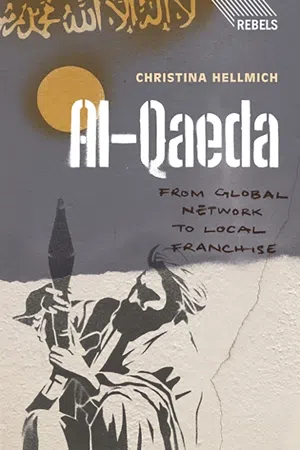
Since the attacks of September 11th 2001 and up to and beyond Osama bin Ladin's death, al-Qaeda has come to embody the new enigmatic face of terrorism, dominating discussions of national and international security. Yet in spite of the attention it receives, conflicting assumptions about the group abound. Is al-Qaeda a rigidly structured organization, a global network of semi-independent cells, a franchise, or simply an idea whose time has come? What is meant by talk of the 'global Salafi jihad' that is confronting the West? What are the implications of bin Ladin's death?
Christina Hellmich offers a critical examination of the widely-held notions regarding the origins and manifestations of al-Qaeda and the sources on which they rely, mapping the organisation's alleged transition from what began as a regional struggle against the Soviets in Afghanistan to the increasingly leaderless jihad of the post-9/11 world. Rather than just providing yet another biography of al-Qaeda, Hellmich forensically examines discrepancies between the most common explanations and to the limits of what can realistically be known.
Drawing on a wide variety of sources, 'al-Qaeda: From Global Network to Local Franchise' offers a penetrating insight into an organization which, for all its notoriety, is one of the least-understood of our time.
- English
- ePUB (mobile friendly)
- Available on iOS & Android
eBook - ePub
About this book
Information
Notes
CHAPTER 1
1. A particularly harsh criticism of the failure to predict the events of 9/11 can be found in Martin Kramer, Ivory Towers on Sand: The Failure of Middle Eastern Studies in America (Washington DC: Washington Institute for Near East Policy, 2001).
2. Magnus Ranstorp, ‘Mapping Terrorism Studies After 9/11: An Academic Field of Old Problems and New Prospects’, in Richard Jackson, Marie Breen Smyth and Jeron Gunning (eds), Critical Terrorism Studies: Framing a New Research Agenda (London: Routledge, 2008), p. 23. For a similar assessment of the field, see Magnus Ranstorp, Mapping Terrorism Research: State of the Art, Gaps and Future Directions (London: Routledge, 2007).
3. Christina Hellmich, ‘Creating the Ideology of Al Qaeda: From Hypocrites to Salafi-Jihadists’, Studies in Conflict and Terrorism, vol. 32, no. 2, 2008, pp. 111–25.
4. For a critical analysis, see Richard Jackson, Writing the War on Terrorism: Language, Politics and Counter-Terrorism (Manchester: Manchester University Press, 2005).
5. Marc Sageman, Leaderless Jihad, Terror Networks in the Twenty-First Century (Philadelphia: University of Pennsylvania Press, 2008), p. 13.
6. For reviews and assessments of the field, see Alex Schmid and Albert Jongman, Political Terrorism: A Guide to Actors, Authors, Concepts, Databases, Theories and Literature (Amsterdam: North Holland, 1988); Ariel Merari, ‘Academic Research and Government Policy on Terrorism’, Terrorism and Political Violence, vol. 3, no. 1, 1991, pp. 88–102; Andrew Silke, Research on Terrorism: Trends, Achievements and Failures (London: Routledge, 2004).
7. Silke, Research on Terrorism, p. 188.
8. Martha Crenshaw, ‘The Psychology of Terrorism: An Agenda for the 21st Century’, Political Psychology, vol. 21, no. 2, 2000, p. 405.
9. For a detailed comment ‘A Treatment for Radical on this phenomenon, see Juan Cole, Ignorance about Islamic Radicalism’, Chronicle of Higher Education, 3 March 2006, http://chronicle.com/article/A-Treatment-for-Radical/26858.
10. Ted Gurr, cited in Ranstorp, ‘Mapping Terrorism Studies after 9/11’, p. 20. For a more comprehensive account, see Ted Gurr, ‘Empirical Research on Political Terrorism: The State of the Art and How It Might Be Improved’, in R.O. Slater and M. Stohl (eds), Current Perspectives on International Terrorism (New York: St. Martin’s Press, 1988).
11. Ranstorp, ‘Mapping Terrorism Studies after 9/11’, p. 26.
12. Ibid., p. 27.
13. Tom Mills, cited in ibid., p. 27. See also David Miller and Tom Mills, ‘The Terror Experts and the Mainstream Media: The Expert Nexus and Its Dominance in the News Media’, Critical Studies on Terrorism, vol. 2, no. 3, December 2009, pp. 414–43.
14. Muhammad Ally, cited in Ranstorp, ‘Mapping Terrorism Studies after 9/11’, p. 28.
15. Evan Kohlmann, ‘Al-Qa’ida’s Yemeni Expatriate Faction in Pakistan’, CTC Sentinel, vol. 4, no. 1, January 2011, pp. 11–15.
16. Ranstorp, ‘Mapping Terrorism Studies after 9/11’, pp. 28–30.
17. Ibid., p. 29.
18. Martin Bright, ‘On the Trail of Osama bin Ladin’, Observer, 11 May 2003, www.guardian.co.uk/theobserver/2003/may/11/society.politics.
19. The 9/11 Commission Report: The Final Report of the National Commission on Terrorist Attacks upon the United States (New York: W.W. Norton, 2004).
20. See, for example, Marc Sageman, Understanding Terror Networks (Philadelphia: University of Pennsylvania Press, 2004).
21. Edna Reid, ‘Evolution of a Body of Knowledge: An Analysis of Terrorism Research’, Information Processing and Management, vol. 33, no. 1, 1997, pp. 91–106.
22. Miller and Mills, ‘The Terror Experts and the Mainstream Media’, p. 414. While some defenders of traditional terrorism studies deny this characterization (see, for example, John Horgan and Michael Boyle, ‘A Case against Critical Terrorism Studies’, Critical Studies on Terrorism, vol. 1, no. 1, 2008, pp. 51–64), it is hard to draw any evidentially based alternative conclusion.
23. During the time of the French Revolution, for example, the Grand Jacobins of the Committee for Public Safety declared themselves ‘terrorists’ and made ‘terror’, which was perceived as a contingent necessity, part of daily affairs. Since then, the word ‘terrorism’, which originally qualified the exercise of state power, has come to signify exactly the contrary – the use of violence in opposition to the state. Alain Badiou, Infinite Thought: Truth and the Return to Philosophy (London: Continuum, 2005), pp. 108–10.
24. Andrew Heywood, Political Theory: An Introduction, 3rd edn (Basingstoke: Palgrave Macmillan, 2004), p. 79. For a more comprehensive reading of the liberal state, see social contractarians such as John Locke and Jean-Jacques Rousseau.
25. Miller and Mills, ‘The Terror Experts and the Mainstream Media’, p. 14.
26. James Der Derian, ‘The Terrorist Discourse: Signs, States, and Systems of Global Political Violence’, in James Der Derian, Critical Practices in International Theory (Routledge: London, 2009), p. 69.
27. It was not until 2005 that a collection of bin Ladin’s most important statements made between 1994 and 2004 finally became available. While this collection, titled Messages to the World: The Statements of Osama bin Ladin, edited and annotated by Bruce Lawrence (London: Verso, 2005), provides one of the most useful insights into the rationale of al-Qaeda to date, it has been surprisingly underutilized. In part, this may be due to the assumption that the phenomenon of bin Ladin’s global jihad is already sufficiently understood.
28. Krista Hunt and Kim Rygiel, (En)Gendering the War on Terror: War Stories and Camouflaged Politics (Aldershot: Ashgate, 2006), p. xiii.
29. Audrey Cronin, ‘How Al-Qaeda Ends’, presentation at the IV Jornadas Internacionales Sobre ‘Los Finales del Terrorismo’, Zaragoza, Spain, 10 November 2010. For a more detailed discussion, see ‘How al-Qaida Ends: The Decline and Demise of Terrorist Groups’, International Security, vol. 31, no. 1, Summer 2006, pp. 7–48.
30. For an excellent discussion of the global jihad and the practice of takfir, see Nelly Lahoud, The Jihadis’ Path to Self-Des...
Table of contents
- Cover
- Rebels
- About the Author
- Title
- Copyright
- Contents
- Acknowledgements
- One: 9/11 and the anxious search for answers
- Two: What is al-Qaeda? From Afghanistan to 9/11
- Three: Hypocrites, Wahhabis and Salafi jihadis: post-9/11 explanations of al-Qaeda’s ideology
- Four: Reclaiming the umma: the ideology of al-Qaeda in the context of the pan-Islamic tradition
- Five: Al-Qaeda post-9/11: destroyed, weakened or re-emergent?
- Six: The future of Al-Qaeda
- Notes
- Bibliography
- Index
- About Zed Books
Trusted by 375,005 students
Access to over 1.5 million titles for a fair monthly price.
Study more efficiently using our study tools.
Frequently asked questions
Yes, you can cancel anytime from the Subscription tab in your account settings on the Perlego website. Your subscription will stay active until the end of your current billing period. Learn how to cancel your subscription
No, books cannot be downloaded as external files, such as PDFs, for use outside of Perlego. However, you can download books within the Perlego app for offline reading on mobile or tablet. Learn how to download books offline
Perlego offers two plans: Essential and Complete
- Essential is ideal for learners and professionals who enjoy exploring a wide range of subjects. Access the Essential Library with 800,000+ trusted titles and best-sellers across business, personal growth, and the humanities. Includes unlimited reading time and Standard Read Aloud voice.
- Complete: Perfect for advanced learners and researchers needing full, unrestricted access. Unlock 1.5M+ books across hundreds of subjects, including academic and specialized titles. The Complete Plan also includes advanced features like Premium Read Aloud and Research Assistant.
We are an online textbook subscription service, where you can get access to an entire online library for less than the price of a single book per month. With over 1.5 million books across 990+ topics, we’ve got you covered! Learn about our mission
Look out for the read-aloud symbol on your next book to see if you can listen to it. The read-aloud tool reads text aloud for you, highlighting the text as it is being read. You can pause it, speed it up and slow it down. Learn more about Read Aloud
Yes! You can use the Perlego app on both iOS and Android devices to read anytime, anywhere — even offline. Perfect for commutes or when you’re on the go.
Please note we cannot support devices running on iOS 13 and Android 7 or earlier. Learn more about using the app
Please note we cannot support devices running on iOS 13 and Android 7 or earlier. Learn more about using the app
Yes, you can access Al-Qaeda by Doctor Christina Hellmich in PDF and/or ePUB format, as well as other popular books in Politics & International Relations & Terrorism. We have over 1.5 million books available in our catalogue for you to explore.