How does our understanding of Africa shift when we begin from the perspective of women? What can the African perspective offer theories of culture and of gender difference?
This work, as unique and insightful today as when it was first published, brings together a wide variety of African academics and other researchers to explore the links between literature, popular culture and theories of gender. Beginning with a ground-breaking overview of African gender theory, the book goes on to analyse women's writing, uncovering the ways different writers have approached issues of female creativity and colonial history, as well as the ways in which they have subverted popular stereotypes around African women. The contributors also explore the related gender dynamics of mask performance and oral story-telling.
This major analysis of gender in popular and postcolonial cultural production remains essential reading for students and academics in women's studies, cultural studies and literature.
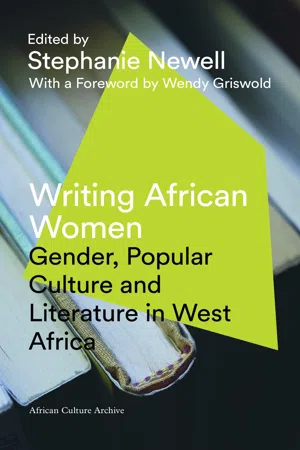
eBook - ePub
Writing African Women
Gender, Popular Culture and Literature in West Africa
- English
- ePUB (mobile friendly)
- Available on iOS & Android
eBook - ePub
About this book
Information
PART I
Theory and Politics
Theory and Politics
1
Reading towards a theorization of African women’s writing: African women writers within feminist gynocriticism
The writing of African women has frequently been read within a representational problematic in which the text becomes merely the image of a given reality. In such a context critical evaluation remains trapped in surface descriptions and analyses which tend to elicit only the normative knowledge of the writing.
A reading of African women’s writing within a feminist framework can bring new energy and vitality to this writing and actually inspire a theorization within its own specific context and within the larger context of feminist writing. For what a feminist framework does is to introduce gender as a fundamental category in literary analysis, enabling the critic to see representations in texts as mediated by sexual difference and the aesthetic and political assumptions that surround gender. At one level it permits us to contest and revise misconceptions and narrow representations that trap women within a male literary discourse; at another more liberating level it contextualizes women’s creative production within a sphere of difference, of a female experience and perception that asks different questions and draws various significances from a woman writer’s texts. By concentrating on the particular styles, themes and structures of women’s writing, this aspect of feminist criticism, termed gynocritics, moves beyond revisionist interpretations towards a sustained investigation of women’s literary production. The focus on female literary difference can provide only a general theoretical framework, however, since the inscription of a woman’s sphere and the meaning of female difference may deviate from culture to culture. Thus, although gynocritics identifies four models of difference – biological, linguistic, psychoanalytical and cultural – the emphasis placed on each model may depend on feminine priorities within cultures.
French feminist criticism may, for instance, emphasize ‘écriture féminine, the inscription of the female body and female difference in language and text’; but African feminist critics, while acknowledging biology as a sphere of difference, recognize the possible limitations and stereotyping that it can generate in an African context (Ogundipe-Leslie 1987: 5). French and American feminist critics may assert women’s difference within a framework of sexual politics, while African feminists would argue that power relations between African men and women should be reconsidered in the context of an African world made vulnerable by the ‘great cataclysmic faults of the ages’ (Aidoo 1977: 118).
This chapter works within the framework of gynocritics, especially the ‘women’s culture’ model, which has the capacity to break a monolithic concept of feminism by presenting women’s writing as different from the point of view of gender and specific cultural contexts:
The ways in which women conceptualize their bodies and their sexual and reproductive functions are intricately linked to their cultural environments. The female psyche can be studied as the product or construction of cultural forces. Language, too, comes back into the picture, as we consider the social dimensions and determinants of language use, the shaping of linguistic behaviour and cultural ideals (Showalter 1988: 345).
The women’s culture model moves beyond the kind of feminist emphasis that polarizes male and female writing in sexual politics. By presenting a wider framework within which a woman’s writing can be defined in terms of cultural contexts and priorities, it acknowledges the variables of nationality, race, ethnicity, history and class as literary determinants which are as significant as gender in a woman’s writing. Such a model inevitably invites perspectives on history, anthropology and sociology within the wider sphere of female cultural experience and difference, and generates several other questions. What, for instance, is the relationship between gender and history? How are representations of the same historical experience mediated by gender or class? How are ideas of manhood and womanhood destabilized within a changing world? How do men and women reconstitute new identities in a post-colonial era? How do men and women relate to the same cultural myths? These are all interrogations which, when satisfactorily pursued, should not only revise our notions of artistic representation, but also inspire a rethinking of the conceptual ground of African literary theory and its assumptions about writing and reading. They are questions that would undermine our view of the African literary tradition and force a reconception of its central canon.
The other advantage of such a model is that it does not remove a female sphere from the general culture shared by men, but presents a woman-centred world within the wider political, economic and cultural world, contextualizing it within two traditions at the same time. It is such a sphere that becomes the site of criticism and theory, unearthing the full implications of female consciousness and giving it vitality and voice.
It is only within such a framework that the complex motivations and impulses around the category of gender may be fruitfully engaged in the analysis of a woman writer’s works. Such a framework would definitely move us beyond what Katherine Frank sees as the single-minded sexual politics of African women’s writing which, ‘embraces the solutions of a world without men [since …] man is the enemy, the exploiter and oppressor’ (Frank 1987: 15). Frank’s view of the woman writer’s outright repudiation of men is only the polemical aspect of a writing which in practice intersects with several other needs and contexts, with the more intimate realities of women as women and with the larger historical facts of existence in a world mediated by other worlds. Ogundipe-Leslie clarifies these other dimensions in her seminal paper on the female writer and her commitment: ‘Being aware of oneself as a Third World person implies being politically conscious, offering readers perspectives on and perceptions of colonialism and neo-colonialism as they affect and shape our lives and historical destinies’ (Ogundipe-Leslie 1987: 11). Valerie Smith, writing in the context of African-American women’s theory, suggests a reading method that would ‘hold all these intersecting aspects in a woman’s work in mutually interrogative … relation’ (Smith 1989: 48).
Within the framework of such a model, a reading strategy can be formulated to enable us to move beyond the normative knowledge of the woman’s text, towards identifying structures and significations and their social import. The reading strategy I have adopted suggests that critical reading can actually construct new meanings from a text by distancing itself from its assumed coherence and discovering the process of its production; it can create meanings from the contradictions which, perhaps unknown to the author, the text continually reveals. This strategy is also based on certain assumptions I have made about the writing of African women: namely, that it is marked by gender perspectives that are mediated by history, culture and class; that it operates within a male discourse and is in constant interaction and dialogue with it through its double-edged perspectives and its revisionist and other interrogations; that women writers themselves engage in dialogue with each other’s writing as a way of linking to or differentiating themselves from a continuum of women’s writing in a continuously changing female discourse.
The first observation that surfaces in an analysis of African women’s writing relates to the writer’s reconstruction of the wider society and her exploration of women’s lives and experiences within it. Here, the first departure from male traditions of inscription and representation occurs, through the very centrality given to women as characters, the reflection of their sensibilities, the opening up of their consciousness, in effect, the privileging of the female voice and world. Mari McCarty has argued that in voluntarily entering this sphere of female experience, a woman writer can write her way out of the cramped confines of patriarchal space (McCarty 1981: 368); it can be argued that Grace Ogot and Flora Nwapa, very early African women writers, began a tradition of appropriating and valorizing female experience and in the process managed to subvert certain fixed definitions of the female subject.
While in earlier reconstructions of colonial society in the works of male writers, women characters often appeared fixed in roles that remained unproblematized, the works of the early women writers countered fixed images of women through narrative strategies in which their women characters appeared in shifting and seemingly contradicting poses, giving the writers leeway to present them as complex and subtle. Grace Ogot’s protagonist in The Promised Land (1966) is in one respect a traditional wife, and in another an alert observer and critic both of her husband and of her society. The motif of migration and the juxtaposed perceptions of husband and wife present a framework for Ogot’s revisionist subversions of women’s defined roles in patriarchal society. In the novel’s reconstruction of the colonial world of the 1930s the subject of migration is still traumatic enough to present Ogot with a context for moral and cultural delineations of character. The two perspectives on the subject revealed by both husband and wife may appear to be the dominant conflict of the novel, but there is a sub-text located in the inner thoughts of Ogot’s female protagonist. In contemplating her opposition to migration and her impotence in preventing an action that may yet change her life, Ogot’s female subject recognizes that the claims of marriage as defined by her community are themselves forms of displacement and imprisonment and an abnegation of choice and will. Such an interrogative perspective may appear contradictory in a character who also appears, on the face of it, to embrace her community and all it stands for.
Flora Nwapa’s woman-centred world presents similar juxtapositions of perspectives and perceptions. What such shifting representations do is to counter a fixed and static definition of woman and invite a more problematic awareness of women as individual characters. Indeed, the entire construction of Efuru (1966) embodies certain deliberate strategies for unearthing and privileging women’s submerged worlds and consciousness. Though the novel appears to unroll in a loose cinematic and unstructured way, it embodies a deliberate strategy to enact the pattern of interactions and relationships which represent the world in which the protagonist defines herself. Thus, if the deliberate realism represents the slow-paced rhythm of life in the protagonist’s woman-centred community, it also enacts the flow of feeling from woman to woman, demonstrating what Nwapa sees as a major characteristic of women and the source of bonding and sisterhood between them.
To represent reality in such starkly realistic terms as enactments of interactions may appear to affirm the authority of the community and to hold no paradoxes for either the author or the reader. Yet, Efuru is a subversive novel which speaks on the surface of women’s powerlessness yet celebrates their power. The women characters themselves continually verbalize their insignificance and impotence in the world of men. Yet the novel itself demonstrates the varied strengths and competence of women. Nwapa’s rhetoric of realism therefore conceals certain ironies and is a strategy of narration which presents women in shifting, changeable positions as a way of countering their static definitions in patriarchal society. As a character, Efuru herself embodies some of these shifting and apparently contradictory representations. For she is both within and outside the norms and prescriptions of her patriarchal world, and her reactions to some of its requirements often shift in relation to a pragmatic sense of her own needs as a person and a woman.
Thus, at one point Efuru might disobey tradition, showing an independent will and a personal ethic, while at other times she might embrace traditions and values within the community’s definition of women’s roles. For instance, her disappointment and internalization of what the community defines as womanly failures may appear to be a total acceptance of the community’s values and prescriptions. In line with Nwapa’s strategies of narration, however, Efuru does make a second choice when she commits herself to the worship of the water deity. It is a choice that may appear to remain inscribed within the tradition, but it is not totally within it. For the deity is presented as embodying a contradictory element in the community’s traditional values: on the one hand, she is goddess and therefore of the community; yet, on the other hand, she does not embody the community’s most cherished values of fertility and motherhood, choosing the best and the most unsullied of the community’s women as worshippers. The fact that she appears to Efuru in a dream, that she is linked to her in an unconscious, spiritual and metaphysical sense, exposes this contradictory element and brings into focus other choices for women within the traditional community. Does the relationship then create an alternative or additional definition of womanhood, something spiritual and creative within the community, yet apart from it in its particular vision? A reading that relates this choice to the various implications of the deity may throw out several illuminations since Nwapa herself is ambiguous about the goddess’s implications as a symbol. Although Maggie Phillips (1994) has seen the deity rightly as embodying a possible contradiction between wealth and fertility, her symbolic ambiguity is such that she could well represent an equally viable and creative alternative to the ‘joys of motherhood’.
It is this manipulation of the imponderable forces represented by the supernatural which provides Nwapa with both a context and a narrative with which to write a woman’s text from outside the confines of patriarchal prescription. Her representation inscribes a different texture of imagination, voice and style from a contemporary male writer such as Elechi Amadi who has treated a similar context and theme in a strikingly different way. Amadi’s The Concubine (1966), like Nwapa’s Efuru, explores the tenuous often inexplicable relationship between men and gods in traditional Igbo society, but presents this relationship almost as something given: in Amadi’s world men may expiate, appease and somehow get around the vengeance and capriciousness of gods but may never wrestle with them and win. The fate of individuals caught up in such tragic meshes may arouse pity and fear but is finally no more than what is given. Ihuoma’s curiosity about the material world is answered in her earthly incarnation as a mortal woman. Yet she is punished by a jealous supernatural husband. The powerful sea god denies her matrimonial bliss on earth, thus limiting fulfilment of the very qualities that idealize her as a desirable woman and wife (Amadi 1966: 195). Ihuoma’s story may be made poignant but it remains unproblematized. There is none of Efuru’s urgency to create a different climate of imagination, a different narrative or language which would expose and challenge the patriarchal assumptions that underlie her spiritual and material bondage to the male sea god.
It is in this context of rearranging and rewriting a given reality that African women writers search for new voices, narratives and languages to structure the problematic nature of female experience in a changing African world. Their writing can be seen, then, as a constantly shifting discourse in which writers continually enter into dialogue with each other’s writing within a continuum.
It is significant that in her interrogation of Nwapa’s perspectives in her novel The Joys of Motherhood (1980), Buchi Emecheta should transform the symbolic implications of the sea goddess and do away with the veiled understatements and ambiguities that surround her figure in Nwapa’s novel. In The Joys of Motherhood th...
Table of contents
- Cover
- About the author
- Title
- Copyright
- Contents
- Acknowledgements
- Foreword
- Introduction: Writing African women: gender, popular culture and literature in West Africa
- Part I Theory and Politics
- Part II Literatures
- Part III Popular Culture
- Index
Trusted by 375,005 students
Access to over 1.5 million titles for a fair monthly price.
Study more efficiently using our study tools.
Frequently asked questions
Yes, you can cancel anytime from the Subscription tab in your account settings on the Perlego website. Your subscription will stay active until the end of your current billing period. Learn how to cancel your subscription
No, books cannot be downloaded as external files, such as PDFs, for use outside of Perlego. However, you can download books within the Perlego app for offline reading on mobile or tablet. Learn how to download books offline
Perlego offers two plans: Essential and Complete
- Essential is ideal for learners and professionals who enjoy exploring a wide range of subjects. Access the Essential Library with 800,000+ trusted titles and best-sellers across business, personal growth, and the humanities. Includes unlimited reading time and Standard Read Aloud voice.
- Complete: Perfect for advanced learners and researchers needing full, unrestricted access. Unlock 1.5M+ books across hundreds of subjects, including academic and specialized titles. The Complete Plan also includes advanced features like Premium Read Aloud and Research Assistant.
We are an online textbook subscription service, where you can get access to an entire online library for less than the price of a single book per month. With over 1.5 million books across 990+ topics, we’ve got you covered! Learn about our mission
Look out for the read-aloud symbol on your next book to see if you can listen to it. The read-aloud tool reads text aloud for you, highlighting the text as it is being read. You can pause it, speed it up and slow it down. Learn more about Read Aloud
Yes! You can use the Perlego app on both iOS and Android devices to read anytime, anywhere — even offline. Perfect for commutes or when you’re on the go.
Please note we cannot support devices running on iOS 13 and Android 7 or earlier. Learn more about using the app
Please note we cannot support devices running on iOS 13 and Android 7 or earlier. Learn more about using the app
Yes, you can access Writing African Women by Stephanie Newell in PDF and/or ePUB format, as well as other popular books in Social Sciences & Gender Studies. We have over 1.5 million books available in our catalogue for you to explore.