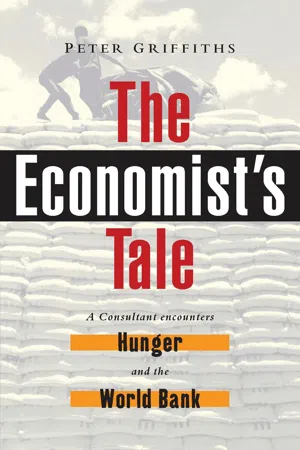
What really happens when the World Bank imposes its policies on a country? This is an insider's view of one aid-made crisis. Peter Griffiths was at the interface between government and the Bank.
In this ruthlessly honest, day by day account of a mission he undertook in Sierra Leone, he uses his diary to tell the story of how the World Bank, obsessed with the free market, imposed a secret agreement on the government, banning all government food imports or subsidies. The collapsing economy meant that the private sector would not import. Famine loomed. No ministry, no state marketing organization, no aid organization could reverse the agreement. It had to be a top-level government decision, whether Sierra Leone could afford to annoy minor World Bank officials.
This is a rare and important portrait of the aid world which insiders will recognize, but of which the general public seldom get a glimpse.
- English
- ePUB (mobile friendly)
- Available on iOS & Android
eBook - ePub
Trekking On
FRIDAY, 22 SEPTEMBER
As we drove away from the university this morning, I realized that I have not seen a single bicycle in Freetown or in the country. And this in a continent where the bicycle is the main form of transport.
‘There used to be a lot of them when I was young,’ Thomas explained. ‘Everybody had one. If a man went to work in the diamond fields for a couple of months, he brought back a bicycle as well as money. The coffee and cocoa buyers used to sell them.
‘Then the economy went wrong, and you could not get spare parts. After a bit, tyres wore out or tubes got punctures, and you could not get spares. Everybody put their bicycles away to wait for good times.
‘When I went to Oxford to do my M.Sc., I bought myself a bicycle. It was great. I could go anywhere without walking and without taking a taxi. I brought it home with me. In Freetown it meant I was free to go where I wanted, unlike all my friends. It was like having a car. Then the tyre blew. So it is stored in the roof of my house. I oil it sometimes, and hope it will still work when the country has enough foreign exchange.’
His deep voice was quiet, unemotional. He did not seem to be bitter, just fatalistic about something outside his control, something happening to his country, but he did not seem to blame anyone. There is no indignation.
I note that three-quarters of the cars on the road are Mercedes. There are a few of other makes, mainly owned by the projects, and no bicycles at all. This accurately reflects the distribution of wealth in the population.

Our first puncture. We changed the tyre and drove on to the next town. The puncture was not repairable, and none of the shops had a Land-Rover tyre, so we were left without a spare. I thought we would have to cancel the trip, as I was not willing to risk getting another puncture somewhere in the bush, and wait there for a week until we could send to Freetown for a spare. However, Mohammed disappeared and appeared an hour later with a grin on his face, carrying a very old tyre. It was completely bald but would do in a real emergency. We could at least crawl to the next town if we got another puncture. The seller knew he had us at his mercy, and I had to pay the full price of a new tyre in Freetown. Thank God, Mohammed has the gumption to find the only spare tyre in a town like this. No doubt he got a commission though. Smart lad, Mohammed.
Mohammed complained that the VW Passat that he normally drives for the World Bank does not have a proper spare tyre, just a thin little emergency tyre designed not to take up too much space in the boot. The instruction book claims that you can drive 50 miles on it, at speeds of up to 45 miles an hour.
‘They are no good Sah. Maybe they OK in Freetown, but on bush roads, they last four, five miles. On bush roads, I get a puncture every week maybe. We bought a proper spare tyre, but it does not fit properly in the boot. Why do they have no proper tyre like the old car?’
I do not think he believed my explanation that it was OK in Germany where you expect one puncture every 50,000 miles and all the roads are tarred.
As we drove further inland, I gazed out of the window looking at the scenery. Mostly it looked like unbroken jungle on each side of the car, though I got enough glimpses of trees I recognized, like oil palm trees and bread fruit, to realize that it was not jungle at all, but a mixed plantation of coffee, cocoa, oil palm, and any other trees that might provide food or a bit of money. Occasionally there were small fields at the side of the road, again with a mixture of crops – yams, beans, sesame, a few maize plants and a plot of cassava. This mixed planting gives higher total yields than a field full of one crop, and it reduces insect damage, but it does take more work per acre. Behind these small fields was another belt of trees. Occasionally we crossed a valley and saw a swamp, either untouched, or reclaimed as a paddy field.
What we did not see was a view. This is an incredibly flat country, and we are still not much above sea level. I suppose there must be a lot of small hills, but if there is a hill, we generally do not get any view from it, as there are trees next to the road. Once today and once yesterday we came to the top of a rise and I was able to see beyond the strip of trees by the roadside. Surprisingly I did not see a mass of jungle beyond. Instead, it looked rather scrappy, patches of trees and patches of open ground. It is heavily populated, and there is no spare ground for new fields to feed the increasing population. I suppose this explains why people are turning swamps into paddy fields in spite of the ‘health risk’.
I saw a lot of pits in the red soil, 15 to 30 feet in diameter and 10 feet deep. There was water at the bottom of the pits and men were working in them.
‘They are diamond diggers,’ explained Thomas. We stopped and went over to a pit. There were half a dozen men in it, wearing shorts. Some were standing waist deep in the water, scraping up gravel. Two were washing the gravel to get rid of the soil and loose particles. One was going through the gravel carefully, looking for diamonds.
‘We have diamonds everywhere,’ said Thomas. ‘It is not like South Africa or other countries, where there are one or two diamond pipes. The diamond pipes are the plugs of old volcanoes where the diamonds were formed by the heat and the pressure. It was like that here many millions of years ago, but the pipes were washed away and the diamonds were left in river beds and swamps. In fact, many of the diamonds were washed down from the Sahara when it used to rain there.’
He had switched to his earnest explanation mode. He was speaking slowly in his deep voice, with a slight wrinkling between the eyebrows as he concentrated.
‘This is what we call a diamond swamp,’ he continued. ‘You can see of course that it is not a swamp now, but it was millions of years ago when enormous rivers came here from the Sahara. The fast water washed the diamonds out of a pipe and downstream. Then the river hit a flat area and became a swamp. The water ran slowly, and the diamonds fell down. Then the swamp filled with mud, and the river moved somewhere else. If you can find where there used to be a swamp, there are lots of diamonds.’
‘Can anyone dig here?’ I asked. ‘Do they have to stake a claim, or what?’
‘You need a licence,’ he explained seriously, ‘But any Sierra Leonean can get one. The man with the licence must be born in the chiefdom where he lives. The other workers must be from Sierra Leone. The big problem is capital, cash flow. You see, the man with the licence has to pay the workers all the time, even if they do not find any diamonds. You can see here that they have to throw away the top 10 feet of soil before they come close to where the diamonds are, so he has to pay a lot of wages before he starts to make any money at all. Then he has to buy a water pump and diesel oil, because these areas are low and they soon fill with water.’
He started to tell me everything he knew about the diamond industry in enormous detail. My girlfriend complains that men never talk about their emotions: they exchange facts. Thomas was having a very male conversation. But then, I am male too, so I encouraged him.
‘But how many diamonds do they find? How much money do they make?’ I asked.
‘They expect to find about one diamond for every worker for every month. Mostly they are small diamonds, worth maybe $ 15. Sometimes they are big, but hardly ever.’
‘How do they sell them?’ I asked, thinking of all the books I read in my youth, in which the illicit diamond buyers were the villains. In fact, one of the James Bond books starts with him zapping illicit diamond buyers in Sierra Leone. However, I recently read an article which claimed that the demonizing of illicit diamond buying was a ploy to support the de Beers diamond monopoly.
But Thomas dispelled this line of thought: ‘In any of these towns we go to, you see licensed diamond buyers. Mostly they are Lebanese, or the shops are owned by Lebanese, but the man behind the counter is a Sierra Leonean. The buyers have to sell the diamonds to the State Diamond Monopoly. The Monopoly pays a 30 per cent export tax and sells on the world market. It is exactly the same as coffee or cocoa.’
He paused and pondered. If he was going to impart information, he was going to impart accurate information. ‘No, it is not exactly the same. It is much easier to smuggle diamonds than coffee or cocoa. We think that nearly all diamonds are smuggled abroad to avoid export tax, and to get black market dollars. Of course, the buyers have to sell some diamonds to the State Diamond Monopoly, or they lose their trading licence.’
I remembered the English colonel who was in charge of security for the diamond companies, the one who warned me to stay clear of the local girls, and I asked Thomas who he would have been working for.
‘Oh, yes. There are the big international mining companies too. For example, there is the Sierra Leone Selection Trust. Once they were the only people allowed to mine diamonds here. The colonial geological survey discovered diamonds here, then the colonial government said that only the Sierra Leone Selection Trust was allowed to mine them. Just like South Africa I think.
‘But this was not like South Africa, which was settled by whites who took everything: it was a protectorate for the native people. The people asked why they should let a foreign company take all the diamonds out of the country. So, just before independence we were allowed to mine too. The country had to pay the Sierra Leone Selection Trust a lot of money in compensation.
‘There were two reasons the Colonial Government wanted to work with the Sierra Leone Selection Trust, not the people. First, there would be no smuggling. Second, they use industrial mining methods, which are more efficient: when they mine a swamp, they get every last diamond. These pits you see here, they miss a lot.’ He waved his hand dismissively.
‘So what is the position with the big companies nowadays?’ I asked.
‘I do not know. Nobody will talk much. Perhaps they continue to mine efficiently, perhaps they do not do any smuggling themselves, perhaps they pay all their export taxes, perhaps they do not pay any bribes.’ He shrugged his shoulders.
Mohammed broke in, ‘You see the men who dig here. They all try to thief a diamond. Sometimes, they thief two, three in one dry season. The men who work at the Selection Trust, they also steal. So every family in Sierra Leone has three, four diamonds, and they hide them in a tin under the floor of the house.’
This morning’s project HQ is on a high river bank, looking over a river which might be from Saunders of the River or Heart of Darkness. It is a wide, wide river, green and greasy in a way the Limpopo never was, with unbroken jungle on each side.
I introduced myself to the Project Director, then went to talk with the technical officers. We did not go into their offices, but went and sat outside on a headland overlooking the river and enjoyed the breeze. We sat in wicker chairs under an umbrella and had an ice-cold beer, courtesy of the project. We talked about food and marketing and credit and the progress of the project. I got lots of information which I am trying to fit in with what I have learnt already. Sometimes I get new theories, surprising facts, flashes of insight, but more often it is just like today, more anecdotes, more facts and different perspectives, which slowly build up into an understanding of what is going on.
Dugout canoes kept arriving on the river bank beside the compound. The women paddled the canoes to the bank, waded ashore until they were ankle deep, shook loose the sarong-like cloth that they had tucked about their waists, then put on bras, dazzlingly white against their sun-blackened skin, so they were not entirely topless when they went into the town. They picked up their baskets of vegetables and went into market.
Bare-breastedness is common here. It is hot and humid ten months of the year, and hot and dry the other two, when the harmattan comes down from the Sahara. Clothes are uncomfortable in this climate. Most of the women in the villages wear a sarong and are bare from the waist up. In town, they usually wear a blouse or a T-shirt. When it is hot, they roll the T-shirt up under their armpits, so their breasts can cool in the breeze. The fact that more than a third of the population are Muslim and another third are Christian does not seem to have any impact on this. I have not seen a single Muslim chador or veil. Nor have I seen a woman cover her face or hair – quite unlike Pakistan, where I have spent a month at a time without seeing a woman’s face. Everybody seems to accept that you need ventilation in a hot, humid climate, and it is only in hot, dry deserts that you need to cover yourself completely to keep the hot wind out.
I also get the impression that religion and sex are completely separate, as is slowly becoming the case in Europe. Our churches ruled for centuries by the strategy of finding a strong, fundamental, instinct, and making us feel guilty about it. Irish Catholicism is still doing it, as are some versions of Islam. The local version of Islam seems to be completely relaxed about sex. It is not just Mohammed’s girlfriends that make me think that. People are quite uninhibited in the bars at night. What is more, one of the ...
Table of contents
- Cover
- About this Book
- Title
- Copyright
- Contents
- Foreword: Is the Story True?
- The Task Ahead
- Meeting the Minister
- The Expats
- Meeting the Officials
- The Casablanca
- Exchange Rates
- The United Nations
- Doing Business in Freetown
- Finding the Facts
- The Casablanca
- The Weekend
- In the Markets
- Vanishing Rice
- Military Coups
- Planning My Expedition
- Alarm at the World Bank
- Into the Interior
- Visiting the Projects
- The Resthouse
- More Projects
- The University
- Trekking On
- Finding the Facts
- The Southern Province
- Colonialism
- Home Again
- Financing the System
- What Happened to the Money
- Freetown
- Getting Information
- How Civil Servants Survive
- Trickle Down
- How Much Food is There?
- The World Bank Reform
- Cash Flow Problems
- The Agricultural Marketing Board
- Of Coups and Rumours of Coups
- How Much Rice is Imported?
- Who Will Import?
- How Do I Get Action?
- The Casablanca
- Cabinet Paper
- Getting it to the Decision-makers
- Handing it Over
- On Trek Again
- Mother Theresa
- Waiting for Action
- The Marketing Board
- A Sundowner
- Revisiting the Importers
- A Second Cabinet Paper
- Dishonest Expatriates
- Alerting the World Food Programme
- Breaking the Rules
- The Showdown
- And Then What?
- Glossary
Trusted by 375,005 students
Access to over 1.5 million titles for a fair monthly price.
Study more efficiently using our study tools.
Frequently asked questions
Yes, you can cancel anytime from the Subscription tab in your account settings on the Perlego website. Your subscription will stay active until the end of your current billing period. Learn how to cancel your subscription
No, books cannot be downloaded as external files, such as PDFs, for use outside of Perlego. However, you can download books within the Perlego app for offline reading on mobile or tablet. Learn how to download books offline
Perlego offers two plans: Essential and Complete
- Essential is ideal for learners and professionals who enjoy exploring a wide range of subjects. Access the Essential Library with 800,000+ trusted titles and best-sellers across business, personal growth, and the humanities. Includes unlimited reading time and Standard Read Aloud voice.
- Complete: Perfect for advanced learners and researchers needing full, unrestricted access. Unlock 1.5M+ books across hundreds of subjects, including academic and specialized titles. The Complete Plan also includes advanced features like Premium Read Aloud and Research Assistant.
We are an online textbook subscription service, where you can get access to an entire online library for less than the price of a single book per month. With over 1.5 million books across 990+ topics, we’ve got you covered! Learn about our mission
Look out for the read-aloud symbol on your next book to see if you can listen to it. The read-aloud tool reads text aloud for you, highlighting the text as it is being read. You can pause it, speed it up and slow it down. Learn more about Read Aloud
Yes! You can use the Perlego app on both iOS and Android devices to read anytime, anywhere — even offline. Perfect for commutes or when you’re on the go.
Please note we cannot support devices running on iOS 13 and Android 7 or earlier. Learn more about using the app
Please note we cannot support devices running on iOS 13 and Android 7 or earlier. Learn more about using the app
Yes, you can access The Economist's Tale by Peter Griffiths in PDF and/or ePUB format, as well as other popular books in Economics & Economic History. We have over 1.5 million books available in our catalogue for you to explore.