In 2001 the first World Social Forum was held in Porto Alegre, Brazil. The meeting was viewed by many at the time as a new manifestation of the global Left, a people's opposition to the World Economic Forum that stood as the first real front to global capitalism since the collapse of the Soviet Union. While many activists and intellectuals on the left have since become deeply critical of the Forum, newer movements, such as Occupy, the Arab Spring and the indignados, have built upon its successes and innovations.
Another World is Possible is the original collection of essays and demands from the heart of the 'movement of movements'. Based on the work of the first two annual meetings of the WSF, this classic collection not only set out the initial aims of the movements that came together, it also paved the way for the theoretical study of new social movements, their multiple and participatory character. Today, as many crises affect all our lives, it is time to revisit the original demands of a global solidarity movement, united in its determination to fight against the concentration of wealth, the proliferation of poverty and inequalities, and the destruction of our earth, and to reconstitute a global left.
eBook - ePub
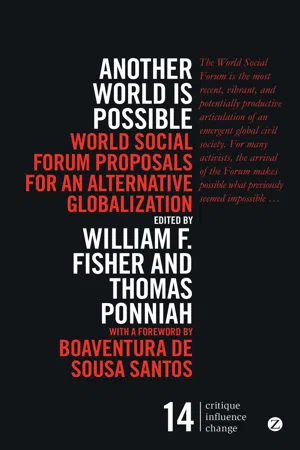
Another World Is Possible
World Social Forum Proposals for an Alternative Globalization
- English
- ePUB (mobile friendly)
- Available on iOS & Android
eBook - ePub
Another World Is Possible
World Social Forum Proposals for an Alternative Globalization
About this book
Information
PART I
THE PRODUCTION OF WEALTH & SOCIAL REPRODUCTION
OVERVIEW
Key Questions, Critical Issues
WILLIAM F. FISHER AND THOMAS PONNIAH
Key Questions
The key questions in Part I concern:
•external debt;
•repercussions of the colonization of Africa/Brazil;
•necessity of controls on financial capital;
•comparative disadvantage of international trade;
•need to limit the mobility of transnational corporations;
•the attack on the labour movement; and
•the relationship between ‘the solidarity economy’ and neoliberalism.
With respect to the debt, these papers begin by acknowledging that the neoliberal model of development has led to perpetual indebtedness, stolen wealth deposited in Northern banks, and Southern dependency on international financial markets, the International Monetary Fund and the World Bank. They go on to ask: how does one move from an economy of indebtedness towards financing and building a sustainable and socially just development? What are the different sources for funding development? What is a new development strategy? What are the local, regional and global alternatives to privatization, structural adjustment programmes, external markets and free trade (Toussaint and Zacharie)?
What new rules are needed to ensure fair, transparent and equitable global financial practices between creditors and debtors? Who should formulate new rules? If the background to the problem of perpetual indebtedness lies in the history of colonialism, then should the discourse of debt focus on ‘forgiveness/cancellation of the debt’ or should it aim for reparations for the North’s historical social, economic and ecological debt to the South (Africa/Brazil synthesis)?
The papers argue that the repercussions of colonialism are compounded by the current lack of control over the global economy. How can an alternative globalization, premised on sustainable development and an economics that is in the service of humankind, respectful of the environment and the diversity of people, be constructed? How can development be made to sustain the diversity of life, nature and culture? What is the relationship of the state to development and specifically to financial capital? What are the specific strategies to regulate capital (ATTAC, France)? What radical reforms can be applied to international financial institutions (IFIs)?
Related to questions around development and financial capital are the disadvantages of the contemporary form of international trade. These papers see the ‘free trade’ policies promoted by the World Trade Organization producing a society that is at the service of the economy (International Trade Conference synthesis). How can the economy be redirected into fulfilling the broader society’s needs? In order to challenge international trade there needs to be a discussion of how to regulate corporations democratically. The challenge is that corporations currently have the power to unilaterally direct government. As these papers articulate, their presence in political decision-making is so profound that it has become common sense that their strategies of privatization and investment are the best methods for achieving employment and development. The challenge of regulating corporations is compounded by the potentially divisive varieties of resistance: environmentalist, human rights, labour, and advocates of corporate responsibility versus those of corporate accountability. How can these various approaches be brought into a complementary agenda that promotes ‘life values’ against the ‘profit values’ that permeate the current context (Karliner and Aparicio)?
Discussions of debt, trade and corporate power inevitably circle around the question of labour. How should labour respond in light of the World Trade Organization (WTO), the International Monetary Fund (IMF) and the World Bank’s policies that promote the interests of those ‘who invest for a living’ versus the interests of those who ‘work for a living’ (Faux)? In light of the global reach of the investor class, should unions focus on strategies for national sovereignty or should workers transnationalize their resistance and their alternatives? Two significant aspects of this question relate to the place of African trade unions and women in new strategies of labour organizing (COSATU). What principles should African workers adopt and what forms of solidarity can workers around the world propose to African labour? In relation to gender, it is well known that women are often threatened at work, on the street and in the home. In addition, they are a minority in terms of power and decision-making in the union movement. In light of the history of patriarchy and the current neoliberal conjuncture, what needs to be done to ensure equality between the genders?
The last challenge is the question of the solidarity economy. It is a form of economy that is publicly debated in Latin America and parts of Europe. The question asked is: since neither capital, the state bureaucracy, nor representative democracy place the whole human being, in both its masculine and feminine dimensions, at the centre of social and economic development, what new economic processes and institutions need to be invented (Solidarity Economy Conference synthesis)? Further questions are: is the solidarity economy self-sufficient or is it meant to complement other forms of economic activity? Is it meant to attenuate the failures of the neoliberal project or is it meant to be the building-block of the new society?
Critical Issues
In Part I, there are two significant areas of antagonism that could divide and disarticulate the global solidarity movement: the conflict between ‘radicals’ and ‘reformers’, and the potential incommensurability between diverse ideological scales of political demands.
The conflict between today’s radicals and reformers is most evident in the debate on whether to abolish or reform the WTO, the IMF and the World Bank. On one side are reformers who believe that civil society should dialogue, negotiate and form partnerships with the international financial institutions. Their underlying beliefs are, first, that change can come through reasonable discussion, and, second, that the global economy needs to be centrally coordinated and these institutions can be used for that purpose. On the other side are radicals who believe that the Bretton Woods institutions and the WTO are fundamentally dysfunctional. To enter into dialogue with these institutions is thus seen as not only pointless but also dangerous because social movements’ acquiescence to consultation provides much-needed legitimacy to the IMF, World Bank and WTO. These radicals also believe that the world economy would work better for the poor in a fluid system of checks and balances that were not dominated by any particular configuration of global institutions. Many activists look for a compromise by calling for a ‘radical reform’ of the financial institutions and their insertion within the framework of a reformed UN system. This hope also asks activists to believe in the reform of a system that has historically not provided Southern countries with even their reformist demands, let alone their more progressive ones. The radicalism versus reformism debate, in terms of the WTO, IMF and World Bank, can appear irreconcilable.
The second contradiction involves the ideology of scale. There is a conflict in calls for change at the local, national and global levels. Many argue for local self-sufficiency, others argue that a nation-state’s production should be primarily aimed at satisfying its own population’s basic needs, and all agree that there should be universally guaranteed rights to food sovereignty, to consumer choice in relation to genetically modified organisms (GMOs) and to access to natural resources. These various demands are contradictory. How can there be local or national autonomy and universally guaranteed rights? Who will enforce these rights? A Universal Right to Food Sovereignty will have to impose itself on many nations and many locales. In the context of a growing recognition of the long-term impacts of colonialism, who will have the legitimacy, let alone the capacity, to intervene in order to guarantee these rights? Next, how can the local and the national both have economic self-sufficiency? State sovereignty has never meant local sovereignty. In some instances it has meant the opposite. Historically, as the state has become more powerful it has centralized power such that the local has become more and more dependent on the national authority. The demand for the strengthening of the state risks replicating the bureaucratization that both the right and the left have criticized in Eastern and Western Europe, North America and Third World nationalist states.
Most ‘relocalist’ groups and many proponents of the solidarity economy, despite the aspirations of the ‘Resist and Build’ document, have as much hostility to the state as they do to capital. They believe that the state is organized and directed by the elite in the North and the South. The return of a strong state will not sit well with these organizations. They believe in the principle of subsidiarity: that is to say, if the decision does not have to be decided at a larger scale, then let it be decided at the smallest scale possible. They recognize the importance of local economic self-sufficiency, local governance, local knowledge and relationships with the local ecology. They recognize that larger scales of governance threaten the sustainability and democratic participation of local levels of governance.
The conflict between the different ideologies of scale, like the radicalism versus reformism debate, can appear irreconcilable, but these antagonisms of scale can also be interpreted in a more positive light if we think of them as politically conditioned. If these antagonisms of scale are politically or historically contingent, we can see them as contradictions in process that could be overcome as a movement intensifies, coalesces new social sectors, articulates a more comprehensive vision, and engages with the continually evolving geometry of forces in global society. While these differences of scale are not natural, they may have a weight or historical persistence that makes them recurrent and irresolvable conflicts that will inevitably arise as a movement attempts to expand and deepen. While the current antagonisms are significant, they are overshadowed by the number of commonalities that the global movement shares. Every document agrees that neoliberal globalization, alone or in alliance with patriarchy, is the central adversary that all the movements have to face. By neoliberal globalization we mean the market-organized and imposed expansion of production that emphasizes comparative advantage, free trade, export orientation, the social and spatial division of labour, and the absolute mobility of corporations. These documents portray neoliberalism as pervading all of the different issues they confront.
Following the critique of contemporary globalization is the agreement that the IMF, World Bank and WTO are the tools of the elite: they exist to help capital realize value, not to serve the cause of development, nor to stabilize the global economy. They are incapable of handling economic crises because their policies produce and reproduce instability, as in the obvious case of the East Asian currency crisis. The minimum common demand is that these institutions are radically reformed, that Third World debt is cancelled and that structural adjustment programmes are terminated.
The critique of neoliberalism also involves a common call to regulate capital flows. National and local economic sovereignty should not be destabilized by external market forces. One initial form of throwing ‘sand into the wheels’ of capital would be via the imposition of a ‘Tobin Tax’ on all financial transactions. The tax would caution speculators and thus reduce the volatility of capital flows. Funds raised would go towards funding health care and education in poor countries. Underneath all of these issues is...
Table of contents
- Cover
- About The Editors
- Title
- Copyright
- Contents
- Acknowledgements
- Foreword to the critique influence change edition
- Preface to the critique influence change edition
- Foreword to the first edition
- Preface to the first edition
- Introduction: The World Social Forum and the Reinvention of Democracy
- PART I: The Production of Wealth and Social Reproduction
- PART II: Access to Wealth and Sustainability
- PART III: The Affirmation of Civil Society and Public Space
- PART IV: Political Power and Ethics in the New Society
- Epilogue: Social Movements’ Manifesto
- Appendices
- Index
Trusted by 375,005 students
Access to over 1.5 million titles for a fair monthly price.
Study more efficiently using our study tools.
Frequently asked questions
Yes, you can cancel anytime from the Subscription tab in your account settings on the Perlego website. Your subscription will stay active until the end of your current billing period. Learn how to cancel your subscription
No, books cannot be downloaded as external files, such as PDFs, for use outside of Perlego. However, you can download books within the Perlego app for offline reading on mobile or tablet. Learn how to download books offline
Perlego offers two plans: Essential and Complete
- Essential is ideal for learners and professionals who enjoy exploring a wide range of subjects. Access the Essential Library with 800,000+ trusted titles and best-sellers across business, personal growth, and the humanities. Includes unlimited reading time and Standard Read Aloud voice.
- Complete: Perfect for advanced learners and researchers needing full, unrestricted access. Unlock 1.5M+ books across hundreds of subjects, including academic and specialized titles. The Complete Plan also includes advanced features like Premium Read Aloud and Research Assistant.
We are an online textbook subscription service, where you can get access to an entire online library for less than the price of a single book per month. With over 1.5 million books across 990+ topics, we’ve got you covered! Learn about our mission
Look out for the read-aloud symbol on your next book to see if you can listen to it. The read-aloud tool reads text aloud for you, highlighting the text as it is being read. You can pause it, speed it up and slow it down. Learn more about Read Aloud
Yes! You can use the Perlego app on both iOS and Android devices to read anytime, anywhere — even offline. Perfect for commutes or when you’re on the go.
Please note we cannot support devices running on iOS 13 and Android 7 or earlier. Learn more about using the app
Please note we cannot support devices running on iOS 13 and Android 7 or earlier. Learn more about using the app
Yes, you can access Another World Is Possible by William Fisher, Thomas Ponniah, William Fisher,Thomas Ponniah in PDF and/or ePUB format, as well as other popular books in Politique et relations internationales & Politique comparée. We have over 1.5 million books available in our catalogue for you to explore.