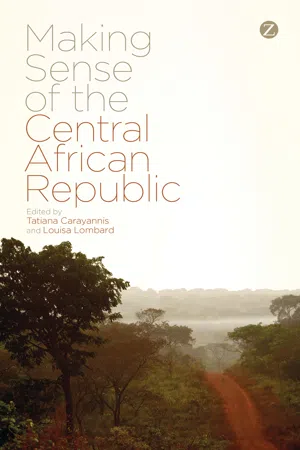
Lying at the centre of a tumultuous region, the Central African Republic and its turbulent history have often been overlooked. Democracy, in any kind of a meaningful sense, has eluded the country. Since the mid-1990s, army mutinies and serial rebellion in CAR have resulted in two major successful coups. Over the course of these upheavals, the country has become a laboratory for peacebuilding initiatives, hosting a two-decade-long succession of UN and regional peacekeeping, peacebuilding and special political missions.
Drawing together the foremost experts on the Central African Republic, this much-needed volume provides the first in-depth analysis of the country's recent history of rebellion, instability, and international and regional intervention.
eBook - ePub
Making Sense of the Central African Republic
- English
- ePUB (mobile friendly)
- Available on iOS & Android
eBook - ePub
Making Sense of the Central African Republic
About this book
Information
1 Making Sense of CAR
An Introduction
What has become increasingly clear with each successive crisis in the Central African Republic (CAR) is that, despite being such a low priority for the international community, it is, in fact, the crossroads of regional and international conflict and gamesmanship. Since its independence in 1960, CAR has had but one democratic transfer of power – in 1993, in an election organized by the United Nations. For its first thirty years, changes in executive office holders were spearheaded or otherwise facilitated by France, the country’s former colonial power. Since then, army mutinies and serial rebellion that draws on collaboration with regional leaders and men-at-arms have resulted in two successful coups, one led by François Bozizé in 2003, and one in 2013, almost exactly ten years later, by a disparate rebel coalition called Seleka that ousted him. Moreover, over the last two decades, the country has become a kind of testing ground for peacebuilding initiatives. Just prior to the deployment of MINUSCA, in early September 2014, it was even proclaimed ‘the world champion of peacekeeping missions’ (AFP, 2014). The country has indeed hosted a two-decade-long succession of UN and regional (CEN-SAD, CEMAC, ECCAS,1 European Union, African Union) peacekeeping missions, special political missions, peacebuilding missions, and bilateral (Chad, France) military interventions. Yet despite lying at the centre of a tumultuous region (its neighbours include Chad, Sudan, South Sudan, and the Democratic Republic of Congo – DRC), CAR and its turbulent history have often been overlooked by analysts. Indeed, no single volume has addressed the country’s post-independence political economy, the role of conflict, and influence of regional and international actors. Making Sense of the Central African Republic begins to fill that gap – a gap whose breadth has become all the more glaringly apparent as people have scrambled to address the war that began in December 2012.
Again and again, interventions in CAR have failed, in part because those spearheading them have operated as if the crisis of the moment was the first of its kind. That is, they have failed to address the longer-running dynamics that have grown out of CAR’s position in the world. The book argues that the CAR’s history of turmoil and instability can only be understood in the context of its violent history of colonization, limited political institutionalization and centralization, and position (geographic as well as geopolitical) in the region. With this in mind, the book focuses less on explaining the post-Seleka crisis, and more on the dynamics that have animated the CAR political economy over the past two centuries, with a focus on the post-independence period. As much as the Seleka crisis reflects new tendencies and new actors, it also reflects these longer-running dynamics (plus ça change). Any attempt to help Central Africans emerge from this nadir will have to consider not just the symptoms but the underlying causes of their plight – a cliché that has been frequently uttered but rarely done when it comes to peacebuilding in CAR.
This book shows how the fault lines across the broader region (ethno-religious rivalries, north–south, transnational armed groups, etc.) are being replicated and re-energized in CAR, feeding off the absence of formal state institutions and creating increasingly complex transnational conflict dynamics. The peripheries of the Central African state – in particular the North, but really every border area – are now more connected to the peripheries of its neighbours than they are to the government in the capital, Bangui. But in contrast to the picture of a shapeless, amorphous political space that emerges in most accounts of this ‘failed state’, there is instead a hive of competing authorities across the region born of specific historical relationships and dynamics. CAR thus merits much more attention than it has received from researchers and international policymakers alike, and we continue to ignore it at our peril.
In this introduction, we offer a snapshot history of CAR and then provide a thematic overview of the book.
An ‘unfortunate colony’ becomes a ‘failed state’
Central Africans, whose country was once known as the ‘Cinderella’ of the French Empire (or, less charitably, as la colonie poubelle – the trashcan colony [Brégeon, 1998]), have never had an easy time of it. When French colonists arrived at the end of the nineteenth century, they found sultans connected to trans-Saharan economic and social networks, as well as dynamic communities seeking both to participate in these new long-distance trades and avoid the wrath of the sultans’ armies. The French saw their task as removing the ‘foreign’ sultans, arguing that they were a colonizing force with no right to rule over Central Africans (the irony of this stance was lost on the French). French colonization was alternately brutal and neglectful.2 Rather than develop their colony themselves, the French leased most of the country’s territory to concessionary companies to exploit (Coquéry-Vidrovitch, 1972). Penury, corruption, and the difficulty of retaining skilled officers plagued the colonial government. A century and a half of slave-raiding, forced labour (which did not officially end until 1954 and which continued unofficially even longer), and new diseases de-populated much of the country. Even today, after rapid post-independence population growth, only about four million people call this territory just larger than France (or the size of Texas) home.
At independence in 1960 the French admitted that of all their former holdings, this one was the least prepared to stand on its own (Brégeon, 1998). The country had only one hospital, and the few health dispensaries were perennially under-equipped. The country’s first lycée had graduated its first class only four years prior. French ‘technical advisers’ effectively ran all the ministries. Central African politicians learned quickly that the powers that be of françafrique would support them decisively if they seemed able to prevent the spillover or repeat of their southern neighbour, the Republic of Congo’s, political crisis (Kalck, 1971). Substantive democracy was among the victims of this policy, which continues into the present.
Despite these inauspicious conditions, a small middle class flourished. Coup leader-turned president (‘for life’, then emperor) Jean-Bédel Bokassa built and hired, and there remained a sense of opportunity for those educated during these decades, even though the economy had already begun its downward slope. The University of Bangui, created by Bokassa in 1969, attracted some of the region’s top students. Given the dearth of qualified Central African civil servants at independence, all university graduates could count on a government job and pension. There had been no ‘free and fair’ elections (coups organized with French involvement had become the norm), but life mostly trundled along. The country even attracted many immigrants, among them a number of Muslim businesspeople from Chad and beyond.
Things began to change in the 1980s. Structural adjustment and a declining economy meant that government jobs dried up for all but the well-connected, and by th...
Table of contents
- Cover
- About the Authors
- Title
- Copyright
- Contents
- Dedication
- Acknowledgements
- List of Maps
- List of Abbreviations
- Chronology
- 01_Making Sense of CAR
- 02_CAR's History
- 03_Being Rich, Being Poor
- 04_Local Dynamics in the Pk5 District of Bangui
- 05_The Elite's Road to Riches in a Poor Country
- 06_A Multifaceted Business
- 07_The Autonomous Zone Conundrum
- 08_CAR and the Regional (Dis)order
- 09_Pathologies of Peacekeeping and Peacekeeping in CAR
- 10_From Being Forgotten to Being Ignored
- 11_CAR's Southern Identity
- 12_In Unclaimed Land
- 13_A Central African Elite Perspective on the Struggles of the Central African Republic
- 14_A Concluding Note on the Failure and Future of Peacebuilding in CAR
- About the Contributors
- Index
Trusted by 375,005 students
Access to over 1.5 million titles for a fair monthly price.
Study more efficiently using our study tools.
Frequently asked questions
Yes, you can cancel anytime from the Subscription tab in your account settings on the Perlego website. Your subscription will stay active until the end of your current billing period. Learn how to cancel your subscription
No, books cannot be downloaded as external files, such as PDFs, for use outside of Perlego. However, you can download books within the Perlego app for offline reading on mobile or tablet. Learn how to download books offline
We are an online textbook subscription service, where you can get access to an entire online library for less than the price of a single book per month. With over 1.5 million books across 990+ topics, we’ve got you covered! Learn about our mission
Look out for the read-aloud symbol on your next book to see if you can listen to it. The read-aloud tool reads text aloud for you, highlighting the text as it is being read. You can pause it, speed it up and slow it down. Learn more about Read Aloud
Yes! You can use the Perlego app on both iOS and Android devices to read anytime, anywhere — even offline. Perfect for commutes or when you’re on the go.
Please note we cannot support devices running on iOS 13 and Android 7 or earlier. Learn more about using the app
Please note we cannot support devices running on iOS 13 and Android 7 or earlier. Learn more about using the app
Yes, you can access Making Sense of the Central African Republic by Tatiana Carayannis, Louisa Lombard, Tatiana Carayannis,Louisa Lombard in PDF and/or ePUB format, as well as other popular books in Politique et relations internationales & Politique comparée. We have over 1.5 million books available in our catalogue for you to explore.