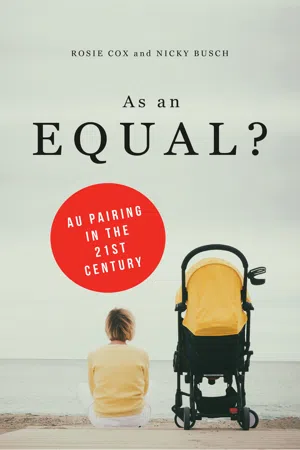
Au pairs are relied upon by tens of thousands of UK families to do everything from childcare and housework to elder care, pet feeding and waiting at dinner parties. Traditionally thought of as privileged and well-educated young women having fun on a 'gap year' abroad, au pairs have been excluded from many of the recent discussions on migrant domestic labour. However, since 2008 au pairing has been effectively unregulated in the UK and the result is that au pairs now constitute one of the poorest paid and least protected groups of workers.
Through an examination of lived experiences, As an Equal? draws on detailed research to examine au pairs and the families who host them in contemporary Britain, revealing au pairing to have become increasingly indistinguishable from other forms of domestic labour. Crucially, hosting an au pair is shown to form part of families' attempts to provide good (enough) childcare in the context of extended working hours and poor public childcare provision. This increased reliance of families on an exploited workforce is shown to form part of the wider political climate of economic austerity, and raises profound questions about the position of women within the neoliberal economy.
- 240 pages
- English
- ePUB (mobile friendly)
- Available on iOS & Android
eBook - ePub
About this book
Information
1 | A SHORT HISTORY OF AU PAIRING
Au pairs have long been an important part of the British solution to a perceived ‘servant problem’. A problem which is as much about the tensions arising from having ‘other’ people within the private home as it is about finding a supply of suitable and supplicant labour. This chapter explores the context for the development of au pairing in twentieth-century Europe and in post-war relations between Northern European countries. The history of au pairing is a little-researched area despite a recent burgeoning in both popular and academic interest in lives ‘below stairs’. Yet the research that has been done shows that au pairs were important figures both in British middle-class family life and the popular imagination in the post-war years.
In its formal incarnation au pairing has only a short history. The Oxford English Dictionary records the first usage of the word to date from 1897, when the Girls Own Paper (16 October) described ‘an arrangement … frequently is made for an English girl to enter a French, German or Swiss School and teach her own language in return for joining the usual classes. This is called being au pair’. The first record of its use as a verb ‘to au pair’ dates only to 1963, but the word, like the practice has longer roots. The history of the word is as an adjective describing an arrangement between parties paid for by the exchange of mutual services. In the early twentieth century, the term ‘au pair’ was often used in advertisements for mothers’ helps or ‘lady helps’ to indicate that the successful applicant would be treated as an equal within the family. It also indicated that no substantial wage would be paid and where the post was for a companion to a lady with limited means it meant that expenses would be shared (Holden 2013). Au pairing as we see it today, therefore, has its immediate antecedents in these types of mutually beneficial domestic relationships but it also has a more complex history relating to practices of lifecycle service, informal exchanges between families and more formal types of domestic service such as the ‘maid of all work’, who also undertook childcare, the governess and, most obviously, the nanny.
Au pairs as a group of migrant domestic workers also have antecedents amongst earlier groups of domestic workers and the chapter traces past trends for British households employing domestic servants from other European countries. In the nineteenth and early twentieth centuries Irish women were the most numerous non-British domestic workers. Later, special schemes were designed by the British government to ensure a supply of ‘acceptable’ domestic workers to British homes. The post-war ‘Baltic Cygnet’ scheme, which placed Latvian refugee ‘volunteer workers’ as domestic workers in Britain, was one such. Latvian women, like Irish women before them, were seen as appropriate domestic workers because they were white but not British. They had just the right degree of similarity and difference to be acceptable within the families they would serve, a theme which is echoed in the au pair scheme.
Au pairing became prominent, or visible, with the decline of residential service in the post-war years but no simple history of subservient British servants being replaced by middle-class au pairs from neighbouring countries exists. There are continuities between au pairs experiences and those of earlier servants and between au pairs and other domestic workers working at the same time. The rise of the au pair did not represent a clean break with a hierarchical and formal servant-employing past but rather a slow evolution of existing practices of lifecycle service and foreign exchange. Au pairing builds on traditions of swapping daughters between households as a form of education and of domestic servants being considered as family members. When seen in the longue durée of domestic service the history of the au pair provides a crucial link between earlier histories of recruitment of European servants and the acceptance of domestic work as a migrant labour niche today (Liarou 2015).
This chapter traces the development of au pairing from these earlier forms of childcare and cultural exchange and also examines the importance of au pairs’ status as ‘equals’ to the families for which they work. It begins by examining the antecedents of the au pair by looking at the history of who provided childcare in private homes, focusing on the figures of the ‘maid of all work’, the governess and the nanny. It then looks at the precursors of the unpaid/cultural exchange aspects of au pairing by examining the history of lifecycle service and exchange, and then moves to look at the history of white migrants being favoured for domestic work in Britain. We then detail the early development of the au pair scheme and changes to the formal au pair scheme from the 1970s to early 2000s.
Domestic work, childcare and being part of the family
Au pairs are a distinct group but also part of a historical continuity of domestic workers involved in providing childcare and living as ‘part of the family’. In more elite houses the governess and the nanny might have figured, and these have clear affinities with au pairs today. In less wealthy households the most common form of domestic worker was the ‘maid of all work’ who undertook cooking, cleaning and laundering as well as childcare if there were children present. For all these domestic workers there could be some ambiguity in their position within the family. Governesses in particular, but nannies also, were meant to be ‘ladies’ or gentlewomen who would be able to instil the correct manners and attitudes in the children they cared for. Their treatment by employers distinguished them from ‘servants’ but they were still enmeshed in household hierarchies which located them as inferior to ‘the family’. Maids of all work could also be included as ‘part of the family’, sometimes because the households they worked in were too small to allow the physical separation and distinctions on which stricter hierarchies relied.
Like au pairs today, foreign governesses were sometimes chosen by Victorian families because their foreignness could help to by-pass the problem of social difference (or sameness) that arose from having a ‘lady’ as an employee in the house. A French or German governess’s references to her family, her clothes and accent could not place her socially with the preciseness that those of an English governess did and so could not be as easily used as evidence of her gentility. Her paid employment was less of an embarrassment (Hughes 1993).
Political unrest in France, Germany and Italy at the end of the 1840s brought a stream of middle-class refugees to Britain, some of whom ended up as governesses. According to the 1861 census there were 1,408 foreign governesses in Britain, the majority from Prussia, France and Switzerland (Hughes 1993). Prestige was also attached to French governesses in the Victorian era, and Kathryn Hughes (1993 p49) comments that Frenchwomen were an exception to the rule that Catholics would not be accepted as governesses in Protestant British homes: ‘the moral threat of their presence was offset by the prestige that came with having one’s daughters taught a modern language by a native speaker’.
There was also discrimination against foreign governesses, particularly Catholic ones, with one advice writer claiming that to allow a French governess into the house was to open ‘a wide flood-gate to frivolity, vanity, and sin’ (Mary Maurice 1847, quoted in Hughes 1993 p106). Foreign governesses could be taunted or blanked by other domestic staff and by the children they were in charge of.
In the pre-war era there is a continuum between informal forms of childcare performed by domestic servants, more specialist nursery maids and children’s nurses, nannies and then later mothers’ helps and au pairs. Nannies quite often occupied a liminal position within the families they worked for: not exactly servants, but not exactly not. Katherine Holden (2013) records the very complicated place nannies had – often adored by their charges and depended upon by their employers, they were still marginalised. Like governesses in an earlier period, nannies were traditionally middle-class women, or ‘ladies’, who were thought to be an appropriate influence on the children they cared for.
In the eighteenth and nineteenth centuries in Britain, the majority of servant-employing households had just one maid who carried out all work including childcare (Delap 2011). While looking after children may have provided some compensation to servants in more elite households that had multiple staff, Carolyn Steedman comments that for most servants, in more modest households ‘a good place was a place without children’ (2009 p228). Children created work, such as the very considerable work of laundering nappies, and they also created friction and disturbed domestic hierarchies. Servants complained at being ordered around by young children and mistresses worried about who should order and who obey – the servant or the child? In the eighteenth century, as in the twentieth and twenty-first, parents used advice manuals to help them in raising children and these often represented servants as people with little judgement from whose bad influences children needed to be protected if they were to be raised correctly (Steedman 2009).
As well as being related to the roles of go...
Table of contents
- Cover
- Praise for the book
- About the author
- Title
- Copyright
- Dedication
- Contents
- List of illustrations
- Acknowledgements
- Introduction
- 1. A short history of au pairing
- 2. Invisible work and hidden inequalities: gender, class and nationality in au pairing
- 3. The twenty-first-century growth in demand for domestic labour
- 4. What is an au pair?
- 5. Au pairs and hosts in cyber space
- 6. The life and times of au pairs
- 7. Good workers? Good parents? Good hosts?
- Conclusion
- References
- Index
- About Zed
Trusted by 375,005 students
Access to over 1.5 million titles for a fair monthly price.
Study more efficiently using our study tools.
Frequently asked questions
Yes, you can cancel anytime from the Subscription tab in your account settings on the Perlego website. Your subscription will stay active until the end of your current billing period. Learn how to cancel your subscription
No, books cannot be downloaded as external files, such as PDFs, for use outside of Perlego. However, you can download books within the Perlego app for offline reading on mobile or tablet. Learn how to download books offline
Perlego offers two plans: Essential and Complete
- Essential is ideal for learners and professionals who enjoy exploring a wide range of subjects. Access the Essential Library with 800,000+ trusted titles and best-sellers across business, personal growth, and the humanities. Includes unlimited reading time and Standard Read Aloud voice.
- Complete: Perfect for advanced learners and researchers needing full, unrestricted access. Unlock 1.5M+ books across hundreds of subjects, including academic and specialized titles. The Complete Plan also includes advanced features like Premium Read Aloud and Research Assistant.
We are an online textbook subscription service, where you can get access to an entire online library for less than the price of a single book per month. With over 1.5 million books across 990+ topics, we’ve got you covered! Learn about our mission
Look out for the read-aloud symbol on your next book to see if you can listen to it. The read-aloud tool reads text aloud for you, highlighting the text as it is being read. You can pause it, speed it up and slow it down. Learn more about Read Aloud
Yes! You can use the Perlego app on both iOS and Android devices to read anytime, anywhere — even offline. Perfect for commutes or when you’re on the go.
Please note we cannot support devices running on iOS 13 and Android 7 or earlier. Learn more about using the app
Please note we cannot support devices running on iOS 13 and Android 7 or earlier. Learn more about using the app
Yes, you can access As an Equal? by Rosie Cox,Nicky Busch in PDF and/or ePUB format, as well as other popular books in Social Sciences & Higher Education. We have over 1.5 million books available in our catalogue for you to explore.