The path towards democracy in Kenya has been long and often tortuous. Though it has been trumpeted as a goal for decades, democratic government has never been fully realised, largely as a result of the authoritarian excesses of the Kenyatta, Moi and Kibaki regimes.
This uniquely comprehensive study of Kenya's political trajectory shows how the struggle for democracy has been waged in civil society, through opposition parties, and amongst traditionally marginalised groups like women and the young. It also considers the remaining impediments to democratisation, in the form of a powerful police force and damaging structural adjustment policies. Thus, the authors argue, democratisation in Kenya is a laborious and non-linear process.
Kenyans' recent electoral successes, the book concludes, have empowered them and reinvigorated the prospects for democracy, heralding a more autonomous and peaceful twenty-first century.
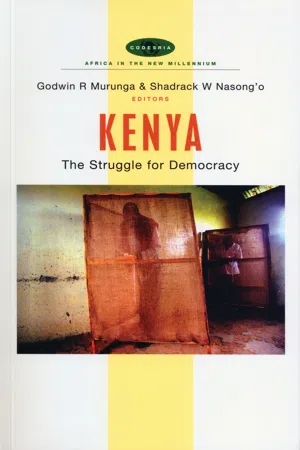
eBook - ePub
Kenya
The Struggle for Democracy
- English
- ePUB (mobile friendly)
- Available on iOS & Android
eBook - ePub
Kenya
The Struggle for Democracy
About this book
Information
PART I
Introduction
1
Prospects for Democracy in Kenya
Shadrack Wanjala Nasong’o and Godwin R. Murunga
Then, we knew we had a dictator as president and found ways to survive in a hostile, autocratic environment; today, our so-called liberators have proved to be no better than wolves in sheep’s clothing. Our sense of betrayal today is far greater than it was even three years ago, because everyone we thought was on our side was actually only looking out for himself and herself. (Warah 2004: 14)
Introduction
The purpose of this chapter is twofold. First, it problematises two key concepts, democracy and democratic transition, that are extensively used in this study with a view to delineating their conceptual and practical applications. Second, it explores the general outlines of the transition from the Moi regime to the Kibaki regime and highlights the dilemmas and democratic prospects this transition has presented. We conclude that the prospects for democracy in Kenya are contingent, to a large extent, upon restructuring the institutions of governance and concomitantly devolving power from the presidency, a process that all governments in Kenya, including the Kibaki one, have been reluctant to shepherd. As the transition from Moi to Kibaki amply illustrates, a mere change of guard is not, in and of itself, a basis for a new mode of politics, notwithstanding the claims and promises of the new ruling elite to the contrary.
Theoretical and Conceptual Considerations
The quest for democratic governance is an almost universal phenomenon. The ubiquitous nature of the wave of democratisation across the world at the end of the twentieth century and the concomitant burgeoning literature on transition politics illustrate this with clarity. Indeed, the honorific nature of the concept of democracy is such that all manner of political systems claim to be democracies. Even countries that have never held an election in decades, such as the former Zaire, are conveniently baptised ‘democratic republics’. Others without a competitive party system, such as Uganda (1986–2006), call themselves ‘non-party democracies’. Yet to others, the only genuine brand of democracy is the liberal variety with its emphasis on individual freedom and civil liberties. In fact, according to Francis Fukuyama (1989), until recently, liberal democracy is the highest form of human government that cannot be improved upon! Given the competing views of democracy including ‘democracy with adjectives’, ‘liberal democracy’, ‘social democracy’ ‘progressive democracy’ (Collier and Levitsky 1997), ‘guided democracy’ and ‘non-party democracy’, some scholars argue that we are living in an age of democratic confusion. Democracy, they assert, is a high-flown concept for something that does not exist in concrete reality (see Sartori 1987) or, at best, exists in the form of ‘choiceless democracy’ where economic realities negate the possibilities for political choice (Ake 1996a; Mkandawire 1999). What, then, is ‘democracy’ and what constitutes ‘democratic transition’?
Conceptualising democracy
According to the liberal conceptualisation, the prerequisite for the concrete realisation of democracy lies in a number of institutional guarantees. These guarantees include (1) freedom to form and join organisations, be they political parties, social movements, or civic, professional and welfare associations; (2) freedom of expression and movement; (3) universal adult suffrage; (4) eligibility, in principle, of any citizen to seek public office; (5) right of political leaders to compete freely for support and votes; (6) existence of alternative sources of information; (7) free, fair and competitive elections; (8) accountable governmental decision-making institutions; (9) freedom of elected officials from overriding opposition from unelected officials (Dahl 1982; Harbeson 1999: 40). The more a country approximates these institutional guarantees, the more democratic it is. This form of liberal democracy, according to Ake (2000), is markedly different from genuine democracy even though it has significant affinities. The affinities include the notion of government by the consent of the governed, formal political equality, inalienable human rights including the right to political participation, accountability of power to the governed and the rule of law. ‘Nonetheless, the differences are highly significant. Instead of the collectivity, liberal democracy focuses on the individual whose claims are ultimately placed above those of the group. It replaces government by the people with government based on the consent of the people. Instead of the sovereignty of the people it offers the sovereignty of “law” and operates by repudiating the very idea of popular power’ (Ake 2000: 10; 1996b).
Claude Ake (1996a: 130) argues that even at its best, liberal democracy is inimical to people having effective decision-making power. The essence of liberal democracy is precisely the abolition of popular power and the replacement of popular sovereignty with the rule of law. As it evolved, liberal democracy became less democratic because its fundamental elements, such as consent of the governed, accountability of power to the governed and popular participation, came under pressure from political elites all over the world as well as from mainstream social science which seemed more suspicious of democracy than political elites. On the pretext of clarifying the meaning of democracy, Western social science has constantly redefined it to the detriment of its democratic values. For instance, the group theory of democracy evades the meaning of democracy and pushes the notion that the essence of democracy is the dynamics of group competition, which prevents the monopolisation of power and allows the accommodation of the broad concerns of many groups. According to the interest group theory of democracy, the citizen is no longer a real or potential lawmaker or a participant in sovereignty, but only a supplicant for favourable policy results in accordance with articulated interests. For the protective theory of democracy, the democratic polity is one in which the citizen is protected against the state, especially by virtue of a vibrant civil society. Popular sovereignty disappears, as does participation, as people settle for protection. It is this approach, Ake affirms, that celebrates apathy as being conducive to political stability or for being a mark of citizen satisfaction with rulers.
For Afrifa Gitonga (1987), democracy exists at three levels: abstract, practical and concrete levels. At the abstract level, democracy is an intellectual visualisation of a model of the possible and desirable in matters of governance. At the practical level, it consists of the ways and means of translating the democratic ideal into reality. And finally, at the concrete level, democracy comprises the balance sheet of past and present experiments of humanity to install a democratic order. In this regard, Ake’s (1996a) conceptualisation of the kind of democracy suitable for Africa is most illuminating. Such democracy entails four key characteristics. First, it has to be a democracy in which people have some real decision-making power over and above the formal consent of electoral choice. This entails, among other things, a powerful legislature, decentralisation of power to local democratic formations, and considerable emphasis on the development of institutions for the aggregation and articulation of interests. Second, it has to be a social democracy that places emphasis on concrete political, social and economic rights, as opposed to a liberal democracy that emphasises abstract political rights (see Mafeje 1995). It has to be a social democracy that invests heavily in the improvement of people’s health, education and capacity so that they can participate effectively. Third, it has to be a democracy that puts as much emphasis on collective rights as it does on individual rights. It has to recognise nationalities, subnationalities, ethnic groups and communities as social formations that express freedom and self-realisation, and thus grants them rights to cultural expression and political and economic participation. Fourth and finally, it has to be a democracy of incorporation – an inclusive politics that engenders inclusive participation and equitable access to state resources and ensures special representation in legislatures of mass organisations, especially the youth, the labour movement and women’s groups, which are usually marginalised but without whose active participation there is unlikely to be democracy or development (Ake 1996a: 132).
The basic assumption is that the objective of the political transition phenomenon in Africa has been, or should be, geared towards maximising the actualisation of the kind of democracy as conceptualised by Ake. It was the expectation of a shift to this mode of politics in Kenya that informed the enthusiastic euphoria that accompanied the transition from the Moi regime to the Kibaki regime in December 2002. Nevertheless, as Ake posits, the attainment of this concrete form of democracy is a function, for the most part, of the extent to which Africans themselves, especially the non-elite, drive the process.
The transition paradigm
Carothers (2002) attributes the notion of democratic transition as an analytic model to the seminal work of O’Donnell and Schmitter (1986) which, in his view, marked the beginning of the emergent academic field of ‘transitology’. The concept was derived from a general interpretation, on the part of scholars, policy makers and democracy advocates, of the patterns of democratic change that were taking place in Africa, Asia, Eastern Europe and Latin America. This change entailed shifting away from military dictatorship, statist developmentalism, single-party authoritarianism and communist totalitarianism to more open systems of governance. As a paradigmatic perspective, ‘democratic transition’ became a way of talking about, thinking about and designing interventions in processes of political change around the world (Carothers 2002: 6). Carothers notes that several assumptions mark the transition paradigm. First is the assumption that any country moving away from dictatorial rule can be considered a country in transition towards democracy. Second is the assumption that democratisation occurs in sequential stages. It begins with political opening, a period of democratic ferment and political liberalisation in which cracks appear in the ruling dictatorial regime, with the main fault line lying between the hardliners and softliners. This is followed by the breakthrough – the collapse of the regime and the emergence of a new democratic system, with the assumption of power by a new government through national elections and the establishment of a new democratic institutional structure, via the promulgation of a new constitution. This transition is then followed by consolidation, constitutive of a slow but purposeful process in which democratic forms are transformed into democratic substance. This is done by the reform of state institutions, regularisation of elections, strengthening of civil society and overall habituation of society to the new democratic rules of political engagement.
The third core assumption of the transition paradigm, as Carothers notes, is the belief in the determinative importance of elections. Harbeson (1999) elaborates this assumption more clearly than Carothers. According to Harbeson, the push for democratisation in the early 1990s suffered from a disproportionate emphasis on the conduct of initial, national-level multiparty elections. This temporally constrained, election-centric conception of the transition phase, according to Harbeson (1999: 42–3), lies in the implicit excessive expectations of this period. The expectations included the presumptions that, first, democratic transition would necessarily produce a regime change from an incumbent authoritarian regime to a new democratically inclined one. Second, that initial multiparty elections and/or regime change would generate the momentum necessary to produce subsequent, broader patterns of democratisation. Third, that this momentum would be sufficient to generate the means for the fulfilment of the broader array of democratisation tasks in the consolidation phase. Fourth, that the initial multiparty elections taking place at the national level would lead to democratisation at the sub-national levels. Fifth and finally, that the polity itself would remain sufficiently stable to sustain the transition and the subsequent consolidation phases of democratisation. Hence the euphoria that attended the onset of transition politics which was assumed to mark democratic resurgence in hitherto undemocratic regimes.
The assumption that any country moving away from authoritarianism is, ipso facto, undergoing transition towards democracy may, however, be mistaken. According to Colomer (2000), multiparty elections held in democratising countries within a context of non-democratic rules of the game constitute what he calls ‘strategic transitions’. Colomer contends that in the quest for democratic transition, authoritarian incumbents and their democratic oppositions always arrive at an intermediate formula between dictatorship and democracy:
In order to be agreeable, a provisional compromise must include the calling of a multiparty election not securing an absolute winner. On the one hand, the rulers can rely upon their advantage as incumbents to turn the compromise into a lasting ‘semi-democratic’ regime, which would allow them not to be expelled from power or even to recover some of their previously challenged positions. On the other side, the democratic opposition can envisage the agreement as a mere transitory stage, giving it some chance of gaining power and introducing further reforms, which can lead to the eventual establishment of a democratic regime. (Colomer 2000: 1–2)
It is in this sense that Ake (1996a) observes that in the hurry to globalise democracy following the end of the cold war, democracy has been reduced to the crude simplicity of multiparty elections to the benefit of some of the world’s most notorious autocrats. In Africa, elections have produced democratic dictators (Ihonvbere 1996). These include Daniel arap Moi of Kenya and Paul Biya of Cameroon, both able to parade democratic credentials without reforming their repressive regimes. On the flip side, Colomer makes the assumption that opponents of authoritarian incumbents are committed democrats. This is not always the case. Given the exclusivist nature of African politics, the democratisation phenomenon may simply constitute an opening wedge for excluded politicians to successfully stage re-entry into power and perpetuate the same exclusivist politics. The expectation that they will introduce reforms towards the establishment of emancipatory politics is not guaranteed (Wamba-dia-Wamba 1992). Democratic transition is thus bound to be messy, fitful and frustrating, with many advances and setbacks along the way.
Prospects for Democracy in Kenya
The struggles for democracy in Kenya have been long and persistent. The results of the December 2002 elections in the country were a landmark in this struggle as they heralded expectations that a new political era of democracy had dawned in Kenya. For the first time, the incumbent Kenya African National Union (KANU) was defeated after four decades in power. Second, again for the first time in the country’s history, a president retired from office. Third, the electoral defeat of KANU occurred against the backdrop of a united opposition under the aegis of the National Alliance Rainbow Coalition (NARC), a reality that promised to usher in a new political era of dialogue, consensus and power sharing. This new dispensation was encapsulated in the NARC Summit – the coalition’s eight-member chief decision-making organ – and the memorandum of understanding (MoU) that committed the coalition partners to conclude the constitutional review process within 100 days of their assumption of power, create new institutions of governance, strengthen existing ones and devolve some of the overwhelming powers of the presidency (see Murunga and Nasong’o 2006 for details). It is this commitment to reduce the powers of the president through a new power-sharing arrangement that the MoU anticipated. As Ndegwa argues, ‘had the constitutional-reform process not been going on at the time of the campaign, it is virtually inconceivable that any opposition leader would have agreed to give up his or her slim chance at the i...
Table of contents
- Cover
- Title
- Copyright
- Contents
- List of Tables and Figures
- Acknowledgements
- List of Abbreviations
- Preface
- PART I Introduction
- PART II Civil Society and the Politics of Opposition
- PART III Major Constituencies in the Democratisation Process
- PART IV Donors and the Politics of Structural Adjustment
- About the Contributors
- Index
Trusted by 375,005 students
Access to over 1.5 million titles for a fair monthly price.
Study more efficiently using our study tools.
Frequently asked questions
Yes, you can cancel anytime from the Subscription tab in your account settings on the Perlego website. Your subscription will stay active until the end of your current billing period. Learn how to cancel your subscription
No, books cannot be downloaded as external files, such as PDFs, for use outside of Perlego. However, you can download books within the Perlego app for offline reading on mobile or tablet. Learn how to download books offline
Perlego offers two plans: Essential and Complete
- Essential is ideal for learners and professionals who enjoy exploring a wide range of subjects. Access the Essential Library with 800,000+ trusted titles and best-sellers across business, personal growth, and the humanities. Includes unlimited reading time and Standard Read Aloud voice.
- Complete: Perfect for advanced learners and researchers needing full, unrestricted access. Unlock 1.5M+ books across hundreds of subjects, including academic and specialized titles. The Complete Plan also includes advanced features like Premium Read Aloud and Research Assistant.
We are an online textbook subscription service, where you can get access to an entire online library for less than the price of a single book per month. With over 1.5 million books across 990+ topics, we’ve got you covered! Learn about our mission
Look out for the read-aloud symbol on your next book to see if you can listen to it. The read-aloud tool reads text aloud for you, highlighting the text as it is being read. You can pause it, speed it up and slow it down. Learn more about Read Aloud
Yes! You can use the Perlego app on both iOS and Android devices to read anytime, anywhere — even offline. Perfect for commutes or when you’re on the go.
Please note we cannot support devices running on iOS 13 and Android 7 or earlier. Learn more about using the app
Please note we cannot support devices running on iOS 13 and Android 7 or earlier. Learn more about using the app
Yes, you can access Kenya by Shadrack W. Nasong'o, Godwin R. Murunga, Shadrack W. Nasong'o,Godwin R. Murunga in PDF and/or ePUB format, as well as other popular books in Politics & International Relations & International Relations. We have over 1.5 million books available in our catalogue for you to explore.