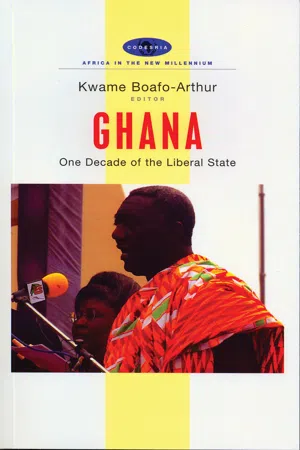
Ghana has witnessed a 'revolution through the ballot box', since its return to constitutional rule in 1993. Yet this period of sustained democratic government in an era of globalization and liberal triumphalism has brought with it new demands. How has Ghana faced up to the problems of institution-building, state-market relations and democratic leadership? Can it deal with the challenges posed by security, human rights and foreign policy in the twenty-first century?
This unique collection interrogates all these issues and assesses the future of the democratic experiment in one of sub-Saharan Africa's rare 'islands of peace'. In doing so, it provides an invaluable guide to Ghana's political past, present and future.
- English
- ePUB (mobile friendly)
- Available on iOS & Android
eBook - ePub
1 | A decade of liberalism in perspective
Since attaining political freedom in 1957, Ghana has tried varied modes of governance; some have been imposed with scant regard to the wishes of the generality of the people and others were the result of democratic elections. Liberal economic and social policies, and varying degrees of authoritarianism, command economics and redistributive policies, policies aimed at minimizing external dependence and so on have all been pursued at various junctures. These tendencies – a combination or succession of state control, freedom of the market and welfare politics – were evident even when the military was in control of the state, as it was for the greater part of the nation’s independent existence.
In January 1993 Ghana embarked on a new democratic experiment after more than a decade of military rule. A new political liberalism was instituted alongside neoliberal economic management strategies that had been practised for some years with the unflinching support of the Bretton Woods institutions and other donor or development partners. Thus, the key motivation for this book is to put the liberal democratic-cum-neoliberal processes over the past decade in clear perspective. Admittedly, a decade is too short to expect significant results from the rather long and tortuous journey into democracy that the country has embarked on; but it is long enough for the liberal state to have yielded some signposts as guides for this journey into the future, as well as providing reasonable grounds for interrogating its record so far. This task is carried out in the following chapters by academics whose areas of teaching and research include Political Science, Economics and Law.
Before 1993, different modes of economic management practices had led over the years to the evolution of a hybrid political economy which engendered various forms of developmental crises. These crises, with economic, political and general developmental implications, became distinctive features of the nation. Each constellation of class forces that dominated the state produced a crisis specific to the policies that it pursued. By the close of the 1970s, the politics and economy of the country had been plunged into severe crises that required immediate and apparently radical measures to prevent the total collapse of the economy. Paradoxically, the challenges involved in restoring the stagnant economy fell on the revolutionary military government of the Provisional National Defence Council (PNDC). However, contrary to its initial Marxist-Leninist agenda, the government of the PNDC that usurped political power in the early 1980s was compelled by the magnitude of the economic problems confronting the state to pursue a neoliberal or free market agenda after its initial socialist posturing, while at the same time supporting internal social democratic forces with an antithetical economic and political agenda. The contradiction produced by that unnatural equation was resolved in favour of a liberal democratic state that would guarantee the growth of a neoliberal economy. January 1993 marked the beginning of yet another democratic journey by the state. The key question to ask is, how does the process of re-democratization get started? This is important because the mode of societal change invariably affects the manner through which the society and economy are managed. For instance, violent left-wing societal changes tend to result in a semblance of a welfare state or administration.
The road to democracy: a brief overview
Various writers have pointed to the fact that the Rawlings-led PNDC was not overly interested in Ghana’s democratization process (Yeebo 1991; Shillington 1992; Folson 1993). That was to be expected, because no dictatorial regime gives up without a struggle. In the case of the PNDC, Ghana’s return to democracy could be attributed to unanticipated changes in the international system as well as to internal agitation by civil society groups. The weak economic base of the nation made the PNDC government extremely vulnerable to external pressures, especially in the late 1980s when leading donors and development partners imposed political conditions on aid recipients in undemocratic regimes. This imposition emboldened civil society organizations whose struggles for political openings had previously been largely uncoordinated and inconsistent. Confronted with both external and internal pressures for democratization, the PNDC adopted several measures to end its dictatorial rule. The main measures were:
1.The holding of district-level elections in 1988 and 1989.
2.The collation of views on the democratic future of the country by the National Commission for Democracy (NCD) set up by the PNDC.
3.The promulgation of a law on 17 May 1991 setting up a nine-member Committee of Experts (Constitution). The mandate of the committee was to prepare a draft proposal (constitution) taking into account previous constitutions of Ghana since independence and any other relevant constitution(s) as well as matters referred to it by the PNDC.
4.Inauguration on 26 August 1991 of a 260-member Consultative Assembly to draw up a draft constitution (based on the work of the Committee of Experts) for the country.
5.Submission to the PNDC on 31 March 1992 of a draft constitution by the Consultative Assembly. Consequently an Interim Electoral Commission (INEC) was set up.
6.A referendum on the draft constitution was held on 28 April 1992 with 92.6 per cent of eligible voters voting in favour of the draft constitution.
7.Lifting of the ban on political party activities on 15 May 1992. Flight Lieutenant Jerry Rawlings, chairman of the PNDC, founded the National Democratic Congress (NDC) to contest the presidential and parliamentary elections.
8.Holding of presidential election on 3 November 1992 and the parliamentary election on 28 December 1992.
9.The inauguration of the Fourth Republic on 7 January 1993 with Rawlings as the President.
The neoliberal mode of economic management had already taken root before the inauguration of the Fourth Republic on 7 January 1993, since the PNDC had dutifully implemented several IMF- and World Bank-inspired and sponsored structural adjustment programmes (Rothchild 1991). The problem was that whereas, under the PNDC, IMF and World Bank programmes had been implemented by executive fiat, it was imperative for the new democratic NDC government led by Jerry Rawlings to involve the people in economic decision-making. There was therefore another seeming contradiction between the democratization process and the demands of structural adjustment programmes. Could the two be pursued together? What were the likely problems of such a mode of economic management? Experiences under the PNDC had proven that the less consultation there was on the modalities of the programme, the more easily it was implemented. Would the new democratic dispensation sound the death-knell of structural adjustment programmes?
Liberal triumphalism
The impetus for the resolution of this apparent contradiction was the liberal triumphalism (Fukuyama 1992) of the late 1980s that more or less made the pursuit of liberal politics and free market policies indispensable for the majority of developing countries, including Ghana. This was the period of hard-nosed Reaganomics and Thatcherism that not only glorified political liberalism and neoliberal economic pursuits but also perceived them invariably as the alpha and omega of political and economic management practices. The international discourse on governance had also affirmed the liberal option as the ultimate and the most sensible choice (Dunn 1992). Francis Fukuyama noted: ‘what we are witnessing is not just the end of the Cold War, but the universalization of Western liberal democracy as the final form of human government’ (cited in Starr 2004). Western liberal democracy moved in tandem with neoliberalism. The neo-liberal creed, as pointed out by Jeremy Clift, emphasizes macroeconomic, particularly fiscal, discipline, a market economy and openness to the world economy (at least with respect to trade and foreign direct investment) (Clift 2003). More importantly, development policies pursued by international financial institutions during the 198os and 1990s came to be labelled the ‘Washington consensus’ or neoliberalism and entailed a more circumscribed role for the state, with economic activities unduly influenced by market forces. In the minds of most people, the Washington consensus, according to Stiglitz, ‘has come to refer to development strategies focusing around privatization, liberalization, and macro-stability (meaning mostly price stability); a set of policies predicated upon a strong faith – stronger than warranted – in unfettered markets and aimed at reducing, or even minimizing, the role of government’ (Stiglitz 1998: 6). It is precisely the way in which the term has been applied since it was coined by John Williamson in 1989, in connection with the adoption of economic management practices in Latin America, that has compelled Williamson to attempt a further definition. According to him, the Washington consensus has been invested with a meaning that is a clear departure from what he originally intended and he has summarized his original version into ten propositions:
•fiscal discipline
•a redirection of public expenditure priorities towards fields offering both high economic returns and the potential to improve income distribution, such as primary healthcare, primary education and infrastructure
•tax reform (to lower marginal rates and broaden the tax base)
•interest rate liberalization
•competitive exchange rate
•trade liberalization
•liberalization of inflows of foreign direct investment
•privatization
•deregulation (to abolish barriers to entry and exit)
•secure property rights (Williamson 2000: 252–3)
He conceived his propositions as an attempt to summarize policies widely viewed as supportive of development at a time when economists had become convinced that ‘the key to rapid economic development lay not in a country’s natural resources or even in its physical or human capital but, rather, in the set of economic policies that it pursued’ (ibid.: 254). Even though Williamson has been at pains to explain the misapplication of the term and his propositions, it is hard to believe that his propositions, when examined alongside the ongoing neoliberal postulates of development policies the Bank applied to Latin America, Africa and Asia, do not conform in principle to his position. Originally, the policy prescription was applied to Latin America, but Williamson agrees that there would have been no marked difference if he had been asked to apply it to Africa or Asia (ibid.: 255). And as pointed out by Jeremy Clift (2003), the policy measures were quickly seen as a model for the wider developing world.
The sweeping political changes that followed the capitalist triumphalism and the end of the Cold War had both economic and political repercussions in Africa and the communist stronghold of China. Though many African countries, including Ghana, had no choice but to open up the political space, what was perceived as bourgeois liberalism was brutally repressed by China in Tiananmen Square. The fact remains, however, that neoliberal economic management practices and the accompanying liberal democracy have gained unprecedented adherents since the collapse of the Eastern bloc. It was argued that liberal democracy would be the most appropriate political arrangement to allow room for the implementation of neoliberal economic policies. What, then, is the nature of liberalism and what are the benefits? What is the relationship between liberalism or political openness and neoliberalism?
Features of liberalism and its assumed benefits
The liberal state, its exponents argue, guarantees a congenial environment for the growth of capitalist civilization. That is, the capitalist economy and society thrive on a stable and secure environment provided by the liberal state through its laws and other regulations. The liberal state protects private property, guarantees appropriate conditions for its growth, and ensures the creation of material wealth that will be for the good of the whole society. Above all, it guarantees political stability; liberal democracy is the best form of social interaction to strive for if the dignity of individuals is to be assured. Liberal democracy is based on the will of the majority. Its distinguishing features include free institutions, representative government, free elections, and guarantees of individual liberty, freedom of speech and religion, and freedom from political oppression. It is incontrovertible that liberalism is also committed to protecting the freedom to choose, question and revise one’s own conception of the good life. This explains why ‘liberalism defends (among many other things) freedom of conscience, expression and association, as well as mandatory, universal education’ (Lowry 2000). Liberalism sees the main function of the state as to provide sufficient protection to allow individuals the greatest possible freedom to exercise their basic human rights and fulfil their potential. This is in contrast to systems that rely on terror and oppression, a controlled press and radio and the suppression of personal freedoms (Spiegel 1995). Stanley Hoffman (1995) points out that ‘liberalism was and is, in large part, an expression of revulsion against illegitimate violence: that of tyrants at home and of aggressors abroad’. Put simply, liberal democracy affords humankind the only political arrangement that lays exclusive claim to set the standard for legitimate political authority.
C. B. Macpherson points out that liberalism is generally taken to mean ‘the democracy of a capitalist market society’ or ‘a society striving to ensure that all its members are equally free to realize their capabilities’ (Macpherson 1977: 1). He contends, therefore, that ‘the central ethical principle of liberalism’ is ‘the freedom of the individual to realize his or her human capacities’ (ibid.: 2). In other words, liberalism creates avenues for the full realization of the potential of individuals in the state. Modern liberalism, as John Kane-Berman (2004) argues, ‘has drawn strength from the fact that the most contented and prosperous people are those living in open societies which are both economically and politically free and in which the rule of law prevails’. The laws have a persuasive and salutary role to play in this process because it is the effective application of the law that gives the individual the freedom to enjoy civil and other liberties. The intellectual vibrancy and deep political involvement of citizens are influenced by the state’s adherence to the rule of law. On this, Peter Biro points out that ‘liberalism depends, for its sustainability, on the notion that the individual members of society will remain continually engaged in the never-ending process of balancing personal aspirations with community objectives and, wherever possible, actualizing one in the pursuit of the other … Participatory democracy in the liberal state requires a constant critical … compliance with the laws’ (Biro 2000: 14) by both the rulers and the governed. In its various philosophical guises, liberalism, as noted by Hoffman (1995), ‘was and is a ram against authoritarian regimes. It tries to free individuals from tyranny by providing them with the right to consent to their political institutions and to the policies pursued in the framework of these institutions, as well as with a set of freedoms protected from governmental intrusions and curtailments’. The key question is, does the current liberal Ghanaian state exhibit all the features of liberalism as enunciated above? What constrains the adherence to the principles of the rule of law and respect for the fundamental rights of the people, for instance?
The liberal Ghanaian state in perspective
Ghana has been on this liberal path before: the First Republic from 1957 to 1966, the Second Republic from 1969 to 1972, and the Third Republic from 1979 to 1981. Ironically, the liberal democratic experiment during the First Republic was replaced with a one-party state that extolled state planning and democratic centralism and never allowed the finer features of liberalism such as freedom of expression and association to be enjoyed by the citizenry. Those liberal regimes that could, to a large extent, lay some modicum of claim to adhere...
Table of contents
- Cover
- Africa in the New Millennium
- About CODESRIA
- Title
- Copyright
- Contents
- Tables and figures
- Acknowledgements
- Abbreviations and acronyms
- 1 A decade of liberalism in perspective
- 2 Trends in the promotion and protection of human rights under the 1992 Constitution
- 3 Challenges of economic growth in a liberal economy
- 4 Markets and liberal democracy
- 5 Institutions and economic performance: Ghana’s experience under the Fourth Republic, 1992–2002
- 6 Political conflict and elite consensus in the liberal state
- 7 A decade of political leadership in Ghana, 1993–2004
- 8 The security agencies and national security in a decade of liberalism
- 9 Organized labour and the liberal state
- 10 The liberal Ghanaian state and foreign policy: the dynamics of change and continuity
- 11 Women and politics in Ghana, 1993–2003
- General bibliography
- List of contributors
- Index
Trusted by 375,005 students
Access to over 1.5 million titles for a fair monthly price.
Study more efficiently using our study tools.
Frequently asked questions
Yes, you can cancel anytime from the Subscription tab in your account settings on the Perlego website. Your subscription will stay active until the end of your current billing period. Learn how to cancel your subscription
No, books cannot be downloaded as external files, such as PDFs, for use outside of Perlego. However, you can download books within the Perlego app for offline reading on mobile or tablet. Learn how to download books offline
Perlego offers two plans: Essential and Complete
- Essential is ideal for learners and professionals who enjoy exploring a wide range of subjects. Access the Essential Library with 800,000+ trusted titles and best-sellers across business, personal growth, and the humanities. Includes unlimited reading time and Standard Read Aloud voice.
- Complete: Perfect for advanced learners and researchers needing full, unrestricted access. Unlock 1.5M+ books across hundreds of subjects, including academic and specialized titles. The Complete Plan also includes advanced features like Premium Read Aloud and Research Assistant.
We are an online textbook subscription service, where you can get access to an entire online library for less than the price of a single book per month. With over 1.5 million books across 990+ topics, we’ve got you covered! Learn about our mission
Look out for the read-aloud symbol on your next book to see if you can listen to it. The read-aloud tool reads text aloud for you, highlighting the text as it is being read. You can pause it, speed it up and slow it down. Learn more about Read Aloud
Yes! You can use the Perlego app on both iOS and Android devices to read anytime, anywhere — even offline. Perfect for commutes or when you’re on the go.
Please note we cannot support devices running on iOS 13 and Android 7 or earlier. Learn more about using the app
Please note we cannot support devices running on iOS 13 and Android 7 or earlier. Learn more about using the app
Yes, you can access Ghana by Kwame Boafo-Arthur in PDF and/or ePUB format, as well as other popular books in History & African History. We have over 1.5 million books available in our catalogue for you to explore.