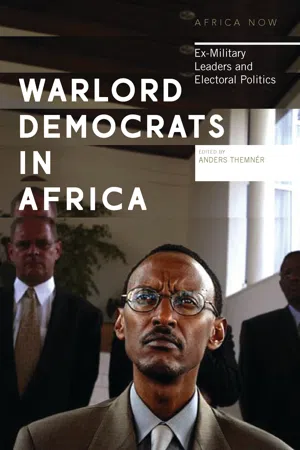
Post-war democratization has been identified as a crucial mechanism to build peace in war-ridden societies, supposedly allowing belligerents to compete through ballots rather than bullets. A byproduct of this process, however, is that military leaders often become an integral part of the new democratic system, using resources and networks generated from the previous war to dominate the emerging political landscape.
The crucial and thus-far overlooked question to be addressed, therefore, is what effect the inclusion of ex-militaries into electoral politics has on post-war security. Can 'warlord democrats' make a positive contribution by shepherding their wartime constituencies to support the building of peace and democracy, or are they likely to use their electoral platforms to sponsor political violence and keep war-affected communities mobilized through aggressive discourses?
This important volume, containing a wealth of fresh empirical detail and theoretical insight, and focussing on some of Africa's most high-profile political figures – from Paul Kagame to Riek Machar to Afonso Dhlakama – represents a crucial intervention in the literature of post-war democratization.
- English
- ePUB (mobile friendly)
- Available on iOS & Android
eBook - ePub
About this book
Information
1 | Pompier-pyromanocracy: Mbusa Nyamwisi and the DR Congo’s inflammable post-settlement political order
Introduction
In April 2003, the belligerents of the Second Congo War (1998–2003) adopted a peace accord, signed in December 2002, that was bombastically dubbed the “Global and All-Inclusive Agreement”. This inaugurated a transitional period that would last up to the organization of general elections in 2006. The accord paved the way for a double political and military power-sharing deal, implying that the breed of violent actors that had gained dominance during the war were officially entitled to a part of the “national cake”. Positions in the politico-administrative apparatus were divided among the signatories of the peace deal, including the political representatives of former insurgent outfits, which were transformed into political parties. This form of power-sharing was mirrored in the military domain. New national armed forces were cobbled together from troops and officers of most of the ex-belligerent factions, leading to the creation of mixed units placed under an integrated command chain.
The political order that developed out of this power-sharing exercise is characterized by intense and sometimes violent power competition, in particular in the eastern part of the country, where violence at various levels of intensity is ongoing. In the immediate post-settlement period, politico-military entrepreneurs struggled to maintain and extend the political, economic and military spheres of influence they had carved out during the wars, both within and outside the state apparatus. At the same time, the various competing factions tried to take advantage of the new political constellation by repositioning themselves in the national and sometimes also regional political and military arenas. A common method of such repositioning was participation in electoral politics, notably the 2006 and 2011 presidential and parliamentary elections. However, the electoral and wider political inclusion of former warlords is generally believed to have contributed to the ongoing violence in the east, in part by creating incentives among those with poor electoral prospects and results to take up arms. Furthermore, by reinforcing ethnic outbidding, it is said to have provided an impetus to armed mobilization along ethnic lines (Stearns et al. 2013).
Without contradicting these observations, this chapter intends to refine the analysis of how the electoral and wider political inclusion of ex-belligerents has contributed to the militarization of the eastern Democratic Republic of the Congo (henceforth the Congo). By exploring the post-settlement trajectory of one particular politico-military entrepreneur, Antipas Mbusa Nyamwisi, it shows how even political actors with relatively good electoral prospects and results, and who do not explicitly draw upon antagonistic ethnic discourses, have contributed to ongoing violence. During the Second Congo War, Mbusa was the president of the insurgent movement Congolese Rally for Democracy/Kisangani-Liberation Movement (Rassemblement Congolais pour la Démocratie/Kisangani-Mouvement de Libération, RCD/K-ML), the main stronghold of which was the Grand Nord area, encompassing Beni and Lubero territories in the north of North Kivu province. After the signing of the final peace accord, the RCD/K-ML was transformed into a political party, of which Mbusa became the president. Mbusa was subsequently appointed minister in the transitional and first post-transitional governments, and stood for president in both the 2006 and 2011 elections. In 2011, he also ran for election as a member of parliament (MP). However, whereas in 2006 the RCD/K-ML participated as part of a platform of pro-government parties, in 2011 it ran on an opposition ticket, reflecting the growing rift between Mbusa and Congo’s President Joseph Kabila.
This switch to the opposition can be attributed both to the changing position of Mbusa Nyamwisi in the national and provincial political landscape and the strategies he devised for navigating these arenas. Mbusa reigned supreme over the RCD/K-ML and therefore had preponderant influence in determining the party’s course. In continuity with the war era, his strategies largely followed the logics of “brokerage” and “multi-positioning”: he maintained contacts with nominally opposed factions, whether in the political or military domain, which enabled him to reinforce his negotiation position by threatening to intensify links to other factions’ enemies. Furthermore, Mbusa positioned himself at once locally (in the Grand Nord, and subareas thereof), provincially (North Kivu), nationally (Congo) and regionally (Great Lakes area). This multi-positioning allowed him to play a role as gatekeeper to and broker between different types of networks located at different levels.
Since Mbusa’s strategy of multi-positioning and brokerage included maintaining ties with armed groups and military figures, his post-settlement quest for power had important security effects. But rather than manipulating armed groups directly, he mostly maintained low-key, secretive contacts, creating a veil of mystery surrounding his dealings. Yet in a climate awash with rumors, tensions and violence, mere suspicion of links to armed actors has direct security effects, for instance prompting opposing factions to militarily reinforce their position. Furthermore, in the militarized political-economic order of the eastern Congo, the ability to manipulate armed actors is a valued currency, as it often translates into enhanced negotiating power. By demonstrating the value of this currency, although with diminishing effectiveness, Mbusa’s ways of navigating the post-settlement order have importantly contributed to its ongoing militarization, and therefore to the manifestations of organized violence that this militarization entails. As such, Mbusa’s political dealings are reminiscent of the classic strategy of the pompier-pyromane (firefighter-pyromaniac), referring to the firefighter who lights fires in order to capitalize upon his or her own capacity to extinguish them.
While Mbusa’s personal agency has been an important factor in determining his post-settlement trajectory, the latter has also been strongly shaped by the general political-military context. Therefore, the chapter sets out by sketching a number of general characteristics of the Congo’s pre-war and post-settlement orders, and the two wars in between these periods. It then zooms in on Mbusa Nyamwisi, describing his personal career and the strategies he adopted both during the war and after the settlement, which are analyzed against the background of his position both in the RCD/K-ML and in the Grand Nord. The insights flowing from this analysis allow for a number of conclusions on the effects of the political participation of politico-military entrepreneurs on the nature of the post-settlement political order, in particular its violent character.
Two wars and two intransitive transitions
The violent nature of political competition in the post-2003 era is not a novel phenomenon in the Congo. At regular conjunctures in the country’s history, various forms of violence have played a pronounced role in channeling power struggles. One such period followed Mobutu’s announcement of a transition to multiparty democracy in 1990. The subsequent limited and imperfect opening of political space intensified ethnic and armed mobilization. At the root of this hardening of the political climate was a complex interplay between, on the one hand, local-level inter-community tensions, often surrounding land and local authority, and on the other hand, manipulation by national and provincial politicians. This manipulation was partly fed by the divide-and-rule politics that Mobutu embarked upon to thwart the nascent democratization process (Mamdani 1998). One manifestation of this was géopolitique, or an effort to balance political and administrative representation between different regional and ethnic groups. Géopolitique institutionalized competition between groups framed as “ethnic”, and focused attention to the question of who was a “native” and could therefore represent a certain area, and who was not (Mararo 2005). A second strategy was the application of the pompier-pyromane scenario. This entailed stoking up animosities to the point that they turned violent, and then extinguishing them in order to reassert control, in this way reinforcing and demonstrating authority. The clearest application of this strategy was in the province of Shaba (now Katanga), where political manipulation fueled an ethnic cleansing campaign executed by radical youth militias that led to the expulsion of thousands of Kasaians, many of whom died, in 1992 and 1993 (Dibwe dia Mwembu 1999). While top-down manipulation was less evident in the case of the violence that flared up in North Kivu in 1993, which was strongly nourished by long-standing local tensions, the national political context did provide new incentives for armed mobilization, and the provincial politicians that played a key role as instigators were close allies of Mobutu (Mararo 2003).
Due to concerted efforts to derail the democratization process, not least by Mobutu, the announced introduction of a multiparty system heralded no more than an “intransitive transition” (de Villers and Omasombo 2002), which ultimately fostered exclusionary and violent politics. Yet despite managing to maintain the upper hand in this disorder, Mobutu was not to retain power for long. In 1997 he was ousted from power by an insurgent coalition backed by regional powers, the Alliance of Democratic Forces for the Liberation of Congo-Zaire (Alliance des Forces Démocratiques pour la Libération du Congo-Zaïre, AFDL). Within less than seven months, the insurgents managed to capture Kinshasa, thereby ending the First Congo War (1996–1997). However, the new regime that was installed under Laurent-Désiré Kabila soon fell out with its erstwhile backers, in particular Rwanda and Uganda. The latter therefore engineered yet another rebellion, that of the Congolese Rally for Democracy (Rassemblement Congolais pour la Démocratie, RCD), which erupted in August 1998. This inaugurated the Second Congo War (1998–2003), which grew to be a complex mixture of a regional war that drew in no fewer than seven African countries, a variety of civil wars that were fought on Congolese soil, and a myriad of local conflicts that turned violent. The Congo became a patchwork of political-military orders, having a government-held zone in the west, and a host of rebel-held areas in other parts, most of which were further fragmented due to the presence of dozens of small-scale armed groups, often labeled “Mai-Mai”. The most important Congolese rebel movements were the Uganda-backed Movement for the Liberation of the Congo (Mouvement pour la Libération du Congo, MLC) in the northwest, and the RCD in the east. However, the RCD gradually fell apart into three factions due to power struggles and differences in political vision and strategic preferences, both between and among its foreign supporters and their Congolese clients. While the core group of the RCD, supported by Rwanda, controlled the province of South Kivu, and parts of the provinces of Maniema, Katanga and North Kivu, specifically its southern part, a Uganda-backed branch, which gradually morphed into the RCD/K-ML, had its fiefdom in the Grand Nord. A smaller faction called RCD-National, which was also sponsored by Uganda, operated to the north of that, in Orientale Province (Lanotte 2003; Stearns 2011).
The multitude of belligerents involved in the Second Congo War severely hampered the implementation of the final peace accord and related power-sharing arrangements. The signatories were a motley crew comprised of the following parties: the Congolese government, since 2001 headed by President Joseph Kabila in the wake of his father’s assassination; the “unarmed political opposition” regrouping twenty-eight different political parties; the somewhat nebulous category of “civil society”; and finally five armed players, one of which, the so-called “Mai-Mai entity”, consisted of a loose amalgam of myriad armed groups. All these factions vied for position not only between, but also among themselves, which both exacerbated existing internal divisions and generated new ones. This power competition compounded policy processes, not least because it polarized decision-making bodies. The transitional presidency, comprised of one president and no fewer than four vice-presidents from different factions, was no exception to this. This so-called “1 + 4” formula was emblematic of the entrenched factionalism, power grabbing and political paralysis that were a hallmark of this second transition, as epitomized by the widely circulating pun “1 + 4 = 0” (Willame 2007).
Aside from the power struggles, the transition was also hampered by the slow pace and problematic nature of the military integration process. In order to maintain their military spheres of influence, several belligerents withheld (a part of) their troops from integration. This was for instance the case with Mai-Mai groups that had only local spheres of influence and constituencies, and lacked connections and clout at the national level. Similar foot-dragging could be detected among larger groups that were marginalized in the presidential patronage network and stood little chance in the elections, but had relatively autonomous sources of revenue. For example they controlled trans-border trade networks or had direct outside support. To such groups, which included a part of the RCD, the main strategy of navigating the transition was to maintain a powerbase predominantly outside of the centrally controlled state apparatus. Consequently, they withheld a part of their troops from the military integration process. Other groups, by contrast, invested heavily in the political games played out in the new national political arena, and were more willing to send their troops into the national army. This did not imply, however, that they readily ceded control over their local strongholds or entirely gave up independent military capacities. Rather, they mostly changed the modalities of maintaining control, trying to manipulate the national and local state institutions, including the national armed forces. They maintained networks of loyal officers within the army, leading to parallel command chains and divided loyalties. For example, the MLC initially held on to a large separate security guard to protect its president. Some factions also resorted to non-state channels to retain a capacity for militarized maneuvering, such as liaising with foreign rebel groups or local militias (Verweijen 2014). As will be further explained below, this was also the strategy followed by parts of the RCD/K-ML.
The ex-belligerents’ half-hearted commitment to military integration importantly contributed to the ongoing militarization of politics, prompting competing factions to turn to (threats of) force or army disintegration to reinforce their political position. As this strategy was often successful, a system emerged in which political actors had incentives to take up arms (Eriksson Baaz and Verweijen 2013). The continued existence of (semi-)autonomous military forces both within and outside of the national military also perpetuated the militarization of the economy...
Table of contents
- Cover
- About the Editor
- Title
- Copyright
- Contents
- Acknowledgements
- Introduction: Warlord democrats: wartime investments, democratic returns?
- 1 Pompier-pyromanocracy: Mbusa Nyamwisi and the DR Congo’s inflammable post-settlement political order
- 2 Apotheosis of a warlord: Paul Kagame
- 3 Discourses of peace and fear: the electoral navigations of Sekou Conneh and Prince Johnson in post-war Liberia
- 4 Afonso Dhlakama and RENAMO’s return to armed conflict since 2013: the politics of reintegration in Mozambique
- 5 From warlord to drug lord: the life of João Bernardo “Nino” Vieira
- 6 Shape-shifters in the struggle for survival: post-war politics in Sierra Leone
- 7 Riek Machar: warlord-doctor in South Sudan
- Conclusion: Ambiguous peacelords: the diminishing returns of post-war democracy
- About the contributors
- Index
Trusted by 375,005 students
Access to over 1.5 million titles for a fair monthly price.
Study more efficiently using our study tools.
Frequently asked questions
Yes, you can cancel anytime from the Subscription tab in your account settings on the Perlego website. Your subscription will stay active until the end of your current billing period. Learn how to cancel your subscription
No, books cannot be downloaded as external files, such as PDFs, for use outside of Perlego. However, you can download books within the Perlego app for offline reading on mobile or tablet. Learn how to download books offline
Perlego offers two plans: Essential and Complete
- Essential is ideal for learners and professionals who enjoy exploring a wide range of subjects. Access the Essential Library with 800,000+ trusted titles and best-sellers across business, personal growth, and the humanities. Includes unlimited reading time and Standard Read Aloud voice.
- Complete: Perfect for advanced learners and researchers needing full, unrestricted access. Unlock 1.5M+ books across hundreds of subjects, including academic and specialized titles. The Complete Plan also includes advanced features like Premium Read Aloud and Research Assistant.
We are an online textbook subscription service, where you can get access to an entire online library for less than the price of a single book per month. With over 1.5 million books across 990+ topics, we’ve got you covered! Learn about our mission
Look out for the read-aloud symbol on your next book to see if you can listen to it. The read-aloud tool reads text aloud for you, highlighting the text as it is being read. You can pause it, speed it up and slow it down. Learn more about Read Aloud
Yes! You can use the Perlego app on both iOS and Android devices to read anytime, anywhere — even offline. Perfect for commutes or when you’re on the go.
Please note we cannot support devices running on iOS 13 and Android 7 or earlier. Learn more about using the app
Please note we cannot support devices running on iOS 13 and Android 7 or earlier. Learn more about using the app
Yes, you can access Warlord Democrats in Africa by Anders Themnér in PDF and/or ePUB format, as well as other popular books in Politics & International Relations & Democracy. We have over 1.5 million books available in our catalogue for you to explore.