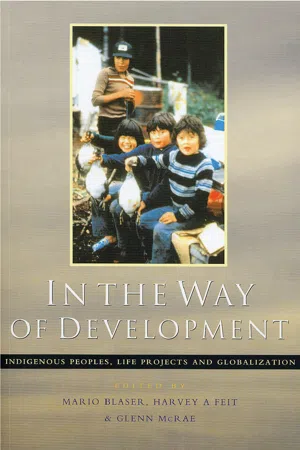
A collaboration between indigenous leaders, social activists and scholars from a wide range of disciplines, In the Way of Development explores the current situation of indigenous peoples enmeshed in the remorseless expansion of the modern economy.
The volume assembles a rich diversity of statements, case studies and wider thematic explorations all starting with indigenous peoples as actors, not victims. The accounts come primarily from North America, but include also studies from South America, and the former Soviet Union.
In the Way of Development shows how the boundaries between indigenous peoples' organizations, civil society, the state, markets, development and the environment are ambiguous and constantly changing. This fact makes local political agency possible, but also, ironically, opens the possibility of undermining it.
eBook - ePub
In the Way of Development
Indigenous Peoples, Life Projects and Globalization
- English
- ePUB (mobile friendly)
- Available on iOS & Android
eBook - ePub
In the Way of Development
Indigenous Peoples, Life Projects and Globalization
About this book
Information
1
Indigenous Peoples and Development Processes: New Terrains of Struggle
MARIO BLASER, HARVEY A. FEIT AND GLENN MCRAE
In the last three decades Indigenous peoples’ struggles to keep control of their lives and lands have moved from being of concern only to themselves, and some specialists and specialized bureaucracies, to being issues of wide public awareness and debate in many sectors of society. Indigenous peoples’ struggles are now carried on within complex transnational networks and alliances that traverse the boundaries between the state, markets and civil society, including the environmentalist and human rights movements. International forums such as the United Nations have become important sites in these networks, but major transnational organizations like the UN and the World Bank must themselves now have policies in place and access to expertise on Indigenous peoples in order to carry out many of their projects. Nearly every time the constitution of a nation-state is rewritten today, a major debate develops about how to include some form of recognition of Indigenous rights. Transnational corporations have to grapple with laws, norms and regulations that complicate their operations when these affect Indigenous peoples. These examples are but a few indications of the dramatically transformed terrains in which Indigenous peoples carry on their lives and their struggles today. Much has changed. But much has not changed.
This book provides the reader with a diverse series of analyses, strategic assessments, examples and reflections on Indigenous peoples’ agency and struggles in the face of development projects carried out on these changing terrains. Many of the changes in the arenas in which Indigenous peoples carry on their struggles have been reshaped in these last decades by the initiatives of Indigenous peoples themselves. But much of the terrain has also been dramatically reshaped by others, through the changing roles of the nation-state and of NGOs, the growing importance of transnational corporations and global flows of capital, the expansion of media networks, and the rise of the environmentalist and human rights movements. These changes have altered Indigenous peoples’ strategies of struggle to survive and to retain the autonomy they still exercise. We argue, however, that Indigenous peoples’ agency and their alliances with wider movements themselves can have, and sometimes have had, transformative effects on the emergence of alternative structures of governance1 that are not rooted in globalizing development.
The chapters in this book present diverse insights into these developments. The editors have invited chapters from Indigenous leaders and Indigenous and non-Indigenous activists and scholars in the conviction that emerging issues can be best explored and understood by working through a set of differing perspectives and literary forms. The forms range from declarations, to histories, comparative analyses, theoretical explorations and analytical case studies, to practitioners’ handbooks.
The ‘mix’ of authors is also an important feature of the book because their perspectives and experiences are rarely brought together. Rather they tend to be seen either as mutually exclusive (even antagonistic), or as representing diverse ‘levels’ on a scale of knowledge. We reject models that put local/traditional knowledge and global/scientific knowledge on opposing extremes of a scale of accuracy and, therefore, authority. It is within a framework of openness to dialogue and emerging understandings that we seek to explore the themes of this book.
The theme of Indigenous peoples’ agency in the context of the changing terrains in which development processes take place is explored in many of the chapters of this book as a counterpoint between ‘life projects’ and ‘development projects’. The two introductory chapters serve the parallel aims of providing the contexts for the chapters that follow, and contributing to an emerging conceptual framework for understanding and acting in these new terrains. This introduction contextualizes the changes in the terrains of Indigenous action over recent decades, and provides a preview of each chapter in the volume. The other introductory chapter, by Mario Blaser, sets out the idea and practice of Indigenous life projects as a key to understanding and rethinking Indigenous agency in the midst of these changing contexts. It explores how Indigenous projects are linked to those terrains but also how Indigenous life projects differ from the dominant and more common ideas and practices of development and development projects. That chapter also provides an account of the structure of the volume in terms of its thematic sections.
Our sense as editors is that many readers of this volume will come to it with familiarity with one or more of the areas of these changes. But because we think that there has been only limited overlap between the literatures and venues devoted to Indigenous issues and those focused on development, we assume that many readers will not be familiar with the recent developments in all of the fields involved, and that most will not be familiar with the growing connections between them. This introduction was, therefore, conceived of as an overview of recent trends in, and the interconnections among, the areas of Indigenous rights, human rights, sustainable development, civil society and globalization. Our aim is not to review each area comprehensively, but to draw out how the changes in each of these areas impact and are impacted by Indigenous peoples. Indeed, we think that Indigenous peoples and issues have become key links among these terrains of knowledge and struggle.
Terrains of Subordination and Survival
Indigenous lives and life projects have never been pursued in a vacuum; they can only be pursued amidst other projects. If the relations between different projects were more or less symmetrical, the broad cultural values and the visions of both Indigenous peoples and developers would each find some point of mutual accommodation. As a few chapters in this volume show, when conditions of a relative balance of power occurred the treaties made between Indigenous peoples and newcomers have embodied the cultural underpinnings of both groups, as in the Two-Row Wampum discussed by Deborah McGregor and by Mary Arquette, Maxine Cole and the Akwesasne Task Force on the Environment.
Yet once the newcomers secured their dominion over Indigenous peoples – by resettlement with the aid of depredations caused by the spread of disease, military conquest, or incremental dispossession – they refused to recognize the latter’s conceptions of right and the pursuit of their life projects, justifying this on the basis that Indigenous societies and cultures were primitive and undeveloped (Asch 2000). In this new situation of asymmetry, the colonizers have repeatedly imposed their cultural forms on relations with Indigenous peoples. Thus, under the ‘custody’ of the nation-states, Indigenous lands and resources, and even their children, have been susceptible to seizure either in the name of the greater good, for an abstract ‘all’, or for their own presumed benefit. These actions assume the colonizers’ conceptions of the correct relationships that must prevail among humans, as individuals and groups, and between human and non-human entities, or roughly what is called ‘nature’.
In the international system of sovereign states those Indigenous spokespersons who have again and again called attention to these abuses have gone mostly unheard (Wilmer 1993: 2–3). Further, even when abuses were attended to, the basic storyline of development was not doubted. As the International Labor Organization Convention 107 of 1957 expressed it:
Considering that there exist in various independent countries indigenous and other tribal and semi-tribal populations which are not yet integrated into the national community and whose social, economic or cultural situation hinders them from benefiting fully from the rights and advantages enjoyed by other elements of the population … [g]overnments shall have the primary responsibility for developing co-ordinated and systematic action for the protection of the populations concerned and their progressive integration into the life of their respective countries [although] recourse to force or coercion as a means of promoting the integration of these populations into the national community shall be excluded. (ILO 1957)
Thus Indigenous peoples continually find themselves subordinated within the nation-state and international system. This implies that, for the most part, their struggles to pursue their own life projects take place in a field dominated by Western ‘cultural underpinnings’, including the central idea of development (see Stavenhagen 1996; Tully 2000).
In contrast, the visions embodied by Indigenous life projects entail a relationship between equals and an end to the subordination of Indigenous peoples. Thus, attention to the field of power relations in which they operate is among the central considerations of life projects. This attention to relationships and power informs the strategies through which Indigenous organizations struggle to end the subordination of their life projects and to pursue their unhindered realization. Central to their strategies has been the mobilization of Indigenous peoples for recognition of their rights. When we speak of rights, we are speaking of more than legal issues. We are talking more broadly of the life projects that embody visions of the world and the future, and of the inherent right to pursue one’s own life.
As a consequence of the subordination of Indigenous peoples, their life projects have had to be furthered through the cracks left open, by unexpected events and the passage of time, in the oppressors’ own discourses and legal expressions of rights. By having to speak the ‘language’ of the dominant group, the broad cultural underpinnings of Indigenous peoples’ struggles have often been obscured, and their political significance has gone unaddressed by most analysts. This volume is part of a growing and diverse literature that seeks to reduce that omission.
From the 1960s onwards, and in connection with both the civil rights and decolonization struggles occurring around the world, subordinated groups, including Indigenous peoples, began to call more effective attention to the contradictions between the standards of human rights proclaimed by nation-states and international standards, and the actual way in which these were imposed on or ignored for Indigenous peoples (see Brysk 2000; Messer 1993; Niezen 2003; Wilmer 1993; Wright 1988). In the process they contributed to the erosion among nation-state authorities, and the public more generally, of unselfconscious confidence in dominant Western values, including the ideas of development.
In order to provide a background picture of how these transformations took place, what new political terrains they have shaped, and how Indigenous peoples pursue their life projects in them, we will examine several areas on which key changes have occurred. In the next section of this chapter we provide a brief overview of the processes through which Indigenous rights emerged in the context of development and the connections of these processes with environmental issues. In the following section we focus on the contemporary political terrains that have been partly shaped by these processes and discuss Indigenous peoples’ organizational adaptations and strategies to pursue their life projects in the new terrains.
In reviewing the changes of recent decades we also set out to build some additional bridges between the domains of Indigenous rights as a specialization and critical development work, because these connections have often not been considered central to social analysis and action.
Indigenous Rights and Development
As indicated by the fragment from ILO Convention 107, the broader agenda of development included human rights to the extent that ‘integration’ of Indigenous peoples was supposedly aimed, in part, at extending to them some socio-economic human rights, or ‘second-generation rights’ (Messer 1993: 222). However, in pointing out that force had to be excluded as an instrument of integration, the convention underscored the contradiction between the goal of recognizing human rights and the way in which development was often being delivered.
When, in the late 1960s and early 1970s, the international human rights network began to take shape, some organizations – like the Anti-Slavery Society, the International Work Group on Indigenous Affairs (IWGIA), Survival International and Cultural Survival – focused specifically on the abuses committed against Indigenous peoples (see Martinez Cobo 1986; Wilmer 1993: 141). These organizations were at odds with dominant ideas in governmental circles because they asserted that respect for cultural differences was a viable alternative to integrationist development. Over time they developed active collaborations with ongoing efforts by Indigenous peoples to organize and make their voices heard in international arenas. For Indigenous peoples, this was a means to improve their situation in the national contexts where they lived (see Bodley 1988; Sanders 1977; Davis 1977; Wright 1988).
In the 1970s the proliferation of Indigenous advocacy and Indigenous organizations closely matched the internal expansion of many nation-states as they initiated grand schemes of development affecting resources and Indigenous peoples in ‘peripheral areas’, including, among others, agrarian reform, agricultural colonization, green revolution schemes, road building, dams, mining, and oil exploration and production (Sanders 1973; Wilmer 1993).
Indigenous peoples in Latin America, for example, responded to the developmentalist wave of the 1960s and 1970s by trying to stop it, or trying to direct some of its policies and programmes to their own benefit. The last strategy was used particularly in the context of agrarian reforms initi...
Table of contents
- Cover
- About this Book
- The Editors
- Title
- Copyright
- Contents
- Acknowledgements
- Dedication
- 1. Indigenous Peoples and Development Processes: New Terrains of Struggle
- 2. Life Projects: Indigenous Peoples’ Agency and Development
- PART I Visions: Life Projects, Representations and Conflicts
- PART II Strategies: States, Markets and Civil Society
- PART III Invitations: Connections and Coexistence
- Index
Trusted by 375,005 students
Access to over 1.5 million titles for a fair monthly price.
Study more efficiently using our study tools.
Frequently asked questions
Yes, you can cancel anytime from the Subscription tab in your account settings on the Perlego website. Your subscription will stay active until the end of your current billing period. Learn how to cancel your subscription
No, books cannot be downloaded as external files, such as PDFs, for use outside of Perlego. However, you can download books within the Perlego app for offline reading on mobile or tablet. Learn how to download books offline
Perlego offers two plans: Essential and Complete
- Essential is ideal for learners and professionals who enjoy exploring a wide range of subjects. Access the Essential Library with 800,000+ trusted titles and best-sellers across business, personal growth, and the humanities. Includes unlimited reading time and Standard Read Aloud voice.
- Complete: Perfect for advanced learners and researchers needing full, unrestricted access. Unlock 1.5M+ books across hundreds of subjects, including academic and specialized titles. The Complete Plan also includes advanced features like Premium Read Aloud and Research Assistant.
We are an online textbook subscription service, where you can get access to an entire online library for less than the price of a single book per month. With over 1.5 million books across 990+ topics, we’ve got you covered! Learn about our mission
Look out for the read-aloud symbol on your next book to see if you can listen to it. The read-aloud tool reads text aloud for you, highlighting the text as it is being read. You can pause it, speed it up and slow it down. Learn more about Read Aloud
Yes! You can use the Perlego app on both iOS and Android devices to read anytime, anywhere — even offline. Perfect for commutes or when you’re on the go.
Please note we cannot support devices running on iOS 13 and Android 7 or earlier. Learn more about using the app
Please note we cannot support devices running on iOS 13 and Android 7 or earlier. Learn more about using the app
Yes, you can access In the Way of Development by Mario Blaser, Glenn McRae, Harvey Feit, Mario Blaser,Glenn McRae,Harvey Feit in PDF and/or ePUB format, as well as other popular books in Social Sciences & Cultural & Social Anthropology. We have over 1.5 million books available in our catalogue for you to explore.