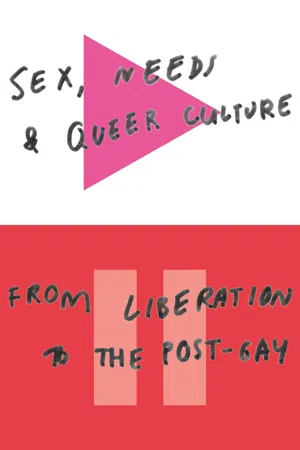
The belief of many in the early sexual liberation movements was that capitalism's investment in the norms of the heterosexual family meant that any challenge to them was invariably anti-capitalist. In recent years, however, lesbian and gay subcultures have become increasingly mainstream and commercialized - as seen, for example, in corporate backing for pride events - while the initial radicalism of sexual liberation has given way to relatively conservative goals over marriage and adoption rights. Meanwhile, queer theory has critiqued this 'homonormativity', or assimilation, as if some act of betrayal had occurred.
In Sex, Needs and Queer Culture, David Alderson seeks to account for these shifts in both queer movements and the wider society, and argues powerfully for a distinctive theoretical framework. Through a critical reassessment of the work of Herbert Marcuse, as well as the cultural theorists Raymond Williams and Alan Sinfield, Alderson asks whether capitalism is progressive for queers, evaluates the distinctive radicalism of the counterculture as it has mutated into queer, and distinguishes between avant-garde protest and subcultural development. In doing so, the book offers new directions for thinking about sexuality and its relations to the broader project of human liberation.
- English
- ePUB (mobile friendly)
- Available on iOS & Android
eBook - ePub
About this book
Information
1
Transitions
Postmodernity, neoliberalism, hegemony
In 1984, Fredric Jameson published his essay, ‘Postmodernism, or the Cultural Logic of Late Capitalism’, claiming we had entered ‘the purest form of capital yet to have emerged’,1 and one which was for that reason qualitatively distinctive. As I remarked in the introduction, the category he used to describe this stage has since substantially fallen out of fashion, though it is one that he has consistently defended.2 Jameson’s essay may well be less familiar to readers today than it was to those of my generation, among whom it was ubiquitous, so I shall rehearse some of its key arguments here. In doing so, however, I want to focus on certain influences on Jameson’s highly eclectic presentation of his case that are not normally accorded such prominence. These are ideas associated with Williams and Marcuse, some of which I have already outlined in the introduction. My reasons for focusing on them have to do with a dissatisfaction with the ways that he and others theorize the period with which this book is concerned, and especially the kind of qualitative transition in capitalism that most would agree has taken place.
I focus largely on Jameson’s first essay on the topic rather than later accounts by him, both because of its general influence, and because it is necessary to an understanding of a less well-known adaptation by Marianne DeKoven in her book, Utopia Limited (2004), of many of the ideas expressed there. DeKoven presents arguments about politics that draw on, but are not consistent with, Jameson’s purposes. Whereas Jameson professes a certain moral neutrality with regard to postmodernity on the grounds that it is an established fact there is no point in lamenting,3 DeKoven is instead a positive enthusiast for the phenomenon. She views it as an advance in all sorts of ways over modernity, in spite of a certain nostalgia she feels for the latter, and especially for the idealism of the movements of the sixties. Her position is therefore more characteristic of the postmodern left than Jameson’s, and there is no question in her case about the appropriateness of that label; it is one she embraces.
The late capitalism of Jameson’s title is an allusion to a book whose argument underpins his. Ernest Mandel describes a three-stage development from freely competitive to monopoly capitalism, and thence to a late capitalism that first emerges in the 1940s. This last stage is characterized by multinational corporations, increasingly global markets, and intensified consumerism, though Mandel also presciently places great importance on the mobility of the finance capital that has since taken on an even more extravagant life of its own. Jameson claims that the three stages Mandel outlines have successively determined aesthetic realism, modernism and postmodernism.4 The defining features of this last stage consist in two kinds of ‘prodigious expansion’ whose intimacy seems to prompt this identical phrasing about them, even though the precise nature of their relationship is left unclear.
The first of these expansions is that of capital itself ‘into hitherto uncommodified areas’5 that most strikingly include the formerly pre-capitalist third world in consequence of the ‘green revolution’ in agriculture,6 and the subjective unconscious through the influence of the media and advertising. These two ‘spaces’ have generated distinctive kinds of resistance in the past. The second expansion Jameson points to is of a formerly semi-autonomous culture that has now become disseminated
throughout the social realm, to the point at which everything in our social life – from economic value and state power to practices and to the very psyche itself – can be said to be ‘cultural’ in some original and yet untheorized sense.7
This expansion is a curious one, since it is predicated on a supposed prior restriction of modernist culture, whose limited circulation among a self-conscious aesthetic elite facilitated its preservation of a certain utopian promise through the artwork’s distance from, critical relation to and transfiguration of reality. Under postmodernism, by contrast, culture has apparently expanded, not merely through the culture industry as identified by the Frankfurt School, but also through the proliferation of images and other modes of signification attendant on developments in the field of communication technology to the point of having become absolutely ubiquitous. Of course, since this essay was written, all the developments said to have determined the emergence of postmodernism have intensified (think of smartphones, for instance, and the even more rapid circulation they facilitate). If Jameson was right back in 1984, we must be more securely postmodern now than ever. Marianne DeKoven even cites this as the reason for the term’s demise: the postmodern condition is so ubiquitous as to have ‘become invisible’.8
The cultural effects of capital’s expansion, however, are made evident to us in Jameson’s account through readings of novels, poetry, art photography, architecture, painting and so on. These works may have an ideological character, he suggests, in their playfully diverting qualities, but they also manifest a certain realism. This is not because they are generically realist – they do not aspire to recreate a plausible, recognizable world for us – but because they effectively convey traits that are associated with contemporary sensibilities. These include: the resort to blank pastiche and affectlessness, rather than parody; a displacement of temporal awareness by spatial consciousness; random heterogeneity, fragmentation and incoherence. The purpose in highlighting these characteristic works may be evinced from Jameson’s concluding point that a
new political art (if it is possible) will have to hold to the truth of postmodernism, that is to say, to its fundamental object – the world space of multinational capital – at the same time at which it achieves a breakthrough to some as yet unimaginable new mode of representing this last, in which we may again begin to grasp our positioning as individual and collective subjects and regain a capacity to act and struggle which is at present neutralized by our spatial as well as our social confusion.9
In considering Jameson’s argument in more detail, though, I shall not be concerned with his specific readings of artworks; in relation to these, I shall simply say that his tendency to divorce the ideological from the realistic properties of those works, without taking into account questions of cultural production – institutions and ideologies of art, that is, that mediate their relations with reality – is one that is abrupt and obviously problematic. However, I am more concerned with his characterization of the kind of world that generates the consciousness said to be evinced by these works.
When Jameson speaks of the cultural dominance of modernism and postmodernism, he clearly means two quite distinct things. Whereas artistic modernism is held to have been dominant because it was the most advanced, most self-consciously uncompromising and experimental form of cultural production of its time, culture under postmodernism is dominant in the sense that it is everywhere. Modernism occupied a peculiar status in a distinct cultural sphe...
Table of contents
- Cover
- Halftitle
- About the author
- Title page
- Copyright
- Contents
- Acknowledgements
- Introduction
- 1. Transitions
- 2. Is Capitalism Progressive (for Queers)?
- 3. Feeling Radical: Versions of Counterculture
- 4. Subculture and Postgay Dynamics
- Postscripts
- Index
Trusted by 375,005 students
Access to over 1.5 million titles for a fair monthly price.
Study more efficiently using our study tools.
Frequently asked questions
Yes, you can cancel anytime from the Subscription tab in your account settings on the Perlego website. Your subscription will stay active until the end of your current billing period. Learn how to cancel your subscription
No, books cannot be downloaded as external files, such as PDFs, for use outside of Perlego. However, you can download books within the Perlego app for offline reading on mobile or tablet. Learn how to download books offline
Perlego offers two plans: Essential and Complete
- Essential is ideal for learners and professionals who enjoy exploring a wide range of subjects. Access the Essential Library with 800,000+ trusted titles and best-sellers across business, personal growth, and the humanities. Includes unlimited reading time and Standard Read Aloud voice.
- Complete: Perfect for advanced learners and researchers needing full, unrestricted access. Unlock 1.5M+ books across hundreds of subjects, including academic and specialized titles. The Complete Plan also includes advanced features like Premium Read Aloud and Research Assistant.
We are an online textbook subscription service, where you can get access to an entire online library for less than the price of a single book per month. With over 1.5 million books across 990+ topics, we’ve got you covered! Learn about our mission
Look out for the read-aloud symbol on your next book to see if you can listen to it. The read-aloud tool reads text aloud for you, highlighting the text as it is being read. You can pause it, speed it up and slow it down. Learn more about Read Aloud
Yes! You can use the Perlego app on both iOS and Android devices to read anytime, anywhere — even offline. Perfect for commutes or when you’re on the go.
Please note we cannot support devices running on iOS 13 and Android 7 or earlier. Learn more about using the app
Please note we cannot support devices running on iOS 13 and Android 7 or earlier. Learn more about using the app
Yes, you can access Sex, Needs and Queer Culture by Doctor David Alderson in PDF and/or ePUB format, as well as other popular books in Philosophy & Political Philosophy. We have over 1.5 million books available in our catalogue for you to explore.