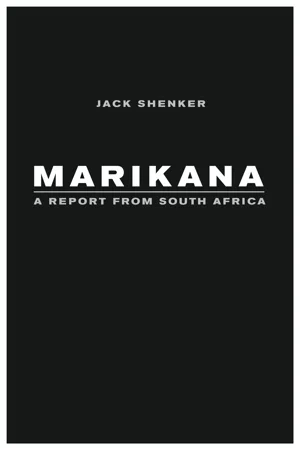
On 16 August 2012, the world looked on in horror as South African police gunned down striking mine workers at Marikana, leaving thirty-four dead and many more wounded. It was a massacre that echoed apartheid-era violence at Sharpeville and Soweto, shattering the international image of South Africa as a liberated 'rainbow nation'. The bloodshed laid bare the lingering inequalities and class tensions that have endured beyond South Africa's democratic transition, and which the ruling African National Congress has done little to address.
Marikana, an ebook exclusive by award-winning Guardian journalist Jack Shenker, explores the origins of the massacre and the truth behind the establishment's attempted cover-up, which has played out against a backdrop of growing popular disillusionment with the ANC and a spike in worker militancy. Weaving together the history of international mining interests in southern Africa, the mutation of the ANC from economic radicals into free-market cheerleaders and the emergence of new forms of popular resistance, Marikana poses vital questions about the massacre's legacy both within South Africa's borders and beyond. Offering a new and invaluable insight into one of the darkest episodes in South Africa's modern history, Shenker's work could not be more timely.
- English
- ePUB (mobile friendly)
- Available on iOS & Android
eBook - ePub
About this book
Information
The people shall govern
In January 1990, the month before his release from jail, Nelson Mandela wrote a note to his supporters clarifying the ANC’s economic philosophy. “The nationalisation of the mines, banks and monopoly industries is the policy of the ANC,” he confirmed, “and the change or modification of our views in this regard is inconceivable.” Within four years, just such a change had occurred.16
South Africa’s economic journey since 1994 has, with some minor deviations at the edges, followed a heavily neoliberal course. As in many other parts of the planet, the potency of South African neoliberalism has been derived from its dual function: both economic theory and political project. On the one hand, it operates as a notion that societies and economies are best served when capital is disembedded from any form of state or popular control, when no limits are placed on private accumulation, and when all forms of goods, services and human interactions can be commodified and traded; when sovereignty, to put it another way, lies ultimately with the market. But at the same time neoliberalism in South Africa has been a programme designed to concentrate financial resources under the control of the few, by opening up new financial landscapes and opportunities for wealth accumulation at the top. Despite the opposition of theoretical neoliberalism to state involvement in the economy, this second function depends on an active partnership between the state and socioeconomic elites in which the former helps create new markets for the latter, insulates their activity from popular pressure, and disciplines citizens who dissent.
Since being road-tested in General Pinochet’s Chile and implemented on a much broader scale by Margaret Thatcher in Britain and Ronald Reagan in the USA throughout the 1980s, neoliberalism has undergone a global process of democracy-proofing that reached its zenith in South Africa. Part of that process has involved redefining neoliberalism not as a contested economic theory or factional ideology, but rather as an uncontested reality, indistinguishable from modernity, freedom and common sense; anybody challenging the orthodoxy is therefore rendered an extremist. “There is no alternative” was Thatcher’s slogan as she drove a battering ram through many of the UK’s collectively held social goods. Another part of the process has been the hollowing-out of government sovereignty in neoliberal states, so that popular demands for social justice become impossible to implement. Since the 1980s, in both the global north and the global south, vast areas of government activity have been hived off into the hands of “technocrats”, supposedly apolitical experts freed from the chains of public pressure who think and work entirely within neoliberal strictures. This shrinking of the territory upon which governments can take action and electorates can exert any influence has left states even more dependent than previously on “market confidence” to maintain their economic wellbeing. Having surrendered many key policymaking tools, governments find themselves vulnerable to market discipline; any move away from the neoliberal orthodoxy leaves the country vulnerable to capital flight, which devastates jobs, incomes and trade. The result has been that across the planet neoliberal practice and soaring inequality have spread hand in hand. Since the late 1970s, the share of national income held by the top 1 per cent of the population has tripled in many countries, including Britain and the USA; the share of the top 0.1 per cent has quadrupled. We now live in a world in which the 80 richest people control more wealth than the bottom half of the global population – that’s 3.5 billion people – combined; by next year, the planet’s wealthiest 1 per cent will own more than the rest of the 99 per cent put together.
In the early 1990s, Francis Fukuyama, a neoconservative American academic, published his famous thesis proclaiming economic liberalism as “the end of history”. At the same time, however, South Africa – awkwardly for neoliberals – was making history of its own. In the long struggle against apartheid, millions of citizens like Mazula, Thembisa and Lungisile had acquired expectations for liberation that went far beyond an end to formal segregation and the chance to put a cross on a ballot paper once every five years. Black South Africans, after generations of colonial exploitation and racial abuse, sought economic security, human dignity, and the right to shape their futures via the exercising of a collective democratic will. The liberation they were granted proved to be very different: formal political rights were there, but little else. Today the ability of Mazula, Thembisa and Lungisile to confront inequality and economic exclusion is – at least within formal channels – no greater than it was under apartheid. Just as in many other countries in Africa, and all over the world, direct imperialism and racial domination have been replaced by an empire of capital – an empire that structures and delimits all of our lives, and which, as Marikana proved, will go to extraordinary lengths to defend its hegemony.
By the time Mandela emerged from jail, this empire of capital was rampant; the collapse of the Soviet Union, the economic liberalisation of China, and the spread of financial deregulation in the West had boosted neoliberal confidence to such a degree that, on a global level, alternative economic philosophies were disappearing fast from the mainstream political lexicon. South Africa, suddenly front and centre of the world stage, had the potential to be different. Seeded within the arduous battle for freedom were radical visions of meaningful wealth redistribution, with economic production and mineral resources being placed under the control of the people. But elites, both local and international, had no desire to see this now hugely influential nation buck the broader trend. Throughout the transition period, as the ANC was legalised and negotiations began on the creation of a procedurally democratic electoral system, both the outgoing National Party and advisers from international financial institutions sought to restrict the incoming government’s room for economic manoeuvre by tying the country to global trade agreements, “depoliticising” crucial policymaking areas, and committing the Rainbow Nation to long-term structural adjustment reforms that left its economic health reliant on the whims of financial speculators and private investors. The ANC’s Freedom Charter claimed “The People Shall Govern!”. But by the time Mandela’s party arrived in power, the domain over which governance was possible had shrunk beyond all recognition. By 1996, economic liberalisation – involving not just the maintenance of mine ownership in private hands but also the privatisation of many other industries, plus the dismantling of social safety nets – had been formally codified in the form of the Growth, Employment and Redistribution (GEAR) programme, which committed the government to cutting back spending, selling off more assets, and relaxing controls on capital. Liberation as political, social and economic empowerment for the masses had morphed into liberation for market forces alone to truly run free. By the turn of the millennium, the ANC’s original economic vision had undergone such a thorough reversal that Mandela himself was able to declare, with pride, “I am sure that Cecil John Rhodes would have given his approval to this effort to make the South African economy of the early 21st century appropriate and fit for its time.”
Although the global context played a major role in transforming the ANC from a movement of freedom fighters into an instrument of market fundamentalism, the party’s evolution was never merely a matter of Mandela’s well-intentioned negotiators being outfought or hoodwinked by their counterparts on the other side of the table. The ANC comprised many different factions, and the party’s conservative wing had always looked askance at the more revolutionary tendencies displayed by some colleagues. During the 1980s, instinctive neoliberals within the party such as Thabo Mbeki – South Africa’s future prime minister, who upon the launch of the GEAR programme labelled himself a Thatcherite – had gained the upper hand against leftists like Chris Hani, so that by the time the ANC assumed power much of its leadership was already immersed in an economically right-wing tradition. Of course this drift, from radicalism under a state of insurgency to conservatism once the state has been seized, was a process hardly unique to the ANC. Throughout history, emerging political forces have harnessed the profoundly transformative hopes of the masses which support them in order to propel themselves into government, only to contain and dampen such hopes as soon as power is achieved. Once party leaders are inside the state and well placed to take advantage of elite economic opportunities, the existing mechanisms of wealth creation and distribution begin to look a lot more attractive. Frantz Fanon, in his classic analysis of postcolonial societies, describes the historic mission of the bourgeoisie as having “nothing to do with transforming the nation: it consists, prosaically, of being the transmission line between the nation and a capitalism rampant though camouflaged”.17 It is undoubtedly the case that some among the ANC leadership defined themselves in these terms, and that they were able to win out over those who, like most of the movement’s supporters, interpreted freedom from apartheid as something with more depth than an isolated trip to the polling station once every half-decade. “Releasing...
Table of contents
- Cover
- About the Author
- Title
- Copyright
- Contents
- Introduction
- Tremors below
- “Are we going to be killed today?”
- The people shall govern
- Rise of the Marikanas
- Notes
Trusted by 375,005 students
Access to over 1.5 million titles for a fair monthly price.
Study more efficiently using our study tools.
Frequently asked questions
Yes, you can cancel anytime from the Subscription tab in your account settings on the Perlego website. Your subscription will stay active until the end of your current billing period. Learn how to cancel your subscription
No, books cannot be downloaded as external files, such as PDFs, for use outside of Perlego. However, you can download books within the Perlego app for offline reading on mobile or tablet. Learn how to download books offline
Perlego offers two plans: Essential and Complete
- Essential is ideal for learners and professionals who enjoy exploring a wide range of subjects. Access the Essential Library with 800,000+ trusted titles and best-sellers across business, personal growth, and the humanities. Includes unlimited reading time and Standard Read Aloud voice.
- Complete: Perfect for advanced learners and researchers needing full, unrestricted access. Unlock 1.5M+ books across hundreds of subjects, including academic and specialized titles. The Complete Plan also includes advanced features like Premium Read Aloud and Research Assistant.
We are an online textbook subscription service, where you can get access to an entire online library for less than the price of a single book per month. With over 1.5 million books across 990+ topics, we’ve got you covered! Learn about our mission
Look out for the read-aloud symbol on your next book to see if you can listen to it. The read-aloud tool reads text aloud for you, highlighting the text as it is being read. You can pause it, speed it up and slow it down. Learn more about Read Aloud
Yes! You can use the Perlego app on both iOS and Android devices to read anytime, anywhere — even offline. Perfect for commutes or when you’re on the go.
Please note we cannot support devices running on iOS 13 and Android 7 or earlier. Learn more about using the app
Please note we cannot support devices running on iOS 13 and Android 7 or earlier. Learn more about using the app
Yes, you can access Marikana by Jack Shenker in PDF and/or ePUB format, as well as other popular books in Politics & International Relations & International Relations. We have over 1.5 million books available in our catalogue for you to explore.