The continuing expansion of neoliberalism into ever more spaces and spheres of life has profound implications for social justice. Despite the number of policies designed to target 'social exclusion', people in many communities continue to be marginalized by economic restructuring.
Social Justice and Neoliberalism explores the connections between neoliberalism, social justice and exclusion. The authors raise critical questions about the extent to which neoliberal programmes are able to deliver social justice in different locations around the world. The book offers grounded, theoretically oriented, empirically rich analysis that critiques neoliberalism while understanding its material impacts. It also stresses the need to extend analyses beyond the dominant spheres of capitalism to look at the ways in which communities resist and remake the economic and social order, through contestation and protest but also in their everyday lives.
Global in scope, this book brings together writers who examine these themes in the global South, the former 'communist' East and the West, using the experience of marginal peoples, places and communities to challenge our conceptions of capitalism and its geographies.
eBook - ePub
Social Justice and Neoliberalism
Global Perspectives
- English
- ePUB (mobile friendly)
- Available on iOS & Android
eBook - ePub
Social Justice and Neoliberalism
Global Perspectives
1
Voices from the trueque: barter networks and resistance to neoliberalism in Argentina
Pete North
In 1914, John Foster Fraser, a British visitor to what he called ‘the amazing Argentine: land of enterprise’, wrote:
one cannot go through the country and see its fecundity, go into the killing houses … watch the ocean liners, with the Union Jack dangling over the stern, being loaded with many sides of beef, visit the grain elevators … pouring streams of wheat destined for European consumption into the holds of liners, without the imagination being stimulated when standing on the threshold of this new land’s possibilities. (Fraser 1914: 70)
Fraser has not been the only commentator to point to Argentina as a place from which wider lessons could be drawn. Eighty-four years later, IMF secretary general Michel Camdessus invited Argentine president Carlos Menem to address the organization’s plenary, the only head of state, apart from Bill Clinton, to be afforded the honour. Camdessus lauded Argentina thus:
In many respects, the experience of Argentina in recent years has been exemplary … clearly, Argentina has a story to tell the world: a story which is about the importance of fiscal discipline, of structural change, of monetary policy rigorously maintained. (quoted in Blustein 2005: 58)
While Argentina’s charismatic leader Juan Péron had, in the 1940s and 1950s, thrown the Union Jack if not off the liners, then off Argentina’s railways,1 and ensured that strong trade unions meant that the workers were well paid for their labour, latter-day Peronist Menem was lauded as an exemplar of good development practice by reinserting Argentina into the global economy and pegging the peso to the dollar, thereby bringing ‘stability’ to a formerly chaotic economy at the cost of reducing workers’ wage levels, job security and working conditions. According to the IMF, following its ‘sound policies’ set Argentina apart from those other Southern countries that were not prepared to take the ‘tough’ decisions. Argentina, again, showed the way.
However, just as the cosy world of 1914 described by Fraser would soon be plunged into a world war that led to the great Depression, fascism and communism, so neoliberal success proved short-lived. While the peso-to-dollar peg did provide stability and gave Argentine elites access to a high-value currency that enabled them to live a First World lifestyle, the privatizations, bankruptcies and cuts in public-sector payrolls meant destitution for many. Some of the losers – the picket or picquetero movement – who were unable to strike (they were unemployed) or to affect the circulation of (increasingly virtual) capital, fought back by attacking neoliberalization in its concrete form by blocking roads to hit at the circulation of goods (Dinerstein 2001; Petras 2002). Others, mainly the new poor who had recently lost their jobs, responded to the crisis of liquidity caused by the peg by creating their own forms of money, traded through a network of markets. Menemismo was not, therefore, uncontested.
The protests grew, and things fell apart in a classic currency crisis in December 2001. The state had tried to meet a pending payment to the IMF by raiding pension funds, thus breaking confidence in its trustworthiness and financial competence. Convinced that the peg was no longer sustainable and that devaluation was inevitable, those who were able started moving their money out of the country. The state responded to the run on the currency by limiting the amount of cash people could take out of their accounts to an amount that barely allowed for subsistence. Enraged customers mobbed the now closed banks, banging pots and pans. When the state attempted to declare a state of emergency, Buenos Aires erupted into three days of street violence that saw thirty-six dead and the resignation of four presidents in a week. The fifth person to put on the presidential sash, the Peronist Duhalde, bowed to the inevitable and broke the peg.
As the peso fell to one-quarter of its previous value, the middle class found that their savings had been decimated and their retirements perhaps ruined. Previously, they had thought nothing of a shopping spree to Paris or Miami. The economy collapsed. GDP sank by 16.3 per cent in the first three months of 2002, whilst manufacturing output fell by 20 per cent. Some 52 per cent of the population, 19 million people, lived in poverty; 20 per cent of Argentines were reported as living in ‘severe’ poverty, which meant they could not meet basic daily nutritional needs. As many as 20 per cent were unemployed, while 23 per cent were underemployed (Rock 2002). As the crisis dragged on through 2002, Argentina moved from the status of IMF poster child to that of problem child.
If in 1914 and 1998 Argentina offered a vision of enterprise, by 2001 the crisis gave hope to many on the anti-capitalist left (Dinerstein 2002; Harman 2002; Klein 2003; López Levy 2004). Argentina seemed to be showing that ‘it is possible in the 21st century for human development to be undone. “Progress” is not a given. It has to be fought for and defended’ (López Levy 2004: 5). Neoliberal prescriptions were not only failing, but were being seen to fail spectacularly, while new forms of resistant practices spread like wildfire across Argentina. The pickets not only blocked roads, but some also created their own communal kitchens, organic gardens, schools and small enterprises in an effort to create more liberated forms of economic life (Chatterton 2005). In the cities, neighbourhood assemblies brought people together to talk about their problems and work out collective solutions to them (Dinerstein 2003). Sacked workers occupied closed enterprises, reopened them, and ran them on collective lines (North and Huber 2004; Dinerstein 2007). The new forms of economic organization generated by the resistance to the crisis seemed at last to answer the question, ‘If you don’t like neoliberalism, what would you do in its place?’ The answer before seemed to be ‘replace capitalism with something really nice’, which is not a very convincing alternative. Argentina seemed to have provided a better answer.
Denied access to money, the luckiest were those who could join the barter networks, which through 2002 attracted literally millions of participants trading goods and services with money they produced themselves. These lucky few could meet basic needs and avoid destitution. Millions, it seemed, were developing a living example of an alternative to financial disciplining. If the IMF disciplined the Argentine government, and the government disciplined Argentine banks, which then restricted currency issuance, so disciplining individuals, then individuals, on the face of it, negated this disciplining by issuing their own currency. This chapter, based on fieldwork undertaken in 2002/3,2 discusses the barter networks in the context of the Argentine crisis to examine the extent to which they were a form of resistance to neoliberalization and, perhaps, a vision of a more liberated economy – or just a coping mechanism, helping those decimated by the crisis to get by.
Alternative currencies and neoliberalism
While nation-states or banks are generally thought of as the originators of money, over the last twenty years subaltern groups of many kinds have responded to poverty, to globalization and to neoliberalization by creating and exchanging their own forms of money, known variously in different parts of the world as LETS, Hours, Talents or Time Money (North 2007b). Argentina’s alternative currency networks were founded in 1995, during the Menem years. A Buenos Aires-based environmental NGO, Programa de Autosuficiencia Regional (PAR or Regional Self-sufficiency Programme) heard about Hours, the local currency circulating in Ithaca, upstate New York (Glover 1995). PAR, which at the time was mainly a conservation organization, wanted to use its knowledge of ecology and of the international Green movement to design new solutions to the poverty and unemployment that was seen all around (Primavera et al. 1998). While the original project started with twenty neighbours, as unemployment and poverty spread across Argentina through the second half of the 1990s, so did the Red Global de Trueque (Global Barter Network).
Participants joined the network by going along to a market, or nodo (node), where they were issued with a supply of money, called creditos, created by the organizers of the market. In some well-organized nodos this money looked very like state-issued banknotes, but was less polished in bootstrap nodos. Participants might buy their first creditos for pesos, or be required to bring something to sell or that they had made in order to earn them. Nodos were typically in church halls, disused factories, car parks or baseball courts, and were held at a set time each week. People could find out where and when nodos took place by word of mouth, or through the network’s newsletters. By 2002 PAR claimed there were 4,500 markets across Argentina used by half a million people spending 600 million credits (Norman 2002). The real figure is unknowable. Nodos organized autonomously. Some used PAR’s notes, some accepted currencies from nodes elsewhere, while others would not. As barter spread across Argentina, PAR’s Red Global de Trueque (RGT) began to face criticism from nodes that organized themselves as the Red Global de Trueque Solidario (RTS), which argued for more explicitly solidaristic forms of organization.
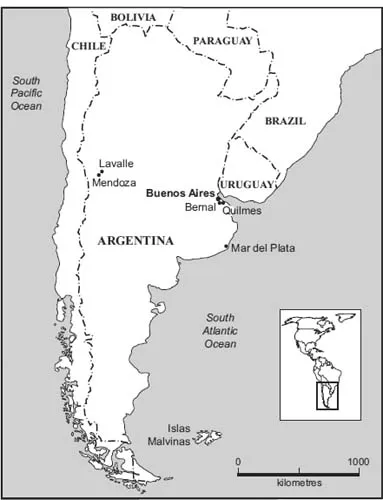
Figure 1.1 Map of Argentina’s barter networks discussed
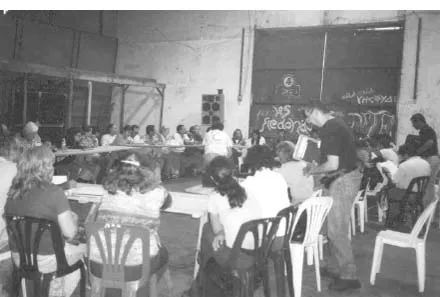
Figure 1.2 Barter network meeting in Gualeguachu, Argentina
Thus Argentina became the poster child not only for global capitalism, the IMF, and then the anticapitalist movement, but also for proponents of alternative currencies (De Meulinaire 1999).
The Argentine experience of alternative currencies is also of interest to a wider audience. Alternative currencies are in some ways a challenge to neoliberalism, while in others they resonate with it. The challenge comes first from claims that people’s needs should be put before the need for financial discipline and that conventional money does not reward people fairly or equally for their contribution. All should be included and valued. Second, free trade at a global level is held to be ecologically unsustainable in that it leads to the creation of vulnerable economic monocultures that can be devastated by currency crises, and is built on unsustainable levels of fossil fuel use moving goods around the globe that could be produced more locally (Helleiner 2000). Rather than locating development in an international division of labour in which all do what they do best and trade with each other, local currency proponents argue for the localization of economies (Hines 2000) and for the production of an economy that works at a slower pace, reusing and recycling more. It is a radically Green vision of a localized, humane, decentralized and participatory economy (Trainer 1995).
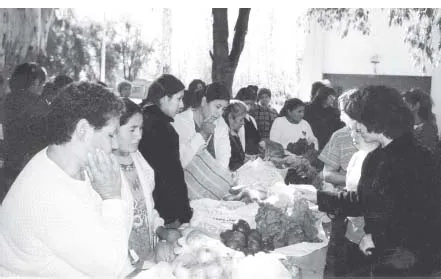
Figure 1.3 Barter network vegetable market in Mendoza, Argentina
Yet, as discussed in more detail below, advocates of alternative currencies also value forms of economic organization advocated by neoliberals and generally rejected by the left. These include an attachment to allocation through markets (as opposed to through planning); to self-sufficiency and personal responsibility (as opposed to state welfare); and to forms of economic organization centred on small and micro-businesses. Alternative currency networks are essentially markets through which small traders operating in perfect competition exchange goods and services. As such, they constitute clear Smithian utopias critiqued as such by normally supportive, Marxist-influenced, Green commentators like Wall (2005: 62) and Kovel (2007). Hayek (1990), for example, called for money to be denationalized and for there to be a choice of currencies. If it is not necessarily the responsibility of the state to run enterprises and provide welfare, Hayek asked, is it necessarily the state’s role to provide money?
So alternative currencies, generally promoted by Greens for their ecological outcomes (Douthwaite 1996) and by leftists for their egalitarian outcomes (Bowring 1998), also have neoliberal resonances. Dividing lines therefore become blurred. Has neoliberalism lost its definition as an object of antagonism for the left? Has it become so hegemonic that left and Green supporters have been seduced by elements of it, or lost confidence in their critique of the market and in their defence of collectivism and planning? Or does it mean that, as Larner argues, ‘the new political configurations of what we call neoliberal are more multi-vocal than might previously have been understood’ (Larner 2005:11)?
This ambivalence suggests that in considering neoliberalism we need to pay more attention to economic diversity. In particular, we need to move on from thinking that market-based economic activity is inevitably neoliberal (Gibson-Graham 2006). Markets and entrepreneurs existed long before neoliberalization, and they existed in formally state-controlled economies like the former Soviet Union (Ledeneva 1998). If neoliberals advocate markets, is this always something to be opposed? Might some kinds of market-based economic activities provide more enjoyable, resilient and prosperous livelihoods, at a slower, less stressful and more ecologically sustainable rhythm, than exploitative, dehumanizing paid work for an employer? Might community-controlled, participatory forms of welfare provide more dignified solutions than doled-out state welfare? Are we guilty of erasing the exploitative nature of Fordist-era work and welfare, focusing too much on what we have lost and indulging in rose-tinted nostalgia for that which has gone (Larner 2005: 10–11)?
Rethinking neoliberalism in this way follows Larner’s (2003, 2005) concern to recognize that more is going on than the inscription throughout the world of plans that were originally developed in Chicago and rolled out from the global centres of Thatcher’s Britain and Reagan’s America though processes of neoliberalization coded as the imposition of Northern agendas on a powerless global South. We need to identify the ways that neoliberalization was co-constructed by and resisted by Southern actors, and that this process was more diverse than previously considered. Some elements of neoliberalism do indeed look like they are part of a wider class process to revitalize capitalism by reimposing capitalist discipline and making the ideology of capitalism a new ‘common sense’, thus securing the extraction of profits for the next generation (Harvey 2005). The similarities in neoliberal projects throughout the globe can make them look like they were rolled out (Peck and Tickell 2002) according to a script written by World Bank bureaucrats who do not even leave their hotel rooms when they parachute into the lates...
Table of contents
- Cover
- Title
- Copyright
- Contents
- Figures and tables
- Acknowledgements
- Introduction: Social justice and neoliberalism
- 1 Voices from the trueque: barter networks and resistance to neoliberalism in Argentina
- 2 Confounding neoliberalism: priests, privatization and social justice in the Peruvian Andes
- 3 Travelling neoliberalism: Polish and Ghanaian migrant workers in London
- 4 Neoliberalization and its discontents: the experience of working poverty in Manchester
- 5 Bargaining with the devil: neoliberalization, informal work and workers’ resistance in the clothing industry of Turkey
- 6 Transitions to work and the making of neoliberal selves: growing up in (the former) East Germany
- 7 The emergence of a working poor: labour markets, neoliberalization and diverse economies in post-socialist cities
- 8 Difference without dominance: social justice and the (neoliberal) economy in urban development
- Conclusion: Neoliberalization, social justice and resistance
- Contributors
- Notes
- Index
Trusted by 375,005 students
Access to over 1.5 million titles for a fair monthly price.
Study more efficiently using our study tools.
Frequently asked questions
Yes, you can cancel anytime from the Subscription tab in your account settings on the Perlego website. Your subscription will stay active until the end of your current billing period. Learn how to cancel your subscription
No, books cannot be downloaded as external files, such as PDFs, for use outside of Perlego. However, you can download books within the Perlego app for offline reading on mobile or tablet. Learn how to download books offline
Perlego offers two plans: Essential and Complete
- Essential is ideal for learners and professionals who enjoy exploring a wide range of subjects. Access the Essential Library with 800,000+ trusted titles and best-sellers across business, personal growth, and the humanities. Includes unlimited reading time and Standard Read Aloud voice.
- Complete: Perfect for advanced learners and researchers needing full, unrestricted access. Unlock 1.5M+ books across hundreds of subjects, including academic and specialized titles. The Complete Plan also includes advanced features like Premium Read Aloud and Research Assistant.
We are an online textbook subscription service, where you can get access to an entire online library for less than the price of a single book per month. With over 1.5 million books across 990+ topics, we’ve got you covered! Learn about our mission
Look out for the read-aloud symbol on your next book to see if you can listen to it. The read-aloud tool reads text aloud for you, highlighting the text as it is being read. You can pause it, speed it up and slow it down. Learn more about Read Aloud
Yes! You can use the Perlego app on both iOS and Android devices to read anytime, anywhere — even offline. Perfect for commutes or when you’re on the go.
Please note we cannot support devices running on iOS 13 and Android 7 or earlier. Learn more about using the app
Please note we cannot support devices running on iOS 13 and Android 7 or earlier. Learn more about using the app
Yes, you can access Social Justice and Neoliberalism by Professor Adrian Smith, Professor Alison Stenning, Katie Willis, Professor Adrian Smith,Professor Alison Stenning,Katie Willis in PDF and/or ePUB format, as well as other popular books in Economics & Economic Theory. We have over 1.5 million books available in our catalogue for you to explore.