Many African migrants residing abroad nurture a hope to one day return, at least temporarily, to their home country. In the wake of economic crises in the developed world, alongside rapid economic growth in parts of Africa, the impetus to 'return' is likely to increase. Such returnees are often portrayed as agents of development, bringing with them capital, knowledge and skills as well as connections and experience gained abroad. Yet, the reality is altogether more complex.
In this much-needed volume, based on extensive original fieldwork, the authors reveal that there is all too often a gaping divide between abstract policy assumptions and migrants' actual practices. In contrast to the prevailing optimism of policies on migration and development, Africa's Return Migrants demonstrates that the capital obtained abroad is not always advantageous and that it can even hamper successful entrepreneurship and other forms of economic, political and social engagement.
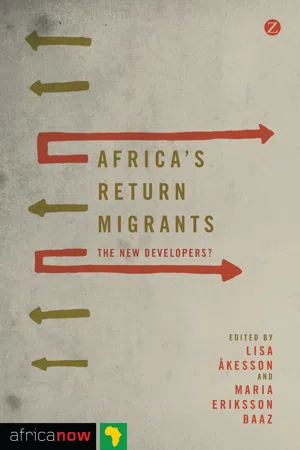
eBook - ePub
Africa's Return Migrants
The New Developers?
- English
- ePUB (mobile friendly)
- Available on iOS & Android
eBook - ePub
Africa's Return Migrants
The New Developers?
About this book
Information
1 | Introduction
Many African migrants who reside in Europe nurture a hope to one day return, either permanently or on a more temporary basis. Increasingly restrictive migration policies make many migrants hesitant to ‘return’, as that might imply closing the door to Europe (de Haas 2006; Schoumaker et al. 2013). Yet, in the wake of developments in Africa and in Europe, it is possible that the impetus to return might increase in the coming years. The economic crisis in parts of Europe has made the lives of migrants particularly difficult, as manifested in their further marginalisation in labour markets but also in the upsurge of xenophobic, anti-migrant discourses and practices. At the same time, many African economies are growing at a fast rate1 and have an increased demand for skilled labour.
Contemporary policy discourse has come to attach great expectations to African returnees, portraying them as ‘agents of development’. Return migration – particularly to sub-Saharan Africa – occupies a central position in current policy debates on migration and development. In recent years, governments in the global North, international agencies and non-governmental organisations (NGOs) have come to expect returnees to play an important role in the development of their ‘home countries’ (see, for example, European Commission 2011; Global Forum on Migration and Development 2012). As Sinatti and Horst (2015: 144) note, return is emerging as a key issue in the most recent policy documents on development in the European Union (EU) as well as in various member countries – representing ‘a new chapter within the migration–development debate’. Also, some African migrant sending countries, such as Senegal, Cape Verde and Ghana, are promoting return migration, at least of highly skilled migrants. Hence, in the contemporary policy discourse, returnees are often portrayed as agents of development who will bring back economic capital, knowledge and skills as well as social connections, values and attitudes gained in ‘a developed North’.
Yet little attention so far has been directed to the experiences of return migrants themselves or to the structural factors shaping returnees’ possibility of assuming the role of ‘the new developers’. While there is an extensive literature on how African migrants contribute to ‘development at home’ through remittances (for example, Bardouille et al. 2008; Mohapatra and Ratha 2011; Pérouse de Montclos 2005), the experiences of African return migrants have received only scanty attention (for an exception, see Grabska 2014). This silence is even more problematic given the often great – and individualised – expectations put on these migrants in policy debates.
Based on original qualitative ethnographic and interview material with return migrants in Ghana, the Democratic Republic of Congo (DRC), Senegal, Somaliland, Burundi, South Sudan and Cape Verde, this book fills a gap in current knowledge on African return migration. It aims to further our understanding of the constraints and opportunities attached to migrants’ efforts to return and to reintegrate within ‘their society of origin’. What kind of capital (social, economic and cultural) have migrants acquired abroad and how useful is that capital for their capabilities when settling in their place of return? How can returnees’ stories shed light on their ability (and willingness) to occupy this role as ‘new developers’? In short, this book aims to provide an in-depth understanding of the structural factors that shape this willingness and ability, highlighting the interplay between return migrants’ experiences and the political, social and economic circumstances in the societies to which they return.
The book problematises the common tendency in Northern policy to locate the ‘useful’ social, economic and cultural capital firmly in the migration experience. According to this dominant perspective, it is the various forms of capital that migrants obtain in Europe that are valuable and will somehow automatically provide the skills required for a ‘successful return’ – not only for the migrants themselves but for society at large. By contrast, this book highlights the fact that ‘successful return’ is a manifestation of a multi-directional transfer of different forms of capital, also acquired ‘at home’ before migration and upon return. Moreover, the contributions show that the capital obtained in Europe is not always advantageous and can sometimes even hamper successful entrepreneurship and other forms of economic, political and social engagement. While the structural context in the destination country (the prospects provided in terms of education, skilled job opportunities and savings) plays a crucial role, so too do the migrants’ own capacity to transform this capital, and acquire new capital, upon their return.
Hence, the book highlights mismatches between policy assumptions and migrants’ actual practices, opportunities and willingness to act as ‘new developers’. This mismatch is reflected in, on the one hand, the tendency to conceptualise the migration experience as something that is inherently useful, and, on the other hand, the propensity to ignore the challenges posed by the circumstances encountered upon return. As the contributions reveal, there are numerous challenges attached to transforming the migration experience into something useful, both for the migrants themselves and for the society of origin. Successful return migration is not primarily dependent on the various forms of social, cultural and economic capital obtained abroad, but on the various obstacles posed by the structures encountered upon return and the returnees’ ability to transform the ‘migration capital’ they have attained.
A qualification is needed. While the book casts doubt on the celebratory story of return migration and development, its intention is not to refute the development contributions of returnees. Clearly, many individual returnees play a significant part in economic and political development. Rather than discarding such contributions, the book highlights the importance of critically evaluating the expectations placed on returnees in migration and development policies, and demonstrates the various challenges migrants face upon their return.
In the following parts of this introductory chapter, we first elaborate further on current tendencies in policies relating to returnees’ contributions to development, highlighting driving forces and limitations. We then present the conceptual and analytical framework guiding the contributions to the book, further elucidating the concepts of ‘development contribution’, ‘return’ and ‘returnees’, as well as the theoretical framework that views return as being contingent on economic, social and cultural capital.
The celebratory story of returnees’ contribution to development
Migrants’ skills and knowledge transfers also constitute assets for development. These could translate into remittances, technology transfers, links to professional networks, investment and – arguably – a better integration of origin countries into the global markets.
This statement by the European Commission (2011: 7) sums up some key assumptions in current policies on migration, return and development. A major supposition is that migration to Northern countries is an enriching experience that leads to the accumulation of different forms of capital that are valuable to the developing countries in the South. The main idea is that the capital obtained is used for investment and business activities, which in turn promote jobs and economic growth. As Black and Castaldo (2009) argue, returnees’ development of small-scale businesses is often construed as being part of the solution to reducing poverty in Africa. In line with this, European donors are funding new programmes to help returnee entrepreneurs set up businesses in their country of origin (Sinatti and Horst 2015: 145). In addition to business activities, returnees are exhorted to also take up political office, work for different types of international organisation and engage in reconstruction processes after armed conflict (Hammond et al. 2011; Kleist and Vammen 2012).
This celebratory story of return has been manifested in a number of new programmes. As Kleist and Vammen (2012) point out, return programmes – both forced and more voluntary versions – date back to the 1970s. Rejected asylum seekers and irregular migrants have mostly been sent back against their will and have been prohibited from returning to the country of immigration. Other return programmes have targeted regular migrants but have imposed conditions on their return, such as the loss of legal status in the European country of residence. Overall, these approaches have failed, since migrants have been unwilling to participate (de Haas 2006; Kleist and Vammen 2012). However, while return programmes are not a novel phenomenon, there has been an increase in new examples in recent years, and these have taken slightly new forms. Influenced by the policy discourse on circular migration, and acknowledging migrants’ transnational involvement and mobility, contemporary programmes focus more on temporary return for short- or long-term qualified work assignments and, unlike before, they often include the right to maintain legal status in the country of immigration. These programmes seem to have had some success in engaging highly skilled migrants in home country development (Kleist and Vammen 2012: 59). However, in general, the impact of such programmes is rather disappointing. Research demonstrates that the majority of returns are spontaneous, and that returnees often have little knowledge of state-led initiatives (Boccagni 2011; Kleist and Vammen 2012). This is also reflected in the research presented in this book, where an overwhelming majority of the returnees have returned on their own, without any assistance from, and often little knowledge of, existing return programmes.
Understanding the increased policy attention to return migration In European migrant receiving countries, the promotion of returnees as ‘the new developers’ can partly be understood as a reflection of more general discourses on the limitations and failures of state-centred development programmes (Turner and Kleist 2013). Conceptualisations of returnees as the new developers gain purchase through representations of the African state as weak and failed, characterised by corruption, and with inefficient bureaucracies and ‘bad governance’ more generally (Abrahamsen 2000; Hansson 2013; Harrison 2004). Along with their other efforts to go beyond the state by supporting business initiatives and various forms of NGO activity, development organisations have increasingly come to see returnees as part of the solution. Hence, the increased attention to return migration in development policy fits well with the contemporary neoliberal understanding (Åkesson 2011; Turner and Kleist 2013) in which the responsibility for development is moved from politics and the state to individuals. While the focus of much development intervention is still on state building to ensure good governance, the neoliberal approach entails partly new techniques of government, by a multitude of different actors, and through the production of self-governing responsible subjects (Abrahamsen and Williams 2011; Duffield 2010; Hansson 2013). Transferred to the field of migration, neoliberal policies present migrants as being responsible for positive social and economic changes in their countries of origin. Migrants are encouraged not only to send remittances, but also to return with money, new ideas and entrepreneurial skills as well as access to influential transnational social networks.
Moreover, returnees – who supposedly are both rooted in African contexts and in tune with European development thinking – are cast in the role of brokers who can mediate between donors’ ideas about development on the one hand and institutions, cultural norms and practices in recipient countries on the other. As Turner and Kleist (2013) argue, the category of the broker is by no means a novelty in European–African relations. Colonial administrations, missionary societies and development organisations have all used brokers as go-betweens and role models. The returnee as represented in migration and development policy has an affinity with the assimilado in the Portuguese African empire and the évolué in the French colonies. The returnee – like the assimilado and the évolué – is often portrayed as somebody who has accepted European values while simultaneously maintaining a rootedness in the African context. The brokers’ exposure to European values has been represented as a guarantee that they will transmit ‘civilisation’ during colonial times and ‘development’ in the postcolonial era.
In addition to being assigned a dubious task, this broker position entails vulnerability, reflecting its liminal location between the European and the African sphere (ibid.). Returnees often experience exclusion in multiple places. In Europe they are often defined as ‘African’ and ‘immigrant’ outsiders, while people in their country of origin may criticise them for having lost their culture and their understanding of local realities. Also, people who return after having escaped conflicts or deep economic insecurity are often condemned by those who have stayed behind – named as disloyal opportunists who escaped the hardships only to take advantage of the new opportunities when they arise (Grabska 2014; Stefansson 2004).
However, while reflecting trends in development discourse and practice, the celebratory story of return migration also takes place against the background of the ‘fight against illegal immigration’ and the elaboration of restrictive and security-oriented control instruments. As Sinatti and Horst (2015: 145) remark, there is a significant overlap between the latest surge of interest in return and efforts to remove unwanted immigrants from destination countries. The wish to control the entrance and exit of migrants to the European territory, and to keep out unwanted migrants, implies that ‘return is coupled with the terms “removal” and “readmission”, and is a means for the turning back of undesired immigrants such as irregular stayers, rejected asylum seekers and people living in marginal conditions’ (Sinatti 2014: 279). Thus, in the discourse of European policy makers, the issue of return also reflects the management and control of migration (Cassarino 2004).
This restrictive understanding is also reflected in the policy debates on circular migration that emerged around 2005. In 2008, the Global Forum on Migration and Development praised circular migration as a win–win solution, combining the interests ‘of highly industrialized countries in meeting labour needs ... with [those] of developing countries in accessing richer labour markets, fostering skills transfer and mitigating risks of brain drain’ (2008: 75). This was followed by similar statements and policy documents from a range of institutions, such as the EU and various member states (see, for example, European Commission 2011). In these texts, migration is portrayed as a ‘triple win’ solution: in receiving countries, circular migrants are expected to meet temporary labour shortages while countries of origin will gain access not only to remittances but to the skills and experiences of the migrants, whil...
Table of contents
- Cover
- About the editors
- Title Page
- Copyright
- Contents
- 1 Introduction
- 2 Successive flops and occasional feats: development contributions and thorny social navigation among Congolese return migrants
- 3 Diaspora returnees to Somaliland: heroes of development or job-stealing scoundrels?
- 4 Pushing development: a case study of highly skilled male return migration to Ghana
- 5 ‘Come back, invest, and advance the country’: policy myths and migrant realities of return and development in Senegal
- 6 The role of social capital in post-conflict business development: perspectives from returning migrants in Burundi
- 7 Threatening miniskirts: returnee South Sudanese adolescent girls and social change
- 8 Obstacles and openings: returnees and small-scale businesses in Cape Verde
- About the contributors
- Index
Trusted by 375,005 students
Access to over 1.5 million titles for a fair monthly price.
Study more efficiently using our study tools.
Frequently asked questions
Yes, you can cancel anytime from the Subscription tab in your account settings on the Perlego website. Your subscription will stay active until the end of your current billing period. Learn how to cancel your subscription
No, books cannot be downloaded as external files, such as PDFs, for use outside of Perlego. However, you can download books within the Perlego app for offline reading on mobile or tablet. Learn how to download books offline
Perlego offers two plans: Essential and Complete
- Essential is ideal for learners and professionals who enjoy exploring a wide range of subjects. Access the Essential Library with 800,000+ trusted titles and best-sellers across business, personal growth, and the humanities. Includes unlimited reading time and Standard Read Aloud voice.
- Complete: Perfect for advanced learners and researchers needing full, unrestricted access. Unlock 1.5M+ books across hundreds of subjects, including academic and specialized titles. The Complete Plan also includes advanced features like Premium Read Aloud and Research Assistant.
We are an online textbook subscription service, where you can get access to an entire online library for less than the price of a single book per month. With over 1.5 million books across 990+ topics, we’ve got you covered! Learn about our mission
Look out for the read-aloud symbol on your next book to see if you can listen to it. The read-aloud tool reads text aloud for you, highlighting the text as it is being read. You can pause it, speed it up and slow it down. Learn more about Read Aloud
Yes! You can use the Perlego app on both iOS and Android devices to read anytime, anywhere — even offline. Perfect for commutes or when you’re on the go.
Please note we cannot support devices running on iOS 13 and Android 7 or earlier. Learn more about using the app
Please note we cannot support devices running on iOS 13 and Android 7 or earlier. Learn more about using the app
Yes, you can access Africa's Return Migrants by Lisa Åkesson, Maria Eriksson Baaz, Lisa Åkesson,Maria Eriksson Baaz in PDF and/or ePUB format, as well as other popular books in Économie & Économie politique. We have over 1.5 million books available in our catalogue for you to explore.