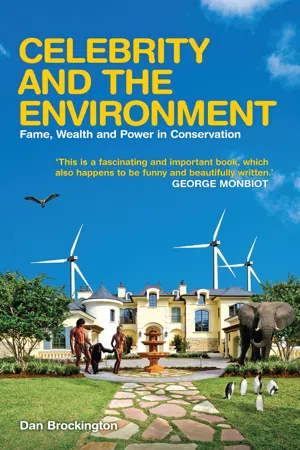
The battle to save the world is being joined by a powerful new group of warriors. Celebrities are lending their name to conservation causes, and conservation itself is growing its own stars to fight and speak for nature. In this timely and essential book, Dan Brockington argues that this alliance grows from the mutually supportive publicity celebrity and conservation causes provide for each other, and more fundamentally, that the flourishing of celebrity and charismatic conservation is part of an ever-closer intertwining of conservation and corporate capitalism. Celebrity promotions, the investments of rich executives, and the wealthy social networks of charismatic conservationists are producing more commodified and commercial conservation strategies; conservation becomes an ever more important means of generating profit.
Celebrity and the Environment provides vital critical analysis of this new phenomena and argues that, ironically, there may be a hidden cost to celebrity power to individual's relationships with the wild. The author argues that whilst wildlife television documentaries flourish, there is a significant decline in visits to national parks in many countries around the world and this is evidence that t a time when conservationists are calling for us to restore our relationships with the wild, many people are doing so simply by following the exploits of celebrity conservationists.
- English
- ePUB (mobile friendly)
- Available on iOS & Android
eBook - ePub
About this book
Information
1 | Introduction
The aim of the liar is simply to charm, to delight, to give pleasure. He is the very basis of civilized society. (Oscar Wilde, The Decay of Lying)
The authorized biography of Sir Laurens van der Post (author and conservationist) caused a stir. Van der Post had been revered by millions as a sage of wilderness and conservation. He had been a guru to Prince Charles (British royalty) and an adviser to Margaret Thatcher (when she was the British Prime Minister). He had been a mystic and a secular saint. Yet J. D. F. Jones’s Storyteller: The Many Lives of Laurens van der Post exposed him as a liar, philanderer and paedophile.1 Jones showed that van der Post had distorted many aspects of his life, deceiving the public and those close to him in pursuit of greatness, sex and popularity.
The sordid details of van der Post’s corruption are not the focus of this enquiry. This is not that sort of book.2 What I find more interesting is the way van der Post’s followers reacted to these revelations. For the diehards, their hero was still a great and wonderful man.3 Van der Post is significant not because he lied, but because his fabrications had such influence and because people believed in him so strongly. They owed their understanding of African environments, wildlife and people to his words and ideas. Responding to Jones’s book, Christopher Booker described sitting ‘entranced while he spoke of the Kalahari or African wildlife’.4 Dea Birkett observed that we ‘needed to believe van der Post. He pandered to a part of the Western imagination that longs for the so-called natural – a pristine wilderness and untouched primitives.’5
I find it fascinating that conservation thinking, hopes, fears, plans and practices can be vested in individuals. Why do their ideas become so powerful? Why are their audiences so credulous? Why do they cling so tightly to their captains, and to their captains’ beliefs?
Unfortunately Jones’s book, as many reviewers noted, could not explain van der Post’s appeal. Jones just demolishes every falsehood that van der Post created about himself. He does not consider why his subject’s deceptions were so beguiling. Van der Post’s supporters insisted that they realized the stories he spun were embellished, and that ‘this tendency to embroider life into “story” was all part of the magic’.6 We will not be able to explain the appeal of falsehoods simply by uncovering the truth. To answer my questions, we need to see van der Post as but one example of the work of celebrity in conservation. We shall have to forget his deceptions, and look at the public construction and consumption of his persona and writings, and those of others like him. There is a multitude of conservationists who enjoy fame and influence (and without van der Post’s inventions). By examining their ideas, actions, claims, consequences and publicity, the responses they elicit and the uses the conservation movement makes of them, we can suggest some answers to my questions about the source and nature of their influence. That is the purpose of this book.
In the process of exploring these issues I have found it useful to distinguish between different varieties of conservation celebrity. I separate those who are already famous, and who lend their fame to conservation, from those who win fame from their conservation work. The latter we can divide into wildlife film presenters, celebrity conservationists and conservation ‘celeactors’ (fictional characters). Behind the celebrities stand ranks of charismatic, wealthy or powerful individuals who also promote conservation. The work of all of these will be explored in the pages that follow.
I shall argue that the interaction between celebrity and conservation is decades old, suggesting that it has accelerated of late, partly because of changes in the production of celebrity and in the organization and funding of conservation. The growth of conservation NGOs has provided new vectors for celebrity in conservation. They guide celebrities’ charitable work, seek celebrity endorsement and support the work of celebrity conservationists themselves. More fundamentally, the flourishing of celebrity conservation is part of an ever-closer intertwining of conservation and corporate capitalism. Companies are greening, with varying degrees of sincerity and effectiveness, because being green enhances sales. Conservation is becoming more commercial because selling commodities provides funds. Far from restricting the activities of capitalism, conservation is becoming one of the means by which profit is generated. Celebrity promotion, the investments of rich executives, and the wealthy social networks of charismatic conservationists are an important, but as yet unremarked, part of this process.
I shall show that celebrity conservation alters the world it tries to save. It can promote an imagined world which may not exist. Yet this very promotion can help to realize such visions. The funding celebrity amasses conjures the dreams into existence. Celebrity also advances particular types of conservation. It can strengthen the conservation of wilderness, charismatic species and work involving indigenous peoples or heroes more easily than other conservation initiatives. This can disadvantage conservation that is not so mediagenic. More subtly, mediagenic conservation can readily promote market solutions for conservation while making certain forms of conservation injustice harder to see.
I shall suggest that perhaps the most insidious and pervasive influence is on countless individuals’ relationships with the wild. In industrial urban societies, people seek to reconnect with nature by vicariously participating in the activities conservationists and celebrities support. At a time when conservationists are calling for people to restore relationships with the wild, many can do so simply by following the exploits of celebrities. People need celebrities to get close to nature on their behalf when they themselves cannot.
Celebrity conservation produces images that are commodities in themselves, sold or used to elicit donors’ support, and which are consumed with little awareness of these images’ origins or conditions of production. It is difficult to imagine an alternative, for celebrity is deeply rooted in the very fabric of modern democracy. As conservation expands in tandem with philanthropy, the challenge NGOs, donors and their critics face is how to encourage investigations of the relationships that lie behind conservation’s images.
An outline of the book
Chapter 2 introduces the two main issues that this book examines – celebrity and conservation. Its purpose is to acquaint the uninitiated in either topic with recent writings, in order to prepare them for the arguments in the rest of the book. Thereafter the book falls into two parts. The next three chapters are more descriptive, the final three more analytical.
Chapters 3 to 5 describe the business of celebrity conservation, dealing in turn with celebrities who support environmentalism, wildlife filmmakers and celebrity conservationists. Chapter 3 plots the contours of celebrities’ support for environmental and conservation causes, particularly climate change. It considers the charge that celebrities can make themselves vulnerable to criticism by supporting such causes. Chapter 4 looks at wildlife films and the nature portrayed by them. It explores the tension between audience demands that wildlife films be authentic and the requirement of the industry that it produces commodities for sale. Chapter 5 considers the people who have won fame from their conservation work. I examine what their work involves and the social, political and economic forces that have created them. These celebrities’ associations with nature are often hallmarks of personal authenticity, but they can only be properly understood as products of forces much larger than their own personalities. Each of these chapters also serves to demonstrate a different aspect of celebrity conservation. Celebrity conservation is strong and powerful (Chapter 3); it is perceived to be authentic and true (Chapter 4), and yet it is a socially constructed world shaped by audiences. Its images and personalities can be understood only in their broader social and historical contexts (Chapter 5).
Chapters 6 to 8 examine the forces that have shaped the interaction of celebrity and conservation, the discontent with this interaction, and the world it creates. Chapter 6 attempts to explain the proliferation of celebrity in conservation. It discusses trends in the nature of celebrity and conservation NGOs which have made them mutually dependent. It also considers trends in the power of foundations and rich individuals as well as corporate needs to support green causes. It examines the implications of recent trends in giving by the wealthy for the democratic nature of conservation work. Chapter 7 looks at a variety of dissatisfaction with celebrity conservation. I consider the charge that celebrities who adopt conservation causes are incompetent at best and often hypocritical. I also examine the role of violence in conservation strategies that celebrities support. I argue that we cannot blame celebrity for the problems at work; they are generic to the conservation movement. Chapter 8 examines some of the more profound consequences of celebrity for conservation. It looks at what these developments portend for popular participation in the environmental movement as a whole. It examines the nature of the mediagenic world in whose image our own world is being remade.
Readers may share my ignorance of the identity and achievements of some famous people. To avoid this I have assumed that no one is so famous that everyone will recognize them. 7 Whenever a famous person is mentioned for the first time in the text I explain why you might be expected to have heard of them. I make no exceptions, not for Nelson Mandela (Africa’s greatest statesman) nor the late Princess Diana (of the British royal family). If you spot exceptions, then either they are careless mistakes on my part, or these individuals have been mentioned in earlier pages (including tables), or they are academic writers of whom I do not expect you to have heard, but whose writings you will find listed in the Bibliography.
Finally, scattered through the text are several thoughts and phrases of Oscar Wilde (wit and writer).8 He is a useful author for thinking about celebrity, although he lived in the nineteenth century just before the dawn of celebrity as we know it. Wilde was an attention seeker throughout his adult life, and preoccupied by fame, particularly his own. He understood that for the well-known ‘there is only one thing in the world worse than being talked about, and that is not being talked about’ (The Picture of Dorian Gray). His bitter observation in prison that ‘between the famous and infamous there is but one step, if so much as one’ (De Profundis) captures one of the qualities of contemporary celebrity. He was fascinated, too, by charisma, noting in Dorian Gray that ‘[t]here was something terribly enthralling in the exercise of influence’.9
There is also a useful contrast between the respective fates of Wilde and van der Post. Both were writers and each was much concerned with his own greatness. There are some parallels, too, in the pain they caused to those who loved them while seeking their own emotional and sexual fulfilment. There are also key differences: Wilde was vilified in his own lifetime, van der Post was lionized. Most importantly, van der Post represented authenticity. He claimed to be real and to be able to show people ‘the real Africa’.10 Wilde played with authenticity, laughed at it, and questioned its meaning. Van der Post serves well as an example of the role of authenticity in conservation, as well as of liars in society. Wilde proves an excellent commentator.
Wilde’s banter should not always be taken too seriously; it certainly was not by Wilde himself. As George Orwell (author) observed of him, one could never be sure if his words, or the man himself, ever meant anything.11 I sought to include his aphorisms at first because they were funny, outrageous and apposite. I hoped that they might offer some light relief. I found, however, that they became more important than that. The more I examined the world of celebrity conservation, the more I realized that this is a realm that tends to prove Wilde remarkably right. His ridiculous ideas become mere descriptions, or prophecies fulfilled. Wilde’s commentary makes it easier to see the antiquity of some of the processes and consequences of celebrity conservation and to see apparently new phenomena as reworkings of much older practices.
2 | Combining celebrity and the environment
The truth about the life of a man is not what he does, but the legend which he creates around himself. (Oscar Wilde, to Jacques Daurelle)
This book addresses two quite different topics, celebrity and the environment, each of which requires a separate introduction summarizing recent writings and developments. I shall examine first the spate of writings in the new sub-discipline of celebrity studies, and look at the nature, causes and effects of celebrity and its curious relationships with democracy. I then consider environmentalism and conservation, exploring the changing nature and growing power of the conservation movement and its social impacts. Finally, I demonstrate why celebrity is so important for understanding the conservation movement, and vice versa.
On celebrity
The origins, nature and consequences of celebrity are the focus of a burgeoning sub-discipline: celebrity studies.1 Turner observes that celebrities are those whose private lives attract more attention than their professional lives.2 They are people who experience a degree of incongruence between the attention normally given to their work and the publicity their lives receive. In Boorstin’s famous phrase, ‘[t]he celebrity is a person who is known for his well-knownness.’3
Celebrities are generally synonymous with the great and the good, but, as Rojek notes, what we celebrate is also their power to transgress, their latitude of excessive behaviour, their profligate consumption of power, beauty, money and luxury, their dwelling in ‘a different world than the rest of us [which] seems to give them licence to do things we can only dream about’.4 Indeed Rojek extends the argument. The desire and pressure to become famous, the experience of ‘achievement famine’, have encouraged some people to pursue notoriety. There are people who have found a place in the celebretariat (the word is Rojek’s) because of their evil deeds.5
Scholars of celebrity are united in emphasizing that celebrity is not a recent phenomenon. One of the principal texts, Daniel Boorstin’s book The Image, was ...
Table of contents
- Cover
- About the author
- Title
- Copyright
- Contents
- Figures and table
- Acronyms
- Preface
- Dedication
- 1 Introduction
- 2 Combining celebrity and the environment
- 3 Conserving celebrities
- 4 Wildlife presenters and wildlife film
- 5 Celebrity conservation
- 6 Concentrations of wealth and power
- 7 Criticisms
- 8 Saving the world
- Notes
- Bibliography
- Index
Trusted by 375,005 students
Access to over 1.5 million titles for a fair monthly price.
Study more efficiently using our study tools.
Frequently asked questions
Yes, you can cancel anytime from the Subscription tab in your account settings on the Perlego website. Your subscription will stay active until the end of your current billing period. Learn how to cancel your subscription
No, books cannot be downloaded as external files, such as PDFs, for use outside of Perlego. However, you can download books within the Perlego app for offline reading on mobile or tablet. Learn how to download books offline
Perlego offers two plans: Essential and Complete
- Essential is ideal for learners and professionals who enjoy exploring a wide range of subjects. Access the Essential Library with 800,000+ trusted titles and best-sellers across business, personal growth, and the humanities. Includes unlimited reading time and Standard Read Aloud voice.
- Complete: Perfect for advanced learners and researchers needing full, unrestricted access. Unlock 1.5M+ books across hundreds of subjects, including academic and specialized titles. The Complete Plan also includes advanced features like Premium Read Aloud and Research Assistant.
We are an online textbook subscription service, where you can get access to an entire online library for less than the price of a single book per month. With over 1.5 million books across 990+ topics, we’ve got you covered! Learn about our mission
Look out for the read-aloud symbol on your next book to see if you can listen to it. The read-aloud tool reads text aloud for you, highlighting the text as it is being read. You can pause it, speed it up and slow it down. Learn more about Read Aloud
Yes! You can use the Perlego app on both iOS and Android devices to read anytime, anywhere — even offline. Perfect for commutes or when you’re on the go.
Please note we cannot support devices running on iOS 13 and Android 7 or earlier. Learn more about using the app
Please note we cannot support devices running on iOS 13 and Android 7 or earlier. Learn more about using the app
Yes, you can access Celebrity and the Environment by Dan Brockington in PDF and/or ePUB format, as well as other popular books in Politics & International Relations & Environment & Energy Policy. We have over 1.5 million books available in our catalogue for you to explore.