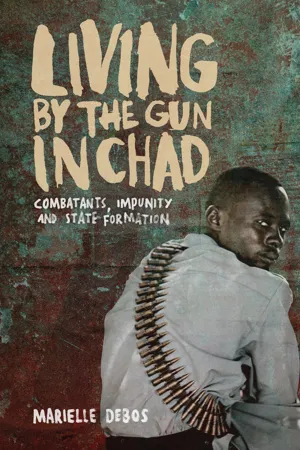
How do people live in a country that has experienced rebellions and state-organised repressions for decades and that is still marked by routine forms of violence and impunity? What do combatants do when they are not mobilised for war? Drawing on over ten years of fieldwork conducted in Chad, Marielle Debos explains how living by the gun has become both an acceptable form of political expression and an everyday occupation.
Contrary to the popular association of violence and chaos, she shows that these fighters continue to observe rules, frontiers and hierarchies, even as their allegiances shift between rebel and government forces, and as they drift between Chad, Libya, Sudan and the Central African Republic. Going further, she explores the role of the globalised politico-military entrepreneurs and highlights the long involvement of the French military in the country. Ultimately, the book demonstrates that ending the war is not enough. The issue is ending the 'inter-war' which is maintained and reproduced by state violence.
Combining ethnographic observation with in-depth theoretical analysis, Living by the Gun in Chad is a crucial contribution to our understanding of the intersections of war and peace.
eBook - ePub
Living by the Gun in Chad
Combatants, Impunity and State Formation
- English
- ePUB (mobile friendly)
- Available on iOS & Android
eBook - ePub
About this book
Information
PART I
ARMED VIOLENCE: A (POST)COLONIAL HISTORY
In this first part on the historicity of armed violence, I will study the militarisation of the economy and of politics – taking account of the different forms it has assumed in the precolonial, colonial and postcolonial periods – that has produced generations of men in arms. I aim to bring out various continuities and discontinuities. Recurrences, here, are understood not as the product of fate, or of some culture, but as historical trajectories. The long-term persistence of conflicts does not imply that they are engendered in some automatic and inevitable fashion. There is no repetition, no mechanical reproduction of past practices. The history of armed violence is complex, uneven, full of peaks and troughs. In this part, I set out to untangle some of the processes involved in the reinvention of the multiple uses of arms since the precolonial period, thereby revealing the ‘objective connections’1 between the different moments of the trajectories followed by men in arms.
Men in arms may have remained central social figures – though continuously changing in nature – since the period of precolonial empires, but this is not because of some culture of bellicosity. Revealing the lines of continuity between certain social practices does not mean that we see them as evidence of some national atavism. Economic, social and political institutions lie behind the development of a specialised occupation involving the handling of arms. First, the different forms of violence are linked to a political economy of predation that is inseparable from state formation, and has been since the precolonial period. Second, politics is marked by violence: state violence, and the violence of rebels against those in power. War has become part and parcel of the everyday operation of the political field. Third, the repeated outbreaks of war and violence in Chad are not just part of the history of Chad; they are also the product of a regional and (post-)colonial history. The former colonial power has never ceased to play a key political and military role in Chad. Chad has become a key area in the African sphere of French influence, and one in which the military dimension is paramount.
CHAPTER 1
Colonial wars and inter-wars
This chapter highlights the main processes of the precolonial and colonial periods that produced generations of men in arms. While the colonial period lasted for only sixty years or so, it constituted a definite break. In this chapter, we shall be seeing how the colonial state maintained a form of permanent inter-war in the colony, which was left in the hands of a small number of military commanders. French colonisers used the men in arms who were already active in the Sahel and I also focus on how they subsequently recruited and deployed combatants inside and outside the country during the two World Wars. Chadians, as well as other inhabitants of the colonies in French Equatorial Africa (Afrique Equatoriale Française or AEF), played a key role during the Second World War, even though their contribution to the French Liberation has still to be recognised.
The warriors of predation
The Sahel empires and their border territories
The region of Central Sudan, in which the borders of Chad currently lie, is characterised by a fragmented geography. It has always been a meeting point for caravans of traders, for nomads and sedentary peoples alike. There were several poles of power and groups belonging to numerous overlapping spaces at the same time: spaces that could be political, cultural, religious or mercantile. The different identities never excluded one another; the notion of an individual with a fixed, unique identity had no meaning before it was introduced by the colonial power.
More or less centralised political organisations were formed and confronted one another from the ninth century onwards. States with strongly hierarchical political structures began to emerge: in the ninth century, Kanem to the north-east of Lake Chad (seven centuries later it would become Kanem-Bornu1); in the sixteenth century, Baguirmi on the River Chari and Wadai to the east. These three states spread across the region currently known as north Chad, but at the peak of their power they also included Bornu (Nigeria), Darfur (Sudan), Borku-Ennedi-Tibesti (far north of Chad) and several regions south of the River Chari. In the seventeenth century, the Wadai empire was locked in conflict with its eastern rival, the empire of Darfur (now in Sudan). Political influence and the control of territory and commercial routes were at stake. This region also included other, less powerful, sultanates concentrated in the interior and on the edges of the empires concerned: Dar Massalit (on the Sudanese side of the current border), Dar Sila,2 Dar Fongoro and Dar Sinyar. The populations in this zone, which corresponds to the present border between Chad and Sudan, swore allegiance to their powerful neighbours.
Islam spread under the influence of Muslim scholars, and Arabic became a common language. Trans-Saharan trade developed and became a factor in significant social transformations: caravans brought ivory, ostrich feathers and skins as well as slaves to Libya, Sudan and Egypt. They returned with fabrics, religious manuals and weapons. Arabo-Muslim countries had a powerful influence on the empires of Chad, although the political independence of the latter was never threatened.3 Thus Chadian empires, like other African societies, were always deeply involved in trading activities with the trans-Saharan and Mediterranean worlds. In the nineteenth century, the Chadian empires became border territories of the Muslim economies of the northern Sahara, which were themselves border territories of Europe.4 These relations with the non-African world were constitutive of the political organisation of those societies.
In the margins of these empires, towards the south, there were societies whose political organisation was not centralised. Described as ‘anarchic’ by colonial administrators whose historical skills were rapidly improvised,5 these societies were often deprived of any state organisation. According to Mario Azevedo, states were in the process of being formed at the time of the colonial conquest, at the end of the nineteenth century,6 with the training of militias in the service of traditional chiefs.
Wars and raids
While war played a major role in the construction of the state in Europe,7 it also encouraged the emergence and reinforcement of the empire states of the Sahel. In the region of Central Sudan, war and trade went hand in hand. According to Stephen Reyna, ‘states … warred to trade and traded to war’.8 States embarked on offensive wars in order to take part in trans-Saharan trade. In return, long-distance trade made it possible to acquire ‘goods’ that were necessary for the development and maintenance of the state bureaucracy, as well as the means of organised violence: horses and firearms.9 ‘Wars without end’10 were inseparable from ‘predatory accumulation’.11 The organisation of those empires that lived on predation was turned towards war. The armed forces of Baguirmi were managed in an efficient and decentralised way. Troops were organised with an eye to military objectives: the number and origin of the men involved depended on the nature of the war that had to be waged. This flexibility was a response to the need to adapt to the constantly changing threats that hung over the empire. As for the police, this was a permanent structure that intervened in regions near the capital. According to Reyna’s estimates, the army of Baguirmi could comprise as many as 3,000 or 4,000 cavalry. At the end of the nineteenth century, the army of Wadai was the most powerful: observers claim a figure of 7,000 or between 10,000 and 11,000 cavalry.12 The military institutions of these empires were hierarchical, and we need to distinguish between the warrior aristocracy and the ordinary soldiers who were often their slaves. Military practices depended on technological developments but also on the way in which these were envisaged. The horse, an indispensable element in any raid, became a highly envied possession and a symbol of nobility. When firearms developed in the nineteenth century, they were reserved for the troops.13
Renegotiating their fluid borders was a crucial issue for these empires. According to Stephen Reyna, who adopted and refined an earlier theory put forward by Jacques Le Cornec,14 the political geography of Baguirmi can be represented as three concentric circles. The first, ‘the centre’, was the heart of political power; the second comprised ‘tributary regions’ subject to a form of indirect government; and the third corresponded to the ‘zone of predation’ where the laws of Massenya, the capital of Baguirmi, did not apply. The centre payed taxes, the tributary regions payed tribute, and the zones of predation provided merchandise and slaves. The empire of Wadai operated on the same model. The territories of the different empires overlapped: the zones of predation of one could be tributary zones of another.
We can distinguish between two types of military expeditions: raids and wars. Raids, most often carried out in stateless societies in non...
Table of contents
- Cover
- About the book
- About the author
- Title page
- Copyright
- Contents
- Acknowledgements
- Foreword
- Introduction
- Part I. Armed violence: a (post)colonial history
- Part II. From one war to the next: rebellion, reintegration, defection
- Part III. Governing with arms: the ‘unnumbered decree’
- Conclusion
- Abbreviations
- Notes
- Bibliography
- Index
Trusted by 375,005 students
Access to over 1.5 million titles for a fair monthly price.
Study more efficiently using our study tools.
Frequently asked questions
Yes, you can cancel anytime from the Subscription tab in your account settings on the Perlego website. Your subscription will stay active until the end of your current billing period. Learn how to cancel your subscription
No, books cannot be downloaded as external files, such as PDFs, for use outside of Perlego. However, you can download books within the Perlego app for offline reading on mobile or tablet. Learn how to download books offline
Perlego offers two plans: Essential and Complete
- Essential is ideal for learners and professionals who enjoy exploring a wide range of subjects. Access the Essential Library with 800,000+ trusted titles and best-sellers across business, personal growth, and the humanities. Includes unlimited reading time and Standard Read Aloud voice.
- Complete: Perfect for advanced learners and researchers needing full, unrestricted access. Unlock 1.5M+ books across hundreds of subjects, including academic and specialized titles. The Complete Plan also includes advanced features like Premium Read Aloud and Research Assistant.
We are an online textbook subscription service, where you can get access to an entire online library for less than the price of a single book per month. With over 1.5 million books across 990+ topics, we’ve got you covered! Learn about our mission
Look out for the read-aloud symbol on your next book to see if you can listen to it. The read-aloud tool reads text aloud for you, highlighting the text as it is being read. You can pause it, speed it up and slow it down. Learn more about Read Aloud
Yes! You can use the Perlego app on both iOS and Android devices to read anytime, anywhere — even offline. Perfect for commutes or when you’re on the go.
Please note we cannot support devices running on iOS 13 and Android 7 or earlier. Learn more about using the app
Please note we cannot support devices running on iOS 13 and Android 7 or earlier. Learn more about using the app
Yes, you can access Living by the Gun in Chad by Marielle Debos, Andrew Brown in PDF and/or ePUB format, as well as other popular books in Politics & International Relations & Political History & Theory. We have over 1.5 million books available in our catalogue for you to explore.