- English
- ePUB (mobile friendly)
- Available on iOS & Android
eBook - ePub
About this book
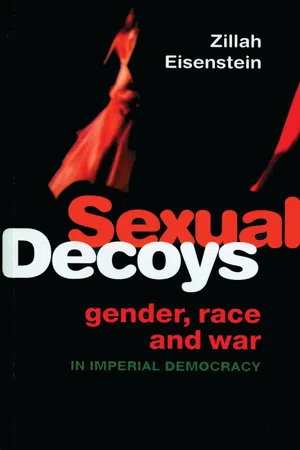
In this book, Zillah Eisenstein continues her unforgiving indictment of neoliberal imperial politics. She charts its most recent militarist and masculinist configurations through discussions of the Afghan and Iraq wars, violations at Guantánamo and Abu Ghraib, the 2004 US Presidential election, and Hurricane Katrina. She warns that women's rights rhetoric is being manipulated, particularly by Condoleezza Rice and other women in the Bush administration, as a ploy for global dominance and a misogynistic capture of democratic discourse. However, Eisenstein also believes that the plural and diverse lives of women will lay the basis for an assault on these fascistic elements. This new politics will both confound and clarify feminisms, and reconfigure democracy across the globe.
Information
1
Gender as Politics
in Another Form
in Another Form
In December 2003 the US was on code orange alert. Air France canceled its Christmas Eve flights because of information that they might be used to ‘hit’ targets in New York City or Los Angeles. Meanwhile The Last Samurai played in theatres romanticizing the Eastern warrior – through the visor of yoga and life’s harmony – and humanized war in Eastern fashion. Death – in war – is honorable despite the fact that the samurai fights on behalf of the emperor and other hierarchies of power. The wife of the slain samurai falls in love with his killer. She is deferential and suffering and therefore noble as well. Elephant also played in our theatres. It tells the story of the massacre at Columbine High School and the sad effects of a militarized culture. This same season the Vietnam War is the backdrop for explaining the unexplainable in life in The Human Stain, a story about racial self-hatred and passing for white while black.
In 2004 a remake of The Manchurian Candidate is produced. It is a story about a fictional right-wing senator who happens to be both female and a mother. She manipulates and betrays her son, and abandons all morals to create a world of complete surveillance and mind control. In the remade film we see people having their brains drilled for implants and total manipulation, and I cannot help but wonder if this is a form of the mindlessness that allowed Bush his second term. And I wonder if the film is a kind of whitewash: that filmgoers look at this depiction of the world and fantasize that they are free because they are not having their brains drilled.
In 2005, King Kong is remade in old form. The beast and natives are still black but made more horrific and terrifying by new digital tech. The beauty is still white and blonde. Misogyny is still the trope: warring factions define human life, be they digital dinosaurs or unfathomable creatures or helpless white men. Females still love anything that protects them.
In real life, war rages in Afghanistan and Iraq but as a backdrop and not front and center. These wars are mired in discourses about democracy and women’s rights to be free from abusive lives under the Taliban or Saddam Hussein. Neither of these wars were committed to freeing women so it remains critically important to think through why these were the particular narratives at this specific point in historic time.
Human rights – and with them women’s rights – have been used to mystify and rationalize the misogynist and racialized aspects of global capitalism. Women’s rights as a discourse both legitimizes democracy and critiques other-than-Western forms of democracy simultaneously. As such, women’s rights parades as Western to the rest of the world. But it is closer to the truth, if there are truths to be found here, that masculinist militarism uses women’s rights for right-wing agendas inside and outside the West. Right-wing fundamentalisms of all sorts – east and west – emphasize militarist agendas alongside the gendering of women’s lives, with or without the veil/chador/abayya/burqa, as decoy.
Bush’s wars of/on terror have authorized a culture of racial intimidation and surveillance while establishing gender confusions to mask this process. New forms of this militarized process create larger numbers of women as the refugees and displaced people of the world, as the rape victims in many locations like Sudan and Nepal, as the new warriors for the US military and as suicide bombers in Palestine and Iraq. Sometimes it looks like women are becoming more like men; if being militarized is the same as being masculinized. But I think similarity is not what is simply happening here but rather that the constructions of gender are being more fully diversified and essentialized simultaneously.
In this militarized setting masculinity and femininity are becoming more complex but not necessarily more equal. The redefinition looks newly different, but is more ‘new-old’ than new. Gender is being mobilized for new purposes and refashioned in more ‘modern’ fashion. Differentiation of women from men remains and yet they each occupy more like spheres in similarly different fashion. Militarized masculinity still needs a heterofeminine gendered complement; and each keeps the other in place.1 So gender codes the Afghan and Iraq wars. It is also not inherently biological. Gender regulates sex and sexuality that are more ambiguous than they are certain. And gender is reshaped continually in order also to shape and control sexual meanings. King Kong still lives.
On gendering sex
Gendering is the process of transforming females to women and males to men when neither of these starting points is completely autonomous from their transformed state. Gendering is a process of differentiating supposed heterosexuality – of making gendered difference matter by institutionalizing it.
It is often thought that sexuality – as in biological sex and sexual preference – is more stable, or static, and predefined, than gender. But I continue to query whether gender – as in the cultural construction of masculine and feminine – is not more static and contrived and more resistant to change.2 In this way gender rigidifies sex; gender regulates sex and sexual preference, as much as, if not more than, the other way around. This is not to overdraw the distinctness of sex and gender but rather to query whether the body’s sexuality is not more ambiguous and multiple and diverse than the constructs of gender allow. Or, put slightly differently, it is to propose that gender exists to control sex and its variability. Gender makes biological sex and sexuality static and rigid. The point: neither sex nor gender is simply essentialist or constructed: they are a complex relational mix. But, given this, the sexual body is probably more fluid than its gendered meaning. Yet the biological body – meaning both the so-called ‘natural body’ and its given heterosexual proclivities – are normalized as a justification for the cultural meanings of men and women. In sum: gender colonizes sex.
According to Anne Fausto-Sterling, “labeling someone a man or a woman is a social decision”; actual physical bodies blur clear boundaries. She argues that the state and legal system may have an interest in maintaining that there are only two sexes, but that “our collective biological bodies do not”. She believes that “masculinity and femininity are cultural conceits”; that the “two party system” of sex is a social construction, and that male and female “stand on extreme ends of a biological continuum” with many other kinds of bodies which are a “complex mix of anatomical components”. As such, our sexual bodies are “indeterminate” and therefore “policed” to become male and female.
It follows both that biology as well as gender is political and that the more gender is challenged the more rigidly sex is constructed as either male or female. This extends to hormones themselves that Fausto-Sterling says are identified as though they were sexually determinant, but rather are simply part of an already “gendered discourse of scientists”. Citing Frank Lillie, Fausto-Sterling states that there is “no such biological entity as sex”: it is merely a name for our impressions about sexual differences. Sex is not fact here. It is random acts of science that name male hormones androgens and female hormones estrogen.3
According to Joanne Meyerowitz there are “overlapping sexes”; possibly a universal bisexuality. Men and women have male and female hormones – “all women had elements of the male and all men elements of the female”. Thus it is scientifically inaccurate to “classify people as fully male or female”.4 In this sense, biology is not simply innate or genetically determined. Nancy Krieger and George Davey Smith write that “societal conditions shape the expression of biological traits”, that there are “linkages between bodily constitution and the body’s politics”.5 New constructs of sexes and genders reflect this fluidity. Krieger argues that self-identified transgender, transsexual and intersexual individuals blur the established boundaries within the gender/sex dichotomy. Gender influences biological traits and sex-linked biological characteristics can affect gender.6
Similarly Susan Oyama queries the distinction made between nature and nurture and says that each is partly constructed by and through the other. She rejects the notion of biology as an innate category and instead argues that innate and acquired characteristics are complexly intertwined – that genes are complexly interactional and change as a result of context. “Bodies and minds are constructed, not transmitted.” As such, nature is a product and a process: “nature is not transmitted but constructed”. The biological/sexual body includes our whole selves “which includes the social worlds in which we are made”. Oyama asks us to reject the “disciplinary imperialism” of “genetic control”.7
It is, then, crucial to understand that gender impinges on how we see and name the sexual body; and the sexual body is used to justify the very notion of gender. Gender even defines the sexed body and the sexed body constructs gender. There are more than two sexes. And there are more than two genders. Yet the language of twoness dominates. This means that both sex and gender are part of the most intimate constructions of our political world; so black slave women were seen as breeders, and not as mothers per se. As slaves they were denied the gender of white women. And sex and gender along with their racial meanings become politics by other means.
So there is always the process of gendering sex and gendering gender; and sexing gender and sexing sex; and regendering gender, and resexing sex, and racializing sex and sexing race and racializing gender… The political – power-filled – dynamics are multiple and chaotic. The plasticity and variability of sex and race may be less visible/visual than the multiplicity of gender. And the complexity of gender identities is defined by one’s sexual origins, and supposedly not by race. Hence, female-bodied women, male-identified females, and so on.8
Judith Butler has long argued that gender is made-up, performed, plastic, improvised, and multiple. Enforced gender categorization is tied to an “anatomical essentialism” when there is no simple original form of the copy. She thinks that many so-called men can do femininity better than she can. A universal notion of gender can be a form of cultural imperialism – so we need to pluralize our understanding of both cultures and their genders. If gender dysphoria and sexual minorities can be embraced and recognized in the human community, then Butler says we must focus on the possible. “For those who are still looking to become possible, possibility is a necessity.”9
The idea that there are two biological sexes is, then, in and of itself a political limitation/regulation that depends on a formulation of gender as twoness also. Sexual and gender classifications are regulatory and by and large stand in defiance of the fluidity and changeability of sexual and gender identities. Sex is assigned at birth; but through a gendered biological visor. According to Paisley Currah this denies chromosomal ambiguity, gonadal ambiguity, gender pluralism and sexual indeterminacy.10 One could instead start with a notion of trans- and multi-genders: a male who thinks he is a woman or a female who thinks she is a man; or a male and a female who are each neither and who think they are neither man or woman.
But there is no adequate language to embrace this complexity, and we re-create gender while debunking it: female lesbians, female men, et cetera. Sexual and gender indeterminacy needs to become a part of a radically pluralized sex/gender system allowing for a democratic sexual life that is freely chosen. The presumption of essentialist biological/ innate gender categories still remains firmly in place, however, even when it is scrutinized. Lawrence Summers, former president of Harvard University, explains that women are underrepresented in tenured science positions at top universities because of “intrinsic aptitude”, a concept sounding awfully close to “innate differences”: as though scientists are born, and not made.11
The politics of sexing gender and gendering sex is embedded in the discussions and changes in gay marriage at present, while still race remains unreadable. It is possible that gay marriage attempts to gender gay sex – to rigidify and control the fluidity of sexuality itself, to domesticate gay sex. As well, same-sex marriage is not really the same thing as same-gender marriage. The law speaks of husband and wife, not males and females. The law is actually about not simply sex, but also gender. Traditional views about marriage are not clarifying here. At one time black slaves could not marry; later miscegenation laws prohibited interracial marriage. So, clearly, things change but what in particular changes is less clear. The politics and power relations of gender and race are not simply the same as the politics of colored and sexual bodies themselves.
And even though gays are willing to prove their patriotism by enrolling in the military, the “don’t ask, don’t tell” policy that bars known gays from serving remains in place. Even though enlistments are down and the military is in need of recruits, over 6,000 soldiers have been discharged since 1998 for being gay.12 A hetero-masculinist military can absorb females, but not those who defy gender differentiation. So the military will become more female, but not more womanly or gay; and more colored but still ‘white’.
If this is so then the process of resexing gender to allow for female masculinity rather than male femininity regenders masculinity with males and females. Meanwhile femininity remains gendered as womanly despite the sex and the military remains misogynist despite the presence of females. This means that females become more like men; but men do not as readily become more like women. Yet females also remain women while males remain men even if more womanly. As such, gender fluidity is written more with women’s bodies than men’s, while racial diversity is appropriated for the purposes of conquest across gender lines.
Gender bending, particularly in terms of women’s rights, allows females to become or be used as decoys for imperial democracy. US-run antidemocratic wars have a woman’s face – Karen Hughes, Condoleezza Rice, General Karpinski, the slain private Michelle Witmer. ‘Women’s rights’ genders the discourses of war while actually constructing the newest stage of US imperial politics. The wars of/on terror use women and people of color like Colin Powell and Rice as imperial decoys while liberal democratic rights are dismantled at home and nowhere in sight in Afghanistan or Iraq. Arab men are unmanly; and anti-war activists become girlie men.
Imperial democracy has always been defined by sexual and racial conquest. As such this form of democracy has required imperial repression, and now gender(ing) becomes war in yet another form. This war is fought with more females than any previous war while women still also continue to birth the next generation.
Gendering gender
Virginia Woolf in Three Guineas writes that war is a man’s thing. Why does she essentialize women in this way given that she got so much right about their lives? Woolf had the gender part partly right – women as a group still remain more peace loving than men – and partly wrong – she essentialized women from the site of privileged white women. Today, much has changed. Our historical moment has refashioned and diversified the lives of most females, especially poor and working middle-class girls and women across the globe. The newest possibility here is then that women – meaning, in terms of their gender – may fundamentally change as a result.
Woolf championed the rights of women – rooted in their right to earn a living of their own. She thought that once a woman earns her own living she is free to criticize and have independent thoughts. It is only then that she can stand against war. Woolf criticized women of wealth for supporting the British empire and the privileges they accrued from it. They consciously were desirous of their “maids, carriages, and fine clothes” while unconsciously desiring “our splendid war”.13 She nevertheless believed it was women that would stand against war in the end. “‘We’ – a whole made up of body, brain and spirit, ...
Table of contents
- Cover
- About this book
- About the author
- Title
- Copyright
- Contents
- Acknowledgements
- Dedication
- Preface
- 1 Gender as Politics in Another Form
- 2 Resexing the Wars of/on Terror
- 3 Terrorized and Privatized Democracy
- 4 Diversifying and Racializing Decoys
- 5 Ungendering Feminisms and the Pluralisms of Sex
- Notes
- Index
Trusted by 375,005 students
Access to over 1.5 million titles for a fair monthly price.
Study more efficiently using our study tools.
Frequently asked questions
Yes, you can cancel anytime from the Subscription tab in your account settings on the Perlego website. Your subscription will stay active until the end of your current billing period. Learn how to cancel your subscription
No, books cannot be downloaded as external files, such as PDFs, for use outside of Perlego. However, you can download books within the Perlego app for offline reading on mobile or tablet. Learn how to download books offline
Perlego offers two plans: Essential and Complete
- Essential is ideal for learners and professionals who enjoy exploring a wide range of subjects. Access the Essential Library with 800,000+ trusted titles and best-sellers across business, personal growth, and the humanities. Includes unlimited reading time and Standard Read Aloud voice.
- Complete: Perfect for advanced learners and researchers needing full, unrestricted access. Unlock 1.5M+ books across hundreds of subjects, including academic and specialized titles. The Complete Plan also includes advanced features like Premium Read Aloud and Research Assistant.
We are an online textbook subscription service, where you can get access to an entire online library for less than the price of a single book per month. With over 1.5 million books across 990+ topics, we’ve got you covered! Learn about our mission
Look out for the read-aloud symbol on your next book to see if you can listen to it. The read-aloud tool reads text aloud for you, highlighting the text as it is being read. You can pause it, speed it up and slow it down. Learn more about Read Aloud
Yes! You can use the Perlego app on both iOS and Android devices to read anytime, anywhere — even offline. Perfect for commutes or when you’re on the go.
Please note we cannot support devices running on iOS 13 and Android 7 or earlier. Learn more about using the app
Please note we cannot support devices running on iOS 13 and Android 7 or earlier. Learn more about using the app
Yes, you can access Sexual Decoys by Zillah Eisenstein in PDF and/or ePUB format, as well as other popular books in Social Sciences & Gender Studies. We have over 1.5 million books available in our catalogue for you to explore.