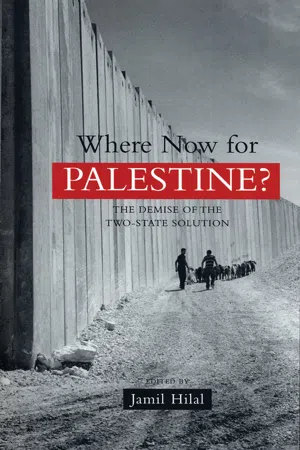
Where Now for Palestine? marks a turning point for the Middle East. Since 2000, the attacks of 9/11, the death of Arafat and the elections of Hamas and Kadima have meant that the Israel/Palestine 'two-state solution' now seems illusory.
This collection critically revisits the concept of the 'two-state solution' and maps the effects of local and global political changes on both Palestinian people and politics. The authors discuss the changing face of Fateh, Israeli perceptions of Palestine, and the influence of the Palestinian diaspora. The book also analyzes the environmental destruction of Gaza and the West bank, the economic viability of a Palestinian state and the impact of US foreign policy in the region. This authoritative and up-to-date guide to the impasse facing the region is required reading for anyone wishing to understand a conflict entrenched at the heart of global politics.
- English
- ePUB (mobile friendly)
- Available on iOS & Android
eBook - ePub
About this book
Information
1 | Palestine: the last colonial issue
JAMIL HILAL
The present as an explanation of the past
Palestinian demand for a sovereign territorial state was voiced soon after the collapse of the Ottoman Empire, and the imposition of British colonial rule on Palestine. It rose with the arbitrary division of the Middle East among the dominant imperialist powers at the time (Britain and France). In 1917, Britain issued the Balfour Declaration committing itself to facilitate the establishment of a ‘Jewish homeland’ in Palestine, ignoring the will of the indigenous inhabitants of the country (the Palestinians) and their right to self-determination. The demand for a Palestinian national territorial state became insistent once it became clear that the Arabs would not have the unified nation-state the British had promised them would be theirs once the First World War had ended. This demand attained a special urgency once the Palestinians realized the aims of the Zionist project, and the full implications of the Balfour Declaration (see Khalidi 1997; Porath 1974; Hilal 2002). This awareness is behind the dual struggle that the Palestinians waged during the Mandate against both British imperial domination and Zionist colonization.1 It also explains why, at the time, the Palestinians stood against the partition of their country into an Arab and a Jewish state; they saw it, rightly, as an unjust violation of their rights. Furthermore, many of the ‘international’ (in reality the USA and Europe) resolutions and initiatives exhibited, and still do exhibit, blatant double standards in the application of the principle of self-determination when its application concerns Palestinians (see Chapter 4 by Butenschøn).
It is important to recall that religious pluralism was not the cause of the conflict between Palestinians and settler Jewish Zionists (later Jewish Israelis). The Palestinian national movement during the British Mandate called for a democratic state to include the various ethnic and religious communities that made Palestine their home. For this reason it was against the establishment of a Jewish state in Palestine.
The well-organized and well-armed European Zionist movement, aided by Britain, was able to defeat the predominantly peasant Palestinian society, with its badly organized national movement led by notable families (Kimmerling and Migdal 2003).2 The highly disorganized and badly armed military contingents sent, in 1948, by neighbouring Arab states (under British and French imperial rule at the time) to aid the Palestinians were easily defeated by the well-organized and well-equipped Zionist forces. Thus, in May 1948, the Zionist movement was able to declare the state of Israel on 78% of Mandate Palestine, much more than the 51% allotted to it by the 1947 United Nations Partition Plan. The remaining 22% of the territory – comprising what came to be known as the West Bank and the Gaza Strip – fell under Jordanian and Egyptian rule respectively. Only a fraction of Palestinians remained in the areas on which Israel was established, to become a national minority (but not acknowledged as such by the Israeli state) in their homeland.
It is ironic that British and American support and collaboration went to a movement committed to the establishment of an ethno-religious state (i.e. Israel) and not to a movement that declared its commitment to a non-religious or ethnic conception. This is ironic because both countries prided themselves on building a state based on equality of citizens, regardless of religious or ethnic affiliations. In was clear, right from the beginning, that the process of creating, empowering, and maintaining a Jewish state in Palestine would entail the indigenous people being subjected to ethnic cleansing, to systemic discrimination and, sooner or later, to a system of apartheid.
Zionism is a special offshoot of European settler colonialism that is a colonialism of an exclusivist (ethno-religious) state-building project. Like European colonialism elsewhere it faced a national liberation movement that sought self-determination, emancipation and independence. The Palestine question is a colonial question, and the last colonial question to remain unsolved in the 21st century.
Israel was created against the will of both the Palestinian people and the peoples of the region as a whole. It did so by relying heavily on the support and collaboration of the world imperialist powers (first Britain, then the United States), and by becoming a highly militarized society in constant war with the region. It is telling that Israel has found it necessary 60 years from its establishment to build a Separation Wall round itself for fear of losing an imagined essentialist character.
A majority of Palestinians, as Israeli new historians (see for example Morris 1987; Pappé 1994) came to acknowledge decades later, was forced to flee the invading Zionist forces (Masalha 1992). These became refugees, and a United Nations agency (UNRWA) was established to administer their affairs in some 60 camps that it established for the most destitute of the Palestinian refugees in the countries surrounding what became Israel. Palestinians who did not flee were given Israeli nationality but were looked upon with suspicion, treated as second-class citizens and as non-Jewish minorities, and not as a national group with collective rights. This is consistent with the self-definition of Israel as combining Jewishness and democracy (see Rouhana 2006), and of confining full democratic and equal rights to Israeli Jews only.3
The remaining 22% of Palestine, i.e. the West Bank and Gaza Strip, came under Jordanian and Egyptian rule respectively. The 1948 Nakba (catastrophe – as Palestinians called it) devastated the Palestinian national movement completely, and it took nearly two decades and another two wars – the Suez invasion when Israel occupied the Gaza Strip and the 1967 six-day war when Israel occupied the West Bank and Gaza Strip as well as Sinai and the Golan Heights – for it fully to re-invent itself as a Palestinian resistance movement under the name of the Palestine Liberation Organization (PLO).
The Palestinian national movement: from a one-state to a two-state solution
The vision of establishing a secular democratic Palestinian state for all its citizens, irrespective of religion or ethnicity, was proposed by the PLO in the late 1960s, but was ignored by Israel and the West. In 1974 (following the Israeli-Arab war of October 1973) the PLO adopted the notion of a two-stage struggle in which it was envisaged that a Palestinian state would exist next to an Israeli one, while the establishment of a full democratic state in historic Palestine was to be left to a later stage of the struggle. This ‘transitional’ co-existence of two states (one Palestinian, the other Israeli) was articulated further in November 1988 during the first Palestinian Intifada, when the PLO endorsed as a strategy the formula of ‘two states for two peoples’. The borders of the Palestinian state were not specified. The implementation of Right of Return for Palestinian refugees (as specified by United Nations Resolution 194) remained an integral part of the two-state solution.
It was the Oslo Accords (signed in 1993 between Israel and the PLO) that defined clearly the occupied West Bank (including East Jerusalem) and the Gaza Strip as the territory of the Palestinian state. It soon became clear, however, that Israel still viewed these territories as disputed areas, thereby giving itself the right to continue its colonial settlement activities, and to solidify its annexation and Judaization of East Jerusalem and the surrounding areas. The painful compromise that the PLO made by accepting a state on 22% of Palestine was rejected by Israel, and, as it turned out, also by the United States.
The explanation of the gradual acceptance by the main stream of the Palestinian national movement of a two-state solution to the Israeli-Palestinian conflict needs to recall the fast-changing situation of the PLO and the impact on it of regional and international shifts from the late 1960s to the late 1980s. The PLO’s lack of a territorial base of its own led to frequent conflicts with the host governments of the countries in which it resided, as happened with Jordan, Lebanon, and Syria. It is also important to stress that the PLO bureaucracy grew rapidly during the 1970s, which limited its agility and created interests specific to this bureaucracy that made it resist change; at the same time it was able to use the relatively large ‘rent’ generated from Arab (mostly from oil-rich states) and international sources (mostly Soviet and socialist countries) to create a kind of a ‘rentier’ relationship with the Palestinian communities, particularly with the Palestinian camps. This took the form of providing employment, welfare, and services. But the PLO also provided empowerment to refugees through arming and organizing them (Sayigh 1979).
The special relationship with the oil-producing Arab states and the socialist camp ensured that the PLO listened to their political counselling; and this counselling tended towards the acceptance of a state on the West Bank and Gaza Strip. Attempts by the PLO to widen its relations with the Western countries were made conditional on its acknowledging the right of Israel to exist and its acceptance of Security Council resolutions 242 and 338. The loss to the PLO of its Lebanon base made it vulnerable to pressure and ultimately it settled for a state on 22% of Palestine.
The dispersal of the PLO forces as a result of the Israeli invasion of Lebanon in 1982 added political weight to the role of the occupied West Bank and Gaza Strip in the PLO’s strategy. The immediate and most important aim for Palestinians in these areas was, and still is, freeing themselves from the Israeli occupation, which raised the question about the political future of the Palestinians. The obvious answer was to establish an independent Palestinian state. The first Intifada, which erupted in December 1987, made the two-state solution the logical solution, particularly following the announcement by Jordan in 1988 that it would cut all its administrative links with the West Bank. The collapse in the late 1980s of the PLO’s main international ally (the Soviet Union and the socialist camp), and the political and financial siege imposed on the PLO by the rich Gulf states as a result of its stand on the Gulf War in the early 1990s, left the Palestinian movement exposed and vulnerable, and ready join the Madrid conference in 1991.
The Oslo Accords reflected the core PLO leadership reading of the balance of forces existing at the time. The Intifada gave that leadership the feeling that it could change the balance of forces once it returned to Palestine, to the extent of achieving an independent Palestinian state. Hence the PLO accepted the establishment of the Palestinian Authority (PA) as a government with limited powers on a part of the 1967-occupied Palestinian territories, and agreed to leave the issue of statehood to ‘final status’ negotiations (to come after a five-year transitional period of the self-governing entity). It thought, mistakenly, that Israel would try to deal with the ‘final status’ issues on the basis of international law, thereby to some degree redressing historic justice, and not on the basis of the balance of power, as in fact Israel did. The four main ‘final status’ issues left for negotiations were: the future of Jerusalem, the fate of the refugees, the question of Israeli settlements, and Israeli-Palestinian borders. When the final status negotiations were held at the Camp David summit in July 2000 between Arafat, Barak, and Clinton, it was the Palestinians who were asked to render concessions to Israel on all four issues.
One consequence of the Oslo Accords was the freezing of the PLO’s national institutions and associations in favour of empowering the new PA. The result was the effective dismantling of the entire organizational superstructure that the PLO had constructed since the late 1960s, which provided a complex network of relations connecting Palestinians in their diverse and scattered communities and a forum for their political deliberations. The freezing of the PLO institutions and mass and professional organizations left Palestinians outside the 1967-occupied territories with a deep sense of abandonment and desertion (recorded by Nabulsi in Chapter 11).
The transformation of the Palestinian national movement
The second Intifada – which came soon after the collapse of the Camp David negotiations – deepened the polarization within the Palestinian political movement into two main political trends: one populist nationalist (represented by Fatah), the other populist Islamist (represented by the Islamic Resistance Movement or Hamas), with the left camp occupying a marginal space as it remained politically fragmented and organizationally sectarian. Since the late 1980s, the influence of political Islam had grown in line with the growth of Islamist influence in the region following the Iranian revolution in 1979 and following the failure of the Arab secular-nationalist states to deliver politically (in terms of democracy, human and civil rights, and Arab unity), and economically (in sustained economic development). The collapse of the Soviet Union and the socialist states in Eastern and Central Europe placed the Arab left in bewilderment, while the rapid growth of the financial capital available to the oil-producing Middle Eastern countries (particularly Saudi Arabia and other Gulf states) was used to bolster these countries’ political and ideological influence. This expressed itself in their control of mass media, satellite television, the publishing of religious books, the growth in the building and use of mosques for political advocacy, and maintaining large charity networks. Apart from Iran since the Khomeini revolution, the oil-producing countries in the region were political clients of the United States.
The organizing of armed resistance against the Soviet occupation of Afghanistan (funded by oil-rich Gulf states and armed and supported by the US) provided the necessary networking and ideological indoctrination for political Islam in the Arab World. Hamas and Islamic Jihad owe their origins to the Muslim Brotherhood movement that was active in Egypt and Jordan long before the Iranian revolution and the Afghan war (see Chapter 8 by Abu-Amr and Chapter 9 by Knudsen and Ezbidi in this book). The Muslim Brotherhood was all...
Table of contents
- Cover
- Praise for this Book
- About this Book
- Title Page
- Copyright
- Contents
- Tables and figures
- Acknowledgements
- Contributors
- 1 Palestine: the last colonial issue
- 2 Zionism and the two-state solution
- 3 Israel and the ‘danger of demography’
- 4 The paradox of Palestinian self-determination
- 5 The Bush administration and the two-state solution
- 6 The economics of an independent Palestine
- 7 The transformation of the Palestinian environment
- 8 Hamas: from opposition to rule
- 9 Hamas and Palestinian statehood
- 10 Searching for a solution
- 11 Justice as the way forward
- Index
- Notes
Trusted by 375,005 students
Access to over 1.5 million titles for a fair monthly price.
Study more efficiently using our study tools.
Frequently asked questions
Yes, you can cancel anytime from the Subscription tab in your account settings on the Perlego website. Your subscription will stay active until the end of your current billing period. Learn how to cancel your subscription
No, books cannot be downloaded as external files, such as PDFs, for use outside of Perlego. However, you can download books within the Perlego app for offline reading on mobile or tablet. Learn how to download books offline
Perlego offers two plans: Essential and Complete
- Essential is ideal for learners and professionals who enjoy exploring a wide range of subjects. Access the Essential Library with 800,000+ trusted titles and best-sellers across business, personal growth, and the humanities. Includes unlimited reading time and Standard Read Aloud voice.
- Complete: Perfect for advanced learners and researchers needing full, unrestricted access. Unlock 1.5M+ books across hundreds of subjects, including academic and specialized titles. The Complete Plan also includes advanced features like Premium Read Aloud and Research Assistant.
We are an online textbook subscription service, where you can get access to an entire online library for less than the price of a single book per month. With over 1.5 million books across 990+ topics, we’ve got you covered! Learn about our mission
Look out for the read-aloud symbol on your next book to see if you can listen to it. The read-aloud tool reads text aloud for you, highlighting the text as it is being read. You can pause it, speed it up and slow it down. Learn more about Read Aloud
Yes! You can use the Perlego app on both iOS and Android devices to read anytime, anywhere — even offline. Perfect for commutes or when you’re on the go.
Please note we cannot support devices running on iOS 13 and Android 7 or earlier. Learn more about using the app
Please note we cannot support devices running on iOS 13 and Android 7 or earlier. Learn more about using the app
Yes, you can access Where Now for Palestine? by Jamil Hilal in PDF and/or ePUB format, as well as other popular books in Politics & International Relations & Civil Rights in Politics. We have over 1.5 million books available in our catalogue for you to explore.