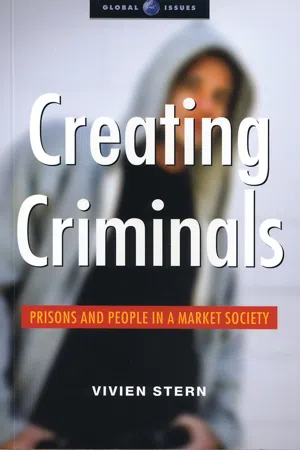
Market society is producing more crime around the world. More acts are being defined as crimes. Ever increasing numbers of people are classified as criminals and more are being locked up in prison. With globalization, the crime and punishment problem is no longer insulated from pressures beyond national borders. The rich may retreat behind their expensive security into gated communities, but the poor are more and more at the mercy of criminals and corrupt policing. Yet, Vivien Stern argues, the trends towards more criminalization and more imprisonment are not making for more effective crime control or safer communities.
This important book demonstrates that the prospects for the future are serious unless NGOs and reformers join in a new movement for reform that gives more control of justice policy back to communities and neighbourhoods.
- English
- ePUB (mobile friendly)
- Available on iOS & Android
eBook - ePub
About this book
Information
1
Behind the Bars: the Injustice of Prison
Glendairy on Fire (March, 2005)
Who would have thought that on March 29th, 2005 the prisoners at the Glendairy Prison in Station Hill, St Michael, would have set fire to the island’s lone adult correctional institution? For days the fire at this 150 year old penal institution made headlines not only in Barbados but across the region. While many Barbadians never saw it coming many others are of the opinion that rioting at the prison was inevitable especially since this institution which was built to hold only 300 was holding up to 997 inmates at the time. The incident allegedly occurred following a homosexual act. The interesting thing is that for a long time now several calls have been made to do something about the perturbing situation of homosexuality in the prison including suggestions to put condoms in the prison. Although the details about how and why the fire was set remain obscure at this point in time, one thing remains evident; the prisoners were discontented with their surroundings.
… Although not completely demolished, it seems that the 150 year old Glendairy Prison is no longer going to be used as a prison. Hopefully they will turn it into a museum or keep it as a historic landmark.1
A Bad Day in Quito Prison
Crime, justice and punishment are always in the news. They are hot topics in most countries, usually in the form of an outcry about rising crime, fear and insecurity, the resulting need for more police powers and a call for harsher punishments. At the same time the prisons of the world get fuller, infectious diseases spread within them, judges pass more severe sentences and technology is increasingly called into service to provide surveillance of convicted people. Rich countries spend more money each year on crime control and detection. Poor countries try to run complex, Western-style criminal justice systems without the requisite resources.
In this chapter we look at penal justice in the twenty-first century, as expressed by sending people to prison. Prison is the backstop of the whole process. People are held in prison after they have been arrested and before they have been convicted of a crime. Prison is the destination for convicted people who are being punished or locked up to protect society from further crimes they might carry out. Prison is the place where countries that still use the death penalty hold condemned prisoners, in a grim block called Death Row, to await the announcement of the date for their execution or to live for years whilst they submit appeals to higher courts. Every country in the world has or uses prisons.
The prisons of the world are often in the news, and rarely because the news is good. For example, an event took place in Ecuador in February 2004 that would have caused no surprise in Latin America because such things happen regularly in that region. In a prison in the capital, Quito, on a Sunday, which is family visiting day, prisoners took more than 300 of the visitors hostage. The prisoners took this action to protest at overcrowding and poor conditions.2 The 33 prisons in Ecuador were built to house 6,000 prisoners, but actually held 12,600 at that time.3 The prisoners were also protesting at the slowness of the judicial system. More than one thousand of them, not yet found guilty of any crime, had been in prison for over a year waiting for their trial to start.
The government began negotiations with the prisoners. They promised to release those who had waited more than a year for their trial and to build three new prisons to ease the overcrowding.4 But their promises were not believed. The action spread and in March a similar hostage taking took place at the women’s prison. Journalists were among the hostages. The situation was complicated further when the prison guards added their protest by going on strike for better pay and improved working conditions.5 The affair ended when the police stormed the prisons and restored order. Some prisoners escaped in the turmoil. The Ecuadorian Interior Minister Raul Baca said, ‘I don’t know how many [inmates] have fled or were killed or wounded. We won’t know this until the operation is over.’6
The story of the Quito prison illustrates many of the problems of prison systems around the world. Most prisoners, men and women, live in bad, unhealthy and overcrowded conditions. Prison guards suffer the same poor working conditions and are badly paid and inadequately trained. Many of the prisons of the world are always overcrowded. Disturbances are frequent and often put down with lethal force. Violent death is an ever-present possibility in the prisons of many countries. Security can be very tight but sometimes prisoners manage to escape. Governments often struggle to run humane prison systems but have insufficient resources to do so.
Improvements are promised but rarely materialize. They were not very successful in Ecuador. In June 2005 hundreds of prisoners again protested. One man was nailed to a wooden cross by other prisoners and two women sewed their lips shut to illustrate their support for a prison hunger strike. Other women cut themselves and used their blood to write placards calling for reforms. Their main demands were for electricity, running water and early release for good behaviour.7
Prisons and the Rule of Law
In this chapter we look in some detail at the injustice of prison. This is not to overlook the acts committed by those who end up in prison, nor the plight of those whom they have harmed. The next chapter will focus on crime, and the effectiveness of imprisonment as a response to it. Prisons are meant to be part of a justice system and what happens in them should affirm and strengthen justice, not deny it. Albie Sachs spent some time in prison in South Africa for opposing the apartheid system. When he was in exile in Mozambique in 1988 he opened a letter bomb addressed to him and lost an eye and a hand. South Africa became democratic in 1994 and he was appointed by the South African President, Nelson Mandela, as a judge in the country’s first Constitutional Court. When asked to rule on the question of whether prisoners should be able to vote, Judge Sachs said:
[p]risoners are entitled to all their personal rights and personal dignity not temporarily taken away by law, or necessarily inconsistent with the circumstances in which they have been placed. Of course, the inroads which incarceration necessarily makes upon prisoners’ personal rights and their liberties are very considerable. Nevertheless, there is substantial residue of basic rights which they may not be denied; and if they are denied them, they are entitled to legal redress.8
Judge Louise Arbour was a member of the Supreme Court of Canada. In February 2004 she became the High Commissioner for Human Rights for the United Nations. She had a similar view to that of Judge Sachs. While she was a judge in the Toronto Appeal Court she carried out an investigation into an event at the Federal Women’s prison in Kingston, Ontario. The event involved an emergency response team consisting entirely of men going into the prison after an incident, stripping a group of women naked, placing them in restraints and moving them from their cells. In the conclusions to her investigation she said that ‘the legal order must serve as both the justification and the code of conduct for correctional authorities’.9 In other words, prisons must be run according to the law and that is the only basis on which it is acceptable to take away people’s liberty.
Too Many Prisoners: Not Enough Space
For most prisoners around the world the experience of prison will not be like the experience of prisoners in Denmark or Sweden, who are likely to spend their days in a workshop or education room and their nights in a single cell like a small hotel room with a radio, television and sanitary facilities. Most prison systems of the world are overcrowded, so prisoners will be living very close to each other and struggling for access to space and the basics of life.
The US State Department reported in 2003 that Luanda prison in Angola, built for 800, held 1,750 prisoners. Warehouses in Bengo, Malange and Lunda Norte provinces were used as prisons during the year.10 In 2004 a Bangladesh newspaper reported that the oldest prison in Bangladesh, Dhaka Central, built to hold 2,650, was holding over 11,000 people, including 250 women.11 The US federal prison system is 40 per cent overcrowded.12 The Council of Europe, an intergovernmental human rights body with 46 member countries stretching from Lisbon to Vladivostok, has an official committee which visits places where people are detained and reports on what it finds. In 2001, in Oporto prison in Portugal, this committee, called the European Committee for the Prevention of Torture and Inhuman or Degrading Treatment or Punishment, found cells of seven square metres built for one person but holding three people.13
Overcrowding can be dramatic with, at the ...
Table of contents
- Cover
- About the author
- Title
- Copyright
- Contents
- List of Tables
- Foreword and Acknowledgements
- Introduction
- 1 Behind the Bars: the Injustice of Prison
- 2 Crime and Its Definition: How Just Is Criminal Justice?
- 3 Crime – a Good Business? The Impact of the Free Market
- 4 The ‘War on Drugs’ and Migration
- 5 ‘In the Name of Justice’: Is There a Better Way?
- 6 Criminal Justice and Social Justice
- Selected Further Reading
- Useful Websites
- Index
Trusted by 375,005 students
Access to over 1.5 million titles for a fair monthly price.
Study more efficiently using our study tools.
Frequently asked questions
Yes, you can cancel anytime from the Subscription tab in your account settings on the Perlego website. Your subscription will stay active until the end of your current billing period. Learn how to cancel your subscription
No, books cannot be downloaded as external files, such as PDFs, for use outside of Perlego. However, you can download books within the Perlego app for offline reading on mobile or tablet. Learn how to download books offline
Perlego offers two plans: Essential and Complete
- Essential is ideal for learners and professionals who enjoy exploring a wide range of subjects. Access the Essential Library with 800,000+ trusted titles and best-sellers across business, personal growth, and the humanities. Includes unlimited reading time and Standard Read Aloud voice.
- Complete: Perfect for advanced learners and researchers needing full, unrestricted access. Unlock 1.5M+ books across hundreds of subjects, including academic and specialized titles. The Complete Plan also includes advanced features like Premium Read Aloud and Research Assistant.
We are an online textbook subscription service, where you can get access to an entire online library for less than the price of a single book per month. With over 1.5 million books across 990+ topics, we’ve got you covered! Learn about our mission
Look out for the read-aloud symbol on your next book to see if you can listen to it. The read-aloud tool reads text aloud for you, highlighting the text as it is being read. You can pause it, speed it up and slow it down. Learn more about Read Aloud
Yes! You can use the Perlego app on both iOS and Android devices to read anytime, anywhere — even offline. Perfect for commutes or when you’re on the go.
Please note we cannot support devices running on iOS 13 and Android 7 or earlier. Learn more about using the app
Please note we cannot support devices running on iOS 13 and Android 7 or earlier. Learn more about using the app
Yes, you can access Creating Criminals by Vivien Stern in PDF and/or ePUB format, as well as other popular books in Social Sciences & Criminology. We have over 1.5 million books available in our catalogue for you to explore.